Vampire Squid Marine Snow: The Deep Sea’s Slowest Diet
A vampire squid eats marine snow: the slow, endless drizzle of dead plankton, faecal pellets and abandoned mucus filters that falls out of the sunlit ocean into the dark. That is the whole answer — no blood, no chase, no ambush. It hangs nearly motionless around 690 metres down, in water so starved of oxygen that almost nothing can follow it, and combs dinner out of the falling debris using two hair-fine filaments that stretch up to eight times the length of its own body.
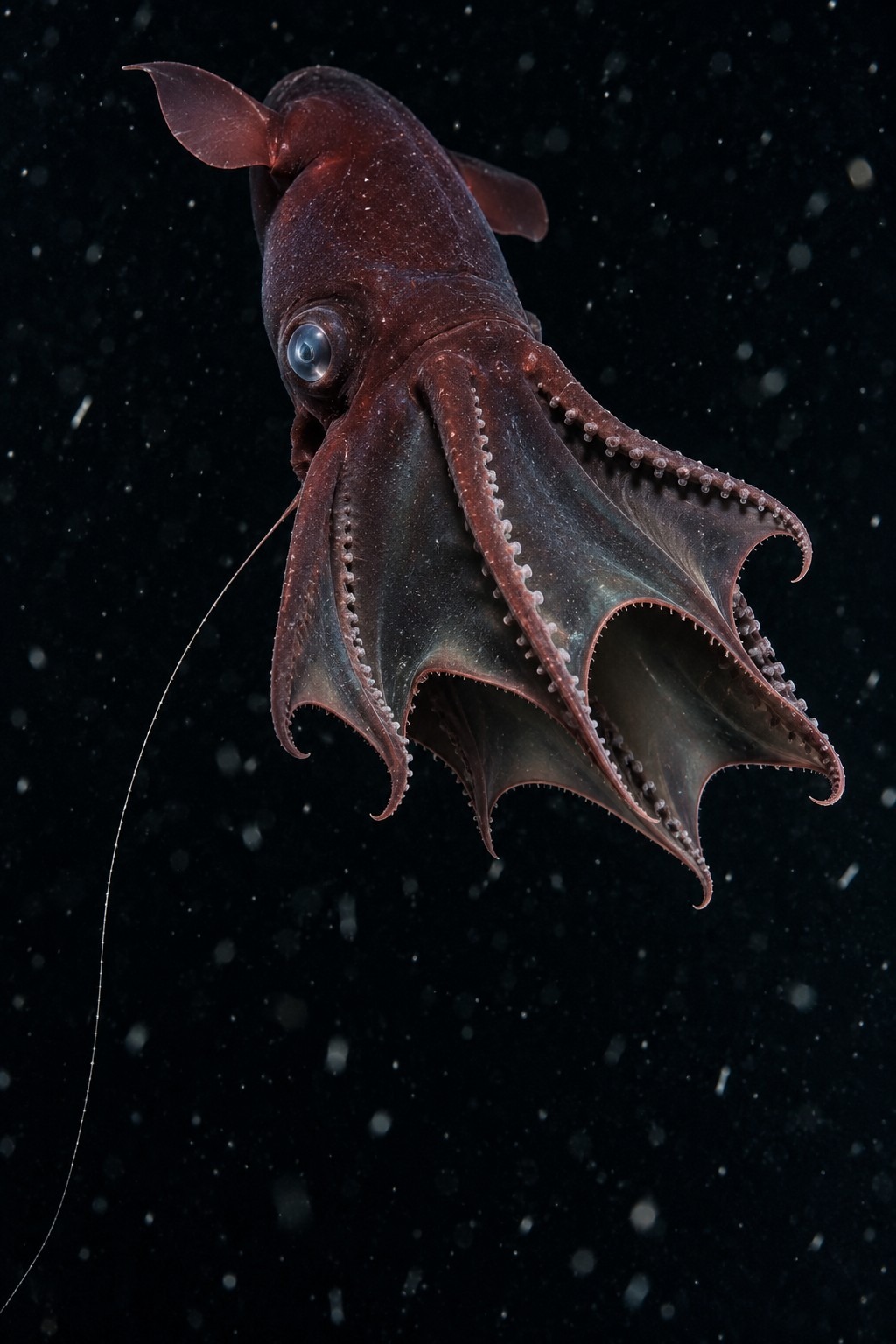
- Who: Vampyroteuthis infernalis — the only living species in the order Vampyromorphida. Not a true squid. Not an octopus. Its own evolutionary branch.
- Size: roughly 28–30 cm long overall — about the bulk of an American football, with proportionally enormous eyes.
- Where: the oxygen minimum zone. Monterey Bay animals sit at an average depth of 690 m, in water holding about 0.22 millilitres of oxygen per litre, at 2–6 °C.
- What it eats: marine snow — faecal pellets, dead algae, crustacean fragments, jelly scraps, discarded larvacean mucus nets — gathered on two retractile filaments.
- How long it lives: the adult stage may run eight years or more, with more than twenty separate spawning episodes — a record among modern soft-bodied cephalopods.
Key Facts
- Vampyroteuthis infernalis is the only living species in the order Vampyromorphida, described by German zoologist Carl Chun in 1903.
- Monterey Bay vampire squid average a depth of 690 metres, in water holding about 0.22 millilitres of oxygen per litre at 2-6°C.
- Its two retractile feeding filaments can extend up to eight times the animal’s own body length (over 2 metres for a 30 cm squid).
- A 2015 Current Biology study by Henk-Jan Hoving found evidence of an adult stage lasting up to eight years, with more than twenty separate spawning episodes per female.
- A 1999 study led by physiologist Brad Seibel measured a haemocyanin half-saturation pressure of just 0.47-0.55 kilopascals and an oxygen consumption of about 0.07 micromoles per gram per hour, the lowest recorded for any cephalopod.
In short: Vampire squid feed on marine snow using two retractile filaments that reach eight times their body length, living in Monterey Bay’s oxygen minimum zone around 690 metres deep. Unlike most short-lived cephalopods, they survive eight years or more with over twenty spawning cycles, sustained by extremely low oxygen needs and tightly oxygen-binding blood.
So what is marine snow, exactly?
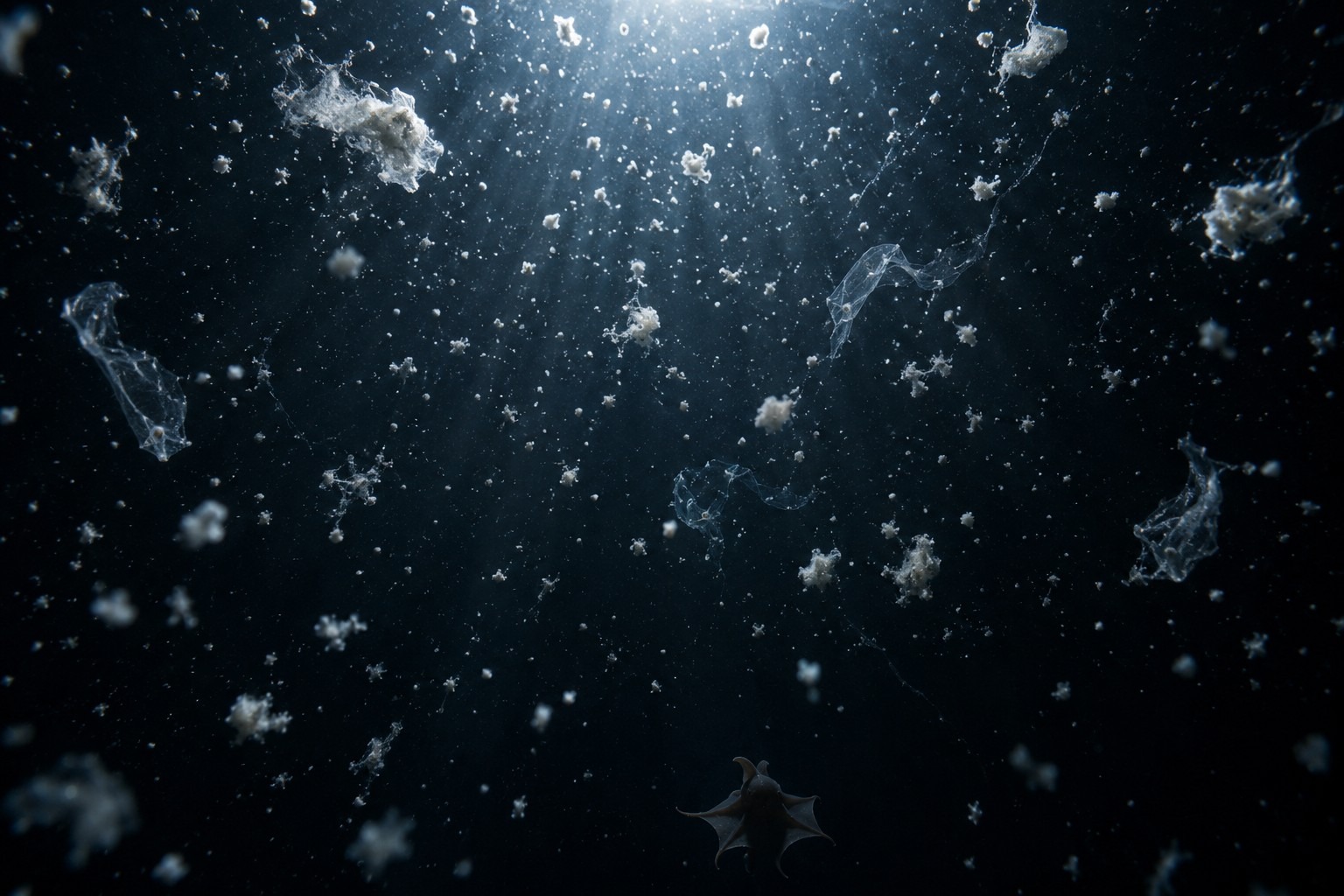
Look up from 600 metres and there is no light, but there is traffic. Everything the sunlit surface produces eventually dies, is eaten, or is excreted, and the leftovers clump together into fragile grey-white aggregates that drift downward for days. Oceanographers named it marine snow because that is exactly what it looks like in a submersible’s floodlights.
Is it appetising? Not remotely. A single flake may contain diatom corpses, copepod and krill droppings, bacteria, bits of larval skin, and the cast-off mucus houses that giant larvaceans build and abandon several times a day. Clumping matters, though: loose single particles sink at roughly a metre a day, while bound aggregates fall at 100 metres a day or faster, which is the difference between dissolving in the warm shallows and actually arriving somewhere deep.
Most of it never arrives. Bacteria and midwater animals strip the aggregates on the way down, and researchers at institutions including the Woods Hole Oceanographic Institution estimate that only around a tenth of the carbon fixed at the surface makes it past 200 metres. By 690 metres, what’s left is thin, cold gruel. Which is precisely why almost nothing bothers to live on it.
The vampire squid marine snow playbook: two filaments, one mucus ball
Among its eight webbed arms, a vampire squid carries two structures no other cephalopod has: long, retractile filaments, thread-thin, coated in fine hairs and packed with dense networks of sensory nerves. Deployed, one can reach eight times the animal’s body length (for a 30-centimetre animal, that is a reach of well over two metres). The squid drifts neutrally buoyant, filaments trailing, and lets the snow come to it.
Particles stick. When enough has collected, the animal draws the filament back through its arms, scraping the haul off along the way, and mucus-producing cells on its suckers glue the scrapings into a single compact ball. Finger-like appendages called cirri then walk that ball down the arm web to the beak. Food delivery by conveyor, essentially — and it costs the squid almost no movement at all.
Turns out the cirri are part of why the animal confused biologists for a century. Carl Chun, the German zoologist who described the species in 1903, named it for its cloak-like web and dark red-brown colour, not for any vampiric habit. Nothing about Vampyroteuthis drinks blood. The spiny-looking cirri are soft, harmless, and used mainly for handling mucus-wrapped plankton droppings.
{IMAGE_2}
Why a garbage diet is the smartest menu in an oxygen desert
Here’s the thing most accounts skip: marine snow is a terrible food, and that is the entire point. Eating it requires almost no effort, so an animal that can run on very little energy gets a whole habitat to itself — one its competitors and predators physically cannot enter.
Measurements back this up with unusual clarity. A 1999 study titled “Vampire blood,” led by physiologist Brad Seibel with co-authors including James J. Childress, found that vampire squid haemocyanin — the copper-based blue pigment cephalopods use instead of haemoglobin — binds oxygen more tightly than that of any cephalopod previously measured, with a half-saturation pressure of just 0.47–0.55 kilopascals. Pair that with unusually large gill surface area and you get a body that can extract oxygen from water other cephalopods would suffocate in. Its routine oxygen consumption, about 0.07 micromoles of oxygen per gram per hour, is the lowest recorded for any cephalopod.
Put the pieces together and the “squid from hell” reputation collapses into something far more interesting: this is one of the most energy-efficient large animals in the ocean, and if you want a model of what genuine deep-sea success looks like, the vampire squid beats the giant squid hands down.
Slow food, slow life: eight years and twenty spawnings
Cephalopods are famous for burning out. Most grow explosively, breed once, and die within a year or two — the bigfin reef squid is among the fastest-growing marine invertebrates known, and it is typically dead before its first birthday.
Vampire squid broke that rule. In a 2015 paper in Current Biology, Henk-Jan Hoving and colleagues examined preserved females and found something unheard of among soft-bodied cephalopods: after spawning, the ovaries return to a resting state and then build a fresh batch of eggs. The cycle appears to repeat more than twenty times. From that, the team estimated an adult stage lasting up to eight years, with total lifespan longer still.
And the diet is the reason. On a low-calorie trickle of marine snow, gathering enough resources for one more clutch of eggs takes a long time, so the animal spreads its reproductive effort across years instead of gambling everything on a single terminal spawn. Slow food, slow metabolism, slow life — one coherent strategy rather than three separate oddities.
Twenty breeding seasons, funded entirely by plankton droppings.
| Trait | Vampire squid | A typical shallow squid (e.g. bigfin reef squid) |
|---|---|---|
| Habitat | Oxygen minimum zone, ~690 m core, 0.22 ml O₂/L | Warm, well-oxygenated coastal water |
| Feeding | Passive detritivore; filaments collect marine snow | Active predator; strikes live fish and crustaceans |
| Metabolic rate | Lowest measured of any cephalopod (~0.07 µmol O₂/g/h) | High — fast growth, constant swimming |
| Lifespan | Adult stage possibly 8+ years | Usually under one year |
| Spawning | Repeated — estimated 20+ episodes | Compressed into a brief end-of-life window |
How do we actually know what it eats?
For most of the twentieth century, nobody did. Vampire squid arrived at the surface in trawls as battered, half-dissolved specimens, and their oversized eyes and beak suggested a hunter. The filaments were assumed to be lures or trip-wires for catching live prey.
Henk-Jan Hoving, then a postdoctoral fellow at the Monterey Bay Aquarium Research Institute, and MBARI senior scientist Bruce Robison settled it in 2012 in Proceedings of the Royal Society B. They combed 25 years of remotely operated vehicle footage — 170 video clips totalling more than 23 hours of observation — and combined it with laboratory feeding trials, anatomical study of the filaments, suckers and cirri, and gut-content analysis. Stomachs held algal remains, eggs, faecal pellets, jelly fragments, crustacean parts, larvacean mucus debris, and once the flesh of another deep-sea squid, almost certainly scavenged rather than hunted.
Plenty is still unknown, and it is worth saying so plainly. Where vampire squid mate, where their eggs develop, and how hatchlings feed before their filaments are functional have barely been observed in the wild. The eight-year figure is an estimate built from preserved ovaries, not from a tagged animal followed through its life. Honest gaps, not settled facts.
Has it been eating marine snow for 30 million years?
Possibly — and the evidence is a shell, not a squid. In February 2021, a team led by Martin Košťák of Charles University in Prague, with Ján Schlögl of Comenius University in Bratislava and Dirk Fuchs of the Bavarian State Collection for Palaeontology in Munich, published in Communications Biology an analysis of Necroteuthis hungarica, an Oligocene vampire-squid gladius from Hungary roughly 30 million years old.
Geochemistry of the surrounding rock was the striking part. The sediments recorded a stratified, highly productive water column with dissolved oxygen between 0.1 and 0.3 millilitres per litre — bracketing the 0.22 ml/L where Monterey Bay’s vampire squid live today. The fossil also helps close a roughly 120-million-year gap in the lineage’s record, and the authors argue that expanding oxygen minimum zones through the Cretaceous and Cenozoic pushed vampire squid off shallow shelves and into the deep, low-oxygen refuge they still occupy.
Nobody can read a diet directly off a 30-million-year-old gladius. But the habitat chemistry matching that precisely is a real hint that the marine-snow strategy is ancient rather than a recent quirk.
Two things most articles still get wrong (2026 update)
First, the second species. In 2024, Chinese researchers described Vampyroteuthis pseudoinfernalis from a female collected near Hainan Island in the South China Sea at 800–1,000 metres, citing differences in tail shape, beak and photophore position plus apparent genetic distance. Headlines everywhere announced a second vampire squid. In 2026, Heather Judkins, Pedro Peres, Heather Bracken-Grissom and Michael Vecchione re-examined the case in the Bulletin of Marine Science and concluded that broader genetic sampling does not support a separate lineage: pseudoinfernalis is now treated as a junior synonym of V. infernalis. One living species, still.
Second, the depth numbers, which genuinely conflict between sources. Reference works commonly give a range of 300–3,000 metres and say most animals sit at 1,500–2,500 m; MBARI’s long-term observations put the Monterey Bay population’s centre near 690 m. Both can be right. The oxygen minimum zone sits at different depths in different oceans, so “where vampire squid live” means “wherever the oxygen floor is locally” — shallower off California, deeper elsewhere. Treat any single depth figure as regional, not universal.
Common Questions
Does the vampire squid suck blood? No. The name describes the dark cloak of webbing between its arms and its red-brown colour, assigned by Carl Chun in 1903. Its diet is marine snow and scavenged carrion.
Is marine snow really made of faeces? Partly, yes. Copepod and krill faecal pellets are a major component, alongside dead phytoplankton, bacterial films, animal remains and discarded larvacean mucus filters. It is the ocean’s organic fallout.
What eats a vampire squid? Few things, which is the appeal of the oxygen minimum zone. Their beaks have been recovered from the stomachs of large deep-diving fishes, seals and sea lions, and whales. When threatened they throw their arms back over the body in the so-called pineapple pose, exposing the cirri, and can release a cloud of glowing mucus that persists for minutes while the animal slips away.
Will ocean deoxygenation help or hurt them? Unknown, honestly. Oxygen minimum zones are expanding as the ocean warms, and an animal built for low oxygen might gain ground while competitors are squeezed — but that is a reasonable expectation drawn from its physiology, not a measured result, and warming also affects metabolic costs. Treat confident predictions either way with suspicion.
Sources and Notes
- Hoving, H.-J. T. & Robison, B. H., “Vampire squid: detritivores in the oxygen minimum zone,” Proceedings of the Royal Society B, 2012
- Hoving, H.-J. T. et al., “Vampire squid reproductive strategy is unique among coleoid cephalopods,” Current Biology, 2015
- Seibel, B. A., Chausson, F., Lallier, F. H., Zal, F. & Childress, J. J., “Vampire blood: respiratory physiology of the vampire squid in relation to the oxygen minimum layer,” Experimental Biology Online, 1999
- Košťák, M., Schlögl, J., Fuchs, D. et al., “Fossil evidence for vampire squid inhabiting oxygen-depleted ocean zones since at least the Oligocene,” Communications Biology, 2021
- Judkins, H., Peres, P. A., Bracken-Grissom, H. & Vecchione, M., on Vampyroteuthis pseudoinfernalis as a synonym of V. infernalis, Bulletin of Marine Science, 2026; plus observational material from the Monterey Bay Aquarium Research Institute
The practical takeaway is a change in how you watch the deep sea. Next time a documentary shows that slow white drift falling through a submersible’s lights, you are not looking at scenery — you are looking at the ocean’s conveyor belt, the pathway that moves surface carbon into the dark, and the vampire squid is the one animal that built an entire 30-million-year career out of standing beside it with a net. MBARI publishes much of the remotely operated vehicle footage behind the 2012 study, and the Monterey Bay Aquarium’s species pages carry stills of the pineapple pose; both are free to browse, and both are better than any artist’s impression. Watch the snow, not the monster.
Frequently Asked Questions
Q: What does a vampire squid eat?
It eats marine snow – a mix of dead plankton, faecal pellets, and discarded mucus filters that drifts down from the sunlit ocean. It uses two retractile, hair-covered filaments that can extend up to eight times its body length to gather particles, mucus-glues them into a ball with its arm suckers, and moves the ball to its beak via finger-like cirri.
Q: Where do vampire squids live?
Vampire squids live in the oxygen minimum zone of the deep ocean. In Monterey Bay, studied animals average around 690 metres deep, in water holding about 0.22 millilitres of oxygen per litre at 2-6°C – conditions too harsh for most predators and competitors to follow them into.
Q: How long do vampire squids live?
Unlike most cephalopods, which grow fast and die after a single breeding event within a year or two, vampire squids may live an adult stage of eight years or more. A 2015 study examining preserved females found evidence of more than twenty separate spawning episodes per individual, a record among soft-bodied cephalopods.
Q: How does a vampire squid survive in low-oxygen water?
A 1999 study led by physiologist Brad Seibel found vampire squid haemocyanin binds oxygen more tightly than in any other cephalopod measured, with a half-saturation pressure of 0.47-0.55 kilopascals. Combined with large gill surface area, this lets it extract oxygen from water where other cephalopods would suffocate, while running on the lowest recorded oxygen consumption of any cephalopod.
Illustrations are AI-generated. Article fact-checked and human-edited. Our editorial standards.