We Carry Kevan: How Friendship Unlocks the Ancient World
Imagine telling someone they don’t belong somewhere — not with words, but with stairs. With cobblestones. With the absence of a ramp so complete it becomes its own language. That’s what Kevan Chandler heard every time he looked at the ancient world. We Carry Kevan accessibility travel began as four friends refusing to accept that answer. What they built instead — a custom-fitted backpack, a philosophy, a question that outlasts any single journey — forced the world to ask something it had quietly avoided: who actually decides which bodies get to stand at the summit?
Key Facts
- Kevan Chandler has spinal muscular atrophy (SMA), a genetic condition caused by mutations in the SMN1 gene.
- SMA affects approximately 1 in 6,000 to 1 in 10,000 live births globally.
- In 2016, Kevan’s friends carried him through Ireland, France and England using a custom-built backpack that distributes his weight across a carrier’s shoulders and hips.
- The Americans with Disabilities Act, signed in 1990, is estimated to have improved physical access for over 61 million Americans by 2020.
- Other frameworks followed, including the UK’s Equality Act in 2010 and the EU’s European Accessibility Act in 2019.
In short: Kevan Chandler, who has spinal muscular atrophy, was carried through Ireland, France and England in 2016 by friends using a custom backpack that spreads his weight across a carrier’s body. The We Carry Kevan project reframes accessibility as friendship, tackling the gap where ancient heritage sites resist modern accessibility infrastructure.
The Backpack That Changed What Access Means
Spinal muscular atrophy, or SMA, is a genetic condition caused by mutations in the SMN1 gene, which is responsible for producing a protein critical to motor neuron survival. According to the Spinal Muscular Atrophy Wikipedia entry, the condition affects approximately 1 in 6,000 to 1 in 10,000 live births globally, making it one of the most common genetic causes of infant mortality when left unmanaged. Kevan Chandler received his diagnosis as a child. By adulthood, living in Fort Wayne, Indiana, he’d built a full life — writing, speaking, connecting. What he hadn’t done was travel the ancient world. Not because he lacked the desire.
Because the ancient world hadn’t left space for him.
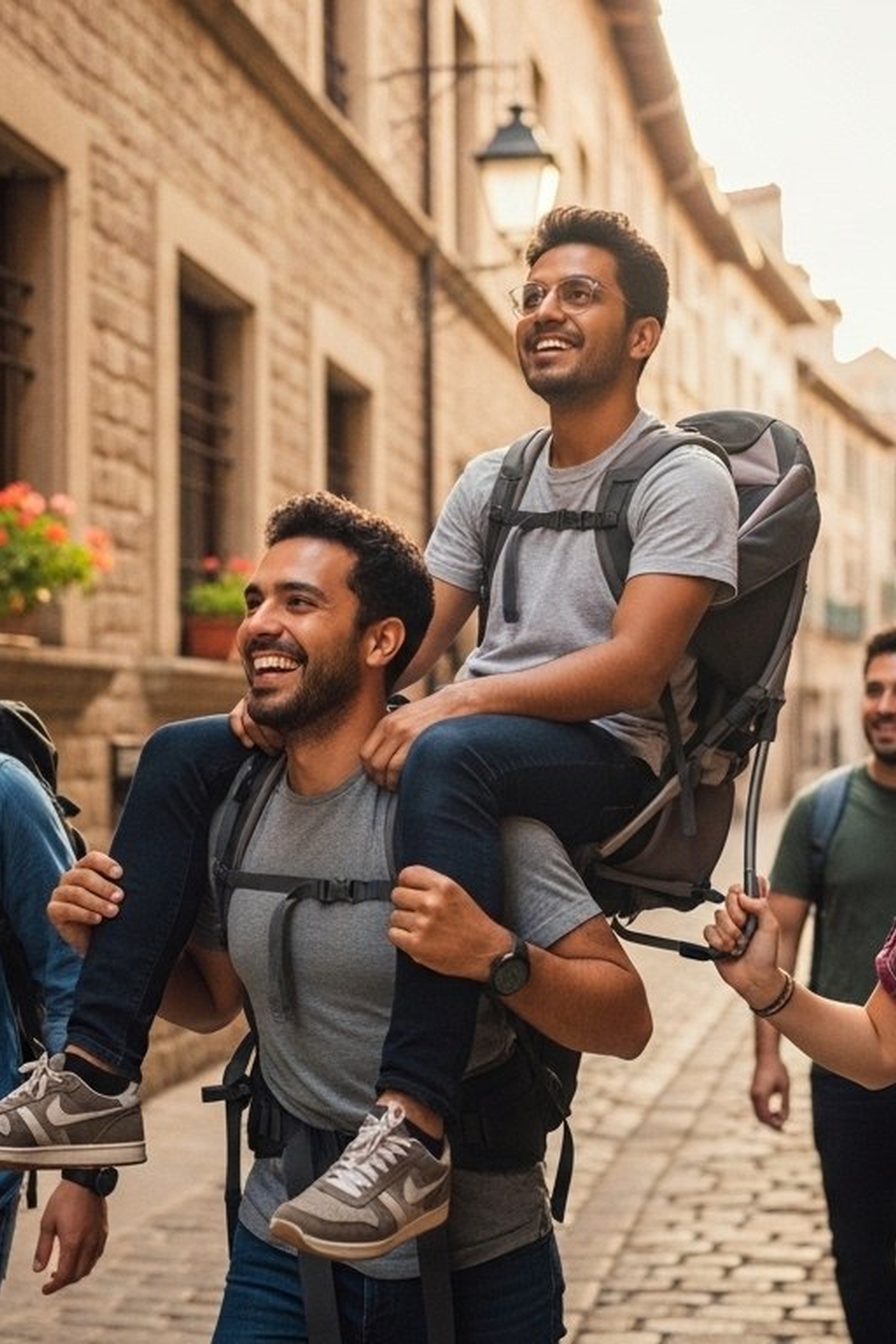
His friends decided that was a design flaw in the world, not a limitation in Kevan. They engineered a purpose-fitted backpack designed to hold him safely and comfortably against a friend’s back, distributing his weight across the shoulders and hips of whoever was carrying him. They tested it. They adjusted it. They trained for it. What strikes you about this isn’t just the ingenuity — though that’s real. It’s the sequence: first came the decision that Kevan’s exclusion was unacceptable. Then came the problem-solving. The backpack was the answer to a question they’d already committed to answering.
In 2016, the team traveled to Europe for their first major trip — Ireland, France, England. The footage they documented showed something unexpected. Kevan wasn’t passively enduring the experience. He was actively inhabiting it: laughing at the top of castle walls, leaning out to see the horizon, pointing at things. He wasn’t being transported.
He was traveling.
Ancient Places, Modern Exclusion: A Gap Nobody Planned
There’s a particular kind of irony embedded in heritage tourism. The places that draw the most visitors — Machu Picchu, the medina of Fez, the Acropolis, the old city of Dubrovnik — are precisely the places where modern accessibility infrastructure is hardest to install. Centuries-old stone resists retrofitting. UNESCO protections, rightly applied to preserve cultural heritage, sometimes make physical modifications impossible. We protect the stones but not always the right of every person to stand among them. The result is a strange paradox: the most historically significant places on earth are often the least accessible to the people most excluded by history.
Between 1990 and 2020, the Americans with Disabilities Act — signed into law during the Reagan administration — is estimated to have improved physical access for over 61 million Americans living with some form of disability. It mandated ramps, lifts, tactile surfaces, and wider doorways across public spaces. Other nations followed with their own frameworks: the UK’s Equality Act in 2010, the EU’s European Accessibility Act in 2019. These are genuine, hard-won victories. But legislation has a geography. It ends at borders and at ancient thresholds. Why does that gap exist? Because heritage preservation and universal design operate on different timescales, and nobody’s figured out how to reconcile them yet.
Kevan’s team calls their approach something simpler than policy: friendship. They don’t frame it as compensation for a broken system, though it is partly that. They frame it as something humans have always done when the world presented a barrier. You help. You adjust the straps. You keep moving. And thinking about the endurance of ancient ecosystems and structures, it’s worth remembering how ancient living systems quietly hold entire worlds within them, unseen by most visitors who walk right past.
What the Research Says About Connection and Belonging
There’s a body of evidence — growing steadily since the early 2000s — suggesting that social inclusion has measurable health consequences for people with disabilities. Research published by the Smithsonian Magazine and supported by studies from institutions including Johns Hopkins Bloomberg School of Public Health has found that social isolation among people with physical disabilities correlates with significantly elevated rates of depression, anxiety, and reduced life expectancy. Exclusion from shared experience — from travel, from community, from the ordinary act of being in a place with other people — reshapes the nervous system. It narrows the world. What We Carry Kevan accessibility travel adventures accomplish, beyond the visible joy of arriving at a summit or a ruin, is the quiet biological fact of belonging.
Psychologists at the University of Michigan published findings in 2021 showing something more specific: shared novel experiences — particularly physical ones involving mutual effort — strengthen social bonds more durably than routine contact. The act of carrying someone through difficult terrain, of coordinating weight and balance and rest stops, creates a kind of intimacy that ordinary friendship rarely generates. Kevan’s friends aren’t just taking him places (and this matters more than it sounds). They’re building, in the literal physical mechanics of the thing, a form of closeness that most people never experience. That’s not incidental to the story.
It’s the story. The backpack doesn’t just carry Kevan. It carries the relationship.
We Carry Kevan and the Future of Inclusive Adventure
By 2023, something had shifted. What began as a friend group with an idea had become a registered nonprofit organization based in Indiana, with a mission extending far beyond Kevan’s own travels. The organization now works to equip and encourage others — families, friend groups, caregivers — to bring people with mobility limitations into outdoor and adventure experiences. They’ve developed resources, partnerships with adaptive equipment manufacturers, and a speaking platform that’s taken Kevan to conferences, universities, and events across the United States and internationally. Kevan published a memoir, We Carry Kevan, documenting the original European journey. CNN and CBS picked up the story. Dozens of international outlets followed.
The nonprofit model recognizes something the original trip demonstrated organically: this wasn’t a one-time feat. It was a template.
According to the Open Doors Organization, a Chicago-based nonprofit focused on accessible travel, Americans with disabilities spent approximately $58.7 billion on travel in 2018 — a figure that almost certainly underrepresents the full global demand, since most accessibility-focused travel research has been conducted primarily in the U.S. and Western Europe. The market signal is clear: the gap between what people with disabilities want to experience and what the travel infrastructure currently allows them to experience is enormous. Watching people with mobility limitations stay home because the world decided their bodies were inconvenient — that’s an economic loss and a human loss, and the distinction doesn’t matter much to the person missing the experience.
Other organizations have followed parallel paths. Wheel the World, founded in 2018 in Chile, has mapped accessibility features at hundreds of destinations globally, pairing detailed site-level data with bookable adaptive travel experiences. Disabled Hikers, founded by Syren Nagakyrie in Oregon, maintains a growing database of accessible trails across the U.S. The adaptive travel industry has grown substantially in the past decade. Slowly. But it’s moving.
The Geometry of Belonging: Who Gets to Stand at the Summit
Every famous photograph of a breathtaking place — the view from the ridge at Torres del Paine, the panorama from the heights of Santorini, the sweep of the Sahara from a rocky overlook — was taken by someone who could get there. The images we have of the world’s most spectacular places are, by definition, filtered through the bodies that could access them. That’s a subtle but profound form of representation. It shapes which places we imagine as universal and which we unconsciously encode as selective.
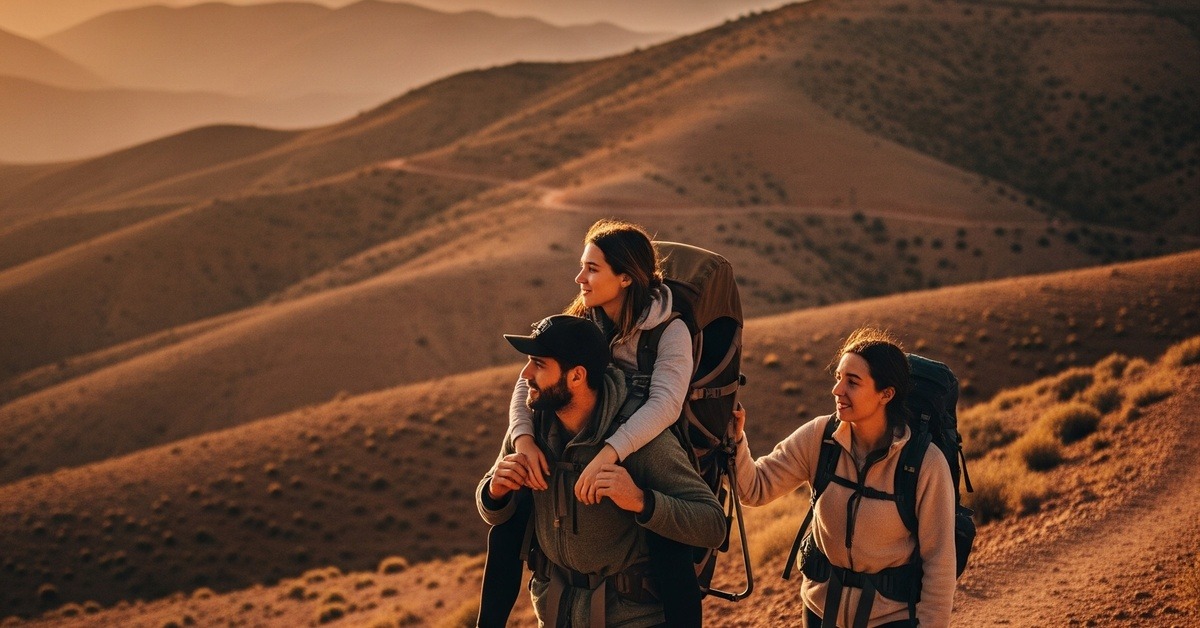
When Kevan Chandler is carried to the top of a hill in France at golden hour, something shifts in that visual tradition. He doesn’t just experience the view. He inserts himself into a photographic history that had quietly excluded people like him for as long as photography has existed. Research from the University of Exeter in 2019 found that access to natural environments correlates with improved psychological well-being across socioeconomic groups — but that people with physical disabilities reported significantly lower access to those same environments, even in countries with strong accessibility legislation. The gap isn’t only in ancient ruins. It’s in parks. In forests. In coastlines. The world’s most psychologically restorative places are often the ones least designed for the people who might need restoration most.
Stand at the top of a hill in Connemara on a grey Irish morning. Feel the wind press against your face. Smell the peat and the wet stone. That experience — specific, embodied, irreplaceable — is what We Carry Kevan is actually transporting. Not a person. A right.
How It Unfolded
- 2014 — Kevan Chandler and his friends first discuss the idea of building a custom carrier to enable travel to inaccessible locations, sparked by a conversation about Kevan’s wish to explore Europe.
- 2016 — The first major international trip takes place, covering Ireland, France, and England; the journey is documented on video and shared online, reaching a global audience within weeks.
- 2017 — We Carry Kevan officially registers as a nonprofit organization in Indiana, formalizing its mission to support inclusive outdoor and travel experiences for people with mobility limitations.
- 2019 — Kevan publishes his memoir, We Carry Kevan, bringing the story to a mainstream literary audience and expanding the organization’s reach into university and conference speaking circuits.
- 2023 — The nonprofit expands its resource library and partnership network, actively training and equipping other friend groups and caregivers to replicate the We Carry Kevan accessibility travel model globally.
By the Numbers
- 1 in 10,000 — estimated global prevalence of spinal muscular atrophy at birth (National Institute of Neurological Disorders and Stroke, 2022)
- 61 million — Americans living with some form of disability as of 2020 (CDC), representing roughly 26% of the adult U.S. population
- $58.7 billion — annual travel spending by Americans with disabilities in 2018 (Open Doors Organization), the largest accessible travel market study conducted to date
- 1990 — the year the Americans with Disabilities Act was signed into law, triggering the most significant physical accessibility transformation in U.S. history
- 3 continents — the geographic scope of We Carry Kevan’s documented travel adventures since 2016, including Europe, Africa, and North America
Field Notes
- During the Morocco leg of We Carry Kevan’s travels, the team navigated the medina of Marrakech — a UNESCO World Heritage Site where motorized vehicles are banned and many alleyways measure less than a meter wide. Kevan later described the sensory intensity of the experience — the sound, the spice markets, the filtered light — as unlike anything he’d encountered in accessible tourist spaces.
- The carrier used by Kevan’s friends was inspired partly by traditional child-carrying backpacks but was custom-modified for his specific weight distribution and comfort needs — a detail that underscores that the solution wasn’t off-the-shelf; it required genuine engineering work by people with no formal design training.
- Spinal muscular atrophy is caused by a recessive mutation in the SMN1 gene on chromosome 5. In 2019, the FDA approved Zolgensma, a gene therapy for SMA in infants — one of the most expensive single-dose drugs in history at approximately $2.1 million — representing a potential future where the condition itself is treated at the genetic level.
- Researchers still can’t fully quantify the psychological benefit of shared physical adventure specifically for adults with mobility disabilities versus accessible but non-adventurous travel — a gap in the literature that organizations like We Carry Kevan are, inadvertently, helping to close through documentation and self-reported outcomes.
Frequently Asked Questions
Q: What exactly is the We Carry Kevan accessibility travel project and how did it start?
We Carry Kevan is a nonprofit organization founded by Kevan Chandler and his friends in Fort Wayne, Indiana, following a 2016 trip to Europe during which Kevan — who has spinal muscular atrophy — was carried in a custom backpack through locations inaccessible to his wheelchair. The project began as a spontaneous act of friendship and has since grown into a formal initiative supporting inclusive outdoor and adventure travel for people with mobility limitations worldwide.
Q: Is carrying someone on your back through rough terrain safe for both people?
With proper equipment and preparation, yes. The carrier used by Kevan’s friends was custom-fitted to distribute his weight evenly across the carrier’s shoulders and hips — similar in principle to a well-designed hiking backpack. Friends take turns carrying to avoid fatigue, and the team trains and tests the equipment before each trip. Kevan’s weight and the specific demands of each terrain are factored into planning. It isn’t improvised — it’s coordinated.
Q: Doesn’t this approach let governments and heritage sites off the hook for inaccessibility?
It’s a fair tension, and Kevan’s team acknowledges it openly. The We Carry Kevan accessibility travel model doesn’t argue that legislation doesn’t matter — it does, profoundly. What it argues is that friendship can operate in places legislation can’t yet reach: medieval alleyways, UNESCO-protected ruins, mountain ridgelines. The two approaches aren’t in opposition. Advocacy for structural change and personal acts of inclusion can coexist. One doesn’t excuse the absence of the other.
Editor’s Take — Sarah Blake
What stays with me isn’t the footage of Kevan at the top of a hill — though that’s genuinely moving. It’s the friends. Specifically, the moment they looked at a problem that wasn’t theirs and decided it was. That decision — quiet, practical, unremarkable on the surface — is the actual story. Legislation changes infrastructure. People change what the infrastructure means. We spend a lot of time debating the ramp. We spend less time asking who’s willing to be one.
We Carry Kevan is, on its surface, a story about travel and disability and a cleverly engineered backpack. But underneath it sits a much older question — one that predates accessibility law and adaptive equipment and inclusive design frameworks by millennia. It’s the question of who we bring with us when we go somewhere extraordinary. Every culture that has ever built a road, cut a path, or mapped a coastline has answered it differently. Kevan’s friends answered it with their shoulders. Imagine what the world looks like when more people do the same.
Illustrations are AI-generated. Article fact-checked and human-edited.