How Old Are the Schöningen Spears? The 2025 Answer
How old are the Schöningen spears? The honest 2025 answer is about 200,000 years — a figure roughly 100,000 years younger than the number still printed on most museum labels and repeated in nearly every YouTube video about them. These slender lengths of spruce and pine, dug out of a German coal mine in the 1990s, are the oldest complete hunting weapons ever found. And in May 2025 the science behind them quietly rewrote itself.
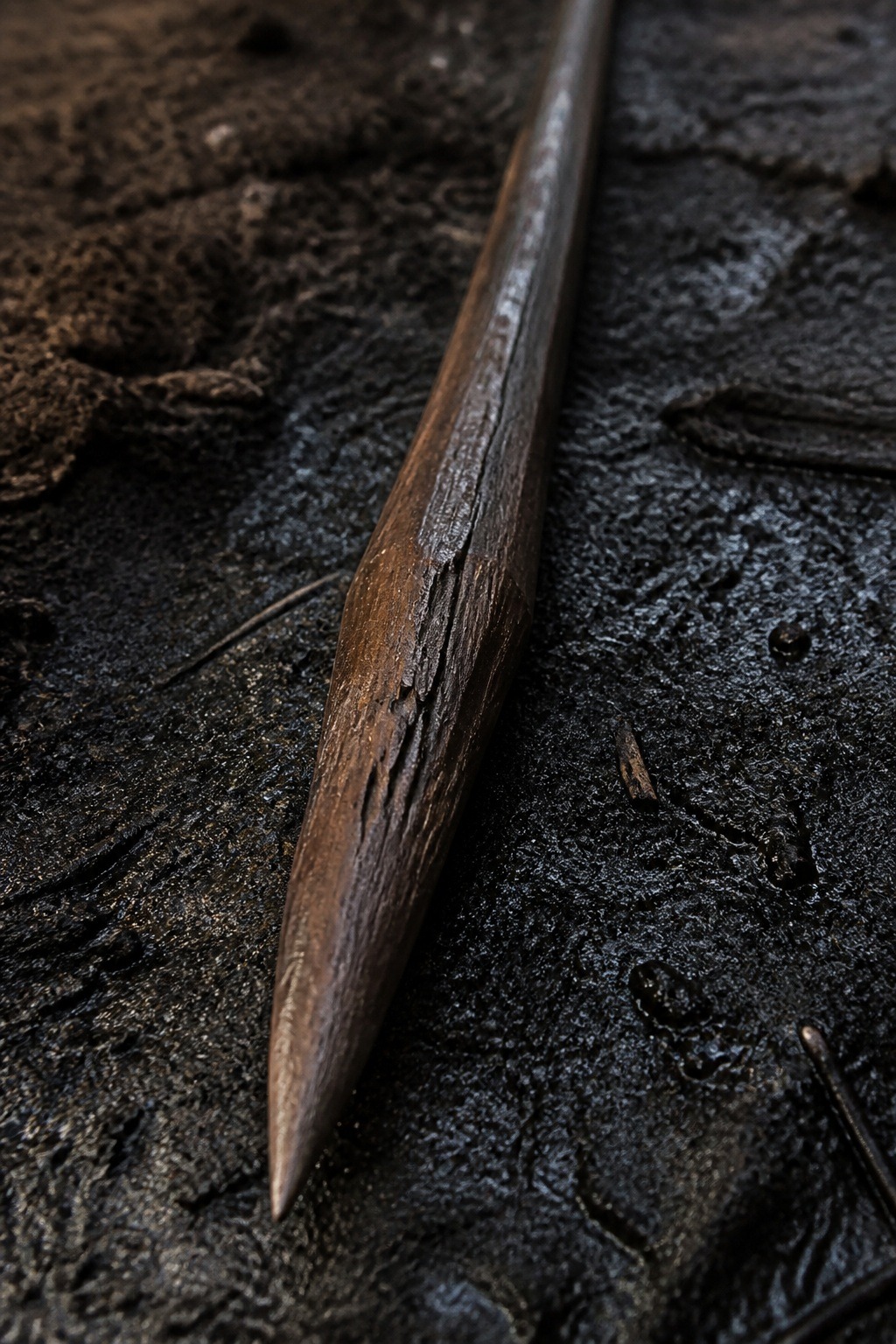
- ~200,000 years — revised age (Hutson et al., 2025)
- ~300,000–400,000 years — the older estimate still widely quoted
- ~10 wooden weapons recovered — spears and throwing sticks, not three
- ~50 horses and 12,000+ butchered bones at the lakeshore
- 15–20 m — how far replica spears flew in throwing tests
- 1994–1999 — the excavation window in Schöningen, Lower Saxony
The short answer: about 200,000 years old — revised downward in 2025 from earlier estimates of 300,000 to 400,000 years, and now most likely the work of early Neanderthals rather than Homo heidelbergensis.
Key Facts
- A 2025 study (Hutson et al., Science Advances) revised the spears’ age to about 200,000 years, roughly 100,000 years younger than earlier estimates.
- The Schoeningen spears, excavated 1994-1999 in Lower Saxony, are the oldest complete wooden hunting weapons ever found.
- About 10 wooden weapons were recovered, alongside remains of some 50 horses and over 12,000 butchered bones.
- The 2025 redating used amino acid geochronology on Bithynia snail opercula, work involving Professor Kirsty Penkman’s lab at the University of York.
- The revised date points to early Neanderthals rather than Homo heidelbergensis as the likely makers.
In short: The Schoeningen spears, wooden hunting weapons from a German coal mine, were long dated to 300,000-400,000 years. A 2025 study led by Jarod Hutson revised them to about 200,000 years using amino acid dating of snail shells, shifting the likely makers from Homo heidelbergensis to early Neanderthals. Around ten weapons were recovered.
What the Schöningen spears are — and why they matter

Picture a wet, grey pit of brown coal in Lower Saxony, machines chewing through ancient lakebed. Between 1994 and 1999, archaeologist Hartmut Thieme and his team lifted from that mud a set of wooden weapons that should not have existed. Wood rots. It almost never survives a few centuries, let alone hundreds of millennia. These survived because the mud sealed them: waterlogged, oxygen-starved lakeshore sediment that stopped the microbes cold.
What emerged were carefully worked shafts of spruce and pine, most about 1.8 to 2.5 metres long — six to eight feet. Each was shaped like a modern javelin, thickest a third of the way from the point, tapering at both ends. That is not a digging stick. That is engineering. For the first time, we had direct, physical proof that Ice Age humans made and used sophisticated hunting weapons, not just the stone tools that usually survive.
That single fact — the oldest wooden spears in the world, complete and unmistakably weapons — is why Schöningen sits on Germany’s UNESCO World Heritage tentative list and why it keeps rewriting the story of what early humans could do.
How old are the Schöningen spears? From 400,000 to 200,000 years
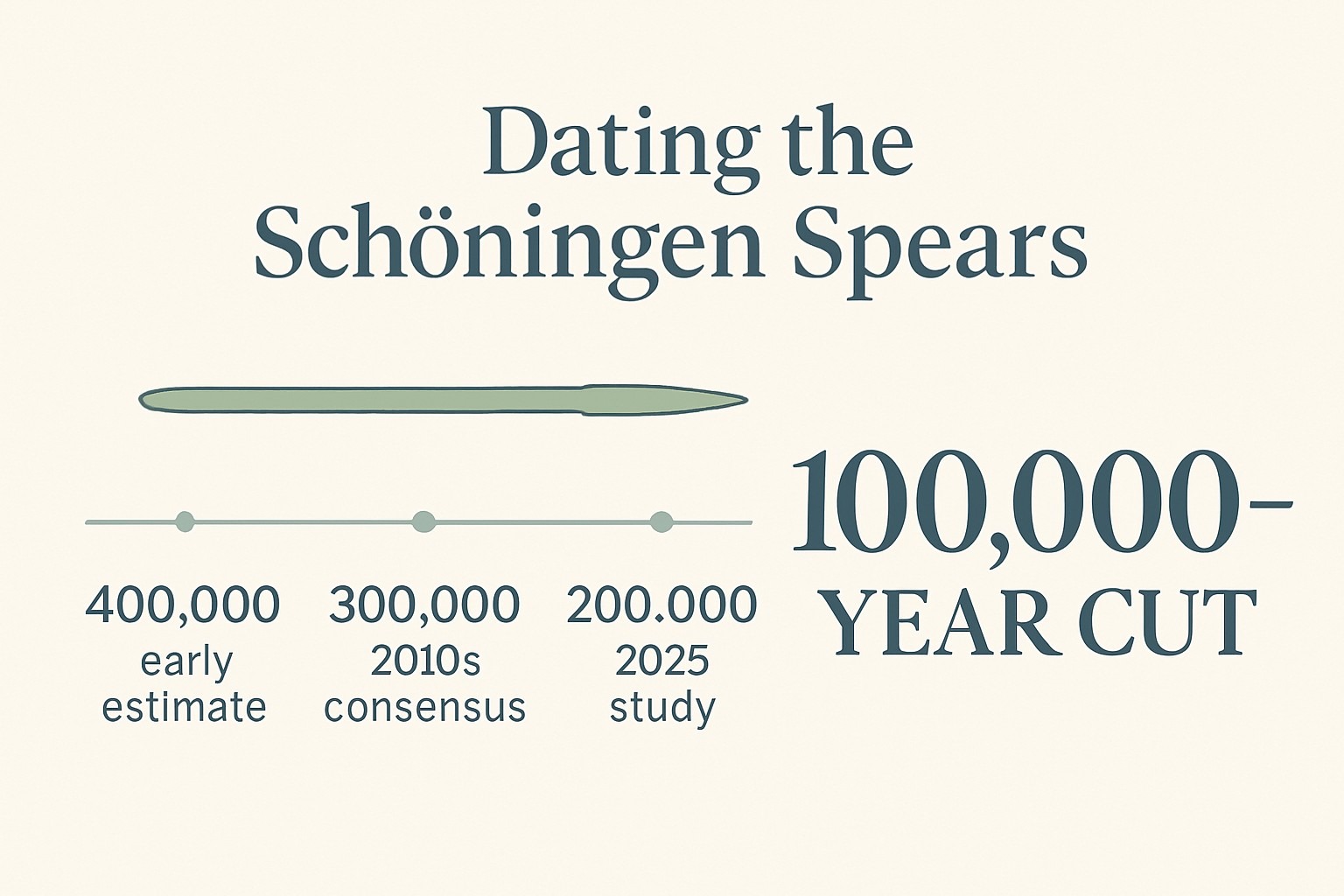
Here is where it gets interesting. For two decades the spears were dated to roughly 300,000 years, with some earlier claims reaching 400,000. That older figure is baked into countless documentaries, and it framed the whole narrative: this was the deep, deep past, long before Neanderthals, made by their ancestors.
Then came the 2025 reassessment. A team led by Dr Jarod Hutson of the Leibniz Centre for Archaeology (LEIZA) in Mainz, publishing in Science Advances, put the spear horizon at closer to 200,000 years. Not older — younger, by about 100,000 years. It is a rare thing in archaeology for a famous date to shrink rather than stretch, and it changes who could have been standing at that lake.
The table below reconciles the shifting numbers in one place — something the older coverage never does, because most of it was written before the revision existed.
{IMAGE_2}
| When claimed | Age given | Attributed maker | Basis |
|---|---|---|---|
| 1990s–2000s | ~400,000 yrs | Homo heidelbergensis | Early stratigraphy |
| 2010s consensus | ~300,000 yrs | Homo heidelbergensis | Refined stratigraphy |
| 2025 (Hutson et al.) | ~200,000 yrs | Early Neanderthals | Amino acid geochronology |
The snail-shell clock: how they redated them in 2025
So how do you re-age a 200,000-year-old lakebed with confidence? Not with the spears themselves — wood carbon-dates only back to about 50,000 years. The trick was the snails.
The team turned to amino acid geochronology, work involving Professor Kirsty Penkman’s laboratory in the Department of Chemistry at the University of York. The material was tiny Bithynia opercula — the hard “trapdoor” a freshwater snail uses to seal its shell. When an animal dies, the amino acids locked in that structure slowly flip from one molecular mirror-image to the other. Chemists call it racemization; think of it as left-handed and right-handed versions of the same molecule.
Turns out that flip runs at a temperature-dependent, roughly clock-like pace. Measure the ratio of the two handedness forms, calibrate against sites of known age, and you get a date. Applied across the Schöningen sequence, that molecular clock pointed to about 200,000 years — the “how do we know” that almost no popular retelling bothers to explain, even though it is the reason the headline number changed at all.
Who made them: Homo heidelbergensis or Neanderthals?
The date is not just a number. It moves the spears into a different chapter of human evolution. At 300,000-plus years, the obvious candidate was Homo heidelbergensis, the broad-browed species often cast as the common ancestor of both Neanderthals and us. The Smithsonian’s Human Origins Program describes heidelbergensis as an early large-brained human of exactly that era — a tidy fit for the old chronology.
Pull the date down to 200,000 years and that tidiness dissolves. By then, early Neanderthals were established across Europe. The 2025 authors argue the more likely toolmakers were Neanderthals, and that the Schöningen kit reflects what they call an intensification of cooperative behaviour — organised, repeated big-game hunting deeper in the Neanderthal story than most reconstructions allow.
Worth being straight about the limits: no human bones were found with the spears, so attribution rests on the date and the regional record, not a skeleton. Which name you attach depends heavily on which age you accept.
Not three sticks but an arsenal
Ask most people about Schöningen and they will mention “the three famous spears.” That framing is badly out of date. The site yielded on the order of ten wooden weapons, and a 2024 study in the Proceedings of the National Academy of Sciences catalogued the full inventory of the Spear Horizon.
It was not one design but a graded toolkit. Alongside longer thrusting-and-throwing spears sat lighter, faster javelins and double-pointed throwing sticks — shorter batons, sharpened at both ends, that could be hurled to break the legs of prey or knock down birds. Different weights, different jobs, made to a consistent template.
Strip away the argument over the exact age and the more remarkable claim survives intact: this is a designed weapons system, not three lucky finds. People who plan a whole arsenal are people who plan a hunt.
50 horses at the lake: evidence of a planned ambush
The weapons are only half the scene. The spears lay among the butchered remains of roughly 50 wild horses of the extinct species Equus mosbachensis, part of an assemblage exceeding 12,000 animal bones, with red deer and large bovids in the mix too. Cut marks and impact damage show the carcasses were systematically worked over — meat stripped, marrow cracked.
Fifty horses is not one lucky ambush by one hunter. A lakeshore kill on that scale implies a group driving animals against the water, coordinating positions, and butchering the haul before it spoiled. That means planning ahead, cooperating in the moment, and communicating — the cognitive package we tend to reserve for much later humans. The “old stick” headline buries what is arguably the bigger find: the behaviour around the weapons.
Could they actually kill? The throwing experiments
A sharpened pole is not automatically a weapon. To test whether these could really function, researchers built faithful replicas and had trained javelin athletes throw them. Work led by archaeologist Dr Annemieke Milks of the University of Reading found the replicas flew as effective weapons, reaching usable distances of roughly 15 to 20 metres — about 49 to 66 feet — and behaving in flight much like a modern competition javelin.
That range matters. It is short enough to demand a close, concealed approach, and long enough to strike a horse at the water’s edge before it bolts. The balance point sat where a thrower would want it. Whatever the exact age of the wood, the physics is settled: these were built to be launched, and they worked.
The debate: what a younger date really means
Is this the last word? No, and it should not be sold that way. Cutting a landmark date by 100,000 years is a big claim, and dates that reshape the human-evolution timeline invite hard scrutiny — as they should. The amino acid method is well established, but any single revision of a site this important will be tested and re-tested by other labs and other techniques before it fully settles into consensus.
What is not really in dispute is the significance. Whether 200,000 or 300,000 years, Schöningen remains the oldest preserved hunting weaponry on Earth and hard evidence of organised, cooperative big-game hunting deep in prehistory. The 2025 date sharpens the question rather than closing it: not just how old are the Schöningen spears, but who, exactly, was already clever enough to make them.
Questions readers ask
How old are the Schöningen spears? About 200,000 years, according to the 2025 amino acid study — revised down from earlier estimates of roughly 300,000 to 400,000 years.
Who made the Schöningen spears? Under the older date, Homo heidelbergensis; under the 2025 date, most likely early Neanderthals. No human bones were found with them, so it rests on the age.
How were they dated? Through amino acid geochronology on the opercula of tiny Bithynia freshwater snails — measuring how far the amino acids had “flipped” between mirror-image forms as a molecular clock.
How long are the spears? Most are about 1.8 to 2.5 metres — roughly six to eight feet — made of spruce and pine and shaped like javelins.
Sources and notes
- Hutson, J. et al. (2025), Science Advances — revised ~200,000-year age and Neanderthal cooperative behaviour (Leibniz Centre for Archaeology, LEIZA, Mainz).
- Professor Kirsty Penkman, Department of Chemistry, University of York — amino acid geochronology on Bithynia snail opercula.
- Proceedings of the National Academy of Sciences (2024) — full inventory of the Schöningen wooden artifacts and Spear Horizon.
- Dr Annemieke Milks, University of Reading — replica throwing experiments and effective-range findings.
- Smithsonian Human Origins Program — background on Homo heidelbergensis.
- UNESCO World Heritage Centre tentative list — Site of the Schöningen Spears; faunal remains and Equus mosbachensis.
The spears have not moved in 200,000 years, but the story around them keeps shifting under fresh science — and that is the point. A coal-mine discovery from the 1990s is still teaching us, in 2026, that our idea of “primitive” was never quite right, and that the next lab result may nudge the timeline again.
Frequently Asked Questions
Q: How old are the Schoeningen spears?
The 2025 answer is about 200,000 years old — roughly 100,000 years younger than the 300,000-to-400,000-year figure still printed on many museum labels. The revision came from a team led by Dr Jarod Hutson of the Leibniz Centre for Archaeology, publishing in Science Advances. It is unusual in archaeology for a famous date to shrink rather than stretch, and it changes who could have been standing at that lakeshore.
Q: How were the spears redated to 200,000 years?
Wood only carbon-dates back about 50,000 years, so researchers dated the surrounding lakebed instead. They used amino acid geochronology on tiny Bithynia snail opercula — the trapdoor a freshwater snail uses to seal its shell. As the amino acids slowly flip between mirror-image forms at a clock-like, temperature-dependent pace, measuring that ratio yields a date. Applied across the site, it pointed to about 200,000 years.
Q: Who made the Schoeningen spears?
At the older 300,000-year date, the likely maker was Homo heidelbergensis. The 2025 redating to about 200,000 years instead points to early Neanderthals, who were established across Europe by then. However, no human bones were found with the spears, so attribution rests on the date and the regional record rather than a skeleton — meaning the answer depends heavily on which age you accept.
Q: How many spears were found at Schoeningen?
The site yielded on the order of ten wooden weapons, not the three famous spears often cited. A 2024 study in the Proceedings of the National Academy of Sciences catalogued the full Spear Horizon inventory, which was a graded toolkit including spears and shorter throwing sticks. They were found alongside the remains of some 50 horses and over 12,000 butchered bones at an ancient lakeshore.
Illustrations are AI-generated. Article fact-checked and human-edited. Our editorial standards.