Why Bongos Eat Charcoal After Lightning Strikes
After a lightning storm hits Central African forests, bongos walk straight to the charred trees and start eating the ash. Nobody figured out why until researchers watched it happen over and over on camera trap footage.
Here’s what’s weird: it took scientists years to notice that bongos were doing this at all. These animals are so secretive, so deliberately invisible, that their entire lives happen in shadow. But the pattern became impossible to ignore. Lightning strike. Fire dies down. Bongo emerges from the forest and heads directly to the burned wood. It’s not hunger driving this. It’s something else entirely.
The bongo (Tragelaphus eurycerus) is a forest browser — leaves, shoots, bark, the soft stuff from decaying trees. All the calories an antelope could want. But field ecologists working in Gabon and the Congo Basin kept seeing the same behavior after fire events. Post-lightning, post-burn, bongos would appear at charred stumps and consume the ash.
The leading hypothesis: they’re self-medicating.
Key Facts
- Bongos walk to charred trees after lightning fires in Central African forests and eat the ash, a behavior pieced together from trail camera footage
- Wood ash contains roughly 25-45% calcium oxide by weight, along with significant potassium, far more than living plant tissue
- Male bongos weigh between 210 and 405 kilograms, among the heaviest forest antelopes on Earth
- Bongo horns reach up to 99 centimeters in length, and both males and females carry them
- Fewer than 100 mountain bongos survive in Kenya’s wild highland forests, listed as critically endangered (IUCN Red List, 2020)
In short: Bongo charcoal eating is the behavior of forest antelopes walking to lightning-burned trees to consume mineral-rich ash, which holds 25-45% calcium oxide by weight. Likely self-medication for a mineral-poor rainforest diet, it was discovered via trail cameras and matters most for the fewer than 100 critically endangered mountain bongos in Kenya.
What Burned Wood Actually Contains
When lightning burns a tree, the heat doesn’t just destroy — it concentrates. Wood ash ends up loaded with sodium, calcium, potassium, and trace minerals that living plant tissue locks away inside itself. For a forest browser, the regular diet is deceptively poor in the salts that large mammals actually need. Fiber, water, calories? Sure. But the chemistry required for muscle function, digestion, bone density? That’s missing.
It’s like living in a restaurant where every meal fills you up but nothing actually nourishes.
Geophagy — eating earth or mineral-rich materials — shows up across dozens of mammal species. Elephants excavate mineral caves. Macaws eat riverbank clay. Deer lick salt deposits. Bongo charcoal eating fits the pattern perfectly. The difference is that the “mineral lick” happens to be a tree struck by lightning in the middle of a tropical forest.
Wood ash contains roughly 25–45% calcium oxide by weight.
That concentration is staggering compared to what living leaves offer.
The Animal That Refuses to Be Seen
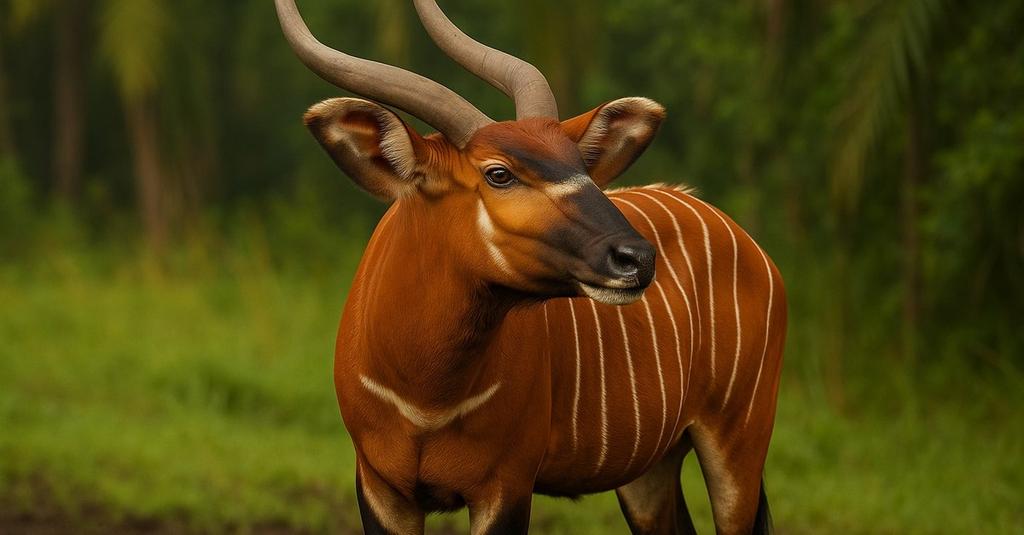
Bongos are almost pathologically secretive. Males can weigh over 400 kilograms — they’re one of the largest forest antelopes in Africa — and yet humans almost never see them. They move at night. They freeze when threatened. Those white stripes? Perfect camouflage in dappled forest light. For decades, everything scientists knew about wild bongos came from tracks, from camera traps, from the occasional fleeting glimpse in dim forest.
Bongo charcoal eating wasn’t discovered through direct observation. It was pieced together from trail cameras positioned near burn sites. Researchers watching footage at 2 a.m., noticing the same animal returning to the same burned tree, over and over.
Both males and females carry those dramatic spiraling horns — up to 99 centimeters long. When a bongo pushes through dense undergrowth, it tilts the horns back along its body so they don’t catch on branches. That’s not instinct. That’s learned, deliberate, calculated movement.
Two Populations, Two Very Different Stories
There are actually two distinct bongo populations. The lowland bongo (T. e. eurycerus) lives in the rainforests of West and Central Africa — still relatively stable in numbers, still moving through its historic range. Bongo charcoal eating has been observed in these populations. The mountain bongo (T. e. isaaci) lives in the fragmented highland forests of Kenya, and it’s in serious trouble.
Fewer than 100 individuals are estimated to survive in the wild.
Which raises the obvious question: when the forests that produce lightning-strike mineral supplements are themselves disappearing, what happens to the animals that depend on them?
That’s not rhetorical. The answer isn’t good.

Why This Reveals Something About How Forests Actually Work
Here’s the thing: when an animal develops a behavior this specific — seeking a very particular resource that only appears after a very particular event — it tells you the forest diet has real nutritional gaps. Dense tropical rainforests are mineral deserts in disguise. They’re extraordinarily productive in calories and biomass, but the minerals that large animals need get cycled tightly through root systems and mycorrhizal networks. Very little reaches the browsers at all. Lightning storms bypass that entire system. They burn vegetation and release those locked minerals in a way nothing else can.
Bongos are essentially exploiting a geological accident.
Every charred stump becomes a resource. Every storm becomes a kind of delivery system. And the animal that looks the most dramatic in the forest — striped, horned, secretive — turns out to be one of the most chemically savvy.
By the Numbers
- Fewer than 100 mountain bongos survive in Kenya’s wild highland forests (IUCN Red List, 2020) — critically endangered.
- Male bongos weigh between 210–405 kilograms, making them one of the heaviest forest antelopes on Earth while remaining almost invisible in the wild.
- Bongo horns reach 99 centimeters in length, and unlike most antelope species, both males and females carry them.
- Wood ash contains 25–45% calcium oxide by weight, along with significant potassium — concentrations far higher than living plant tissue provides.
Field Notes
- Bongos have a uniquely long, prehensile tongue for stripping leaves and gripping branches — allowing them to be extraordinarily selective feeders even in dense, tangled vegetation.
- Almost never heard by humans in the wild. They communicate with subtle visual signals and soft calls. Their primary defense is simply vanishing into the forest before detection.
- Geophagy in forest ungulates is often more pronounced during wet seasons, when rain leaches soil minerals and browser diets become least nutritionally diverse — which correlates with peak lightning storm activity in Central Africa.
What Happens When the Pharmacy Closes
Bongo charcoal eating seems like a curiosity — a strange footnote in an already strange species profile. But it’s actually a window into how forest ecosystems work at a chemical level, and how large animals adapt to the nutritional gaps their environments can’t consistently fill. That last fact kept me reading for another hour, because the implications are serious.
As Central African forests face increasing pressure from logging, agricultural expansion, and climate-driven changes to storm patterns, behaviors like this become harder to sustain. Fewer storms. Fewer burn sites. Fewer mineral deposits scattered across the forest floor.
For a critically endangered population like the mountain bongo, losing access to those supplemental minerals isn’t a minor inconvenience. It affects reproduction. It affects bone density. It affects survival. The charcoal isn’t just a quirk. It’s a lifeline.
What this behavior really reveals is that nature is never doing just one thing at a time. A lightning strike kills a tree. That dead tree feeds a bongo. The bongo gets minerals it needs to survive. And scientists watching on camera trap footage piece together, slowly, that a forest has its own pharmacy — and the animals have known about it for centuries.
The bongo doesn’t know why charcoal helps it. It just knows that it does. That’s the quiet genius of millions of years of trial and error written into instinct. These forests are full of behaviors like this — strange, specific, and meaningful once you know where to look. If you want to explore more of this kind of story, there’s more at this-amazing-world.com.
Frequently Asked Questions
Q: What is bongo charcoal eating and why do bongos do it?
Bongo charcoal eating is the behavior of bongos walking directly to trees burned by lightning fires in Central African forests and consuming the ash. The leading hypothesis is self-medication. Wood ash contains roughly 25-45% calcium oxide by weight plus significant potassium and trace minerals, concentrations far higher than living leaves provide. Since dense tropical forests are surprisingly poor in the salts large mammals need for muscle, digestion, and bone density, the charred wood acts like a natural mineral lick.
Q: How was bongo charcoal eating discovered?
It was not discovered through direct observation, because bongos are pathologically secretive. They move at night, freeze when threatened, and use white stripes as camouflage in dappled forest light. Instead, the behavior was pieced together from trail cameras positioned near burn sites in Gabon and the Congo Basin. Researchers reviewing footage noticed the same animals returning repeatedly to the same burned trees after fire events, revealing a consistent pattern that had escaped detection for years.
Q: How endangered are bongos?
It depends on the population. The lowland bongo of West and Central Africa remains relatively stable in numbers and still moves through much of its historic range. The mountain bongo, however, lives in fragmented highland forests in Kenya and is critically endangered, with fewer than 100 individuals estimated to survive in the wild as of the 2020 IUCN Red List. For this tiny population, losing access to lightning-strike mineral supplements affects reproduction, bone density, and survival.
Q: How big are bongos and what makes them unusual?
Male bongos weigh between 210 and 405 kilograms, making them one of the heaviest forest antelopes on Earth, yet humans almost never see them in the wild. Both males and females carry dramatic spiraling horns up to 99 centimeters long, which the animal tilts back along its body to avoid catching on branches in dense undergrowth. Bongos also have a long, prehensile tongue for stripping leaves, allowing them to feed selectively even in tangled vegetation.
Illustrations are AI-generated. Article fact-checked and human-edited. Our editorial standards.