Why Yasuní Is the Most Biodiverse Place on Earth
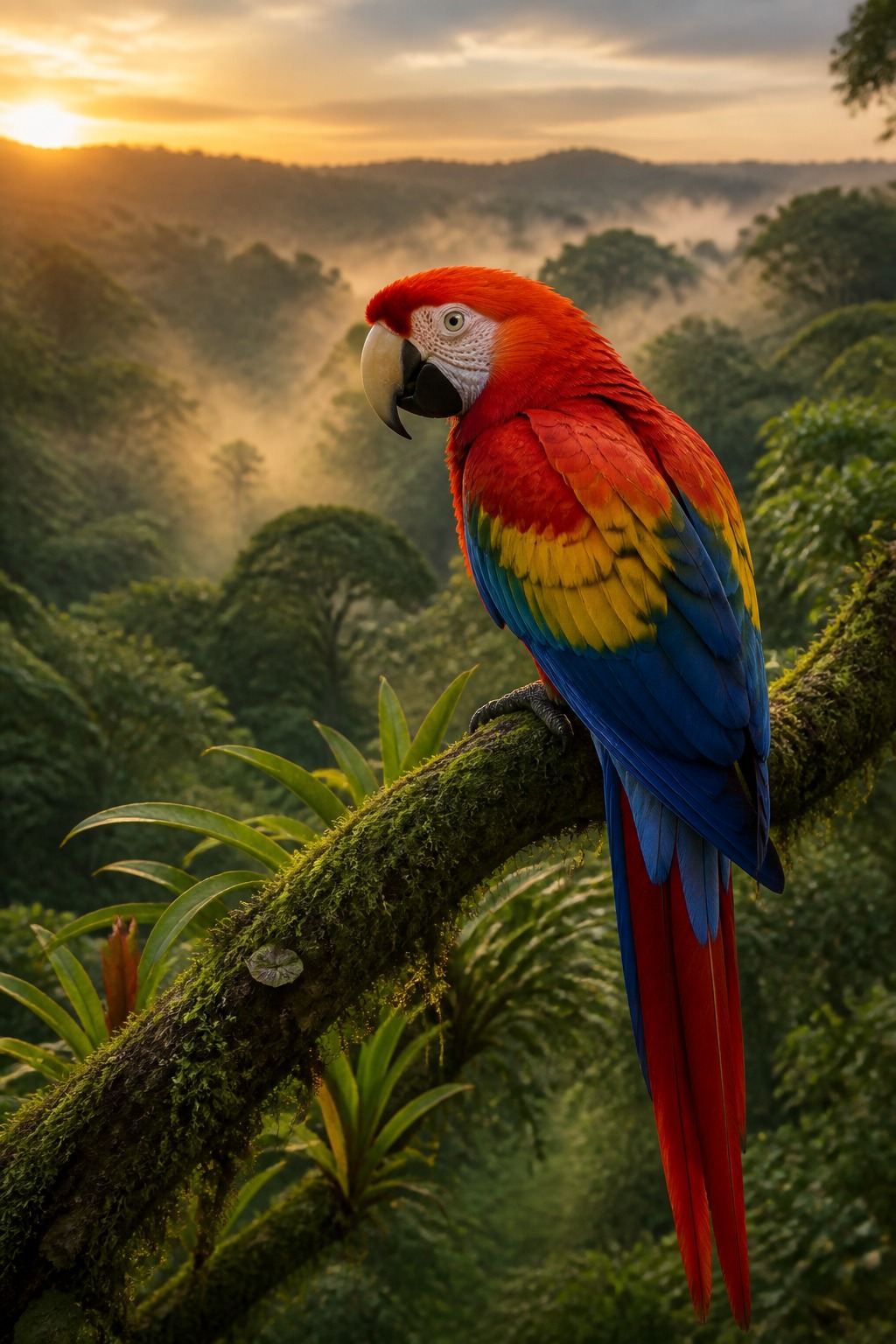
Stand still for one minute at dawn in the Ecuadorian Amazon and you start to understand why Yasuni is the most biodiverse place on Earth: the canopy above you can hold more bird species — 596 recorded inside the park — than live in all of Europe, and a single hectare of the forest at your feet may shelter more kinds of tree than the United States and Canada combined. No fence marks the spot. No sign announces the record. The diversity is just there, layered from the leaf litter to the crowns 40 metres up, humming and croaking and rustling in every direction at once.
Key Facts
- About 596 bird species have been documented in Yasuni National Park — close to a third of all native Amazon birds.
- One hectare of Yasuni upland forest holds 655 tree species — more than all of the continental US and Canada combined.
- The park covers about 10,227 square kilometres in northeastern Ecuador, established in 1979 and named a UNESCO Biosphere Reserve.
- Yasuni holds 150 amphibian species, a world record for an area its size, plus around 170+ mammal species including 13 primates.
- A landmark 2010 study in PLoS ONE, led by scientists including Matt Finer and Clinton Jenkins, documented its record diversity.
In short: Yasuni National Park in Ecuador is arguably Earth’s most biodiverse place: about 596 bird species, 655 tree species in a single hectare, 150 amphibians (a world record), and an estimated 100,000 insect species per hectare. A 2010 PLoS ONE study documented this. The cause is a rare convergence of the Andes, equator and Amazon.
596 Birds in One Park, and What That Number Really Means
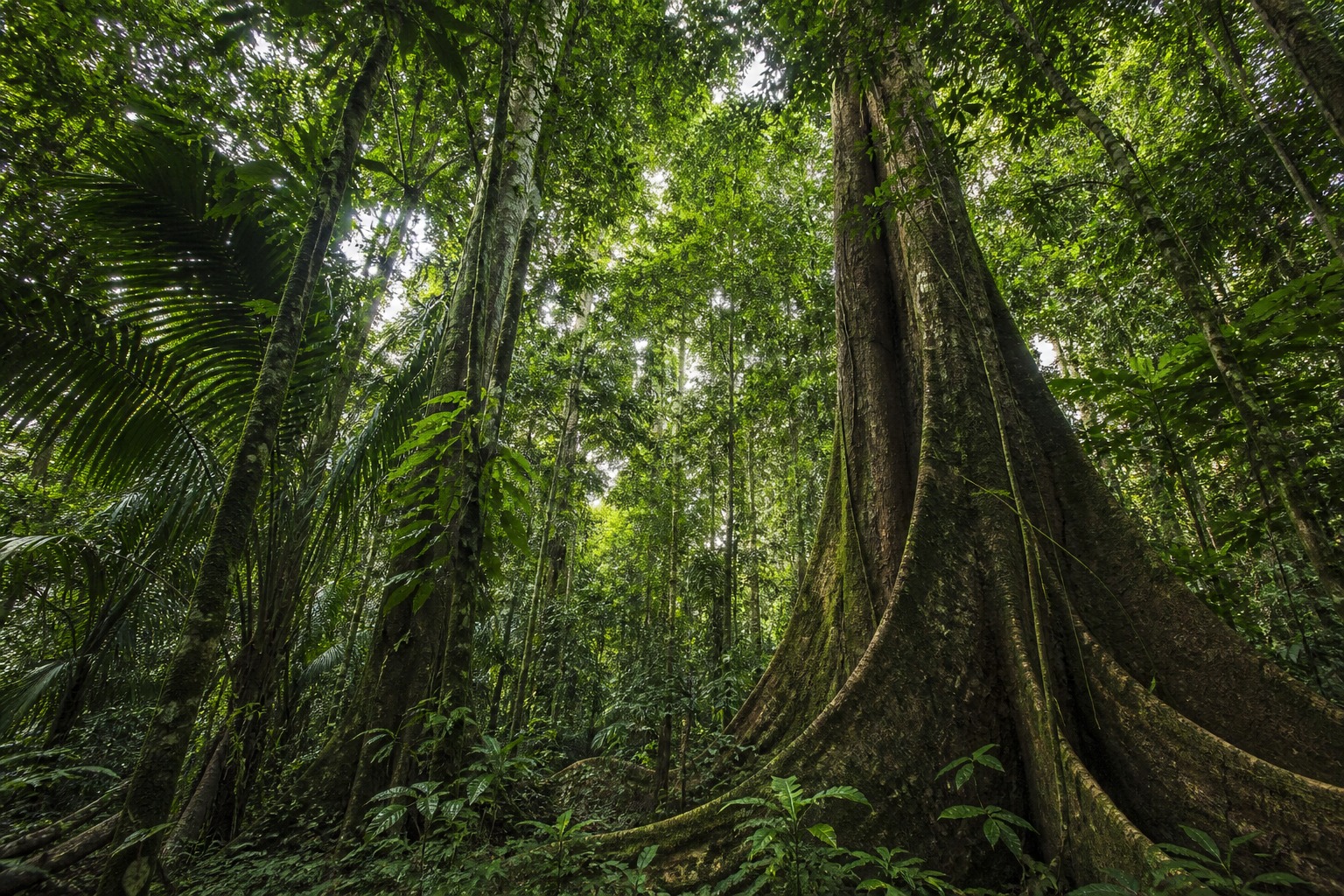
Numbers this large go numb fast, so anchor it to something you know. Roughly 596 bird species have been documented in Yasuní National Park — close to one-third of all the native bird species in the entire Amazon basin, packed into a reserve of about 10,227 square kilometres in northeastern Ecuador. Europe, a continent, is home to somewhere around 530 breeding bird species. Yasuní beats that inside a single national park.
The park was established in 1979 and later named a UNESCO Biosphere Reserve. Its official biodiversity resume was assembled in a landmark 2010 study published in the journal PLoS ONE, led by scientists including Matt Finer and Clinton Jenkins working with Ecuadorian and international researchers. Their conclusion was blunt: for several major groups of life at once, Yasuní sits at or near the global maximum.
That “at once” is the part most articles skim past. Plenty of places are rich in one thing — coral reefs in fish, cloud forests in orchids. What makes Yasuní strange is that the peaks for amphibians, birds, mammals, and plants all stack on top of each other in the same small patch of Earth. That overlap is vanishingly rare.
The One-Hectare Record That Breaks the Mind
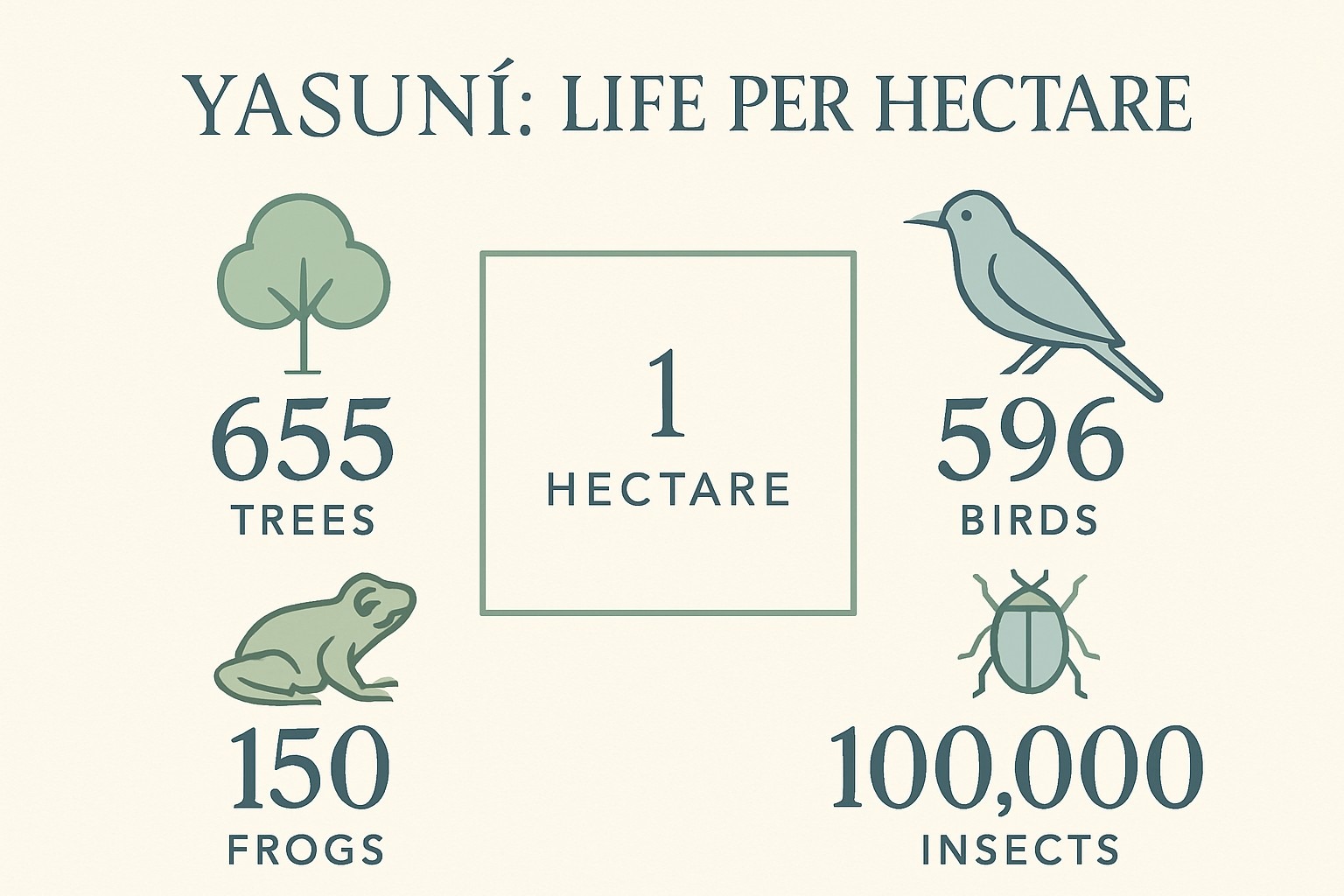
Here’s the statistic that should stop you cold. In one hectare of Yasuní’s upland forest — a square about 100 metres a side, roughly two football fields — researchers have counted 655 species of tree. More tree species in that single square than grow natively across all of the continental United States and Canada put together.
Now go smaller, down to the insects. The late Terry Erwin of the Smithsonian Institution built his career fogging rainforest canopies with insecticide and catching what rained down. Extrapolating from his Amazonian canopy samples, Erwin estimated that a single hectare of this forest could contain on the order of 100,000 insect species — a figure that remains an estimate rather than a hand-counted total, but one that captures how the diversity keeps multiplying the harder you look. Most of those species have never been named.
Turns out the “1 hectare” framing isn’t a marketing gimmick. It’s the honest scale at which Yasuní’s records are set — the highest per-area diversity ever documented on the planet.
{IMAGE_2}
- ~596 bird species — about one-third of all native Amazon birds
- 150 amphibian species — a world record for an area this size
- 121 reptile species
- ~170+ mammal species, including 13 primates
- 382–500+ freshwater fish species
- 655 tree species in a single hectare — more than the US + Canada combined
- ~100,000 insect species per hectare (Erwin estimate)
- 10,227 km² · established 1979 · UNESCO Biosphere Reserve
Why Yasuní Is the Most Biodiverse Place on Earth
So why here, and not some other slice of the vast Amazon? The short answer is a rare triple convergence of geography. Yasuní sits where three great engines of life meet: the eastern flank of the Andes, the equator, and the western Amazon basin. The Andes wring rain out of the air and feed nutrient-rich sediment down into the lowlands. The equator delivers steady, year-round warmth and long, even daylight. The Amazon supplies the sheer expanse of tropical forest for species to spread across.
Sitting on the equator matters more than it sounds. There’s no real winter, no seasonal die-back, no long dry stretch that resets the clock. Life can grow, breed, and specialise every month of the year, and over deep time that steadiness lets ecosystems pile up more and more finely divided niches — a frog for this puddle, a beetle for that fungus, a hummingbird for one particular flower.
Stack those three forces together and you get conditions that almost nowhere else on Earth enjoys simultaneously. That combination, more than any single superlative, is the real reason Yasuní tops the lists.
The Ice-Age Refuge That Never Froze
Geography explains the setting. History explains the depth. During the Pleistocene ice ages, much of the planet cooled and dried, and parts of the Amazon are thought to have contracted into drier savanna, fragmenting the forest. Western Amazonia around Yasuní, warm and wet against the Andes, appears to have stayed forested through those swings — a Pleistocene refugium, a place where the rainforest simply held on.
Think of it as an ark that never had to be evacuated. While lineages elsewhere were squeezed, thinned, or wiped out, the species here kept living, kept splitting into new forms, kept accumulating. When the ice retreated and forests spread back out, refugia like this one became the reservoirs that reseeded the surrounding wilderness.
The refugium idea is still debated among scientists — the ancient climate is hard to reconstruct, and not everyone agrees on how dry the Amazon really got. But as a way to explain why this particular corner is so extraordinarily rich, deep continuity beats a lucky accident.
Beyond Birds: A Frog World Record and 13 Kinds of Monkey
Drop your eyes from the canopy and the numbers keep coming. Yasuní’s 150 documented amphibian species stand as a world record for a park of its size — more kinds of frog and salamander than you’ll find in whole temperate countries. After a warm night’s rain the forest floor becomes a chorus, dozens of species calling over one another in the dark.
The park also holds around 121 reptile species and something north of 170 mammals, among them 13 species of primate — from tiny pygmy marmosets, the world’s smallest monkeys, to howler monkeys whose dawn roar carries for kilometres. In its rivers and flooded forest swim somewhere between 382 and 500 species of fish, including piranhas and electric eels.
Much of this cataloguing runs through the Tiputini Biodiversity Station, a research outpost deep inside the region that has hosted decades of fieldwork. It is one thing to read a species count; it is another to grasp that scientists working here still routinely turn up creatures new to science. The list is not finished. It may never be.
1.7 Billion Barrels Under the Trees — and the 2023 Vote
And here is the tension that shadows every one of those numbers. Beneath the park’s northeastern corner, in an area known as the Ishpingo-Tambococha-Tiputini block — the Yasuní-ITT, or Block 43 — lie an estimated 1.7 billion barrels of crude oil, one of Ecuador’s largest reserves.
For years the country floated the Yasuní-ITT Initiative: leave the oil underground if the world helped pay for the loss. That deal collapsed in 2013, and drilling in Block 43 began. Most older articles about Yasuní end their story right there, on that defeat — which is exactly where they’ve gone stale.
Because on 20 August 2023, Ecuadorians did something no nation had done before. In a binding national referendum, 58.95% of voters — more than 5.2 million people against about 3.6 million — chose to keep the ITT crude in the ground for good, ordering the state oil company to wind down and dismantle its operations there. It was the first time a country’s citizens voted directly to leave a proven oil field untapped. Implementation has been slow and contested since, but the vote itself reset the entire conversation. Protecting Yasuní stopped being a donor bargain and became a democratic mandate.
Seeing Yasuní Without Ruining It
Can an ordinary traveller actually visit? Yes — carefully. The core of the park is remote, reached by river from towns like Coca, and much of it is protected or overlaps the territory of Indigenous peoples, including the Waorani and, deeper still, the uncontacted Tagaeri and Taromenane, whose isolation is legally protected and must never be intruded upon.
Responsible visits run through established lodges and research stations that work with local communities, keep group sizes small, and steer clear of sensitive zones. The point of going is not to tick off a superlative. It is to stand under that canopy at dawn and hear, for yourself, the loudest argument for conservation there is.
Quick Answers
Why is Yasuní the most biodiverse place on Earth? Because a rare triple convergence — the Andes, the equator, and the Amazon basin — meets in one spot, and because the region likely survived the ice ages as a forest refugium, letting species accumulate over deep time. The result is record diversity in birds, amphibians, mammals, and plants all at once.
How many bird species live in Yasuní? About 596 — roughly one-third of all native Amazon bird species, and more than live in all of Europe.
What is the one-hectare record? A single hectare of Yasuní forest holds up to 655 tree species — more than grow natively in the continental US and Canada combined — plus an estimated 100,000 insect species.
Did Ecuador really vote to stop oil drilling there? Yes. In an August 2023 referendum, nearly 59% of voters chose to leave the Yasuní-ITT (Block 43) oil reserves permanently underground.
Sources and Notes
- Bass MS, Finer M, Jenkins CN, et al. “Global Conservation Significance of Ecuador’s Yasuní National Park.” PLoS ONE, 2010.
- Dr. Terry L. Erwin, Smithsonian Institution — canopy insect research and per-hectare diversity estimates.
- Ecuador National Electoral Council (CNE) — results of the 20 August 2023 Yasuní-ITT referendum.
- UNESCO — Yasuní Biosphere Reserve designation and park data.
- Tiputini Biodiversity Station — ongoing field research in the Yasuní region.
Yasuní is the closest thing we have to a full inventory of what a rainforest can be when nothing stops it — and for once, the people who share a border with that abundance chose it over the oil beneath it. Whether that choice holds is the real measure of whether the most biodiverse place on Earth gets to stay that way.
Frequently Asked Questions
Q: Why is Yasuni the most biodiverse place on Earth?
Because the peaks for amphibians, birds, mammals and plants all stack in the same small patch — an overlap that is vanishingly rare. The cause is a triple geographic convergence: the eastern flank of the Andes, the equator, and the western Amazon basin. Sitting on the equator means no winter or seasonal die-back, so life can breed and specialise year-round, piling up finely divided niches over deep time.
Q: How many species live in Yasuni?
The documented totals are staggering: about 596 bird species (nearly a third of all native Amazon birds), 150 amphibian species (a world record for the area), 121 reptiles, 170-plus mammals including 13 primates, and 382-500+ freshwater fish. A single hectare holds 655 tree species, and entomologist Terry Erwin estimated one hectare could contain around 100,000 insect species — most of them never named.
Q: How big is Yasuni and when was it protected?
Yasuni National Park covers about 10,227 square kilometres in northeastern Ecuador, on the western edge of the Amazon basin. It was established in 1979 and later named a UNESCO Biosphere Reserve. Its biodiversity credentials were formally assembled in a landmark 2010 study published in the journal PLoS ONE, led by scientists including Matt Finer and Clinton Jenkins with Ecuadorian and international researchers.
Q: What is the one-hectare tree record?
In one hectare of Yasuni’s upland forest — a square about 100 metres a side — researchers counted 655 species of tree. That is more tree species in a single square than grow natively across all of the continental United States and Canada combined. The one-hectare framing is not a gimmick; it is the honest scale at which Yasuni sets the highest per-area diversity ever documented on the planet.
Illustrations are AI-generated. Article fact-checked and human-edited. Our editorial standards.