How South Korea Reforested After the War: 10 Billion Trees
The story of how South Korea reforested after the war is, at its heart, a story about firewood. In 1953, when the guns of the Korean War fell silent, roughly 58 percent of the peninsula’s south was denuded “bare mountain” — brown, gullied slopes stripped by colonial logging, bombs, and above all the daily need of poor households to cook and stay warm. The wood standing on a hectare of those hills averaged a miserable 5.66 cubic metres. Within a single human lifetime, that same country became about two-thirds forest again. What makes the turnaround worth understanding is not the tree-planting everyone remembers — it is the far quieter fix that made the planting stick.
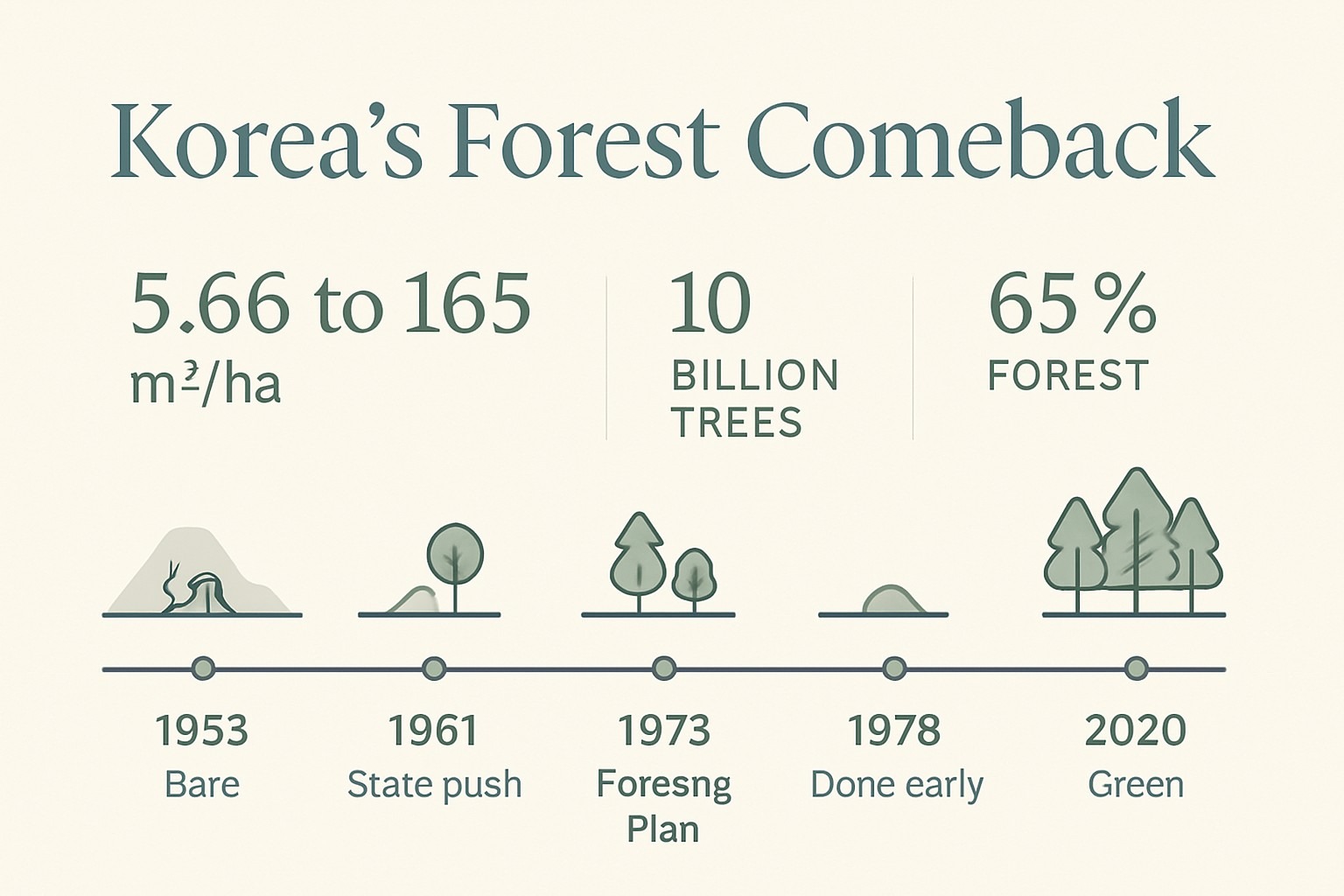
- Starting point (1953): ~58% of the south was bare mountain; growing stock just 5.66 m³ of wood per hectare.
- The turnaround: the 1973–1978 Ten-Year National Greening Plan — completed four years ahead of its 1982 target.
- The scale: more than 10 billion trees planted, driven by the Saemaul (“New Village”) Movement, Arbor Day, schools, and villages.
- Where it stands now: roughly 65% of the country is forest; growing stock is about 165 m³/ha — some 29 times the 1953 figure.
- Outside verdict: the UN’s FAO in 1982 called Korea the only developing nation to fully rehabilitate its forests after WWII.
Key Facts
- In 1953, roughly 58% of South Korea was bare mountain, with growing stock of just 5.66 cubic metres of wood per hectare.
- The 1973-1978 Ten-Year National Greening Plan was completed four years ahead of its 1982 target.
- More than 10 billion trees were planted, driven by the Saemaul (New Village) Movement, Arbor Day, schools and villages.
- Roughly 65% of the country is now forest, with growing stock about 165 cubic metres per hectare — some 29 times the 1953 figure.
- The government subsidised yeontan coal briquettes to replace firewood, removing the main driver of deforestation.
In short: After the Korean War, about 58% of South Korea was denuded bare mountain. A 1973-1978 greening plan planted over 10 billion trees and finished four years early, making the country roughly two-thirds forest again. The quieter key was switching households from firewood to subsidised coal briquettes, removing the reason people kept cutting trees.
Bare mountains: what the war and the cooking fire left behind
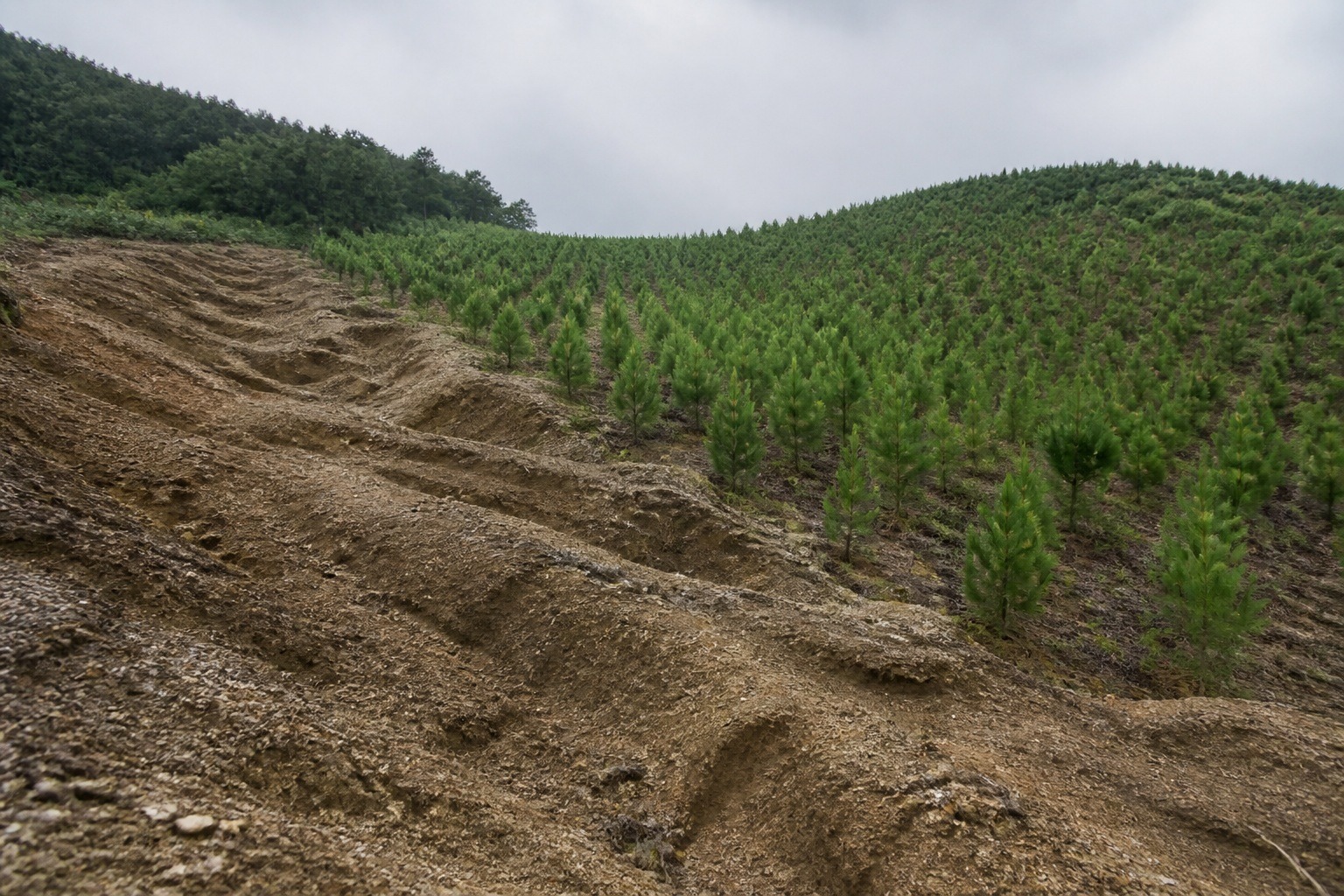
Picture the hills around Seoul in the mid-1950s: not the dense green ridgelines tourists photograph today, but raw earth, exposed rock, and the scars of erosion after every rain. Decades of Japanese colonial extraction had already thinned the forests. Then three years of war churned the landscape. And through all of it ran a constant, grinding pressure that no ceasefire could stop — people had to eat and not freeze.
Nearly every kitchen burned wood. Every winter demanded fuel. In a country this poor, the nearest hillside was the fuel depot, and it was being emptied faster than anything could grow back. This is the piece competitors skip, and it is the whole key: you cannot keep a forest alive while the people beside it are still cold. The trees were not dying of neglect. They were being harvested for survival.
Add the practice of hwajeon — slash-and-burn farming, where families cleared and burned mountain plots to grow a season’s food — and the arithmetic only got worse. By the early 1950s the forest was, in the coldest sense, an asset being liquidated.
The decade that failed first (1945–1961)
Here’s the part almost no ranking video mentions: Korea tried to replant, and it failed. Repeatedly. Efforts after liberation in 1945 and through the 1950s put seedlings in the ground, but the seedlings didn’t survive — because the underlying demand for firewood and cleared land never changed. Plant a slope in spring, and by the next winter much of it was gone again, cut or grazed or burned.
That failed decade is exactly what makes the later success meaningful. It proved that planting alone is theatre. Administrative capacity was thin, enforcement was weak, and villagers had every rational reason to keep taking wood. Growing stock crept from 5.66 m³/ha in 1953 to only about 11 m³/ha two decades later — a rounding error, not a recovery.
What changed after 1961, when a military government took power, was not enthusiasm for trees. It was the willingness to attack the reasons the trees kept disappearing. The Korea Forest Service was established in 1967 to run the effort as state machinery rather than a seasonal campaign.
{IMAGE_2}
1973: how South Korea reforested after the war, on a deadline
In 1973, President Park Chung-hee launched the First Ten-Year National Greening Plan. The framing was military and it was meant to be. Reforestation became a national mobilization: quotas for provinces, seedlings for schools, planting duty for villages, and Arbor Day turned into a genuine national holiday when the whole country went to the hills with shovels.
The Saemaul (New Village) Movement supplied the muscle and the social pressure — village committees organized labour, ran tree nurseries, and were rewarded or shamed by results. According to Jong-Choon Woo, Professor Emeritus at Kangwon National University, writing in The Earth & I in 2021, this was the third of Korea’s national forest plans and the one that finally worked at scale, hitting its targets four years early.
Read that again: a ten-year plan finished in six. More than 10 billion trees went into the ground over the campaign. But the trees are only half the story, and the smaller half at that.
The lever nobody dramatizes: coal instead of firewood
If you fix only the supply of trees and ignore why people cut them, you get the failed 1950s all over again. Korea’s real breakthrough was on the demand side. The government heavily subsidized yeontan — cylindrical anthracite coal briquettes, perforated top to bottom — and pushed them into homes as the replacement for firewood.
It worked because it was cheaper and easier for a cold family, not because anyone was lectured about ecology. By around 1980 the majority of urban households were heating and cooking with coal briquettes rather than wood. The single biggest driver of deforestation simply lost its customer base.
Strip away the ceremony, and the “miracle” was really an accounting trick with fuel: Korea did not just plant trees, it removed the reason people cut them. Researchers at CIFOR-ICRAF, in their account “Turning bare land into a green nation,” name this fuel switch — alongside rising rural incomes and migration to cities that pulled people off the land — as a hidden engine of the recovery. It is the detail the top-ranking explainers leave out, and it is the one that actually explains why this attempt held.
The iron fist behind the green
The honest version of this story is not entirely gentle. The recovery leaned on coercion as much as on shovels and briquettes. This matters because a clean fairy tale teaches the wrong lesson to any country hoping to copy it.
The national police were mobilized to protect the young forests. Illegal logging was reclassified as a serious crime, with real penalties. And the hwajeon slash-and-burn farmers whose plots interrupted the reforesting slopes were forcibly relocated off the mountains — their way of life ended by policy so the trees could return. Was the outcome extraordinary? Undeniably. But it was purchased partly with authority that a democratic government today could not, and arguably should not, wield the same way.
None of this erases the achievement. It just means the “Korean model” is a package — fuel substitution, income growth, science, and hard enforcement, together — not a feel-good planting drive that anyone can lift wholesale.
By the numbers: 10 billion trees and a 29-fold comeback
Strip out the narrative and the raw figures are still startling. This is the stat block the competing pages never assemble in one place.
- Wood per hectare, 1953: 5.66 m³ → 2020: ~165 m³ (about a 29× rise)
- For context: 165 m³/ha now exceeds the OECD average of roughly 131 m³/ha
- Trees planted: more than 10 billion since the campaign began
- Forest cover today: ~65% of national land
- Greening Plan: launched 1973, finished 1978 — four years early
- Ecosystem-service value (2013): ~US$92 billion/year, ≈ 9% of GDP
A country that in 1953 had less wood on a hectare than a modern backyard woodpile now carries more standing timber per hectare than the average wealthy nation. That is not a trend line. That is a reversal.
The $92-billion forest — and its asterisk
What is a national forest actually worth? A 2025 peer-reviewed study, published in a journal indexed by the U.S. National Library of Medicine and re-examining Korea’s restoration through a revised “plan-do-check-act” framework, put the value of the ecosystem services those forests deliver at roughly US$92 billion a year as of 2013 — about 9 percent of the country’s GDP. That is the return from carbon storage, water regulation, and erosion control that the bare mountains of 1953 simply could not provide.
Lester R. Brown of the Earth Policy Institute, in Plan B 3.0 (2008), went further and called South Korea “a reforestation model for the world.” The praise is earned. But there is an asterisk the boosters rarely print.
To green the hills fast, planners reached for quick “pioneer” species — poplars and false acacia (black locust) that grow rapidly and hold soil. Speed was the point, and speed was delivered. The cost came later: large stands of fast, similar trees are ecologically thin, and subsequent generations of Korean foresters have spent decades converting those monocultures toward more diverse, resilient, and economically useful forests. The country got a forest quickly; it is still, quietly, working to make it a good forest.
Can anyone copy Korea?
This is the question that matters for Indonesia, Mongolia, Ethiopia, and the countries of Africa’s Great Green Wall — and the honest answer is: some of it, not all of it. So which parts travel?
The transferable core is the demand-side insight: attack the reason forests are cut, don’t just plant more. For millions of people that reason is still cooking fuel, so an affordable alternative to firewood — and rural incomes that make protecting a hillside worthwhile — may do more than any seedling target. Korea also shows the value of running restoration as a sustained, well-funded state program with real science behind it, not a photo-op.
What does not transfer cleanly is the coercion, the specific coal-and-anthracite fuel path (few countries want to lock in a fossil fuel today), and the particular luck of an economy industrializing fast enough to pull people off the land. Korea’s story is proof that a stripped country can come back. It is not a template you can photocopy — it is a set of lessons you have to translate.
Quick Answers
How long did it take South Korea to reforest? The decisive push ran from the 1973 Ten-Year Greening Plan, which was completed by 1978 — four years early — though recovery and forest-quality work continued for decades after and still goes on today.
How many trees did South Korea plant? More than 10 billion over the campaign, planted through mass mobilization: schools, villages, the Saemaul Movement, and a national Arbor Day.
What was the single most important factor? Beyond planting, the fuel switch — subsidized yeontan coal briquettes replacing firewood — removed the main cause of deforestation, which is why this attempt succeeded where the 1945–1950s efforts failed.
How much of South Korea is forest now? Roughly 65 percent, with growing stock around 165 m³/ha — about 29 times the 1953 level, and above the OECD average.
Sources
- Korea Forest Service (KFS) — national forest statistics, growing stock 5.66 m³/ha (1953) to ~165 m³/ha (2020).
- Food and Agriculture Organization of the UN (FAO), 1982 country assessment on post-war forest rehabilitation.
- Jong-Choon Woo, Professor Emeritus, Kangwon National University — “Full Reforestation After War: How South Korea Did It,” The Earth & I (2021).
- CIFOR-ICRAF Forests News — “Turning bare land into a green nation: How South Korea recovered its degraded forests.”
- Lester R. Brown, Earth Policy Institute — Plan B 3.0 (2008).
- “Reexamining Korea’s successful forest restoration through the revised PDCA framework” — peer-reviewed study (2025), valuing ecosystem services at ~US$92 billion.
South Korea proved a stripped nation can put its mountains back — measurably, in one lifetime, with numbers that still look impossible. The open question it leaves is quieter and harder: a fast forest of pioneer trees is not the same as a rich, living one, and turning the first into the second is the slow work the next fifty years will judge.
Frequently Asked Questions
Q: How did South Korea reforest after the war?
It combined mass tree-planting with a demand-side fix. The 1973-1978 Ten-Year National Greening Plan mobilised provinces, schools and villages through the Saemaul Movement and Arbor Day, planting over 10 billion trees. Crucially, the government subsidised yeontan coal briquettes to replace firewood, so households stopped stripping the hills for fuel. Earlier planting efforts in the 1950s had failed precisely because firewood demand never changed.
Q: Why did South Korea’s earlier reforestation fail?
Efforts after 1945 and through the 1950s put seedlings in the ground, but they did not survive because the underlying demand for firewood and cleared land never changed. Nearly every kitchen burned wood, and slash-and-burn farming cleared more hillsides. A slope planted in spring was often cut or burned by the next winter. Growing stock crept from 5.66 to only about 11 cubic metres per hectare in two decades — a rounding error.
Q: What was the real key to the recovery?
The fuel switch. The government heavily subsidised yeontan — cylindrical anthracite coal briquettes — and pushed them into homes as a cheaper, easier replacement for firewood. By around 1980 most urban households heated and cooked with coal rather than wood, so the single biggest driver of deforestation lost its customer base. Researchers at CIFOR-ICRAF name this switch, alongside rising rural incomes and urban migration, as the hidden engine.
Q: How much of South Korea is forest today?
Roughly 65% of the country is now forest, with growing stock of about 165 cubic metres of wood per hectare — some 29 times the 5.66 recorded in 1953. In 1982 the UN’s FAO called Korea the only developing nation to fully rehabilitate its forests after the Second World War. The whole turnaround happened within a single human lifetime.
Illustrations are AI-generated. Article fact-checked and human-edited. Our editorial standards.