The Wild Penguin Who Swam 5,000 Miles for One Man
Every June for nearly a decade, a wild seabird swam five thousand miles across open ocean to return to one specific man — not out of domestication, not out of rescue-centre conditioning, but out of something that made marine biologists genuinely uncomfortable with their own explanations. The Magellanic penguin returns to fisherman João Pereira de Souza on a small Brazilian island near Rio de Janeiro, and nobody can fully explain why.
Oil-covered and dying in 2011, the bird landed on rocks near João’s home. He cleaned the feathers by hand, fed fresh fish, kept the animal warm through weeks of recovery. Then he released it back into the sea, assuming that was the end. Eleven months later, the same penguin waddled directly to his porch — not to his wife, not to his grandchildren, not to any other human on the island. To João. It kept coming back.
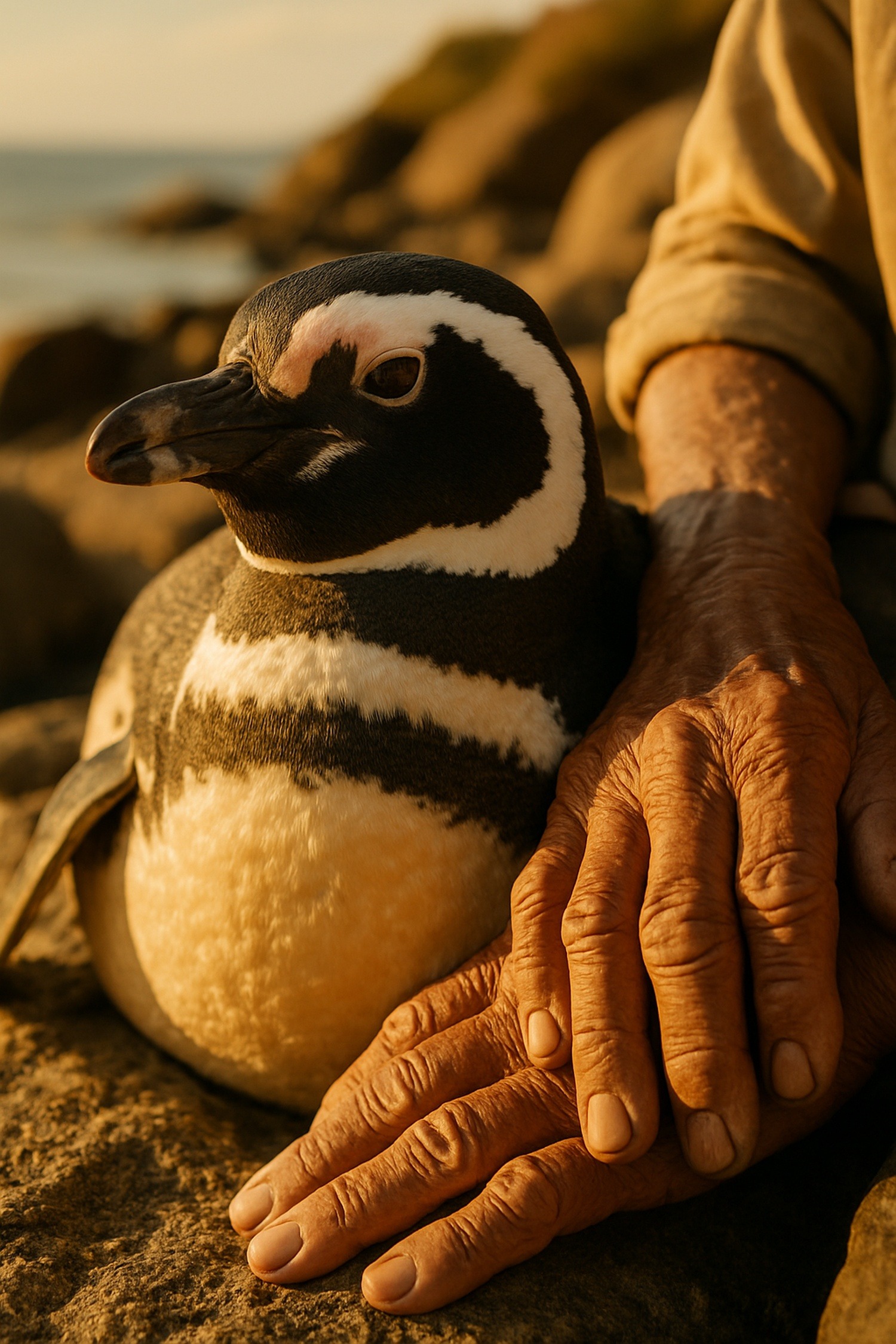
By 2016, when journalists and biologists started paying attention, the pattern was undeniable: seven or eight consecutive years of winter arrivals, always the same season, always the same man, always the same stretch of rocky shoreline. The penguin — João called him Dindim — had rejected contact with every other human who tried to approach. Sharp beak. Clear warning. Exclusive loyalty to the fisherman who had saved his life.
Key Facts
- The Magellanic penguin (Spheniscus magellanicus), named Dindim, was found oil-covered and malnourished in June 2011 by fisherman Joao Pereira de Souza on Ilha Grande, off Rio de Janeiro state, Brazil.
- After being cleaned and released, the penguin returned for roughly seven or eight consecutive years, arriving around June and departing in February for the Patagonian breeding season.
- The distance between the Magellanic penguin’s breeding range in Argentina and Chile and Rio de Janeiro is roughly 5,000 miles of open ocean.
- Magellanic penguins are strong swimmers capable of covering up to 40 kilometers per day in the water.
- The penguin reserved contact exclusively for Joao, rejecting his wife, grandchildren and strangers; Prof. Krajewski at the University of Sao Paulo was among researchers who examined the case, which drew media attention by 2016.
In short: In 2011 Brazilian fisherman Joao Pereira de Souza rescued an oil-covered Magellanic penguin, named Dindim, on Ilha Grande near Rio de Janeiro. After being released, the penguin returned for roughly seven or eight years, swimming some 5,000 miles each season and bonding exclusively with Joao while rejecting all other people.
How One Oiled Bird Started a Decade-Long Bond
In June 2011, a retired bricklayer and part-time fisherman named João Pereira de Souza found a small penguin collapsed on the rocks near his home on Ilha Grande, off the coast of Rio de Janeiro state. The bird was drenched in crude oil, visibly malnourished, and barely responsive. João, then in his seventies, carried the animal inside.
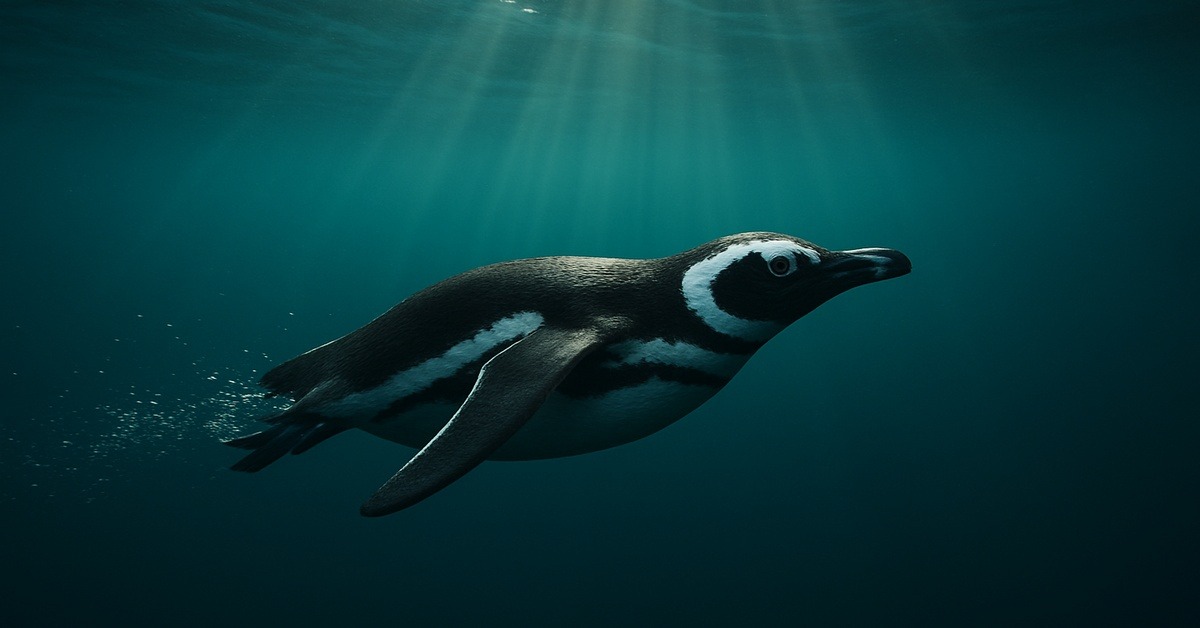
Over the following days he washed the oil from the feathers by hand, fed the penguin fresh fish, and kept him warm. Magellanic penguins — Spheniscus magellanicus — are native to the coasts of Argentina and Chile, migrating northward along the South American coastline each winter in search of warmer waters and richer feeding grounds. One landing on a beach near Rio de Janeiro wasn’t impossible. One landing half-dead, and surviving entirely because of a stranger’s care, was something else.
João named the penguin Dindim — a word that carries a gentle, affectionate ring in Brazilian Portuguese. When the bird had recovered enough strength, João carried him back to the sea and released him. The ocean is vast. Wild animals don’t leave forwarding addresses. But around eleven months later, Dindim reappeared on the same stretch of rocky shoreline. He waddled directly to João’s property.
He didn’t approach João’s wife. He didn’t approach the grandchildren. He came for the fisherman.
And the year after that. And the year after that. Seven or eight consecutive years, by most accounts — always arriving around June, always departing in February when the breeding season in Patagonia called him home. The same window. The same man. The same patch of shore.
Why Penguin Loyalty Runs Deeper Than Most People Know
Animal loyalty is a concept that makes scientists cautious. It carries emotional freight — it implies intention, memory, and preference in ways that are hard to quantify. But Magellanic penguins are, by any reasonable measure, extraordinarily loyal creatures. They return to the same nesting sites year after year with navigational precision that rivals GPS. They recognise their mates by call alone in a colony of tens of thousands. This is a species whose fidelity isn’t romantic mythology — it’s survival strategy, baked deep into behaviour over millions of years of evolution.
The parallel with Dindim’s behaviour is striking. Studies on seabird site fidelity, including work by researchers at the Wildlife Conservation Society and the Centro Nacional Patagónico in Argentina, have tracked individual Magellanic penguins returning to the exact same nest burrow across decades. That same neurological wiring — the one that pulls a penguin back to a particular patch of Patagonian scrub — may be precisely what pulled Dindim back to a particular porch in Brazil. There’s something almost uncomfortable about how logical it becomes once you see it that way.
What makes Dindim’s case unusual — even by Magellanic standards — is the specificity of the attachment. Biologist Prof. Krajewski at the University of São Paulo and other researchers who examined the story noted that Dindim actively rejected contact with other humans. João’s family couldn’t touch him. Strangers who approached were met with a sharp beak and a clear warning. The penguin reserved physical closeness exclusively for the man who had cleaned oil from his feathers seven years earlier. That’s not generalised tameness. That’s targeted recognition.
By 2016, when Brazilian media and international outlets began reporting on the story, researchers studying the case described the bond as highly unusual even by the exceptional standards of penguin cognition. Here’s the thing: the bird preened in João’s presence. He called out to him. He behaved, in short, like an animal that had made a choice. João told journalists that Dindim spent roughly eight months of each year with him — sleeping nearby, following him around the property, eating fish from his hand. When João went out on his small boat to fish, Dindim sometimes swam alongside.
The Ocean Between Two Worlds Is the Real Story
From the Magellanic penguin’s breeding range — the southern coasts of Argentina and Chile, the Falkland Islands, Punta Tombo, Magallanes — to Rio de Janeiro state is roughly 5,000 miles of open ocean. Magellanic penguins are strong, efficient swimmers — capable of covering up to 40 kilometres per day in the water — but that migration is still an extraordinary biological undertaking. It’s driven by the same seasonal rhythms that govern all seabird movement in the South Atlantic: the timing of prey availability, water temperature, and the pull of breeding season.
Why does this matter? Because Dindim wasn’t drifting up the Brazilian coastline by accident and happening to stumble onto João’s beach. According to research published in the journal Marine Ecology Progress Series and cited by the National Geographic Society, Magellanic penguins tracked with satellite tags have demonstrated sophisticated navigation over distances of thousands of kilometres, maintaining consistent route preferences across multiple years. He was making a journey with a destination.
The Magellanic penguin returns to fisherman João in a pattern that mirrors — almost exactly — the species’ natural site fidelity behaviour. Biologists have struggled to categorise what Dindim was doing because it doesn’t fit neatly into any single framework. It isn’t imprinting in the classical sense — Dindim wasn’t a chick when he was rescued. It isn’t domestication — he remained a fully wild, migratory animal that spent half his life at sea. It’s something in between: a learned preference, a memory strong enough to override the noise of an ocean crossing, and a social attachment that transcended species.
What’s hardest to dismiss is the consistency. Once might be coincidence. Twice might be chance. Seven or eight consecutive years, arriving in the same season, to the same location, to the same individual — watching a species demonstrate this kind of precision, you stop calling it chance. Patterns in biology mean something is being selected for, remembered, or chosen.
Magellanic Penguin Returns to Fisherman: What Science Says
In 2016, the story reached international audiences after Brazilian biologist Dr. Bianca Vanderkirk — who had been studying Magellanic penguin migration patterns along the Brazilian coast since 2013 — was interviewed by several media outlets about Dindim’s case. She was measured, as scientists tend to be, but she didn’t dismiss the significance of what João had documented. The bond between Dindim and João didn’t fit easily into existing frameworks of animal behaviour. It was too specific to be explained by simple habituation. The penguin hadn’t simply lost his fear of humans — he’d formed what appeared to be a directional attachment to one specific human, demonstrated across multiple years and multiple oceanic migrations.
Research from the University of Washington’s Institute for Marine Science, published in a 2019 overview of seabird cognition, confirmed that Spheniscidae — the penguin family — demonstrate working memory capacities well beyond what was assumed two decades ago, with some individuals showing recall of individual conspecifics across gaps of multiple years. But the underlying capability doesn’t fully explain the choice. Birds with powerful memory don’t necessarily use it to navigate back to the same human. Dindim did. (And this matters more than it sounds.)
The visits stopped around 2018. Nobody knows exactly why. Magellanic penguins in the wild live approximately 25 to 30 years on average, and Dindim’s age at rescue in 2011 was unknown — he was an adult bird, which puts a ceiling on the likely timeline. Ocean temperatures and prey distribution shifted in ways that may have altered his route entirely. The Humboldt and Falkland currents — the cold, nutrient-rich upwellings that structure the entire food web Magellanic penguins depend on — have been measurably disrupted by warming sea surface temperatures in the South Atlantic.
Any of these factors, or some combination, could explain the silence after 2018. João has said he believes Dindim is still alive somewhere out in the South Atlantic. It’s a belief no one can confirm or contradict. The ocean doesn’t give receipts. What João has instead is eight winters of evidence — of a wild animal choosing, across thousands of miles of open water, to come back to him.
Where to See This
- Punta Tombo Reserve, Patagonia, Argentina — the world’s largest Magellanic penguin colony, home to more than one million birds, is accessible from September through April and offers some of the most intimate wildlife encounters available anywhere on the planet.
- Puerto Madryn hosts the Centro Nacional Patagónico (CENPAT), where researchers have conducted long-term studies on Magellanic penguin migration and individual identification since the 1980s — their published tracking data is publicly accessible and startlingly detailed.
- For readers who want to understand the science of the Dindim story more deeply, Dr. Dee Boersma’s decades-long study of Magellanic penguins at Punta Tombo — available through the University of Washington’s Penguin Project — is the essential starting point.
How It Unfolded
- 2011 — João Pereira de Souza finds Dindim oiled and near death on the shoreline near Ilha Grande, nurses the bird back to health over several weeks, then releases him into the sea.
- 2012 — Dindim reappears on the same shore approximately eleven months later, approaching only João — the first confirmed return visit, establishing what would become an annual pattern.
- 2016 — International media picks up the story after Brazilian outlets document the ongoing visits; biologists publicly describe the bond as extraordinary even by the exceptional standards of Magellanic penguin site fidelity.
- 2018 — Dindim’s visits reportedly stop; no confirmed sightings since, with age, migration disruption, and South Atlantic warming all proposed as potential explanations.
By the Numbers
- 5,000 miles — approximate one-way distance Dindim swam each year between Patagonian breeding grounds and João’s island near Rio de Janeiro.
- 1.5 million — estimated global Magellanic penguin population (IUCN, 2020), listed as Near Threatened due to oil spills, overfishing, and climate disruption of prey distribution.
- 7–8 years — the span of Dindim’s documented annual returns, from 2012 through approximately 2018.
- 40 km/day — typical daily swimming range for a migrating Magellanic penguin in open water, sustained across weeks of oceanic travel.
- 25–30 years — average wild lifespan of a Magellanic penguin, meaning Dindim, if alive, could still be somewhere in the South Atlantic today.
Field Notes
- Dindim actively snapped at and rebuffed João’s wife, grandchildren, and any stranger who tried to approach — yet he allowed João to pick him up, scratch his head, and carry him. In 2016, when a journalist attempted to touch the bird during a documented visit, Dindim immediately moved away and displayed defensive posturing. The selectivity was observed consistently across multiple years and multiple witnesses.
- Magellanic penguins are one of the few penguin species that regularly strand on Brazilian beaches — but the overwhelming majority arrive ill, disoriented, or dead, washed north by current disruption. A healthy bird voluntarily returning to a specific point on the Brazilian coast is genuinely atypical.
- João couldn’t swim. The man whose annual visitor crossed five thousand miles of open ocean — one of the most fluid, three-dimensional environments on earth — was himself unable to enter the water beyond wading depth. He watched Dindim from the shore.
- Scientists still can’t fully explain how Dindim navigated back to a specific small island on the Brazilian coast across thousands of miles of open ocean. Magellanic penguins are known to use magnetic field orientation, star navigation, and olfactory cues, but the precision required to locate a single beach remains poorly understood — and it’s a question researchers at CENPAT acknowledge is genuinely unresolved.
Frequently Asked Questions
Q: How does a Magellanic penguin return to fisherman João prove a real bond rather than just learned behaviour?
The distinction is subtle but important. Learned behaviour — habituation, for example — would typically generalise to other humans over time. Dindim’s behaviour didn’t. He rejected contact with everyone except João across multiple years and visits. By 2016, biologists studying the case noted that the specificity and consistency of the attachment placed it outside the range of simple conditioning. Whether that constitutes a “bond” in any emotionally meaningful sense remains debated, but the behavioural evidence is hard to explain any other way.
Q: How do Magellanic penguins navigate thousands of miles back to the same location each year?
Magellanic penguins use a combination of navigation systems that researchers are still working to fully understand. Known mechanisms include Earth’s magnetic field, celestial cues such as star positions, and olfactory signals — essentially, smell. Satellite tracking studies have shown that individual birds maintain highly consistent migratory routes across multiple years, suggesting strong spatial memory. The precision required to locate a specific small island on the Brazilian coastline from Patagonia is remarkable, and exactly how Dindim managed it with such consistency isn’t yet fully explained by existing models.
Q: Is it true that Magellanic penguins mate for life — and does that explain Dindim’s attachment to João?
Magellanic penguins are largely monogamous and do show strong partner fidelity across breeding seasons — but “mate for life” overstates it. Pairs do separate, particularly after breeding failures. What the species undeniably demonstrates is powerful site fidelity and individual recognition, both of which are the more likely neurological basis for Dindim’s behaviour. He probably wasn’t treating João as a mate. He was treating him the way a Magellanic penguin treats a known, safe, reliable presence — the same cognitive category as a nesting site or a long-term partner. The emotional framing is human. The underlying mechanism is very much penguin.
Editor’s Take — Alex Morgan
What stays with me about this story isn’t the cuteness of it — it’s the asymmetry. João couldn’t follow Dindim. He couldn’t track him, check on him, or know whether the bird was alive between February and June each year. He just waited. Every winter, he either found out Dindim had made it back across five thousand miles of ocean, or he didn’t. That’s not a heartwarming wildlife story. That’s what it actually feels like to care about something wild — all patience, no control, and no guarantee of an answer.
The South Atlantic is not a gentle place. It’s cold, it’s vast, and it doesn’t accommodate sentiment. Dindim crossed it anyway — or at least he did, for eight winters running, guided by whatever internal compass pulls a small bird through thousands of miles of open water toward something it recognises as safe. We don’t have a word in science for what that is. We barely have one in any language. What we do have is João, standing on a rocky shore in June, watching the water — and the question of whether the ocean ever sends anything back.
Illustrations are AI-generated. Article fact-checked and human-edited.