Longest Humpback Whale Migration Ever Recorded: 13,000 km
The longest humpback whale migration ever recorded covered 13,000 kilometers. One male humpback whale migration began off Colombia. It ended near Zanzibar, Tanzania. Nobody expected him to surface an ocean away. He wasn’t chasing food. He was chasing something far stranger than krill.
Scientists had photographed him in the warm Pacific breeding waters off South America. Then his identifying marks turned up in the Indian Ocean, on the far side of Africa. The straight-line distance rivals a flight from New York to Dubai. But he did it underwater, alone, in the dark, with no engine and no map. The obvious question hangs there in the swell: why would any whale do this?
Key Facts
- The recorded journey spanned roughly 13,000 km, from Colombian Pacific waters to the coast near Zanzibar, Tanzania.
- It is the longest documented movement between two humpback breeding grounds, not the usual feeding-to-breeding route.
- Humpbacks normally migrate up to about 8,000 km between polar feeding zones and tropical breeding areas.
- The finding was published in 2024 in the journal Royal Society Open Science by an international research team.
- Humpback songs can travel across entire ocean basins, with phrases spreading between populations thousands of kilometers apart.
In short: The longest humpback whale migration ever recorded ran about 13,000 km from a breeding ground off Colombia to waters near Zanzibar, Tanzania. A single male crossed two ocean basins, likely searching for new mates and carrying his genes between populations that rarely meet.
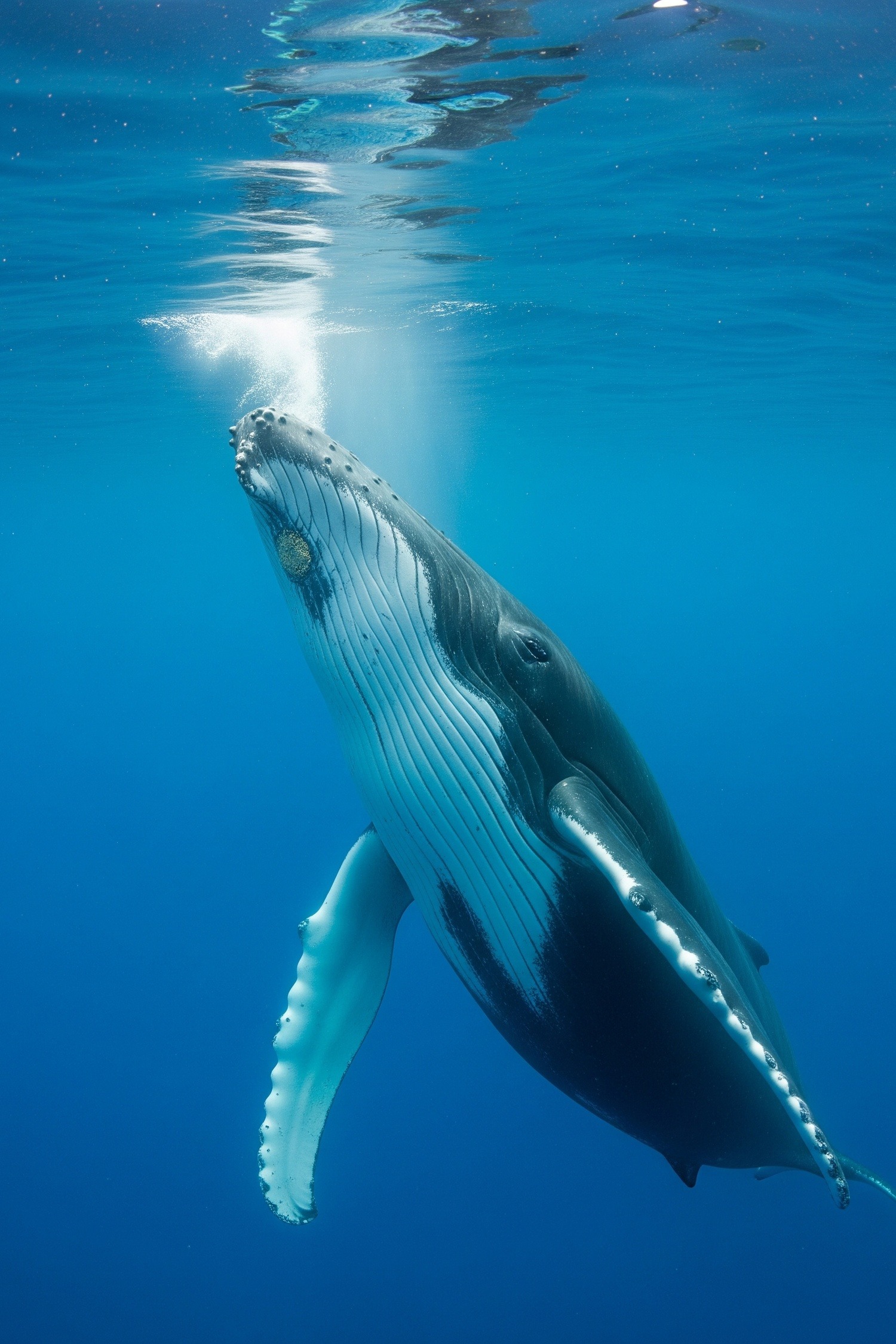
What made the longest humpback whale migration ever recorded so different?
Most humpbacks follow a predictable seasonal loop. They feed near the poles in summer, gorging on krill and small fish, then swim toward the tropics to breed in winter. Ted Cheeseman, a researcher with the photo-identification platform Happywhale, helped confirm the match between the Colombian sighting and the East African one in 2024. The animal had been photographed years and an ocean apart, yet the fluke patterns lined up perfectly. That kind of humpback whale identification works because every tail is as individual as a fingerprint, marked with notches, scars, and pigment that don’t change across a lifetime.
Here’s the thing that puzzled everyone. This wasn’t a feeding trip. He moved from one breeding ground to another breeding ground. Lateral, not vertical. Whales aren’t supposed to do that, at least not at this scale. Breeding populations tend to stay loyal to their home waters, returning year after year to the same warm bays where they were born. The fidelity is so strong that genetically distinct stocks can sit in neighboring ocean basins and almost never interbreed. A single jump between basins breaks that rule wide open.
So what pulled him 13,000 kilometers off script? The leading guess is mates. New females. Fresh genes to spread into water no whale from his line had touched.
How does a whale navigate two oceans alone?
Humpbacks don’t carry maps, but they carry something close. Researchers think they read the planet’s magnetic field, the way migratory birds do, sensing intensity and inclination to hold a heading across featureless open water. They also use sound, memory, the position of the sun, and the long, low structure of the seafloor itself. For deeper context on how marine animals chart these routes, see our feature on the hidden navigation systems of ocean wanderers. A whale this size can sustain a steady cruising pace for weeks without rest in any human sense, switching off half its brain at a time to keep moving while it sleeps.
The mechanics are brutal in their simplicity. A humpback covers roughly 4 to 8 kilometers per hour on migration, day and night, barely pausing to feed once it leaves the cold productive seas behind. At that rate, 13,000 km is a journey of many weeks, possibly several months of nearly continuous swimming. He would have burned through enormous fat reserves laid down during the feeding season, arriving leaner, scarred, and exhausted on the far shore, his body a ledger of everything the crossing cost.
And he did it without a single companion. No pod, no escort, no relay of older whales showing the way. Just one animal, holding a line across half the planet.
Could he have followed a song across the planet?
Humpback song is one of the eeriest phenomena in the ocean. Males produce long, structured sequences that can carry for thousands of kilometers underwater, and the songs evolve over a single season. According to research summarized by the BBC, song phrases sometimes spread eastward across the South Pacific like a cultural wave, one population picking up the melody of another season after season. A male near Australia might suddenly sing something first heard off New Caledonia, as if the tune itself had migrated before the singers did.
If songs travel, the thinking goes, maybe whales travel with them. This individual humpback whale migration might have been a male answering a current of sound he couldn’t ignore, drawn toward distant singers and the females clustered around them. It’s a hypothesis, not a proven fact, and the researchers who described the journey are careful to say so. But it fits the strange shape of what he did better than any tidy feeding-route explanation.
Sound, it turns out, may be the ocean’s longest road.
What does this humpback whale migration mean for the species?
Genetic mixing matters enormously for large, slow-breeding animals. A 2024 analysis tied to the Royal Society Open Science report noted that crossings like this one can shuttle genes between otherwise isolated breeding stocks, keeping populations more resilient against disease and the slow erosion of inbreeding. One wandering male becomes a living bridge between gene pools that the maps treat as separate countries. That single journey may have left descendants in waters his birth population never visits, a quiet rewiring of the species’ family tree.
The implication is bigger than one whale. If even a small fraction of humpbacks make these basin-jumping trips, the world’s populations are more connected than the neat regional charts suggest. Cause and effect tighten under a warming climate: warming seas shift prey, prey shifts movement, and unusual journeys may become less unusual over the coming decades. We simply haven’t been watching long enough, or widely enough, to know how common these outliers really are.
Conservation planners now factor these rare long-haul travelers into how they draw protected corridors. One outlier reshapes the model.
Are these epic crossings becoming more common?
This is where the story turns from a single whale toward the whole ocean. Researchers tracking global humpback movements through platforms like Happywhale have logged a rising number of unexpected long-distance matches since the database crossed 100,000 individuals. Part of that is simply better coverage: more cameras, more travelers, smarter matching software flagging pairs no human would ever notice. But part of it may be real change in the animals themselves, responding to shifting prey and warming water.
The honest answer is that we can’t yet separate the two. A surge in recorded crossings could mean whales are wandering more, or it could mean we’re finally catching behavior that always happened in the dark. Disentangling signal from sampling will take another decade of consistent data. For now, every new long-haul match like the Colombia-to-Zanzibar whale gets logged, measured, and added to a growing pile of evidence that the old regional model is too simple.
What’s certain is that the questions are getting better. That alone is progress.
Where to See This
- Bahía Málaga and the Colombian Pacific coast, July to October, when humpbacks gather to breed and calve in the warm bays.
- Happywhale, the global photo-ID research platform, lets ordinary travelers submit fluke photos that help track individual whales across oceans.
- Bring a decent zoom lens, not a drone. Clear fluke shots from a respectful distance are exactly what scientists need to match individuals.
By the Numbers
- ~13,000 km: the recorded distance between the Colombian and Zanzibar sightings (2024).
- ~8,000 km: the typical maximum length of a normal humpback feeding-to-breeding migration.
- 4 to 8 km/h: a humpback’s sustained migratory cruising speed.
- Up to 16 meters and 30,000 kg: the size of a large adult female humpback whale.
- ~135,000: the rough current global humpback population, recovered from near-collapse after the whaling era.
Field Notes
- The match was made by software, not luck. Photo-ID algorithms compared this whale’s fluke against tens of thousands of others before flagging the 2024 Colombia-Zanzibar pair.
- Humpbacks were hunted to roughly 5 percent of their original numbers by the mid-20th century. Their recovery is one of conservation’s quieter successes.
- A whale’s fluke pattern stays recognizable for decades, which is why a single individual can be tracked across an entire ocean and a span of years.
- Researchers still can’t say how many such basin-crossing journeys happen each year. The ones we catch are almost certainly a tiny, accidental sample of a hidden behavior.
Frequently Asked Questions
Q: What is the longest humpback whale migration ever recorded?
The longest documented humpback whale migration covered roughly 13,000 kilometers, from a breeding ground off Colombia to coastal waters near Zanzibar, Tanzania. It was confirmed in 2024 through photo-identification of the animal’s tail fluke. What made it unusual is that it ran between two breeding grounds rather than between a feeding and a breeding area. That is far longer than the typical 8,000 km seasonal route most humpbacks follow.
Q: Why did the humpback whale swim so far?
The most likely reason is reproduction. A male crossing into a distant breeding ground gains access to unfamiliar females and a chance to spread his genes into a new population. Humpbacks normally migrate to feed and breed, but this lateral move suggests a mate-seeking journey. Some researchers also suspect he may have followed humpback song, which can travel across entire ocean basins and draw males toward distant singers.
Q: How do humpback whales navigate over such huge distances?
Humpbacks appear to use several systems at once. They likely sense Earth’s magnetic field to hold a heading, much as migratory birds do, and they rely on memory of past routes. Sound plays a role too, since whale calls and songs carry for thousands of kilometers underwater. The shape of the seafloor may give additional cues. Combined, these let a single whale hold a steady course across open ocean for weeks.
Q: Is this kind of migration dangerous for the whale?
It is physically punishing. A humpback on migration eats little, burning through fat reserves built up during the polar feeding season. A 13,000 km crossing means weeks or months of sustained swimming with almost no refueling, so the animal arrives noticeably leaner. There are also risks from ship strikes, entanglement in fishing gear, and unfamiliar waters, all of which make these long solo journeys a genuine gamble.
Editor’s Take — Alex Morgan
I keep coming back to the loneliness of it. One animal, no pod, holding a line across two oceans on the strength of instinct and maybe a song he couldn’t shake. We tend to map whales as tidy regional populations. This one humpback shredded that assumption and reminded us the sea is far more connected, and far less knowable, than our charts pretend. He didn’t just migrate. He rewrote what we thought migration could be.
Somewhere out there, right now, another whale is probably doing the same thing, silent and untracked, threading between oceans we still think of as separate. We caught this one by accident, through two photographs taken years apart. Picture how many crossings have happened in the dark while no camera was watching. The ocean keeps its longest stories to itself, surfacing only the occasional fluke to hint at how little we’ve actually seen.
Illustrations are AI-generated. Article fact-checked and human-edited.