The Wood Frog That Freezes Solid and Comes Back to Life
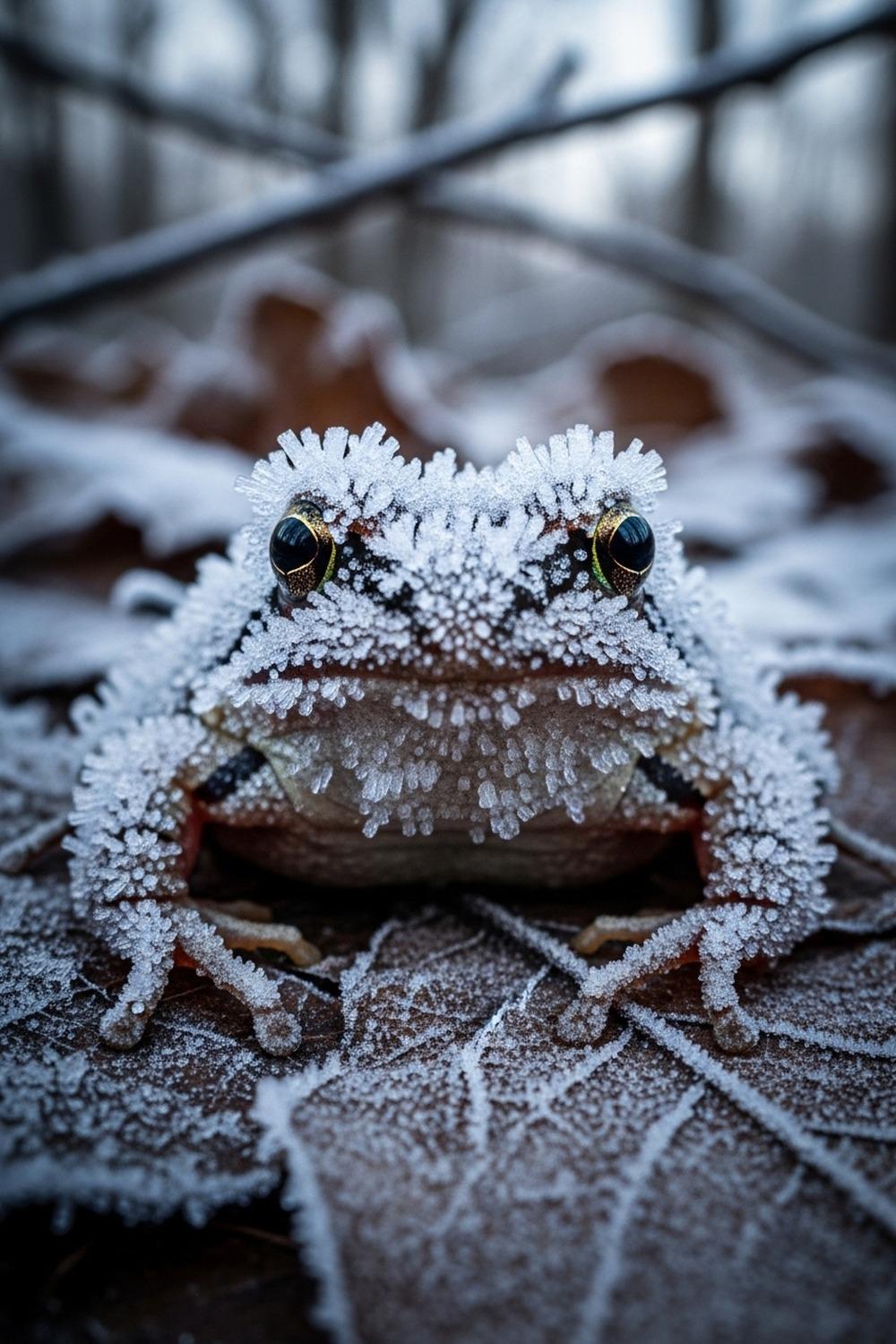
Somewhere beneath the leaf litter of a northeastern American forest, a small amphibian has stopped breathing. Its heart has quit. Ice fills the spaces between its organs. By April, it will thaw and hop away. The wood frog — Rana sylvatica — executes this cycle of clinical death and resurrection every single year, and it remains one of the most extraordinary survival mechanisms ever documented in vertebrate biology.
Right now, Rana sylvatica is doing something no human technology can fully replicate. Blood stopped in its veins. Ice crystals packed between its organs. Come spring, it will thaw, restart its heart, and move toward the nearest vernal pool to breed. The question scientists have spent decades chasing: how does it survive what should kill it?
Key Facts
- The wood frog (Rana sylvatica) survives winter by freezing solid: heart stopped, lungs deflated, ice between its organs, then thaws and resumes life in spring
- Before winter, the wood frog’s liver produces glucose up to 10 times its normal blood sugar concentration as a natural cryoprotectant
- Kenneth Storey at Carleton University in Ottawa has studied Rana sylvatica freeze tolerance for over three decades, publishing foundational work from the 1980s through the 2010s
- In 2013, Brian Barnes’s team at the University of Alaska Fairbanks documented wood frogs enduring temperatures as low as -16°C in laboratory conditions
- In natural environments, wood frogs regularly survive at -3°C to -6°C beneath snowpack for weeks or months; the entire thaw-and-recovery process can take as little as a few hours under optimal conditions
In short: Wood frogs (Rana sylvatica) freeze solid every winter — heart stopped, ice between organs — and thaw alive in spring. Their liver floods the body with glucose up to 10× normal levels as a cryoprotectant, pulling water out of cells so ice forms only between them. Kenneth Storey’s work at Carleton University maps the cascade; Alaska studies recorded survival at -16°C.
How the Wood Frog Frozen Solid Actually Survives
The mechanism begins weeks before the first hard freeze, and it’s more sophisticated than anything a pharmaceutical engineer could currently design. As temperatures begin to drop in late autumn, the wood frog’s liver starts producing massive quantities of glucose — up to ten times its normal blood sugar concentration. Kenneth Storey, a biochemist at Carleton University in Ottawa, has studied Rana sylvatica for over three decades and describes the process in terms that still sound unreal: the frog is essentially pickling itself alive.
Simultaneously, urea levels surge throughout its tissues. Together, these compounds act as a natural cryoprotectant, pulling water out of individual cells before it has the chance to freeze. His lab’s research, published across multiple studies from the 1980s through the 2010s, identified the precise enzymatic cascades that trigger this response — work that remains the foundational literature on vertebrate freeze tolerance. The glucose floods cells. The urea stabilizes proteins. Ice begins to form — but only in the extracellular spaces, the gaps between cells rather than inside them.
Why does this distinction matter? Because ice crystals inside a cell are lethal. They puncture membranes, shred organelles, destroy structure from within — the same reason freezer burn ruins food, scaled down to the cellular level. By drawing water out first, the frog ensures that ice forms only between cells, not within them. The cells themselves become concentrated, viscous, and protected. The ice that forms around them actually holds the body’s shape, creating what some researchers have compared to a glass mold — a frozen architecture that preserves the frog’s tissues intact.
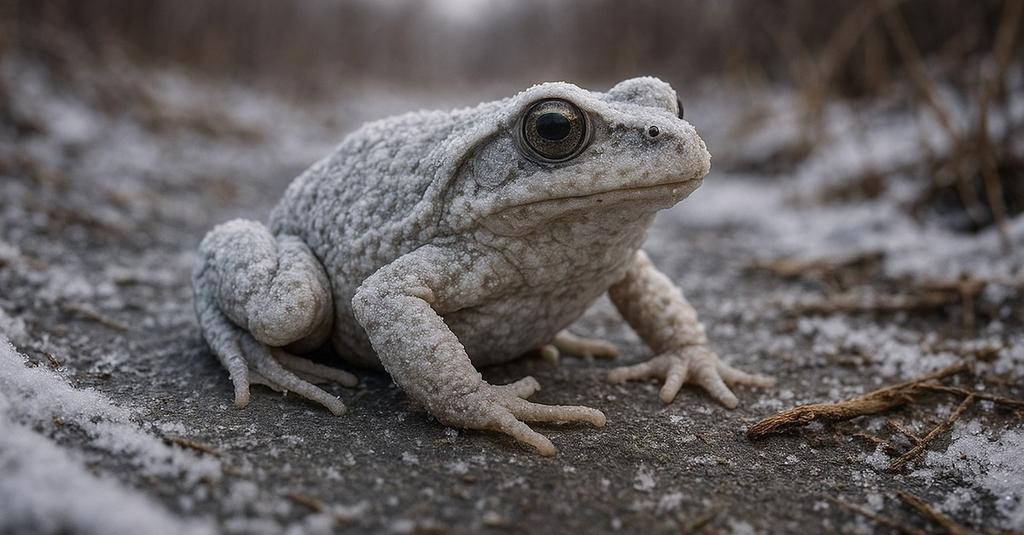
Heart stopped. Lungs deflated. Eyes white and opaque. You can press a finger against a frozen wood frog and feel no give at all. No pulse. No warmth. Absolutely nothing that reads as alive. Pick it up and it’s rigid, cold, indistinguishable from a small piece of bark.
Stiff enough, as one field biologist memorably noted, to clink against another frog like a stone.
The Body’s Shutdown Is Precisely Orchestrated
What makes the wood frog’s strategy genuinely strange — even by the wild standards of animal adaptation — is how controlled the shutdown is. The heart doesn’t just stop; it slows in measurable stages before it halts. Breathing doesn’t cut out suddenly; it decreases and ceases in a documented sequence. This isn’t a system failing. It’s a system executing. Every organ appears to have a role in the process, and none of it seems to be accidental.
Other animals survive cold through very different strategies — consider the mossy frog of Vietnam and Laos, which masters a different kind of disappearing act entirely — but no other vertebrate on Earth tolerates the degree of freezing that Rana sylvatica routinely survives. Some insects can manage it. A few invertebrates. But a frog with a spine and a four-chambered heart? That’s the anomaly.
In 2013, a team at the University of Alaska Fairbanks led by Brian Barnes documented wood frogs enduring temperatures as low as -16°C in laboratory conditions — far colder than field temperatures typically reach. In natural environments, frogs regularly survive at -3°C to -6°C beneath the snowpack for weeks or months at a stretch. What’s remarkable is the repeatability. The same individual frog cycles through this every winter. Not once. Not twice. Every year of its adult life, which can span three to five years in the wild. Field researchers working in Vermont and Alaska have found frozen frogs and left them marked, returning in spring to confirm the same individuals thawing and breeding.
One study tracked the same female through four consecutive winters of complete freezing.
What Thawing Reveals About the Limits of Biology
The thaw is, if anything, more astonishing than the freeze. When temperatures climb above freezing in late March or early April, the wood frog doesn’t gradually warm up and then restart its systems. It restarts them almost simultaneously. The heart begins beating — often irregularly at first, in short bursts — within minutes of thawing beginning at the core. Blood flow resumes before the outermost tissues have even softened.
Research published in the Smithsonian Magazine’s science pages in 2016 described the entire thaw-and-recovery process — from frozen solid to fully mobile — taking as little as a few hours under optimal conditions. That’s not slow convalescing. That’s a restart. The frog’s body appears to prioritize cardiac function above all else, directing the first flush of liquid blood toward the heart and brain. And here’s the thing: the wood frog frozen solid through winter doesn’t emerge weakened or disoriented.
It emerges ready to breed. In fact, wood frogs are among the first amphibians to reach vernal pools each spring, often before snow has completely melted from the forest floor. Males arrive first, filling the air with a sound described variously as quacking ducks or clucking chickens — a chorus that biologists have recorded as early as late February in the southern parts of the frog’s range. The urgency makes biological sense. Their pools are temporary. The race to breed is measured in days, not weeks. The cells that survived the winter intact are the same cells building the next generation. The glucose that protected them is metabolized. The urea clears. The frog hops forward, carrying no apparent damage from something that should, by every standard model of biology, have killed it completely.
What Wood Frog Frozen Solid Science Means for Medicine
Kenneth Storey’s lab at Carleton University didn’t spend forty years on wood frogs purely out of affection for small amphibians. The implications for human medicine are profound — and frustratingly difficult to translate. A human heart, once removed from a donor, survives outside the body for roughly four to six hours before it becomes unusable. A kidney lasts perhaps 36 hours under optimal cold storage. The core problem in organ transplantation is time.
If surgeons could reliably freeze organs for weeks or months and thaw them intact, transplant waiting lists — which in the United States alone held over 100,000 patients in 2023 according to data from the Organ Procurement and Transplantation Network — would look entirely different. The wood frog’s cryoprotectant system is the closest natural model we have for how to do exactly that. Watching a species accomplish in minutes what biomedical engineering has failed to replicate in decades changes how you think about the boundaries between nature and technology.
The challenge is scale and complexity. A frog’s cells are saturated with glucose and urea because its own liver produces those compounds in precise quantities on a precise schedule triggered by temperature. Human organs don’t do this. Flooding a human kidney with glucose would cause cell damage of its own. Researchers at institutions including the University of Minnesota and the Massachusetts General Hospital have experimented with synthetic cryoprotectant solutions inspired by wood frog biology, with partial success in tissue preservation. Full organ cryopreservation remains unsolved.
There’s also the question of trauma medicine. Induced suspended animation — slowing a critically injured patient’s metabolism to buy time for surgery — has been in clinical trials. The wood frog is the proof of concept that such a state is biologically achievable. Whether we can engineer our way there is a different question entirely.
How It Unfolded
- 1982 — Kenneth Storey and Janet Storey at Carleton University published the first systematic documentation of glucose-based freeze tolerance in Rana sylvatica, establishing the biological mechanism.
- 1987 — Subsequent Storey lab research identified the role of urea as a secondary cryoprotectant working alongside glucose, refining the model significantly.
- 2013 — University of Alaska Fairbanks researchers confirmed wood frogs surviving laboratory temperatures as low as -16°C, extending known tolerance limits.
- 2023 — Biomedical teams at multiple institutions continued applying wood frog cryoprotection models to organ preservation research, with synthetic analogues showing improved tissue viability in trials.
By the Numbers
- Up to 10× — the increase in blood glucose concentration the wood frog achieves before freezing, compared to its normal resting level (Storey Lab, Carleton University).
- 65–70% — the estimated proportion of the frog’s total body water that converts to ice during peak freezing, with the remainder retained within cells.
- -16°C — the lowest laboratory temperature at which Rana sylvatica has been documented surviving and recovering, recorded by University of Alaska Fairbanks in 2013.
- 4–6 hours — the survival window for a human heart outside the body under optimal cold storage, compared to months for a frozen wood frog.
- 100,000+ — patients on the U.S. organ transplant waiting list as of 2023 (OPTN), the population that wood frog research most directly hopes to help.
Field Notes
- In a 2019 study conducted in Vermont, researchers marked individual wood frogs with visible implant elastomers and confirmed that frogs surviving four consecutive winters of complete freezing showed no measurable decline in breeding success or body condition — suggesting the process leaves no cumulative damage.
- Wood frogs don’t find shelter underground or in deep leaf piles purely by instinct — they actually freeze faster in shallow leaf litter, which researchers believe helps synchronize the glucose-loading response with the onset of cold. Being near the surface is a feature, not a vulnerability.
- The quacking chorus wood frogs produce at vernal pools each spring is so loud that it can be heard from over 100 meters away — an acoustic signal that has been used by citizen scientists to track the timing of spring thaw across New England and the upper Midwest.
- Researchers still cannot fully explain how the wood frog’s heart restarts without the electrical resetting mechanisms that human defibrillation provides. The cardiac cells appear to retain some residual charge or membrane potential through the freeze — but the exact mechanism remains an open question that cardiac physiologists find genuinely puzzling.
Frequently Asked Questions
Q: How does wood frog frozen solid survival actually work at the cellular level?
The wood frog floods its cells with glucose and urea before temperatures drop, acting as natural antifreeze. This draws water out of cells into extracellular spaces, where ice forms safely between — not inside — cells. Ice inside cells would rupture membranes and destroy tissue. By relocating the water first, the frog creates a frozen lattice around intact, protected cells. The process takes only a few hours once triggered by dropping temperatures in autumn.
Q: How long can a wood frog stay frozen and still survive?
In natural conditions, wood frogs in northern parts of their range — Alaska, Canada — can remain frozen for up to eight months, from autumn through late spring. Laboratory studies have maintained frozen frogs for shorter controlled periods and confirmed full recovery. The limiting factor appears to be ice damage to extracellular tissues over extended time, not cell death. Field data on individual frogs tracked through multiple winters suggest at least four to five years of annual freezing without measurable cumulative harm.
Q: Does this mean a wood frog is technically dead when frozen?
This is where biology gets genuinely uncomfortable. No heartbeat, no breathing, no measurable electrical brain activity — by the clinical markers used in human medicine, the criteria are met. But the frog’s cells remain chemically intact, its DNA undamaged, its enzymes preserved. “Dead” implies irreversibility. What the wood frog experiences is better described as a suspended state for which science doesn’t yet have a clean vocabulary. It’s one reason researchers find this animal philosophically interesting, not just biologically.
Editor’s Take — Alex Morgan
What keeps pulling me back to this story isn’t the freeze itself — it’s the restart. The heart kicking back into rhythm after months of silence, with no external shock, no medical intervention, no machinery. We’ve built entire industries around keeping human hearts beating and restarting them when they stop. This frog does it alone, every year, under a layer of dead leaves. If the organ preservation implications alone don’t change how we think about the boundaries of medicine, I’m not sure what will.
The wood frog’s range stretches from Georgia to Alaska — one of the widest distributions of any North American amphibian — and across all of it, right now, countless individuals are doing something we still can’t fully explain. They’ve collapsed the boundary between life and death into a seasonal rhythm, as routine as the tilt of the Earth. Climate change is already shifting the timing of their freeze-thaw cycles in ways researchers at Carleton University and Yale are actively monitoring. What happens to an animal whose survival depends on precise temperature cues when those cues become unpredictable? That’s the question keeping biologists up at night — and somewhere under the snow, the frog that proved death isn’t always permanent is waiting, frozen, for spring.
Illustrations are AI-generated. Article fact-checked and human-edited. Our editorial standards.