Why Are the Nazca Lines Only Visible From the Sky?
Why are the Nazca Lines only visible from the sky? It is the question nearly every visitor asks — and in June 1941 an American scholar named Paul Kosok asked a version of it himself, standing on the Peruvian pampa at dusk as the setting winter-solstice sun dropped almost exactly along one of the enormous lines scratched into the ground at his feet. Kosok called the desert “the largest astronomy book in the world.” But here is the twist the guidebooks skip: the premise of the famous question is mostly wrong.
Key Facts
- The Nazca Lines are geoglyphs made by the Nazca culture roughly between 200 BC and 600 AD in southern Peru.
- More than 1,300 kilometres of lines are scattered across some 50 square kilometres of desert; the largest figures reach about 370 metres.
- American scholar Paul Kosok noted them in 1941; mathematician Maria Reiche mapped and guarded them for nearly forty years.
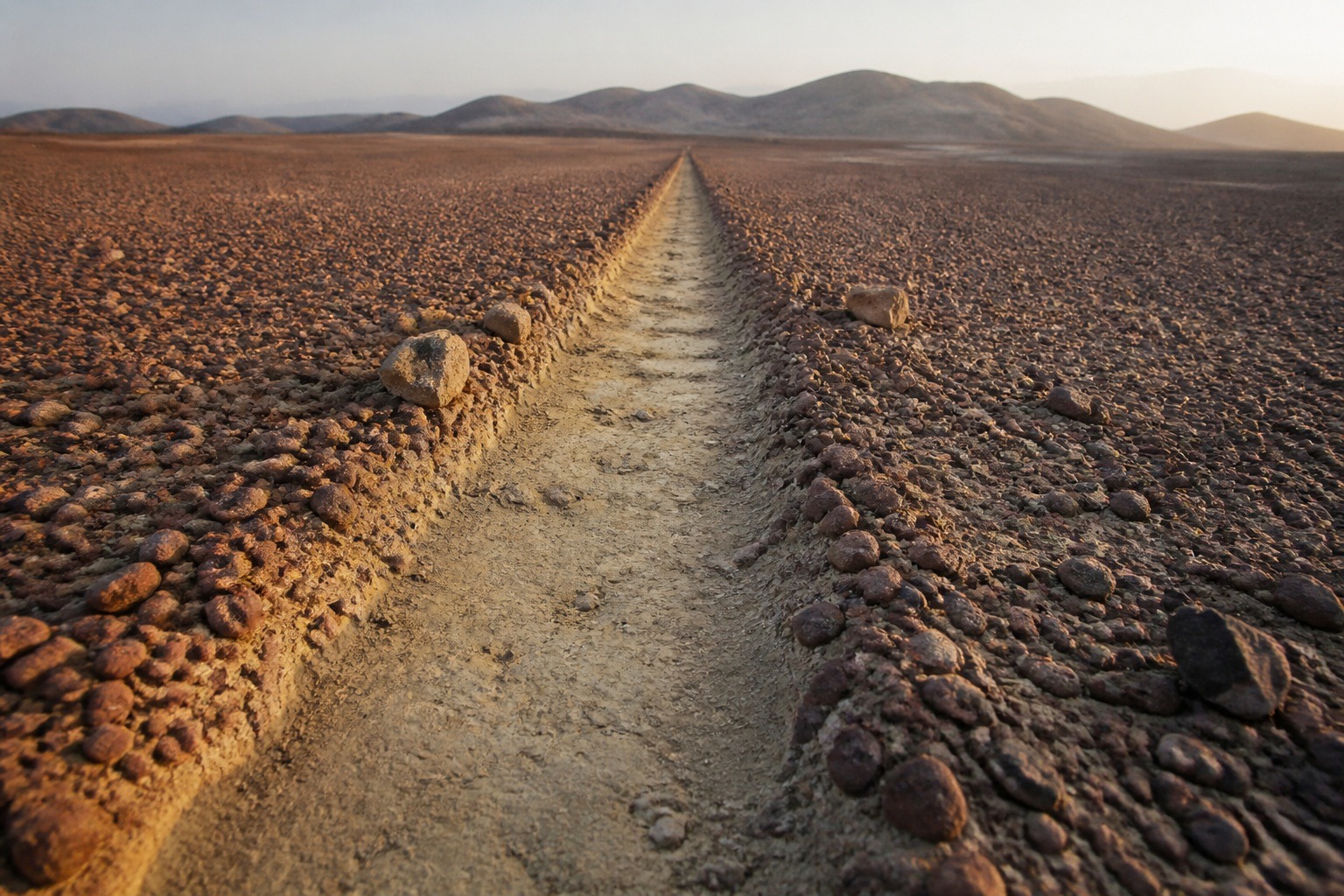
- The lines were made by removing dark surface stones to expose pale subsoil in trenches only 10-15 centimetres deep.
- In 2024, a team led by Masato Sakai (Yamagata University) with IBM Research used AI to confirm 303 new figurative geoglyphs in about six months.
In short: The Nazca Lines are geoglyphs carved into Peruvian desert by removing dark stones to expose pale subsoil in shallow trenches. The popular claim that they are only visible from the air is mostly a myth — many can be read from surrounding foothills. Made 200 BC-600 AD, they were mapped by Maria Reiche; AI added 303 figures in 2024.
What Paul Kosok Actually Saw — and What the Nazca Lines Are
Kosok was not looking for art. He was an irrigation historian, tracing ancient water channels across the Nazca Desert of southern Peru, when he noticed that some of the “channels” led nowhere and made no hydraulic sense. They were drawings. Over the following decades his colleague, the German mathematician Maria Reiche, would spend nearly forty years mapping and defending them, often alone, sweeping the desert with a broom to keep the lines clear.
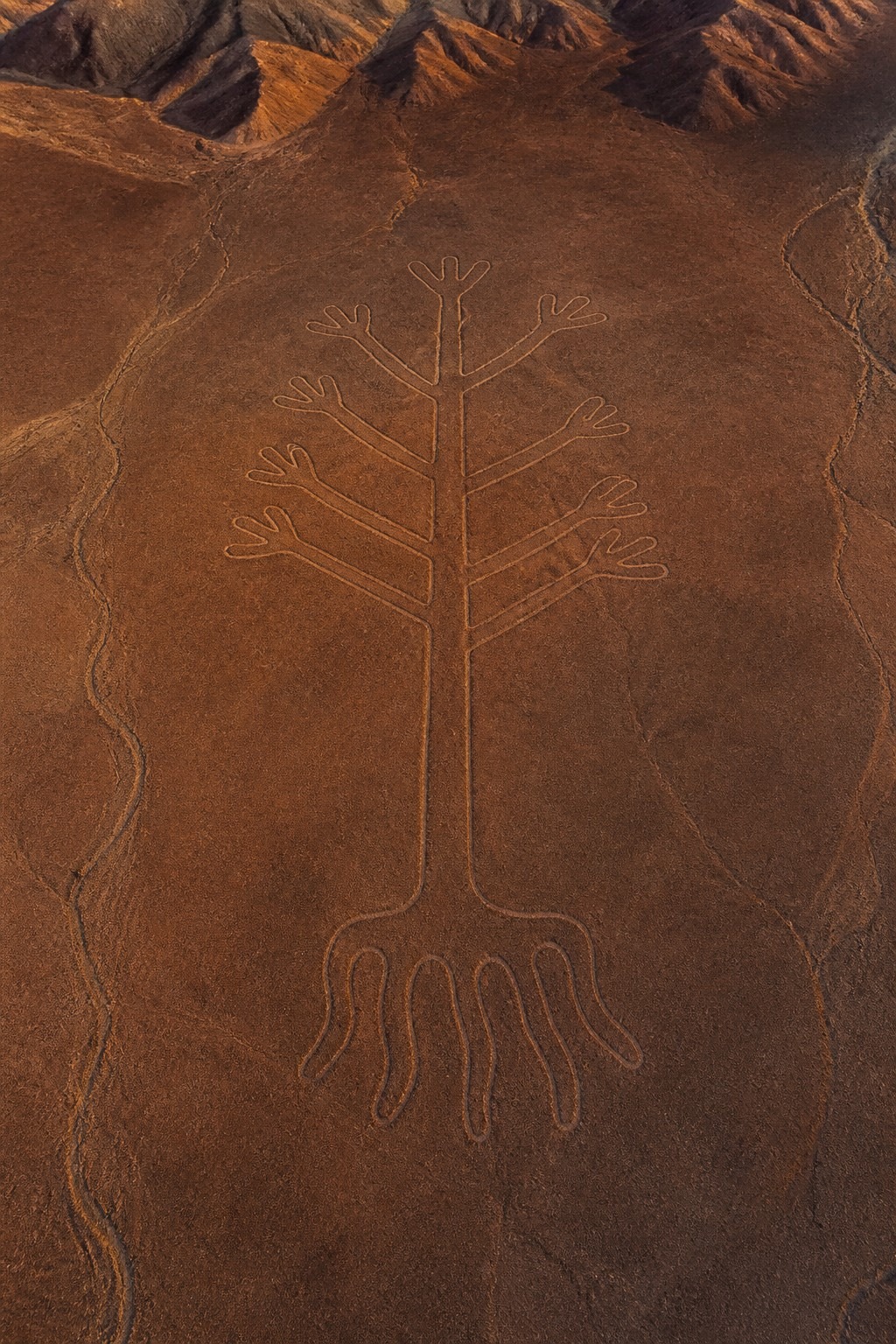
The Nazca Lines are geoglyphs: shapes carved directly into the desert floor by the Nazca culture, which flourished in this region roughly from 200 BC to 600 AD (some of the oldest figures, made by the earlier Paracas people, may predate that). They come in two flavours. There are hundreds of ruler-straight lines and geometric shapes — trapezoids, spirals, triangles — some running for kilometers. And there are the figures everyone comes to see: a hummingbird stretched to about 90 meters, a spider, a monkey with a curled tail, a condor, a killer whale. The largest single figures reach around 370 meters end to end.
All told, more than 1,300 kilometers of lines lie scattered across some 50 square kilometers of high, flat, almost lifeless desert. That scale is the whole puzzle. Hold onto it.
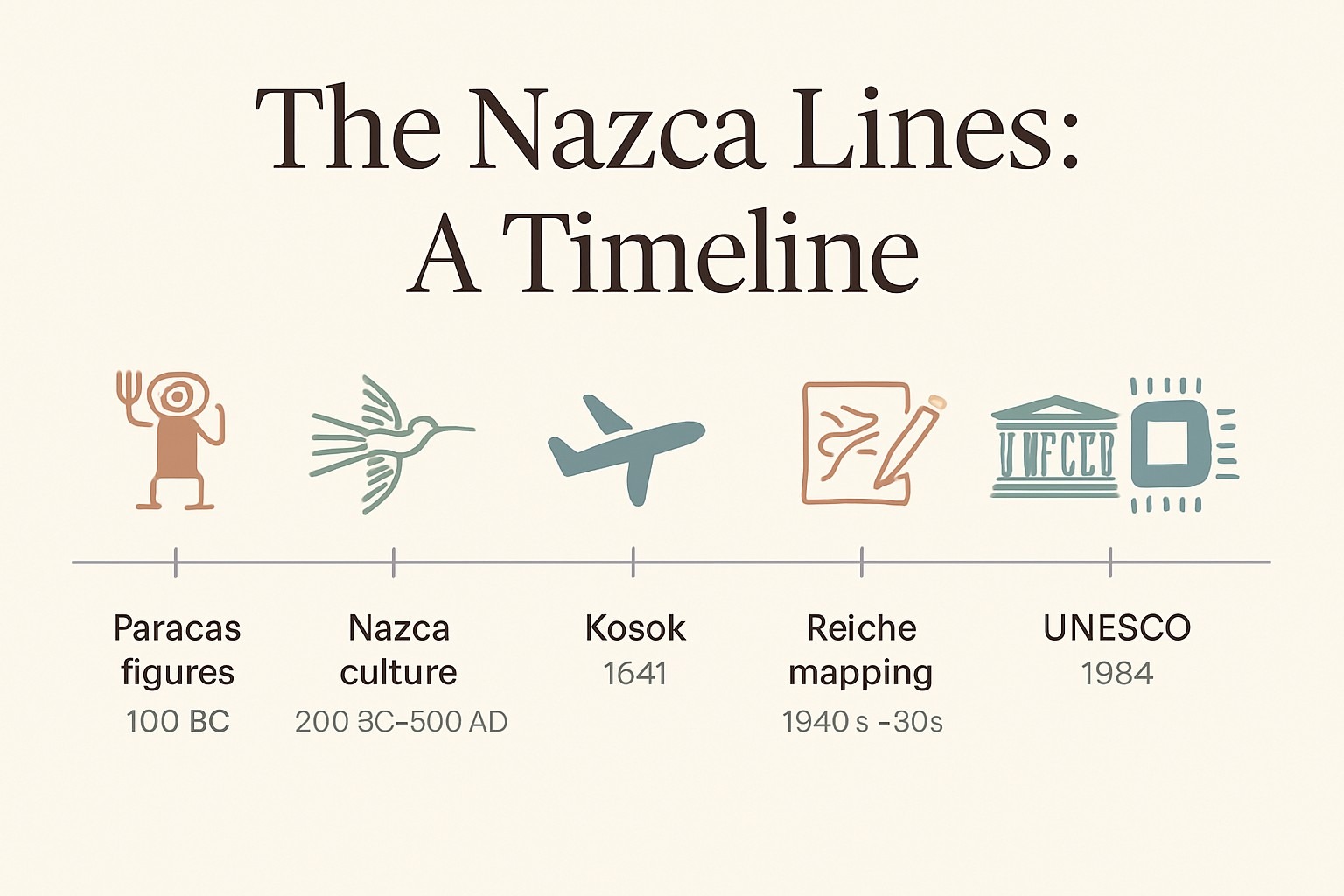
- c. 100 BC — Paracas people carve early figures on hillsides near Palpa
- 200 BC – 600 AD — Nazca culture etches the great lines and figures on the pampa
- 1941 — Paul Kosok watches the solstice sun set along a line
- 1940s–1990s — Maria Reiche maps and guards the site for decades
- 1994 — UNESCO inscribes the Lines and Geoglyphs of Nasca and Palpa as World Heritage
- 2024 — an AI-assisted survey adds 303 new figures in six months
Why Everyone Says the Nazca Lines Are Only Visible From the Sky — and Why That’s Mostly a Myth
Say the words “Nazca Lines” and the next sentence is almost always the same: you can only see them from a plane. It is repeated so often it has hardened into fact. It is not quite true.
Many of the lines can be read perfectly well from the surrounding high ground. The pampa is not a featureless table; it is ringed and cut by low foothills, and from those natural vantage points a great deal of the artwork resolves into recognisable shapes. This is even clearer a short distance north, around the town of Palpa, where an older set of figures was deliberately carved into hillsides — placed, it seems, specifically so that people standing below could see them. Those glyphs were never meant for the sky at all.
So the honest version of the story is not “invisible from the ground.” It is subtler, and more interesting.
{IMAGE_2}
A Trench in the Desert: How the Lines Were Made
The technique is almost embarrassingly simple, which is part of why it worked so well. The Nazca Desert floor is coated in a layer of small stones stained a dark, rusty red by iron oxides baked on over millennia. Directly beneath that dark crust lies pale, yellowish-grey subsoil.
To draw, the Nazca simply lifted away the dark pebbles along a chosen path and piled them at the edges, exposing the light ground underneath in a shallow trench only 10 to 15 centimeters deep. The contrast between the pale line and the dark desert did the rest. No dye, no digging, no masonry — a two-tone drawing made by subtraction, at a scale of kilometers.
Turns out that shallowness is also why the lines are so hard to read up close: from a person’s eye height, a 15-centimeter groove in a vast plain is just a faint scuff underfoot.
Drawing Kilometers Without Ever Leaving the Ground
If the makers never flew, how did they keep a 90-meter hummingbird in proportion? This is where the “aliens must have helped” myth quietly falls apart. The Nazca did not need altitude — they needed rope, stakes, and a plan.
The working theory, supported by the surveying tools the Nazca actually possessed, is a scale-up method: sketch the figure small, lay out a grid, then transfer it point by point to the ground at giant size using cords stretched between wooden posts. Curves become a series of short straight segments, or arcs swung from a central stake like a giant compass. Get the geometry right at each stake and the whole figure comes out true, even though no single worker can ever see it whole.
This is not just speculation. In 1982 the investigator Joe Nickell, working with family members and only tools available to pre-Columbian people — wooden stakes, string, and a small master drawing — reproduced a full-size Nazca condor in a Kentucky field. Their copy was accurate enough to be recognised from the air. No flight, no mystery required.
Strip away the mystery-mongering and the Nazca achievement looks more impressive, not less: a people with no writing and no wheel laid out kilometer-long geometry a modern surveyor would nod at.
2024: The Year AI Almost Doubled the Map
For most of a century, counting the geoglyphs was slow, eye-straining work over thousands of aerial photographs. Then, in 2024, a team led by archaeologist Masato Sakai of Yamagata University in Japan, working with IBM Research, trained an AI model to flag likely geoglyphs in high-resolution imagery — then sent people to check each candidate on foot.
The result, published in the journal PNAS, was startling. In roughly six months of fieldwork the team confirmed 303 previously unknown figurative geoglyphs, nearly doubling the known catalogue of figure-type glyphs in one stroke. Newly revealed subjects included humanoid figures, decapitated heads, killer whales, and domesticated animals like llamas.
What matters is not just the count. The study also gave the clearest answer yet to the question we started with — by showing that the Nazca were making two very different kinds of drawing, for two very different audiences.
Two Kinds of Glyph, Two Kinds of Audience
Sakai’s team drew a sharp line between what they call relief-type and line-type geoglyphs, and the distinction is the key that unlocks the whole “visible from the sky” paradox.
The relief-type figures — the bulk of the newly found 303 — are small, averaging around nine meters and rarely more than twenty. They tend to show human figures, heads, and domestic animals, and, crucially, they cluster right beside ancient walking trails, sitting on average only a few dozen meters from a footpath. These were made to be encountered up close, by individual travellers walking past. They were never meant for a bird’s-eye view.
The line-type geoglyphs are the giants — the sprawling wild animals and the kilometers-long straight lines. These sit along broader routes and are far too big to take in from the ground; the study links them to communal ritual, likely processions walked by groups of people. In other words, some Nazca art was roadside signage for a lone walker, and some was a stage for a whole community. Only the second kind ever demanded a wider vantage.
So Why Do You Need Altitude to “Read” Them? Visibility vs Legibility
Here is the reconciliation, and it is really a matter of two different words we keep confusing.
Visibility is whether you can see that something is there. Standing on the pampa, you absolutely can — a pale trench runs off across the stones in front of you. Legibility is whether you can read the shape as a hummingbird or a monkey. And that is what scale steals from you. When a figure is 90 or 370 meters across and the trench is ankle-deep, a person at ground level only ever sees a fragment: a meandering groove that curves away over the horizon of their own eye line.
To reassemble that fragment into a whole animal you need to get above it — up a nearby hill, or, since the twentieth century, into a plane. That is the honest core of the famous claim. The lines are not invisible from the ground; the big ones are simply unreadable from it, because the human eye sits too low to hold the whole shape at once.
Why 2,000-Year-Old Drawings Are Still Here
There is one more question the paradox raises and few accounts answer: how does a scratch 15 centimeters deep survive two thousand years? A single decent rainstorm should have erased it.
The answer is climate and chemistry. The Nazca pampa is one of the driest places on Earth, with almost no rain and remarkably little wind to move the dark pebbles back over the pale lines. Researchers, beginning with Maria Reiche, also noted a helpful trick of the ground itself: mineral salts and lime in the subsoil are dampened by the region’s morning fog and then bake in the sun, setting into a thin, hardened crust that stabilises the surface. A near-perfect natural preservation system — which is also, sadly, fragile: a single set of careless footprints or tyre tracks can scar the desert for centuries. That fragility is exactly why the site is now protected under UNESCO.
Common Questions
Can the Nazca Lines be seen from the ground? Yes — many can be seen from the surrounding foothills and high ground, and the neighbouring Palpa figures were carved on hillsides to be viewed from below. The largest figures on the flat pampa, though, are too big to make out as complete shapes from eye level.
How were the Nazca Lines made without flight? By rope-and-stake surveying: scaling a small master drawing up onto the desert using cords and wooden posts. Modern experimenters, including Joe Nickell in 1982, have reproduced full-size figures this way using only pre-Columbian tools.
Sources and Notes
- Sakai, M. et al. (2024), “AI-accelerated Nazca survey nearly doubles the number of known figurative geoglyphs and sheds light on their purpose,” PNAS — Yamagata University and IBM Research.
- UNESCO World Heritage Centre — “Lines and Geoglyphs of Nasca and Palpa.”
- Encyclopaedia Britannica — “Nazca Lines.”
- Joe Nickell — experimental reconstruction of a Nazca figure (1982), reported in Skeptical Inquirer.
- Maria Reiche and Paul Kosok — original field mapping and the astronomical-calendar hypothesis (1940s onward).
Eighty years after Paul Kosok watched the sun slide down a line in the sand, the desert is still giving up new figures — 303 of them in a single recent season — and the more we learn, the more the old riddle dissolves. The Nazca Lines were not a message aimed at the sky. They were made by people who walked, for people who walked: some to be met at a bend in the trail, some to be paced out together in ritual. We are the ones who needed to invent the airplane to see what they built by hand. That is not their mystery. It is ours.
Frequently Asked Questions
Q: Are the Nazca Lines really only visible from the sky?
Mostly a myth. Many lines can be read perfectly well from the surrounding high ground, because the pampa is ringed by low foothills that serve as natural vantage points. Near the town of Palpa, an older set of figures was deliberately carved into hillsides so people standing below could see them. The honest version is subtler than invisible from the ground — the shallow trenches are simply hard to read at eye level.
Q: How were the Nazca Lines made?
The technique was strikingly simple. The desert floor is coated in small stones stained dark red by iron oxides, over pale yellowish-grey subsoil. The Nazca lifted away the dark pebbles along a chosen path and piled them at the edges, exposing the light ground beneath in a shallow trench only 10 to 15 centimetres deep. The contrast between pale line and dark desert did the rest — no dye or digging required.
Q: How did the Nazca draw huge figures without flying?
They used rope, stakes and a scale-up method rather than altitude. The working theory is that they sketched a figure small, laid out a grid, and transferred it point by point to giant size using cords stretched between wooden posts, with curves swung from a central stake. In 1982 investigator Joe Nickell reproduced a full-size Nazca condor using only such pre-Columbian tools, accurate enough to be recognised from the air.
Q: What did the 2024 AI survey discover?
A team led by archaeologist Masato Sakai of Yamagata University, working with IBM Research, trained an AI model to flag likely geoglyphs in high-resolution imagery, then sent people to verify each on foot. Published in the journal PNAS, the result was startling: in roughly six months of fieldwork they confirmed 303 previously unknown figurative geoglyphs, nearly doubling the known catalogue of figure-type glyphs in a single stroke.
Illustrations are AI-generated. Article fact-checked and human-edited. Our editorial standards.