Indus Valley Toilets Older Than Roman Plumbing
The claim that Indus Valley toilets older than Roman plumbing is not a stretch of the marketing kind — it is arithmetic. Around 2500 BCE, in a brick city on the floodplain of the Indus, a household could step into a small washroom, pour a jar of water down a chute, and watch the waste vanish into a sealed street drain. Rome would not lay its first great sewer, the Cloaca Maxima, until roughly 600 BCE. That is a head start of about two thousand years, measured not in legend but in fired brick you can still stand in today.
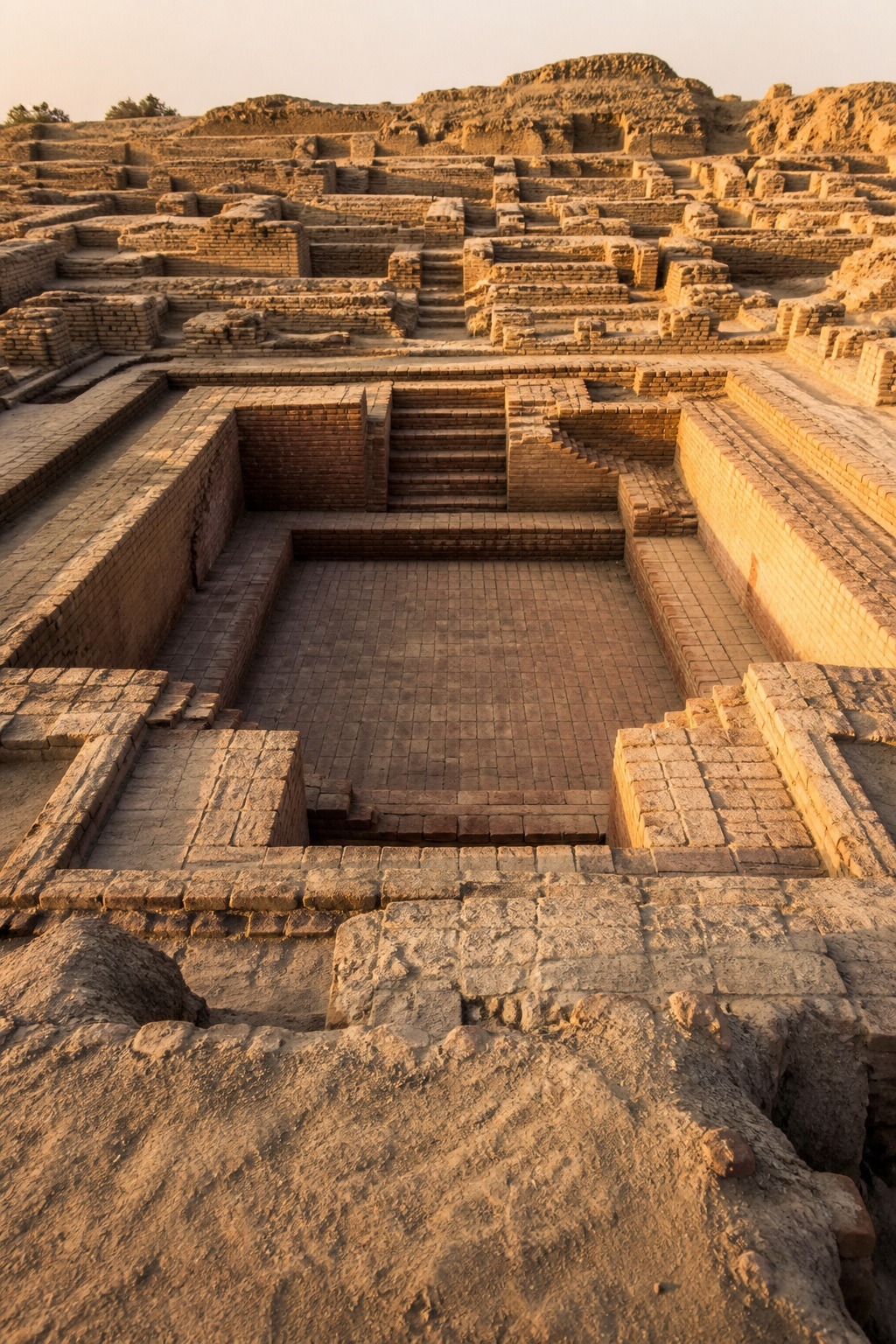
The short answer: Yes — the Bronze-Age cities of the Indus (2600–1900 BCE) had private flush toilets and a covered municipal sewer network some two millennia before Rome built a comparable system, and the physical remains at Mohenjo-daro prove it.
- 2600–1900 BCE — the Mature Harappan phase, when the flush toilets were in use
- ~700 wells — estimated at Mohenjo-daro alone, feeding the water supply
- ~2,000 years — the lead over Rome’s Cloaca Maxima (~600 BCE)
- 1:2:4 — the standardised brick ratio (thickness : width : length) used across the civilisation
- ~12 × 7 m, 2.4 m deep — the Great Bath, sealed watertight with gypsum mortar and bitumen
Key Facts
- Around 2500 BCE, Indus cities like Mohenjo-daro had private flush toilets draining into covered brick street sewers.
- That is about a 2,000-year head start over Rome’s first great sewer, the Cloaca Maxima, begun around 600 BCE.
- The Mature Harappan phase ran 2600-1900 BCE; Mohenjo-daro alone had an estimated 700 wells.
- The Harappans used a standardised 1:2:4 brick ratio (thickness to width to length), documented by archaeologist Jonathan Mark Kenoyer.
- The Great Bath, about 12 by 7 metres and 2.4 metres deep, is the oldest known public water tank, sealed with gypsum mortar and bitumen.
In short: Around 2500 BCE, Indus cities such as Mohenjo-daro had private flush toilets draining into covered brick sewers — roughly 2,000 years before Rome’s Cloaca Maxima. The system used standardised 1:2:4 bricks, gypsum mortar, bitumen sealing, an estimated 700 wells, manholes for maintenance, and the Great Bath, the oldest known public water tank.
A flushing toilet in 2500 BCE — what Ernest Mackay dug out of the brick
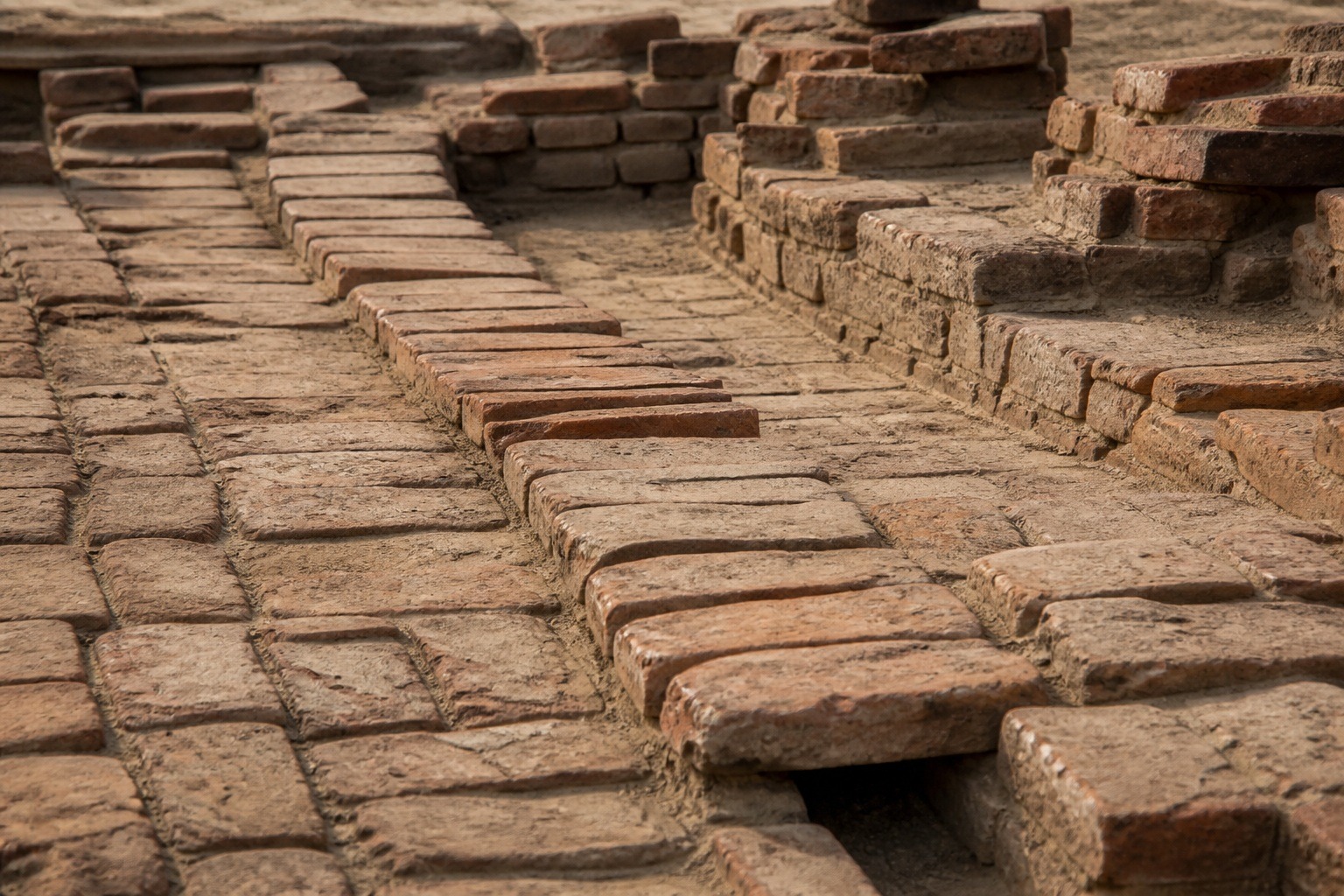
Picture the moment of discovery. In the 1920s and 1930s, the British archaeologist Ernest Mackay, working the trenches at Mohenjo-daro, kept finding the same feature house after house: a small seated platform of brick, a vertical chute, and a channel running out through the wall to the street. These were not ceremonial. They were toilets — ordinary, domestic, and almost everywhere.
The mechanism was gravity and a bucket. There was no cistern and no lever. A resident poured water from a jar down the chute, and the flow carried waste through a short house drain into a covered brick sewer beneath the street, which fed a soak pit or a communal cesspit. It is the same principle a modern flush obeys — move waste with water, keep it sealed, keep it moving away from people. The Harappans simply supplied the water by hand.
What startles archaeologists is not the cleverness of one house. It is the repetition. A single ingenious toilet is a curiosity. A toilet in nearly every home, draining into a shared grid, is something else entirely — evidence of a rule everyone followed.
{IMAGE_2}
The engineering: a standardised brick, gypsum mortar, and manholes every few metres
Strip away the romance and the sanitation runs on unglamorous specifics. The Harappans fired their bricks to a consistent proportion — a ratio of 1:2:4, thickness to width to length — a standard the archaeologist Jonathan Mark Kenoyer of the University of Wisconsin–Madison has documented as remarkably uniform across sites hundreds of kilometres apart. Standard bricks meant drains that fit together predictably, wall after wall, city after city.
The joints mattered as much as the bricks. Waterproof work used gypsum mortar — effectively a proto-cement — and bitumen, natural tar, as a sealer. The Great Bath’s floor is the showpiece: two skins of sawn brick laid on edge in gypsum mortar with a layer of bitumen sandwiched between them, engineered to hold water without leaking. Terracotta pipes carried flow where brick channels could not, their sections sealed at the joins.
And then the detail that reframes everything. The covered street sewers had inspection holes — manholes — set at regular intervals so the drains could be cleared and maintained. Turn that over in your mind for a second: a maintenance hole is not a lucky accident of clever houses. It is proof of a system somebody owned, budgeted for, and cleaned on a schedule. This is civic government written in brick.
700 wells, one Great Bath, and a sewer under every street
A toilet is only as good as the water that feeds it and the drain that empties it, so the Harappans built both ends. Mohenjo-daro alone held an estimated 700 wells — a figure from the survey work of the German architect and archaeologist Michael Jansen — putting fresh water within a short walk of almost any doorway. Few ancient cities came close to that density of supply.
The drainage was equally deliberate. House drains fed covered brick sewers laid below street grade, angled to keep the flow running, connecting to larger channels and communal cesspits. Streets were planned on a grid; the sewers ran with them. This was not plumbing bolted onto a city after the fact. The plumbing and the city were designed together.
Above it all sat the Great Bath — roughly twelve metres by seven, about 2.4 metres deep, the oldest known public water tank in the world. Its watertight construction shows the same obsession with sealing and slope that governed the humblest house drain. Whatever its purpose (ritual bathing is the leading guess, though nobody can read the Indus script to confirm it), it proves the culture could hold clean water at scale, on purpose, for a very long time.
Indus Valley toilets older than Roman plumbing: how big is the head start?
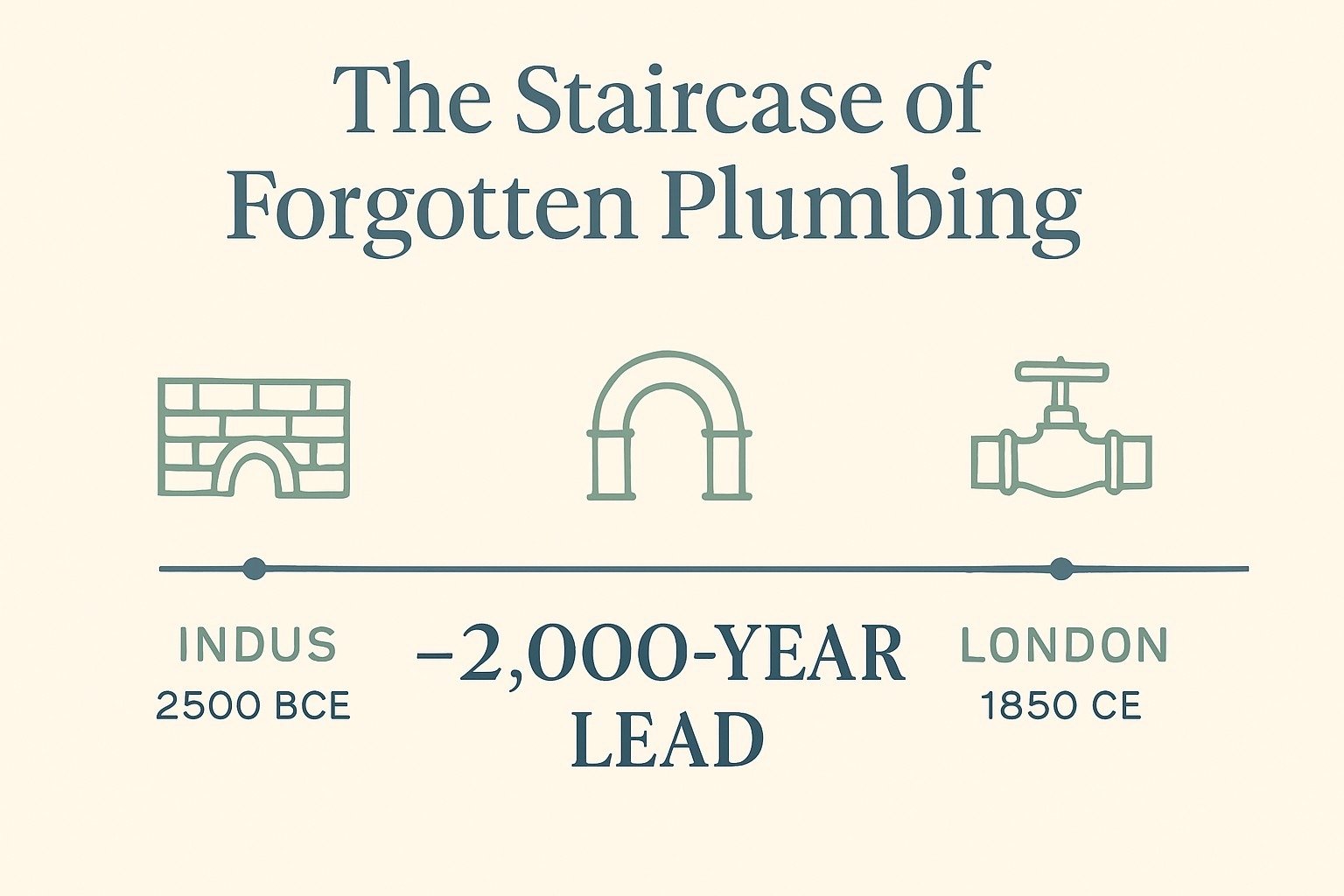
Rome earns its reputation honestly — the Cloaca Maxima, begun around 600 BCE, and the aqueducts that followed were genuine marvels of drainage and supply. But the timeline is blunt. The Indus flush toilet was routine domestic kit some two thousand years before Rome cut its first sewer. To see the full arc, it helps to place three sanitation milestones side by side.
| Civilisation | Roughly when | Household toilet? | Where the waste went |
|---|---|---|---|
| Indus (Mohenjo-daro) | ~2500 BCE | Yes — in nearly every house | Covered brick sewer → soak pit / cesspit |
| Rome | ~500 BCE onward | Rare in homes; public latrines | Cloaca Maxima → the Tiber |
| London | ~1850 CE | Flush toilets spreading fast | Raw into the Thames (until Bazalgette’s sewers, post-1858) |
Read that bottom row twice. In 1850, one of the richest cities on Earth was pouring untreated sewage straight into its river, and would keep doing so until the stench of the 1858 “Great Stink” forced Parliament to fund a proper sewer network. A Bronze-Age Indus household would have found the arrangement primitive.
The 1,300-year dark age nobody narrates
Here is the part the popular accounts skip. The Indus cities decline around 1900 BCE. Rome’s first sewer arrives around 600 BCE. That leaves roughly thirteen centuries in between — and for most of the world, through most of that gap, the flush toilet simply did not exist. Egypt and Minoan Crete had partial drainage in elite quarters, but nothing matched the household-scale, city-wide Indus grid, and even those pockets faded.
The uncomfortable truth is that sanitation is not a straight line of progress — it is a technology a civilisation can simply forget, and for over a millennium, humanity largely did. Knowledge does not survive on its own. It survives inside institutions that maintain it, and when those institutions dissolve, the know-how goes with them.
That is the real headline hiding in the brick: not that the Indus was early, but that the world went backwards after it and stayed backwards for a very long time.
Why it vanished — a weakening monsoon and a dying river
So why did the most advanced sanitation on the planet disappear? The leading explanation is climate, not conquest. Between roughly 2200 and 1900 BCE, the summer monsoon that watered the region weakened, and the great river systems the cities depended on began to fail — including the Ghaggar-Hakra, often identified with the Saraswati of later texts, which is thought to have dried across long stretches.
Cut the water and you cut the city. Populations dispersed into smaller villages, the dense urban grids emptied, and the specialised knowledge that ran the drains — the brick standards, the survey lines, the maintenance crews — had no city left to serve. Sanitation on this scale is downstream of stable urbanism. When the cities died, the plumbing died with them, not because anyone forgot how to lay a drain, but because nobody needed a municipal one anymore.
It is worth being honest about the limits here: the Indus script remains undeciphered, so we cannot read a single Harappan sentence about their own decline. The climate story rests on sediment cores, river geomorphology, and dating, not on any Bronze-Age testimony. It is the strongest reconstruction we have — but it is a reconstruction.
What the experts say — Kenoyer, Possehl and the 1989 Jansen study
The scholarship behind these claims is real and named, which is more than most retellings offer. The single most cited technical source is Michael Jansen’s 1989 paper “Water supply and sewage disposal at Mohenjo-Daro,” published in the journal World Archaeology — the peer-reviewed analysis that mapped the wells, drains and disposal system in engineering detail. Anyone serious about Indus sanitation starts there.
For the wider picture, Jonathan Mark Kenoyer (University of Wisconsin–Madison) has spent decades documenting Harappan standardisation, from brick ratios to weights, and reads that uniformity as a sign of coordinated administration. The late Gregory Possehl of the University of Pennsylvania, in his 2002 synthesis The Indus Civilization: A Contemporary Perspective, remains the standard book-length authority. And recent radiocarbon work by teams including Pakistani archaeologists such as Dr. Asma Ibrahim has pushed the occupation of Mohenjo-daro back toward 2700–2600 BCE — slightly earlier than many older popular accounts still repeat.
What is new in this piece is the framing: not just “the Indus was first,” but the full staircase — Indus, then a 1,300-year regression, then Rome, then a second regression that left even Victorian London dumping waste in its river. Placed on one timeline, the story stops being a trivia fact and becomes a warning about how easily hard-won infrastructure is lost.
Frequently asked questions
Were Indus toilets really flush toilets? By function, yes — waste was carried away by water into a sealed drain. They were manually flushed with a poured jar rather than a mechanical cistern, but the working principle is the same as a modern flush.
How much older is the Indus system than Roman plumbing? About two thousand years. The Indus flush toilets date to roughly 2500 BCE; Rome’s Cloaca Maxima was begun around 600 BCE.
Did every Indus house have a toilet? Not literally every one, but a private toilet was present in a large share of houses at Mohenjo-daro — a level of household sanitation not matched again for millennia.
Which sites besides Mohenjo-daro had this? Harappa, Lothal (around 2350 BCE), Dholavira and Rakhigarhi all show planned drainage, making advanced sanitation a civilisation-wide standard rather than a one-city fluke.
Sources and notes
- Michael Jansen, “Water supply and sewage disposal at Mohenjo-Daro,” World Archaeology, Vol. 21, No. 2 (1989)
- Jonathan Mark Kenoyer, University of Wisconsin–Madison — published work on Harappan standardisation and urbanism
- Gregory L. Possehl, The Indus Civilization: A Contemporary Perspective (2002), University of Pennsylvania Museum
- Excavation records associated with Ernest Mackay, Mohenjo-daro (1920s–1930s)
- National Geographic, feature reporting on Mohenjo-daro (2026)
The Indus left no readable words, only the plumbing — and the plumbing is eloquent enough. It tells us that clean water, private sanitation, and a maintained public drain are not the inevitable rewards of progress but a fragile achievement that can be built, lost, and forgotten for a thousand years at a stretch. Today, billions of people still lack the safe sanitation a Mohenjo-daro household took for granted forty-five centuries ago. The Bronze-Age engineers already solved the hard part. The unfinished work is remembering how much easier it is to lose good infrastructure than to build it — and making sure, this time, we don’t.
Illustrations are AI-generated. Article fact-checked and human-edited. Our editorial standards.