The Oldest Rubber Balls in the World Are Olmec
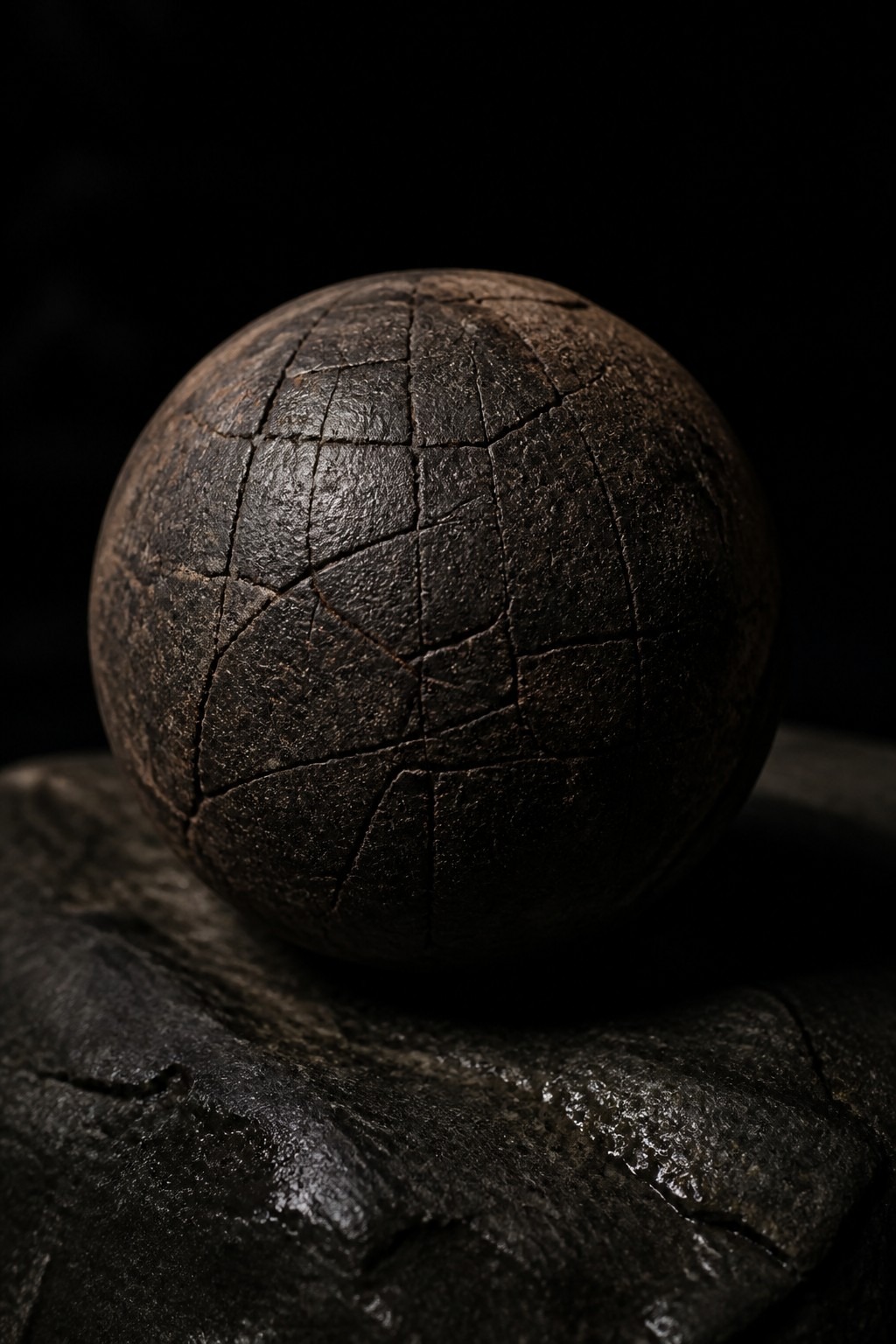
The oldest rubber balls in the world are Olmec, and they were bouncing in ritual offerings some 3,500 years ago — centuries before anyone built a court to play a formal game on. They came out of a waterlogged sacred bog called El Manatí, in the swampy lowlands of Veracruz, Mexico. And here is the part most articles still get wrong: brand-new science has just overturned the textbook story of how these balls were made bouncy.
Key Facts
- The oldest rubber balls were recovered from El Manatí, a sacred freshwater bog near Hidalgotitlán, Veracruz, Mexico, a site located in 1987
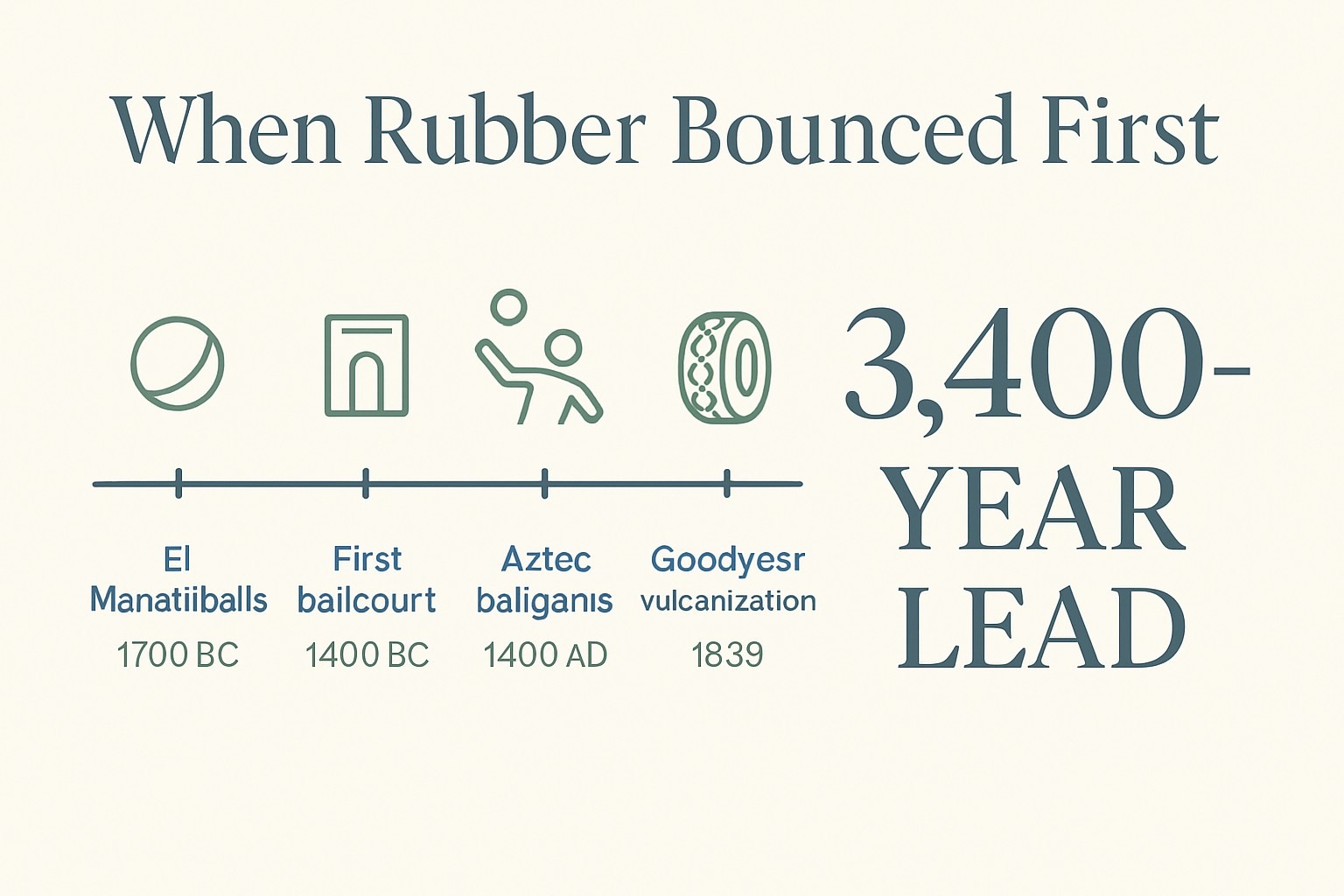
- The oldest balls date to roughly 1700-1600 BC, making them about 3,500-3,700 years old, predating Charles Goodyear’s 1839 vulcanization patent by about 3,400 years
- At least a dozen balls were recovered and 14 are now in active conservation, ranging from 4.9 cm to 33 cm across and 180 g up to about 4.8 kg
- The balls were made of latex from the Castilla elastica tree, wound in dried strips around a central core, as confirmed by a 2023 study in Archaeological and Anthropological Sciences
- The oldest known formal ballcourt, at Paso de la Amada on Mexico’s Pacific coast, dates to around 1400 BC, two to three centuries after the El Manatí balls
In short: The oldest known rubber balls, dated to roughly 1700-1600 BC, came from the Olmec sacred bog of El Manatí in Veracruz, Mexico. Made from Castilla elastica latex wound in strips around a core, they predate the earliest ballcourt by centuries. A 2023 study found no trace of the morning glory vulcanization once assumed for them.
The oldest rubber balls in the world: what an Olmec bog gave up

Start with the bottom line. At a spring-fed hill called El Manatí, near Hidalgotitlán in southern Veracruz, archaeologists recovered a set of rubber balls dated to roughly 1700–1600 BC. That makes them the earliest rubber balls known anywhere on Earth — older than any other worked-rubber object ever found. They predate Charles Goodyear’s patented vulcanization of 1839 by about 3,400 years.
The site was located in 1987, and the balls began surfacing from the muck soon after. They had been placed there on purpose, as offerings, in a place the Olmec clearly treated as holy.
- Where: El Manatí, a sacred freshwater bog near Hidalgotitlán, Veracruz, Mexico (site found 1987)
- Age: the oldest date to ~1700–1600 BC — roughly 3,500–3,700 years old
- How many: at least a dozen recovered; 14 are now in active conservation
- Size & weight: from 4.9 cm to 33 cm across; 180 g up to about 4.8 kg
- Made of: latex from the Castilla elastica tree, native to tropical southern Mexico
Older than the game itself: balls before ballcourts
This is the detail that makes the El Manatí balls genuinely special, and it is the one competitors skip. We usually meet Mesoamerican rubber through the ballgame — the hip-struck sport played on masonry courts, tangled up with sacrifice and myth. But the oldest formal ballcourt we know of, at Paso de la Amada on Mexico’s Pacific coast, dates to around 1400 BC.
The El Manatí balls are two or three centuries older than that.
So the sequence runs backwards from what you might assume. Rubber balls were being shaped, weighted, and offered to a sacred spring before there is any evidence of a built court to bounce them on. The bounce came first; the stadium came later. Whatever the Olmec were doing with these spheres around 1700 BC, it was ritual before it was recreation — and that reframes the whole origin story of the game.
How were the Olmec rubber balls actually made?
For a long time the short answer was “solid rubber,” and that was the end of it. It turns out the truth is more elegant. A 2023 study published in the journal Archaeological and Anthropological Sciences — “Unraveling the Olmec rubber balls from El Manatí” — put the actual objects under radiography, UV fluorescence imaging, optical microscopy, and a battery of chemical tests.
What the X-ray images revealed inside was structure. The balls were not cast in one piece. Instead, Olmec makers took latex tapped from Castilla elastica, dried it into thin strips, and wound those strips around a small central core, building the sphere up layer by layer like a ball of yarn. A final thin latex coat sealed the layers and gave the surface its spring.
{IMAGE_2}
Here is the quietly satisfying part. That rolled-strip method is almost exactly what a Spanish friar described watching Mesoamerican craftspeople do in the sixteenth century — and it is close to how rubber balls are still made by hand in the region today. The radiographs didn’t just reveal a technique; they confirmed a 500-year-old eyewitness account that scholars had never been able to check against the real thing.
Why the “morning glory vulcanization” story is being overturned
If you learned anything about ancient rubber, you probably learned this: the Olmec mixed in juice from the morning glory vine (Ipomoea alba) to toughen the latex, a kind of natural proto-vulcanization thousands of years before Goodyear. That idea comes from a genuinely important 1999 study in the journal Science led by MIT archaeologist and materials scientist Dorothy Hosler, who showed that combining Castilla latex with morning glory sap produces a bouncier, more durable rubber.
That research is real and still cited. But — and this is the freshest fact on the whole topic — the 2023 analysis tested the El Manatí balls themselves and found no chemical trace of Ipomoea alba or of vulcanization in these specific objects. The morning glory recipe may well have been used elsewhere in Mesoamerica, or later in time. On the oldest balls we have, the evidence for it simply isn’t there.
That correction matters, because nearly every popular page still presents the morning glory story as settled fact for these balls. It isn’t anymore. The honest current position: the earliest known rubber was worked skillfully, but exactly how the Olmec achieved its bounce remains partly open.
Heavy, bouncy, and struck with the hip
The El Manatí set is not a matched box of toys. The balls range from a graspable 4.9 centimeters across to a hefty 33 centimeters, and in weight from a light 180 grams to nearly 4.8 kilograms — heavier than a bowling ball at the top end.
In the later, well-documented ballgame, a solid rubber ball of this kind was driven mainly with the hips, thighs, and forearms rather than the hands or feet. Picture the physics: a dense, fast, unforgiving sphere and players in protective gear taking the impact on the body. A ball weighing several kilograms was not a plaything. The smallest El Manatí balls, though, hint that “ball” covered a whole range of ritual and practical objects, not one standard piece of sports equipment.
More offering than sport: the ritual world of El Manatí
Why were rubber balls buried in a bog at all? Because El Manatí was a place of offering, and the balls were gifts to it. The Olmec deposited them alongside a haul of other sacred objects: carved wooden busts with serene faces, polished greenstone axes, skeins of raw rubber, plant remains — and human bones, including those of infants.
Read together, that assemblage says the balls belonged to a world of devotion, not a locker room. They were valuable enough, and charged enough with meaning, to hand over permanently to the spring. This is the ritual foundation the later ballgame grew out of — sport and sacrifice braided together from the very start of the record.
Why a 3,500-year-old rubber ball is rotting now
Rubber should not survive 3,600 years. Organic latex normally oxidizes, hardens, and crumbles in a fraction of that time. The El Manatí balls lasted because the bog saved them: a waterlogged, oxygen-starved spring sealed the rubber away from the air and microbes that would have destroyed it. The same anoxic mud that made the site sacred also made it a natural preservation chamber.
Then archaeologists opened it. Lifting the balls out of that stable, wet, airless environment exposed them to oxygen for the first time in millennia — and the decay clock restarted. By 2025, Mexico’s National Institute of Anthropology and History (INAH), working with UNAM’s National Laboratory of Sciences for the Research and Conservation of Cultural Heritage, reported that the 14 conserved balls were showing cracks, fine fissures, brittleness, shrinkage, and weight loss.
The rescue is a race against chemistry. The teams are designing custom oxygen-free (anoxic) storage cases tailored to each ball, essentially rebuilding the bog’s protective conditions in a sealed box. At the same time they are making high-resolution photogrammetric 3D models, so the exact shape of every ball is captured digitally and can be studied — or displayed — even if the physical object continues to fade. It is a sober reminder that excavation is not the end of an object’s story. Sometimes it is the start of its decline.
What the latest science still can’t explain
Reconstructing the past honestly means naming what we don’t know, and here the gaps are real. The 2023 study nailed down how the balls were built and ruled out one popular recipe, but it did not deliver a finished chemistry of Olmec bounce. If not morning glory, then what — if anything — did the earliest ball-makers add to their latex, and did they add anything at all? The composition points to skilled processing; the exact process is still partly a blank.
Dating is another soft edge. The oldest offerings at El Manatí cluster around 1700–1600 BC, but the site stayed sacred for centuries, and the balls did not all enter the bog at once. Pinning a single tight date to a single ball is harder than a round number suggests. Reputable sources give the site a span roughly between 1600 and 1200 BC for its main activity, with the earliest deposits older still — which is why you will see the age quoted as “about 3,500 years” in some places and closer to 3,700 in others. Both are honest; neither is exact.
And the deepest question is the human one. We can weigh a ball, X-ray its layers, and map the objects buried beside it, yet we cannot ask the people who carried it to the spring what it meant to let it go. That silence is not a failure of the science. It is simply the edge of what rubber, mud, and radiographs can tell us.
Quick answers
How old are the oldest rubber balls? The El Manatí balls date to about 1700–1600 BC, roughly 3,500–3,700 years old — the oldest rubber balls known anywhere.
What are Olmec rubber balls made of? Latex from the Castilla elastica tree, dried into strips and rolled around a core, with a final latex coating.
Did the Olmec vulcanize their rubber with morning glory? A 1999 MIT study showed morning glory sap can toughen latex, but 2023 tests found no trace of it in the El Manatí balls themselves. For these specific objects, the vulcanization story is now in doubt.
Are the balls older than the ballgame? Yes. They predate the oldest known ballcourt (Paso de la Amada, ~1400 BC) by two to three centuries, so rubber bounced in ritual before the formal court existed.
Sources and notes
- Ortega-Avilés, Filloy Nadal et al., “Unraveling the Olmec rubber balls from El Manatí, Mexico: a technological and compositional analysis,” Archaeological and Anthropological Sciences (Springer), 2023/2024 — rolled-strip manufacture; ruled out Ipomoea alba/vulcanization on these balls.
- Hosler, Burkett & Tarkanian, MIT, in Science (1999) — the original morning-glory rubber-processing study, cited here as the claim the newer research revises.
- National Institute of Anthropology and History (INAH) and UNAM’s National Laboratory of Sciences for the Research and Conservation of Cultural Heritage — 2025 conservation report (anoxic cases, photogrammetry, 14 balls, 4.9–33 cm, 180 g–4.8 kg).
- El Manatí Project excavations led by María del Carmen Rodríguez and Ponciano Ortiz (site discovered 1987; balls reported from 1989).
The next time you see a rubber ball bounce, remember it has a 3,600-year-old ancestor sitting in a sealed, oxygen-free case in Mexico — and that our best current science admits it still doesn’t fully know how the Olmec made it spring. That mix of ancient ingenuity and honest mystery is exactly what makes El Manatí worth caring about.
Frequently Asked Questions
Q: How old are the oldest rubber balls in the world?
The oldest rubber balls, recovered from the El Manatí bog near Hidalgotitlán in Veracruz, Mexico, date to roughly 1700-1600 BC, making them about 3,500 to 3,700 years old. That makes them the earliest worked-rubber objects known anywhere on Earth. They predate Charles Goodyear’s patented vulcanization of 1839 by about 3,400 years. The site was located in 1987, and the balls began surfacing from the muck soon after, having been placed there deliberately as offerings.
Q: How were the Olmec rubber balls actually made?
According to a 2023 study in Archaeological and Anthropological Sciences, the balls were not cast in one piece. Olmec makers tapped latex from the Castilla elastica tree, dried it into thin strips, and wound those strips around a small central core, building the sphere up layer by layer like a ball of yarn. A final thin latex coat sealed the layers and gave the surface its spring. This rolled-strip method matched a sixteenth-century Spanish friar’s eyewitness account.
Q: Did the Olmec use morning glory to make rubber bouncy?
A 1999 study in Science led by MIT’s Dorothy Hosler showed that combining Castilla latex with morning glory (Ipomoea alba) sap produces bouncier, more durable rubber. However, the 2023 analysis tested the El Manatí balls themselves and found no chemical trace of Ipomoea alba or vulcanization in these specific objects. The morning glory recipe may have been used elsewhere or later, but on the oldest balls the evidence for it simply isn’t there.
Q: How big and heavy were the El Manatí balls?
The El Manatí set was not uniform. The balls range from a graspable 4.9 centimeters across to a hefty 33 centimeters, and in weight from a light 180 grams to nearly 4.8 kilograms, heavier than a bowling ball at the top end. At least a dozen were recovered, with 14 now in active conservation. In the later documented ballgame, solid rubber balls of this kind were driven mainly with the hips, thighs, and forearms rather than the hands or feet.
Illustrations are AI-generated. Article fact-checked and human-edited. Our editorial standards.