The Uluburun Shipwreck Tin Origin, Finally Traced
The Uluburun shipwreck tin origin runs for roughly 2,000 miles — from a shattered cargo lying on a Turkish seabed all the way back to a single mine in the mountains of Central Asia. That is the distance a chunk of grey metal travelled more than 3,300 years ago, hand to hand, valley to port, before it sank off the cliffs of Uluburun near Kaş, Turkey. For decades nobody could say where that tin was dug from the earth. In 2022 a team of geologists and archaeologists finally read the answer out of the metal itself.
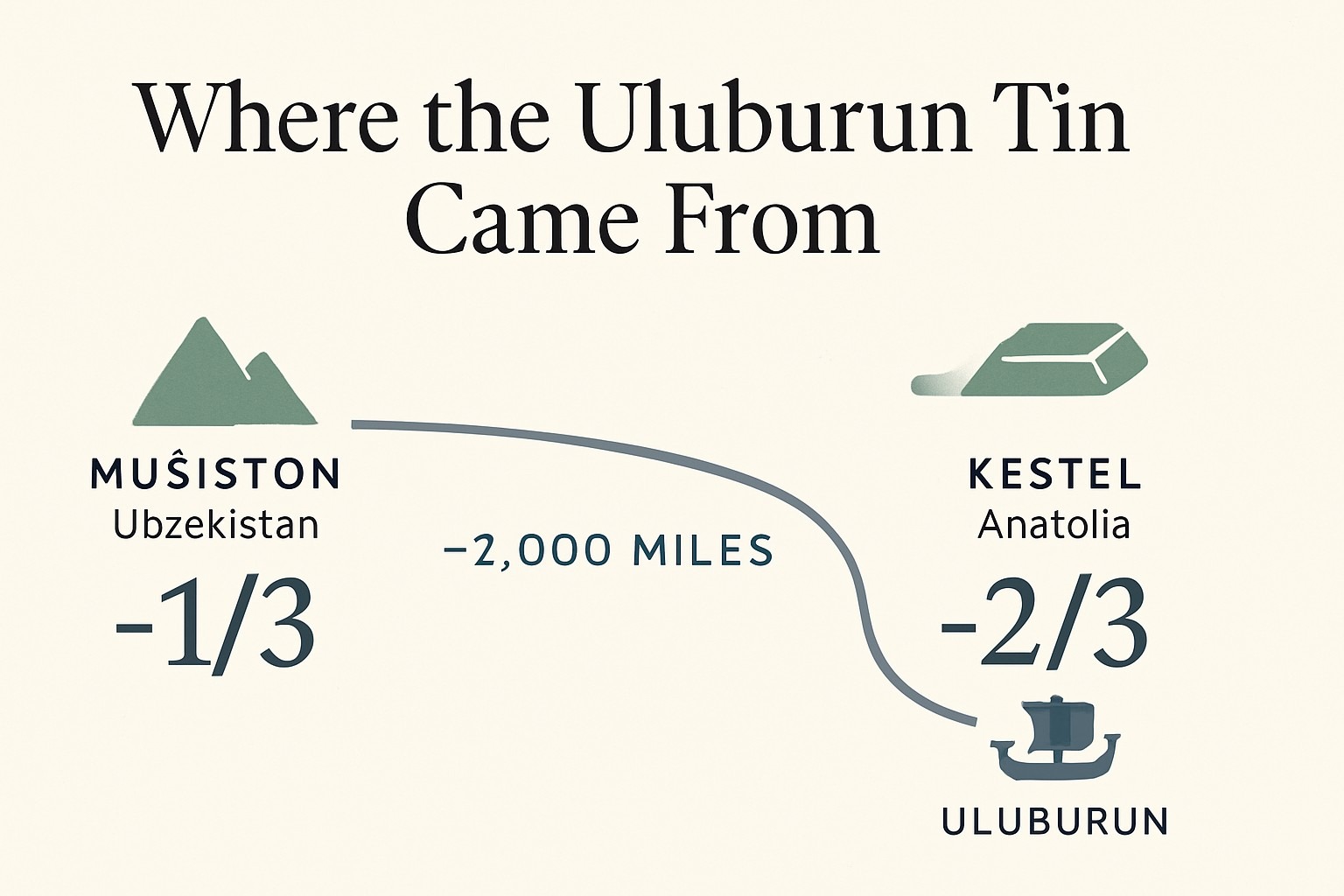
In short: Chemical analysis of the ship’s tin ingots shows about one-third came from the Mušiston mine in present-day Uzbekistan and roughly two-thirds from the Kestel mine in Anatolia — meaning the Bronze Age tin trade reached deep into Central Asia, far beyond any single empire’s control.
- ~1320 BCE — approximate date the ship went down, in the Late Bronze Age
- ~10 tons of copper + ~1 ton of tin — close to the 10:1 ratio that makes bronze
- 105 tin ingots chemically fingerprinted in the 2022 study
- ~1/3 vs 2/3 — the tin’s split between a Central Asian mine and an Anatolian one
- 44–61 m deep, 22,000+ dives — the excavation that took eleven seasons
Key Facts
- The 2022 study chemically fingerprinted 105 tin ingots from the Uluburun shipwreck, published in Science Advances
- About one-third of the tin came from the Mušiston mine in present-day Uzbekistan and roughly two-thirds from the Kestel mine in Anatolia
- The ship carried about 10 tons of copper and about 1 ton of tin, near the 10:1 ratio that makes bronze
- The ship went down around 1320 BCE in the Late Bronze Age off Uluburun near Kaş, Turkey
- The excavation ran 1984–1994 across eleven seasons with over 22,000 dives to a wreck 44–61 metres deep
In short: A 2022 chemical analysis of 105 tin ingots from the roughly 1320 BCE Uluburun shipwreck traced about one-third of the tin to the Mušiston mine in Uzbekistan and two-thirds to the Kestel mine in Anatolia. This showed the Bronze Age tin trade reached deep into Central Asia, far beyond any single empire’s control.
A ton of tin, and a 2,000-mile question
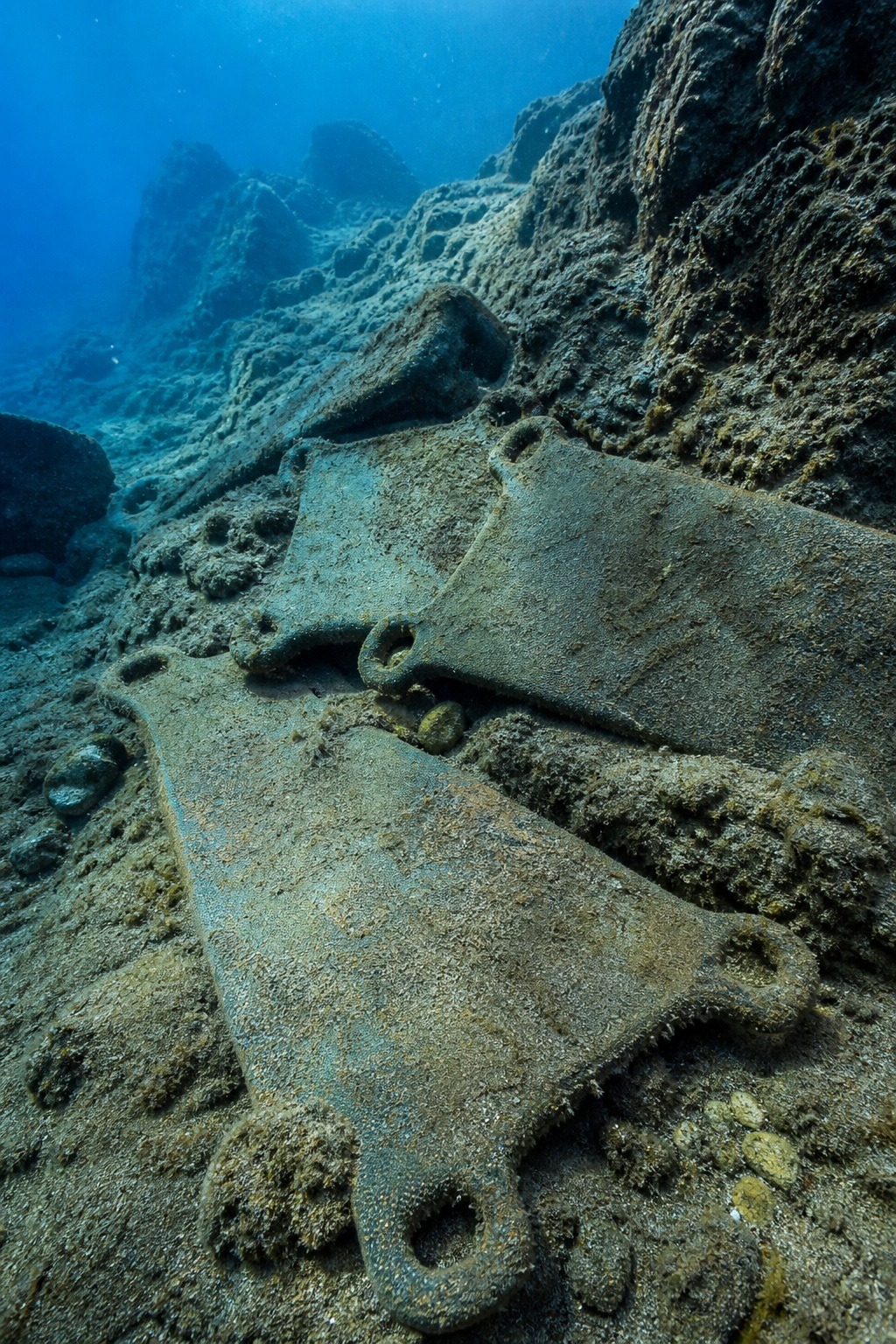
A sponge diver named Mehmed Çakır spotted the wreck in 1982, describing “metal biscuits with ears” scattered on the slope. Those biscuits were oxhide ingots — flat slabs of copper cast with handle-like corners for carrying. Marine archaeologists from the Institute of Nautical Archaeology, led by Cemal Pulak of Texas A&M University, worked the site from 1984 to 1994, logging more than 22,000 dives to a wreck resting between 44 and 61 metres down.
What they raised is still the richest single haul of Bronze Age trade goods ever recovered. And buried inside that haul sat a puzzle. The copper was relatively easy to source. The tin was not. Tin is scarce, geologically fussy, and almost never found near the copper it needs to become bronze — yet here was a full ton of it, cut into neat ingots, ready to be alloyed. Where does a ton of the era’s rarest strategic metal actually come from?
For thirty years, the honest answer was: we don’t really know.
The richest cargo ever pulled from the sea
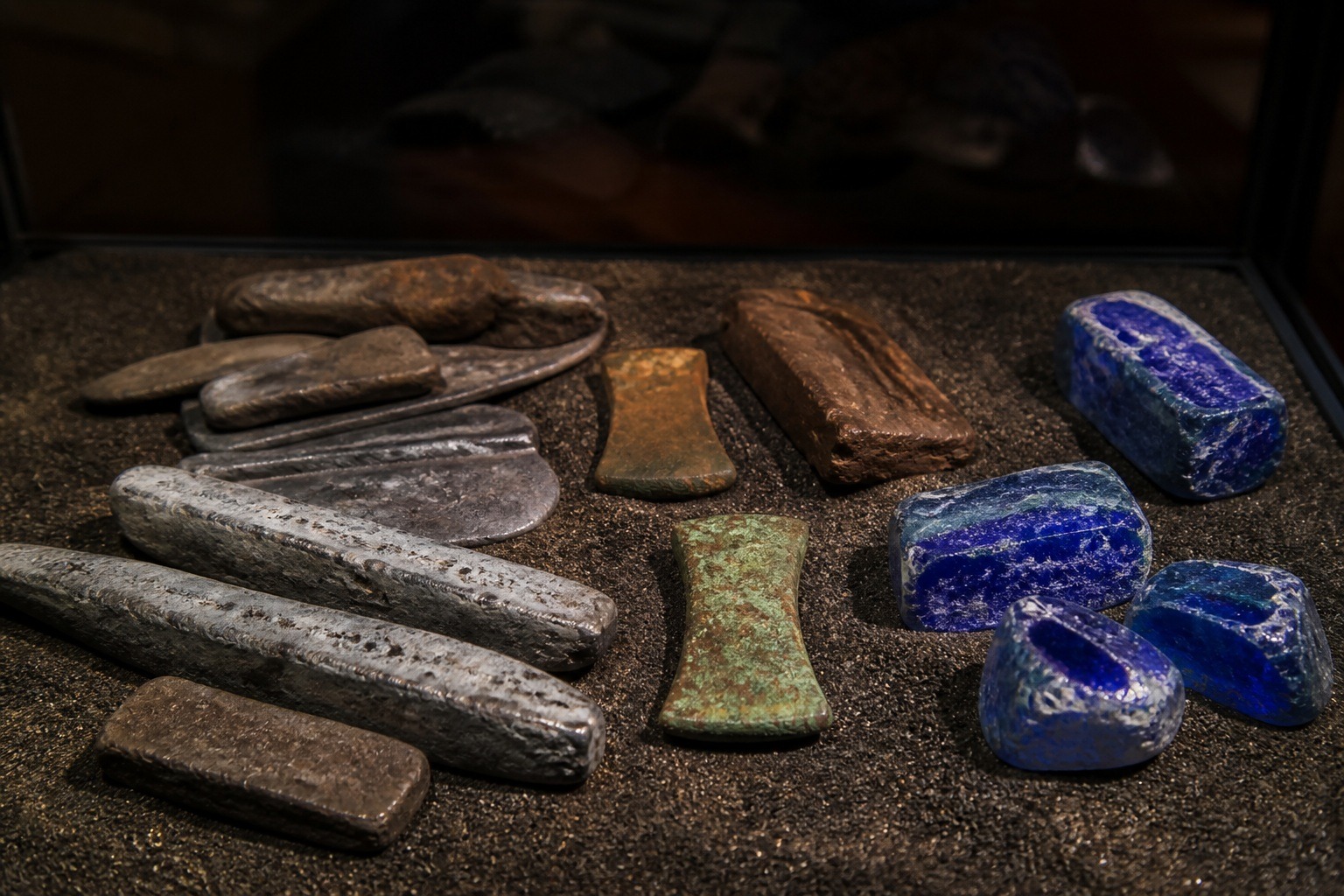
The manifest reads like the inventory of a lost world. Beyond the metal there was raw glass in cobalt-blue and turquoise ingots, ebony logs from Africa, elephant and hippopotamus ivory, ostrich eggshells, Cypriot pottery, amber from the Baltic, and terebinth resin sealed in more than a hundred jars. A gold scarab carried the name of Nefertiti — one of only a handful of objects anywhere to bear it. Cargo on this one ship came from at least a dozen cultures ringing the Mediterranean and beyond.
But the copper and tin were the point of the voyage. Bronze — copper hardened with a splash of tin — was the metal of the age’s weapons, tools, armour and prestige. Copper was comparatively common. Tin was the bottleneck. Combine the two in roughly a ten-to-one ratio and you get bronze; miss the tin and you have soft, near-useless copper. That scarcity made tin the closest thing the Late Bronze Age had to a strategic fuel.
{IMAGE_2}
Why tin was the oil of the Bronze Age
Here’s the thing about tin: whole civilizations depended on it and almost none of them had any. The great powers of the day — Egypt, the Hittites, Mycenaean Greece, the cities of the Levant — sat in a broad belt with rich copper but little to no workable tin. To arm a soldier or cast a plough, they had to import it, sometimes across enormous distances, through middlemen they would never meet.
That dependence is exactly why the wreck’s tin matters. If you can trace where it was mined, you are not just labelling a metal bar — you are mapping the supply line that armed and equipped the eastern Mediterranean. Control that line and you controlled bronze itself. It is a reasonable comparison to oil today: a resource so essential and so unevenly distributed that trade in it stitched distant, unrelated societies into a single fragile web.
How do you fingerprint a 3,300-year-old ingot?
You cannot ask a tin bar where it was born, but you can read its chemistry. The 2022 team, publishing in the journal Science Advances, analysed 105 of the ship’s tin ingots using three overlapping methods: tin-isotope ratios, lead-isotope ratios, and trace-element chemistry. Think of it as a chemical DNA test.
The logic is this. Tin ore forms in different places at different geological moments, and each deposit locks in a slightly different mix of isotopes — the same element in atomic variants of different weight. That mix is a signature. Measure it precisely enough in an ancient ingot, then compare it against ore sampled from known ancient mines, and the ranges either overlap or they don’t. Wayne Powell, a geologist at Brooklyn College and the study’s lead author, and Michael Frachetti, professor of archaeology at Washington University in St. Louis, matched the ingots’ fingerprints against candidate sources across Eurasia. Two lit up.
Afghanistan or Uzbekistan? The real Uluburun shipwreck tin origin
For years the popular shorthand was that Bronze Age tin came “from Afghanistan.” It was a fair guess — Central Asia was known to hold tin, and Afghanistan was the region people had heard of. The 2022 isotope work sharpened that blur into a specific address: not Afghanistan, but the Mušiston mine in what is now Uzbekistan (in the borderland with Tajikistan), which supplied roughly a third of the ship’s tin. The other two-thirds traced to the Kestel mine in the Taurus Mountains of Anatolia, in modern Turkey.
So the older “Afghanistan” claim wasn’t so much wrong as unfocused — the right neighbourhood, the wrong door. The correction is itself the story: better tools turned a continent-sized hand-wave into two named mines.
| Source mine | Region (today) | Share of the tin | Who supplied it |
|---|---|---|---|
| Mušiston | Uzbekistan / Tajikistan borderland, Central Asia | ~one-third | Small highland pastoralist communities, outside any empire |
| Kestel | Taurus Mountains, Anatolia (Turkey) | ~two-thirds | Anatolian mining tradition, closer to the Mediterranean |
The herders who fed a global trade
The most surprising finding is not geological — it’s social. The tin from Mušiston did not flow out of a palace economy or a royal monopoly. According to Frachetti, it was produced and moved by small, mobile communities of highland herders living far outside the reach of any state. Stateless pastoralists, in other words, were feeding metal into a network that armed the pharaohs.
Frachetti’s own analogy is homely and sharp: it was less like a national oil company and more like scattered “backyard oil rigs in Kansas” — countless small operators, none of them powerful, each passing product down the line until it reached a Levantine port and a waiting ship. That the poorest and least powerful people in the whole system turned out to be its indispensable suppliers is the quietly radical thing this wreck has told us.
It reframes how the Bronze Age worked. The grand story is usually one of kings, treaties and armies. The tin says the plumbing underneath ran on ordinary, decentralized hands — a market older and more resilient than any of the empires it supplied.
Not so fast: the scientists who disagree
A tidy answer would be nice. Science rarely offers one. A published rebuttal — pointedly titled “Why Central Asia’s Mushiston is not a source for the Late Bronze Age tin ingots from the Uluburun shipwreck” — argues that the isotope and trace-element data do not actually prove a Mušiston origin, and that the fingerprints could plausibly point elsewhere. The critique targets how narrowly the source ranges overlap and how many candidate deposits were tested.
Which reading is right? Honestly, it isn’t settled. Provenance-by-isotope is powerful but not magic: two distant mines can share overlapping signatures, and the reference database of sampled ancient ores is still incomplete. As of 2026 no newer study has overturned the 2022 result, but neither has it closed the argument. The debate is live — and a good article about the Uluburun shipwreck tin origin should say so rather than pretend the case is shut.
Why a sunken cargo still matters
One ship, one bad night off a rocky headland, and a snapshot of a connected world was preserved for us to read. The value of the Uluburun wreck keeps growing precisely because the tools we bring to it keep improving — the isotope work simply wasn’t possible when the ingots were first raised.
That is the forward-looking promise. Somewhere in the Bodrum Museum of Underwater Archaeology, where the cargo now sits, those bars are still holding data no one has fully decoded. New reference samples from unexplored Eurasian mines, sharper isotope techniques, fresh eyes on the debate — any of these could tighten the map further, or redraw it. A 3,300-year-old cargo is, in a real sense, still being unloaded.
Common Questions
Where did the Uluburun tin come from? The 2022 study found roughly one-third came from the Mušiston mine in present-day Uzbekistan and about two-thirds from the Kestel mine in the Taurus Mountains of Anatolia (Turkey). A published rebuttal disputes the Central Asian source, so it remains debated.
How old is the Uluburun shipwreck? It sank around 1320 BCE, in the Late Bronze Age — roughly 3,300 years ago. A sponge diver found it in 1982, and it was excavated between 1984 and 1994.
Why was tin so valuable in the Bronze Age? Tin, alloyed with copper at about ten-to-one, makes bronze — the era’s key metal for weapons and tools. Tin is rare and rarely found near copper, so it had to be traded over long distances, making it a strategic resource.
Isn’t the tin from Afghanistan? That was the older, looser claim. The 2022 isotope analysis refined “Central Asia / Afghanistan” to a specific mine in Uzbekistan (Mušiston), though the identification is still contested by some researchers.
Sources and Notes
- Powell, W., Frachetti, M., et al. (2022). “Tin from the Uluburun shipwreck shows small-scale commodity exchange fueled continental tin supply across Late Bronze Age Eurasia,” Science Advances.
- Washington University in St. Louis — The Source (November 2022), reporting on Michael Frachetti’s tin-isotope research.
- Institute of Nautical Archaeology / Texas A&M University — Uluburun excavation records, directed by Cemal Pulak.
- Bodrum Museum of Underwater Archaeology (Turkey) — Uluburun Hall, cargo and excavation details.
- Rebuttal paper: “Why Central Asia’s Mushiston is not a source for the Late Bronze Age tin ingots from the Uluburun shipwreck” — documenting the ongoing scholarly dispute.
The metal that armed a civilization was dug by people whose names we will never know, in mountains most of that civilization never saw. That is the strange gift of the Uluburun wreck: it lets us hold, quite literally, the far end of a supply line that ran across a continent — and it is still teaching us how much of the ancient world moved through ordinary hands.
Frequently Asked Questions
Q: Where did the Uluburun shipwreck’s tin actually come from?
The 2022 isotope study identified two named sources. About one-third of the ship’s tin traced to the Mušiston mine in present-day Uzbekistan, on the borderland with Tajikistan in Central Asia. The other roughly two-thirds came from the Kestel mine in the Taurus Mountains of Anatolia, in modern Turkey. This corrected the older vague claim that Bronze Age tin came simply from Afghanistan, replacing a continent-sized guess with two specific mines.
Q: How did scientists fingerprint a 3,300-year-old tin ingot?
The 2022 team, publishing in Science Advances, analysed 105 tin ingots using three overlapping methods: tin-isotope ratios, lead-isotope ratios, and trace-element chemistry, described as a chemical DNA test. Tin ore forms at different geological moments, locking in a distinct isotope signature. By measuring it precisely and comparing against ore from known ancient mines, the ranges either overlap or they don’t, pinpointing the source. Wayne Powell and Michael Frachetti led the matching.
Q: Why was tin so important in the Bronze Age?
Bronze — copper hardened with tin in roughly a ten-to-one ratio — was the metal of the age’s weapons, tools, armour and prestige. Copper was comparatively common, but tin was scarce, geologically fussy, and almost never found near copper. Great powers like Egypt, the Hittites and Mycenaean Greece had rich copper but little workable tin, forcing them to import it across enormous distances. That scarcity made tin the closest thing the Late Bronze Age had to a strategic fuel.
Q: What else was found in the Uluburun cargo?
Beyond about 10 tons of copper and 1 ton of tin, the wreck held raw glass in cobalt-blue and turquoise ingots, ebony logs from Africa, elephant and hippopotamus ivory, ostrich eggshells, Cypriot pottery, Baltic amber, and terebinth resin in more than a hundred jars. A gold scarab carried the name of Nefertiti. Cargo on this single ship came from at least a dozen cultures ringing the Mediterranean and beyond, making it the richest Bronze Age haul ever recovered.
Illustrations are AI-generated. Article fact-checked and human-edited. Our editorial standards.