Did the Mongols Catapult Plague Corpses Into Caffa?
Did the Mongols catapult plague corpses into Caffa? In the story as it is almost always told, the year is 1346, the Golden Horde of Jani Beg has spent months failing to break a stubborn Genoese port on the Crimean coast, and — with plague already thinning his own camp — the khan orders his siege engines loaded with the bodies of his dead and lobs them over the walls. Inside, the Genoese sicken. A handful flee by ship. And the Black Death sails west into Europe. It is a perfect, terrible story. The trouble is that almost every load-bearing part of it now looks shaky.
Key Facts
- Caffa, modern Feodosia on the Crimean Peninsula, was a Genoese trading colony besieged by Jani Beg, khan of the Golden Horde, starting in 1345 and dragging into 1346
- The sole source for the catapult story is Gabriele de’ Mussi, a notary from Piacenza who was never at Caffa and wrote his account around 1348, roughly two years after the events and some 1,500 miles away
- Disarmament scholar Jean Pascal Zanders, writing in the Bulletin of the Atomic Scientists in 2023, concluded the corpse-catapulting probably never happened
- A June 2022 Nature study by Maria Spyrou, Johannes Krause and Philip Slavin traced the Black Death’s origin to Kara-Djigach and Burana cemeteries near Lake Issyk-Kul, Kyrgyzstan, with tombstones dated 1338-1339
- Twelve Genoese ships are traditionally said to have reached Messina, Sicily, in October 1347, carrying the plague into Western Europe
In short: The tale of Mongols catapulting plague corpses into Caffa in 1346 rests on one secondhand account by Gabriele de’ Mussi, who was never there. A 2023 analysis found the feat mechanically implausible, and a 2022 Nature study traced the Black Death’s origin to Kyrgyzstan in 1338-1339, years earlier and thousands of kilometers away.
The night the sky rained the dead — the legend, told straight

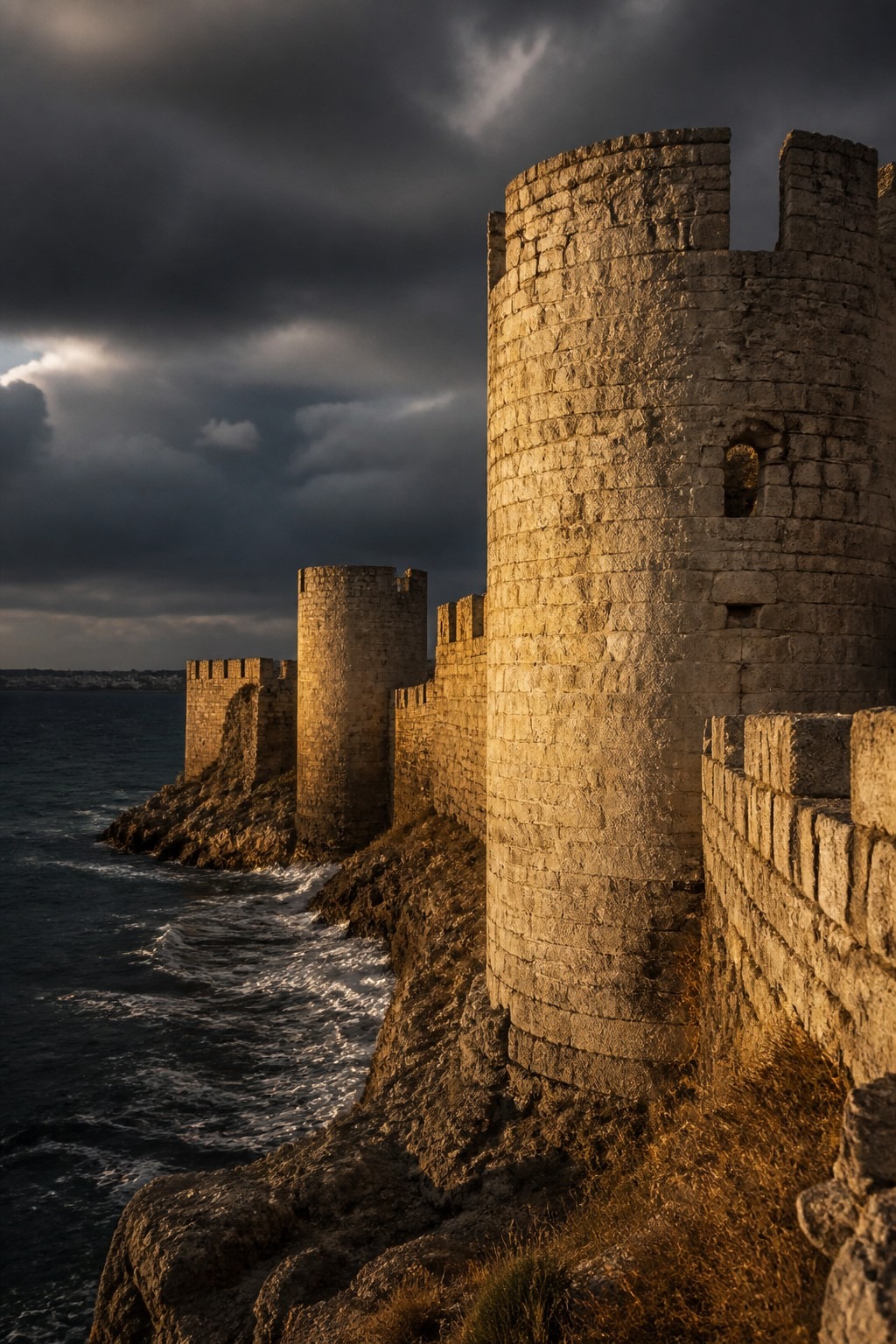
Caffa (modern Feodosia, on the Crimean Peninsula) was one of the great Genoese trading colonies of the fourteenth century — a walled harbour where Italian merchants bought slaves, grain, silk and furs funneled in from the Silk Road. In 1345 it fell under siege by Jani Beg, khan of the Golden Horde, in a quarrel that had turned Genoese-Mongol trade into open war. The siege dragged into 1346.
Then, the story runs, disease broke out among the besieging Mongols. Rather than simply withdraw, Jani Beg is said to have turned catastrophe into a weapon: his men heaped their own plague dead into the siege engines and flung the corpses over Caffa’s ramparts, hoping — this is the crucial detail — that the stench of rotting flesh would poison the air and kill the defenders. Sickness duly erupted inside the city. Genoese survivors crowded onto galleys and ran for home. In October 1347, twelve of those ships are traditionally said to have reached Messina, in Sicily, carrying the pestilence into Western Europe for the first time.
Told that way, Caffa becomes the hinge of European history and, in dozens of textbooks and documentaries, “the first biological weapon in history.” It is repeated with total confidence. Almost none of that confidence is earned.
The one witness who was never there: who was Gabriele de’ Mussi?
Every version of the catapult tale traces back to a single document. Its author, Gabriele de’ Mussi, was a notary from Piacenza in northern Italy — a competent lawyer with a taste for vivid narration. He wrote his account of the pestilence around 1348.
Here is the problem, and it is not a small one. De’ Mussi was in Piacenza. He was never at Caffa. He was writing, at best, from the secondhand reports of returning traders, roughly two years after the events and some 1,500 miles from where they supposedly happened. To this day no eyewitness account from inside Caffa during the siege has ever surfaced — not one. The entire edifice of “medieval biological warfare” rests on one man’s dramatic retelling of a rumour.
That does not make de’ Mussi a liar. Fourteenth-century chroniclers routinely wrote up hearsay as history, and a besieging army dumping its dead near a city under siege is entirely plausible on its own. What it means is narrower and more important: the catapulting of plague corpses at Caffa is a claim, not a documented fact — and it has been treated as fact for seven hundred years.
{IMAGE_2}
Could a mangonel really fling a corpse over Caffa’s walls?
Set the missing witness aside for a moment and ask a purely mechanical question. Could it even be done?
This is where the disarmament scholar Jean Pascal Zanders, writing in the Bulletin of the Atomic Scientists in 2023, took the story apart. Popular retellings picture a towering counterweight trebuchet — the medieval super-weapon that hurls boulders with a swinging mass. But those machines demanded enormous timber frames and skilled crews, and there is no evidence the Horde built them at Caffa or that the treeless Crimean coast even offered the heavy timber to do so. The realistic weapon was the traction mangonel: a lighter engine pulled by teams of men, with a short range and a modest payload.
Now load it with a human body. A corpse is the worst possible projectile — floppy, aerodynamically hopeless, impossible to aim. The terrain at Caffa slopes uphill toward the walls, stealing range from any throw. To clear a defended rampart you would need to park your siege engines within easy bowshot of the defenders and then heave cadavers, one by one, uphill, for hours. Zanders’s verdict is blunt: it “probably never happened.” On the evidence, the catapult has always been a better weapon for storytellers than it ever was for the Golden Horde.
The 2022 bombshell: the Black Death did not start at Caffa at all
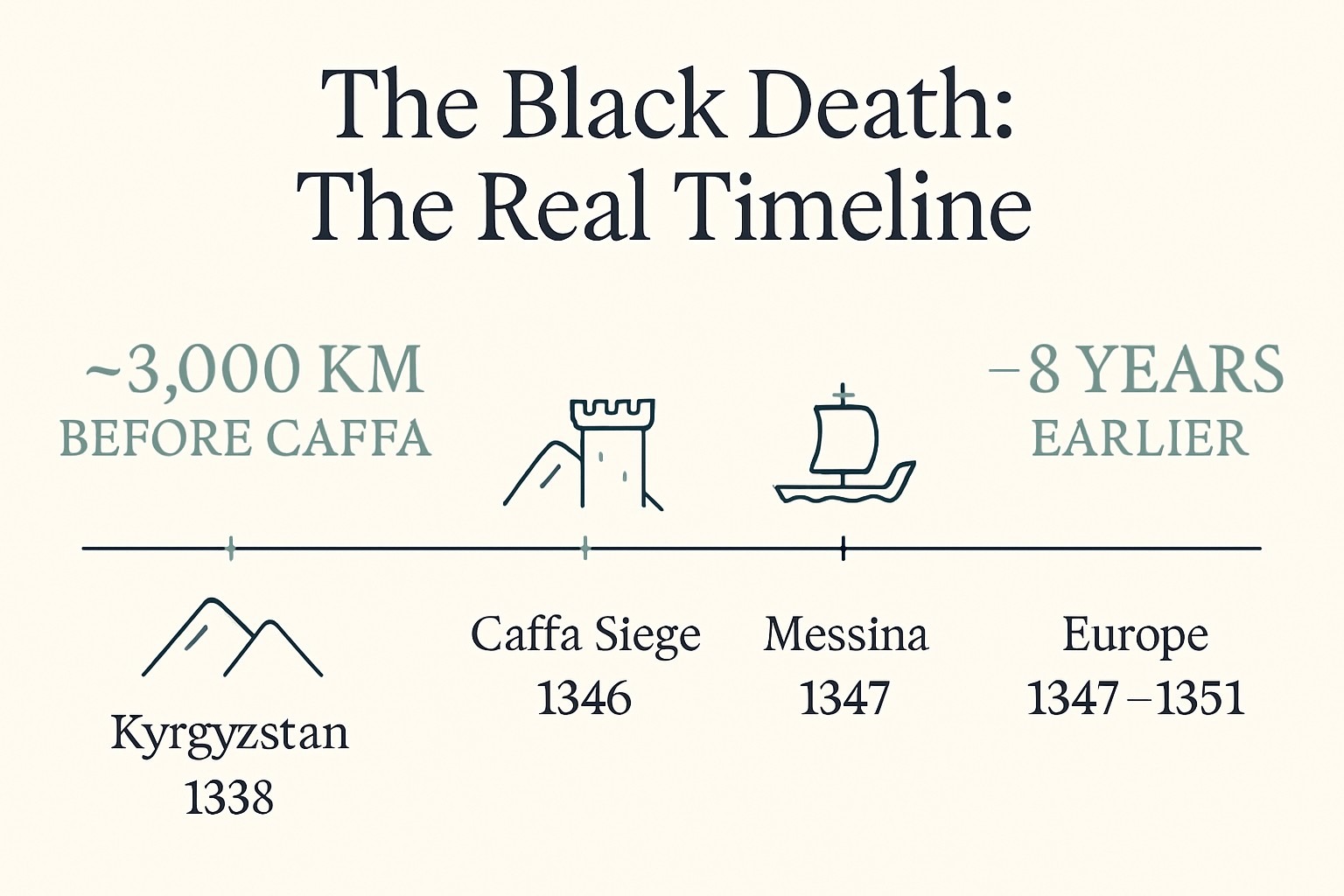
Even if you grant the catapult everything — the timber, the physics, the aim — a second discovery pulls the rug out entirely. Because the Black Death did not begin in Crimea. It began roughly 3,000 kilometres to the east, and years earlier.
In June 2022, a team led by archaeogeneticist Maria Spyrou and Johannes Krause of the Max Planck Institute, with historian Philip Slavin of the University of Stirling, published in Nature one of the great detective stories of modern science. Near Lake Issyk-Kul in the Tian Shan mountains of what is now Kyrgyzstan lay two medieval cemeteries, Kara-Djigach and Burana. They held a strange spike of tombstones dated to 1338 and 1339, and ten of them carried the same word: pestilence. Extracting ancient DNA from the teeth of the buried, the researchers recovered Yersinia pestis — the plague bacterium — and showed that this exact strain sat at the root of the family tree from which every later Black Death strain in Europe descends.
Read that again. The pandemic’s genetic “Big Bang” was in central Asia, in 1338–1339 — very likely a spillover from wild marmots in the Tian Shan, the region’s natural plague reservoir. That is nearly a decade before the siege of Caffa and thousands of kilometres away. Whatever Jani Beg did or did not fling over those walls, the Black Death was already loose in the world.
- 1338–1339 — Lake Issyk-Kul, Kyrgyzstan: tombstones read “pestilence”; ancient DNA confirms Y. pestis at the root of the pandemic (Spyrou et al., Nature, 2022).
- 1345–1346 — Jani Beg’s Golden Horde besieges the Genoese port of Caffa (Feodosia, Crimea).
- c. 1346 — the alleged corpse-catapulting, known only from de’ Mussi.
- October 1347 — Genoese ships reach Messina, Sicily: plague enters Western Europe.
- c. 1348 — de’ Mussi writes his account — in Piacenza, ~1,500 miles from Caffa.
- 1347–1351 — the Black Death kills perhaps 25 million in Europe, about a third of the continent.
Gap between the true origin and Caffa: roughly 8 years and ~3,000 km.
How the plague actually reached Europe: ships, rats and the Silk Road
So if a catapult didn’t carry the Black Death to Europe, what did? The undramatic answer is: trade, over and over again.
Yersinia pestis lives in rodents and travels on their fleas. It moves wherever grain, cargo and rats move — and in the 1340s that meant the caravan roads of the Silk Road and the crowded galleys of the Mediterranean. The disease crept west from central Asia in stepwise hops along these networks, reaching the Black Sea ports, then Constantinople, then Italy, then the whole continent. Bubonic plague announced itself with swollen, blackened lymph nodes — the “buboes” that gave the disease its name — usually a few days after infection, and it killed a frightening share of those it touched.
This is exactly why Mark Wheelis, a microbiologist at the University of California, Davis, urged caution even in his careful 2002 paper for the CDC’s Emerging Infectious Diseases. Wheelis was willing to entertain that a corpse-throwing attack at Caffa could have happened and could have started an outbreak inside the city. But he stressed that it “probably had no more than anecdotal importance in the spread of plague.” The pestilence was already advancing on many fronts, on many ships, along many roads. Caffa was, at most, one leak in a hull that was flooding everywhere at once.
There is a bitter irony buried here. Jani Beg’s men, if they threw anything, were aiming at the smell — medieval “miasma” theory held that foul air, the stench of the dead, was what spread disease. They had the mechanism exactly backwards. The real danger was never the odour drifting over the walls. It was the fleas, and the rats already nesting in the grain holds of the very ships the Genoese would flee on.
So, did the Mongols catapult plague corpses into Caffa?
The honest verdict is a layered one, and each layer matters.
Did a Mongol army besiege Caffa and suffer from plague? Almost certainly yes. Did they fling their dead over the walls? Possibly — armies did grim things with corpses, and we cannot rule it out. Did that act launch the Black Death into Europe? Almost certainly not: the pandemic began in Kyrgyzstan around 1338, spread along trade routes on its own, and would have reached Italy with or without a single Crimean siege. Is the catapult story documented fact? No. It rests on one secondhand chronicle by a man who was never there, and it fails the test of physics and terrain when examined closely.
Strip it down and what survives is modest: a plausible siege, a possible atrocity, and a story that has been inflated far beyond what a single absent notary could ever support.
Quick Answers
Who wrote the catapult story? Gabriele de’ Mussi, a notary from Piacenza in Italy, around 1348 — writing secondhand, having never set foot in Caffa.
Where did the Black Death really begin? Ancient-DNA evidence published in Nature in 2022 points to the Tian Shan region near Lake Issyk-Kul, in modern Kyrgyzstan, around 1338–1339 — years before Caffa and thousands of kilometres away.
Sources and Notes
- Maria A. Spyrou, Johannes Krause, Philip Slavin et al., “The source of the Black Death in fourteenth-century central Eurasia,” Nature, 2022.
- Jean Pascal Zanders, “Catapulting corpses? A famous case of medieval biological warfare probably never happened,” Bulletin of the Atomic Scientists, 2023.
- Mark Wheelis, “Biological Warfare at the 1346 Siege of Caffa,” Emerging Infectious Diseases (US CDC), Vol. 8, No. 9, 2002.
- Contemporary chronicle of Gabriele de’ Mussi (c. 1348), the sole source for the corpse-catapulting account.
What makes Caffa endure is not evidence but shape. It gives a shapeless, world-shattering catastrophe a single villain, a single walled city, a single moment you can picture — the dead arcing over the ramparts at dusk. Real history rarely offers that. The truth here is quieter and, in its way, more unsettling: no one had to do anything for the Black Death to come. It was already travelling, patiently, in the fleas and the cargo holds and the caravan dust, long before anyone in Caffa looked up at the sky. The catapult is a story we tell because it is easier to fear a weapon than to fear the ordinary traffic of the world.
Frequently Asked Questions
Q: Did the Mongols really catapult plague corpses into Caffa?
The claim rests entirely on a single document by Gabriele de’ Mussi, a notary from Piacenza who was never at Caffa. He wrote his account around 1348, roughly two years after the events and some 1,500 miles away, drawing at best on secondhand reports from returning traders. No eyewitness account from inside Caffa during the siege has ever surfaced. This makes the corpse-catapulting a claim, not a documented fact, though it has been treated as fact for seven hundred years.
Q: Was it mechanically possible to fling a corpse over Caffa’s walls?
Disarmament scholar Jean Pascal Zanders, writing in the Bulletin of the Atomic Scientists in 2023, argued it probably never happened. The realistic weapon was the traction mangonel, a light engine with short range and modest payload, not a towering trebuchet. A corpse is a terrible projectile: floppy, aerodynamically hopeless, and impossible to aim. The terrain at Caffa slopes uphill toward the walls, stealing range from any throw. His verdict was blunt: it probably never happened.
Q: Where did the Black Death actually begin?
A June 2022 Nature study led by archaeogeneticist Maria Spyrou and Johannes Krause of the Max Planck Institute, with historian Philip Slavin of the University of Stirling, traced its origin to near Lake Issyk-Kul in Kyrgyzstan. Two cemeteries, Kara-Djigach and Burana, held tombstones dated 1338-1339, ten reading pestilence. Ancient DNA recovered Yersinia pestis sitting at the root of every later European Black Death strain, nearly a decade before the Caffa siege and thousands of kilometers east.
Q: Who was Gabriele de’ Mussi?
Gabriele de’ Mussi was a notary from Piacenza in northern Italy, a competent lawyer with a taste for vivid narration. He wrote his account of the pestilence around 1348. Crucially, he was in Piacenza and never at Caffa, writing from secondhand reports of returning traders roughly two years after the events and some 1,500 miles away. This does not make him a liar, since fourteenth-century chroniclers routinely wrote hearsay as history, but the entire biological-warfare story rests on his single retelling.
Illustrations are AI-generated. Article fact-checked and human-edited. Our editorial standards.