The Vindolanda Birthday Invitation: Rome’s Oldest ‘Save the Date’
The vindolanda birthday invitation is a wafer-thin slip of birch wood, roughly the size of a postcard, on which a Roman officer’s wife wrote to her friend almost 2,000 years ago and asked her to come to a party. That is nearly the whole of it — a few lines of brown ink, an address, a date in September. And yet it may be the most quietly astonishing thing ever lifted from the mud of Roman Britain, because the last lines were added by the woman herself. That makes them the earliest surviving example of Latin handwriting by a woman anywhere in the Roman world.
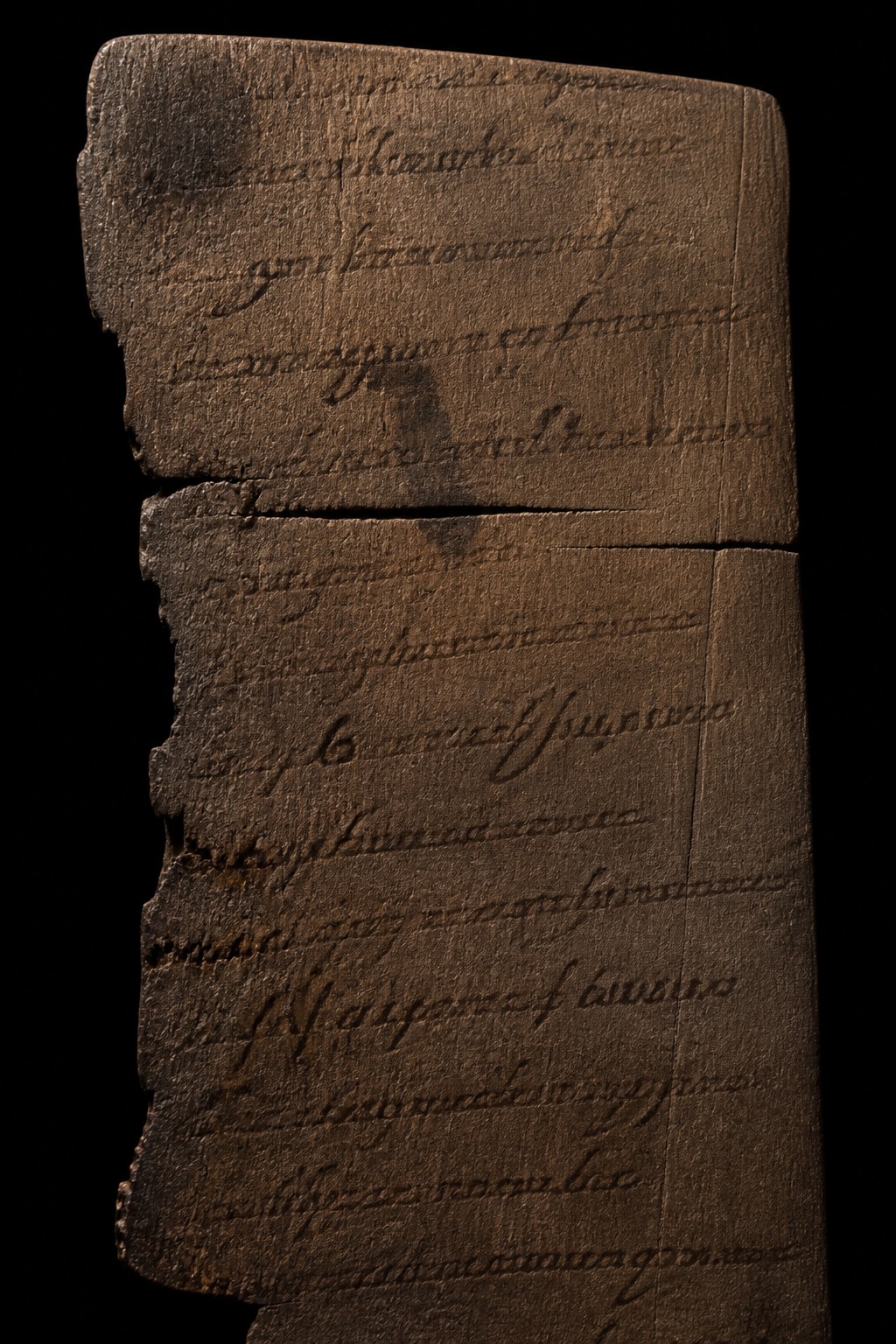
- What it is: An ink-on-wood leaf letter, catalogued as Tab.Vindol. 291
- Written: c. AD 97–105, at Vindolanda fort on Rome’s northern British frontier
- From / to: Claudia Severa, inviting her friend Sulpicia Lepidina to a birthday party
- The claim: The earliest known Latin handwriting by a woman in the entire Roman Empire
- Where it lives now: The British Museum, Roman Britain gallery (Room 49), reg. 1986,1001.64
Key Facts
- Tablet 291 (Tab.Vindol. 291) is an ink-on-birch-wood leaf letter written about AD 97-105 at Vindolanda fort.
- Claudia Severa invites her friend Sulpicia Lepidina to a birthday party on 11 September (iii Idus Septembres).
- The final lines, added in Severa’s own hand, are the earliest known Latin handwriting by a woman in the Roman Empire.
- It now lives in the British Museum, Roman Britain gallery (Room 49), reg. 1986,1001.64.
- It predates Hadrian’s Wall, whose construction began around AD 122, by roughly two decades.
In short: The Vindolanda birthday invitation, Tablet 291, is a thin birch-wood letter written around AD 97-105 in which Claudia Severa invites her friend Sulpicia Lepidina to a party. Severa’s personal sign-off is the earliest surviving example of Latin handwriting by a woman anywhere in the Roman Empire, now held in the British Museum.
A Party Invitation From the Edge of the World
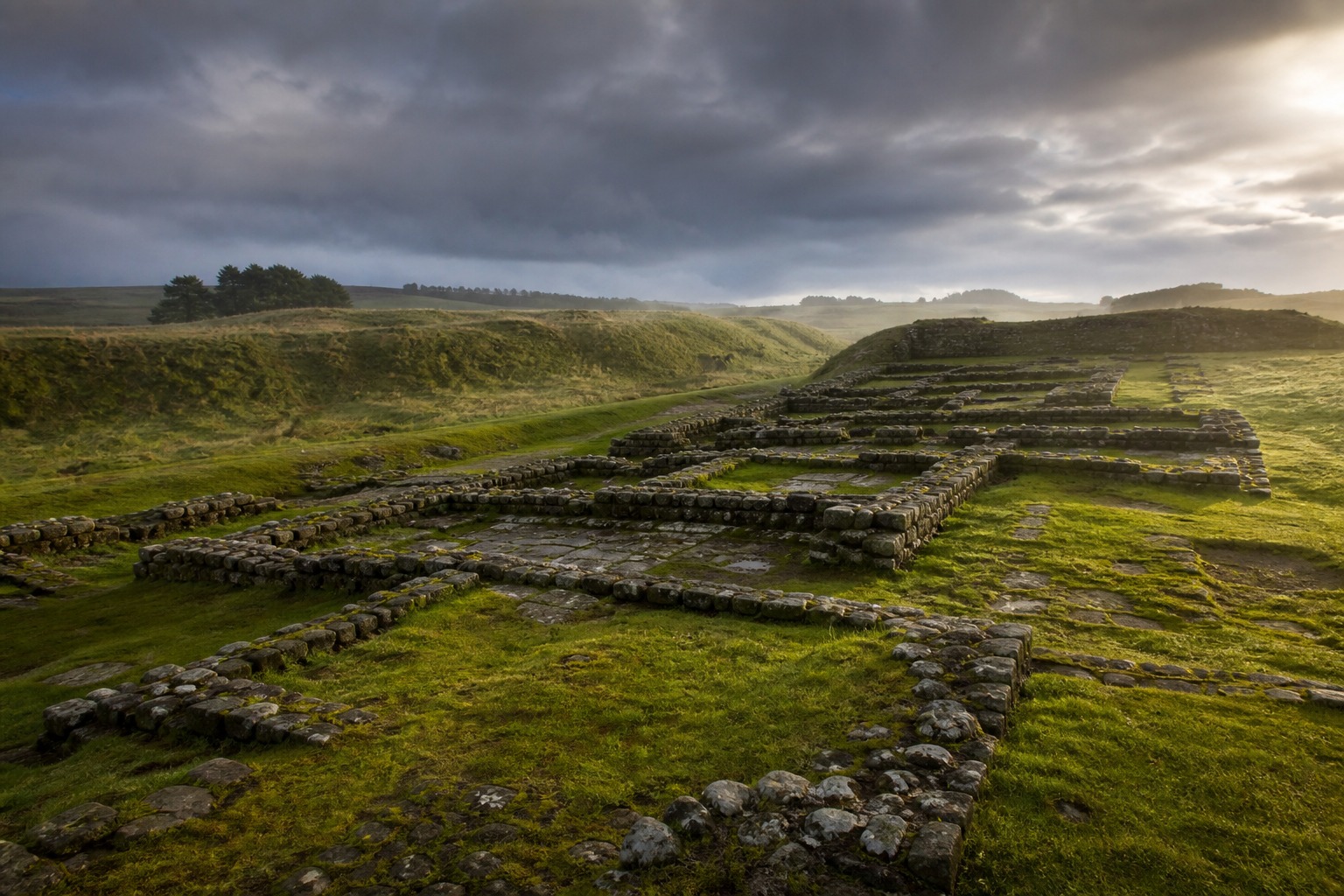
Picture the setting. It is around AD 100, and Vindolanda is a timber-and-turf fort planted in the cold, wet uplands of northern England — the last outpost before hostile territory, garrisoned by auxiliary soldiers far from home. Rain, mud, woodsmoke, and the constant low anxiety of a frontier. Into this a small folded sheet of wood arrives, carried perhaps a dozen miles from a neighbouring fort. It is not a military order or a supply list. It is an invitation to a birthday party.
Claudia Severa is writing to Sulpicia Lepidina. She wants her there on 11 September — in the Roman reckoning, iii Idus Septembres, the third day before the Ides — to help make the day, in her words, more enjoyable. It is, for all practical purposes, a 2,000-year-old “save the date,” and it is often called the oldest surviving birthday invitation known. (Honest caveat: that means the oldest one we have found, not proof no one ever wrote such a thing earlier.)
Here’s a detail almost every retelling gets slightly wrong. The letter is routinely described as coming “from Hadrian’s Wall.” But when Severa dipped her pen, the Wall did not exist yet — construction only began around AD 122, roughly two decades later. Vindolanda already stood on this frontier a full generation before the famous stone barrier rose beside it. The invitation is older than the monument it is usually filed under.
Who Were Claudia Severa and Sulpicia Lepidina?
Both women belonged to the small, privileged world of the Roman officer class posted to Britain. Sulpicia Lepidina was married to Flavius Cerialis, prefect of the Ninth Cohort of Batavians (cohors IX Batavorum), the unit then holding Vindolanda. As the commander’s wife, she ran a household at the very top of the fort’s social order.
Claudia Severa was the wife of Aelius Brocchus, an officer commanding another fort not far away. The two families clearly moved in the same circle. In the letter Severa sends greetings from her husband — “my Aelius” — and from their small son, the ordinary texture of two households that knew each other well.
And they were friends. Real ones. Severa isn’t writing to a stranger out of duty; she is coaxing a companion to make the journey across bad roads so they can spend a day together. That ordinary warmth, preserved by accident, is what turns a scrap of wood into a window.
{IMAGE_2}
The Words She Wrote in Her Own Hand
Look closely at the tablet and you can see two different people at work. Most of the letter — the body, the formal greeting, the date — is written in a tidy, practised script. That was a scribe, someone Severa dictated to, exactly as a busy person might dictate a message today. Then, in the lower right, the handwriting changes. It grows looser, more hurried, unmistakably a second hand.
That second hand is Claudia Severa’s own. She took the pen back from her scribe to add a personal sign-off, the kind of thing you don’t dictate to an employee. Translated from the Latin, it reads:
The affection in the original is even stronger than it looks. She calls Lepidina soror — “sister” — though the two were not related by blood; it’s a term of deep closeness, the way you might call a best friend family. And she signs off anima mea karissima, “my dearest soul.” In her own handwriting, on the far edge of the empire, one woman tells another that she is her dearest soul. Turns out the Romans did tenderness too.
Why It Counts as the Earliest Latin Written by a Woman
The “earliest Latin written by a woman” claim rests entirely on that visible switch of hands, and it’s worth being precise about why. Plenty of Roman letters written for women survive — dictated to male scribes, in male hands. What makes Tablet 291 unique is that we can literally see a woman pick up the pen and write. The change of script is the evidence. Take it away and you have just another dictated note.
Because Vindolanda is so tightly dated by its archaeology — Severa’s letter belongs to the fort’s phase of roughly AD 97 to 105 — scholars can say with confidence that no earlier specimen of a woman’s own Latin handwriting has yet been recovered. That is the careful version of the headline. If you want to be exact, this is the earliest surviving example, and the honesty of that word matters: new finds could always push the record back.
Of everything dug from that muddy fort — the shopping lists, the duty rosters, the famous complaint about the roads — this thin scrap may be the most important, not because it names an emperor or settles a battle, but because it lets an individual Roman woman speak in her own hand across nineteen centuries.
How a Sliver of Wood Survived 1,900 Years
Wood and ink should not last. Bury them and they rot within years. So how did a postcard-thin leaf of birch survive since around AD 100? The answer is chemistry, and a lucky accident of rubbish disposal.
The tablets were thrown out, and ended up in ground that stayed permanently waterlogged and sealed from air. In that oxygen-starved, anaerobic environment, the microbes and fungi that normally devour organic material simply cannot function. The wood didn’t fossilise; it was pickled, held in a soggy, airless limbo where decay effectively stopped. Break that seal — let oxygen and drying reach the wood — and the tablets begin to deteriorate within hours, which is why conservation at the British Museum is so delicate.
Then there is the reading itself. The ink is carbon-based, and on darkened, stained wood the writing is often invisible to the naked eye. Researchers photograph the tablets under infrared light, which makes the carbon ink leap out against the wood in ways ordinary vision can’t catch. Much of what we know from Vindolanda was recovered not by squinting at the surface but by seeing in wavelengths our eyes don’t reach.
Reading the Invisible: The Tablets and AI in 2026
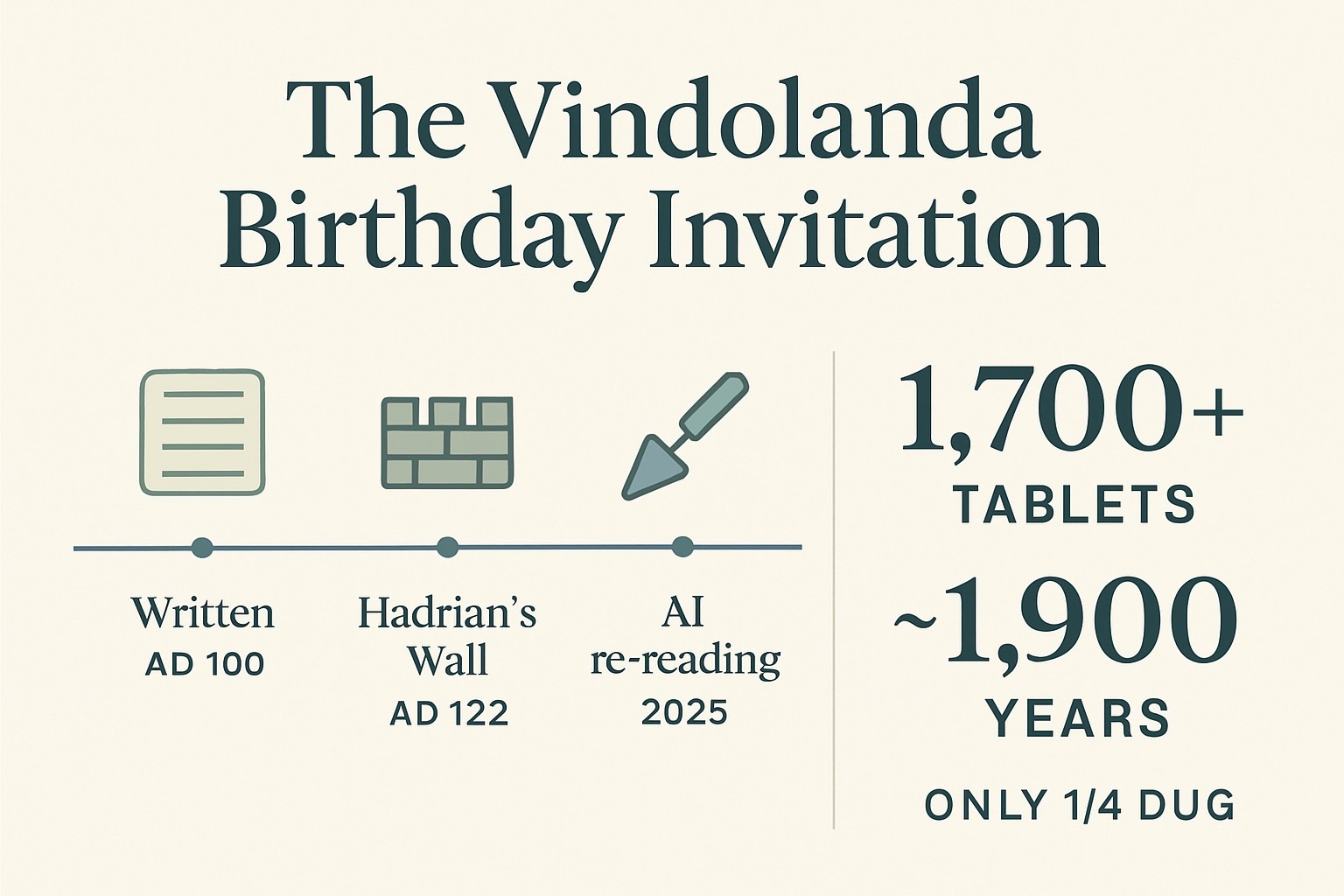
The Vindolanda story is not a closed book — it is being actively rewritten right now. The first tablets emerged in 1973, when archaeologist Robin Birley recognised the fragile slivers coming out of the ground; the birthday invitation itself came to light later, during excavations in the mid-1980s. By the Vindolanda Trust’s count, more than 1,700 ink tablets have now been recovered, with fresh finds still appearing as digging continues. And only about a quarter of the site has been excavated — meaning most of Vindolanda’s written archive is still in the ground.
In 2025 the effort took a modern turn. The British Museum and the University of Nottingham launched a collaborative doctoral project applying generative AI to the tablets — using machine handwritten-text recognition to help recover faded ink, reassemble broken fragments, untangle texts written over one another, and reconstruct missing sections. The work is supervised by Professor Alex Mullen of the University of Nottingham together with Dr Richard Hobbs of the British Museum and Dr Kai Xu of Nottingham.
What that means, in plain terms: letters that were considered too faint or too fragmentary to read may soon give up their words. Somewhere in that unexcavated three-quarters of the site, or in a tablet already dug but not yet legible, there could be Claudia Severa’s reply, or another woman’s hand entirely. The record isn’t finished.
What the Vindolanda Birthday Invitation Really Tells Us
Strip away the “earliest” superlatives for a moment and ask what the letter is actually about. It’s about friendship. Two women, married to soldiers, stationed at the wet, dangerous northern limit of the known Roman world, keeping their bond alive across the miles with a party and a warmly written note. The frontier was a place of violence and logistics and men; the birthday invitation is proof that it was also a place of intimacy, celebration, and female companionship.
Why does that land so hard, two thousand years on? Because it is so recognisable. The impulse to gather friends for a birthday, to say “please come, it’ll mean so much to me,” to sign off with real affection — none of it needs translation. We tend to imagine the Romans as marble statues and marching legions. Severa’s few lines put a living, feeling person back into that world: someone who missed her friend and wanted her at the table.
That is the real gift of Tablet 291. Not that it’s the oldest, or the rarest, though it is both. It’s that it collapses the distance between then and now to almost nothing.
Frequently Asked Questions
Who wrote the Vindolanda birthday invitation?
Claudia Severa, wife of the Roman officer Aelius Brocchus. Most of the letter was penned by a scribe from her dictation, but Severa added the closing lines in her own hand — and those personal lines are what make the tablet historically unique.
What does the invitation actually say?
Severa invites her friend Sulpicia Lepidina to her birthday celebration on 11 September, telling her that her presence would make the day more enjoyable. She sends greetings from her husband and young son, and closes by calling Lepidina “sister” and “my dearest soul.”
Why is it the oldest Latin written by a woman?
Many Roman documents were written for women but by male scribes. On Tablet 291 you can see the handwriting change where Severa took over the pen herself. That visible, datable switch — from the fort’s phase of roughly AD 97–105 — is the earliest surviving example of a woman writing Latin in her own hand anywhere in the Roman Empire.
Where can I see it today?
The tablet is held at the British Museum in London and is displayed in the Roman Britain gallery (Room 49), under registration number 1986,1001.64.
Sources and Notes
- Tab.Vindol. 291, edited by Alan K. Bowman and J. David Thomas, The Vindolanda Writing-Tablets (Tabulae Vindolandenses II) — Centre for the Study of Ancient Documents, Oxford; Roman Inscriptions of Britain online edition
- The British Museum — Vindolanda tablets collection and Roman Britain gallery (Room 49), registration no. 1986,1001.64
- The Vindolanda Trust — excavation history and tablet catalogue figures
- British Museum and University of Nottingham — Collaborative Doctoral Partnership (2025) applying generative AI to the Vindolanda tablets; supervisors Prof. Alex Mullen, Dr Richard Hobbs, Dr Kai Xu
- Richard Leo Enos and Robinson, “Claudia Severa’s Birthday Invitation,” Peitho Journal Vol. 18.2 (2016), peer-reviewed rhetorical analysis
Nineteen centuries after a woman on a rainy frontier asked her friend to come to a party, we can still read the words she wrote with her own hand. The question is how many more voices like hers are still waiting in the unexcavated dark — and whether the next line of faded ink, coaxed back to life by infrared light or a machine, will belong to someone we have never met.
Illustrations are AI-generated. Article fact-checked and human-edited. Our editorial standards.