How the Black-Footed Ferret Was Saved From Extinction
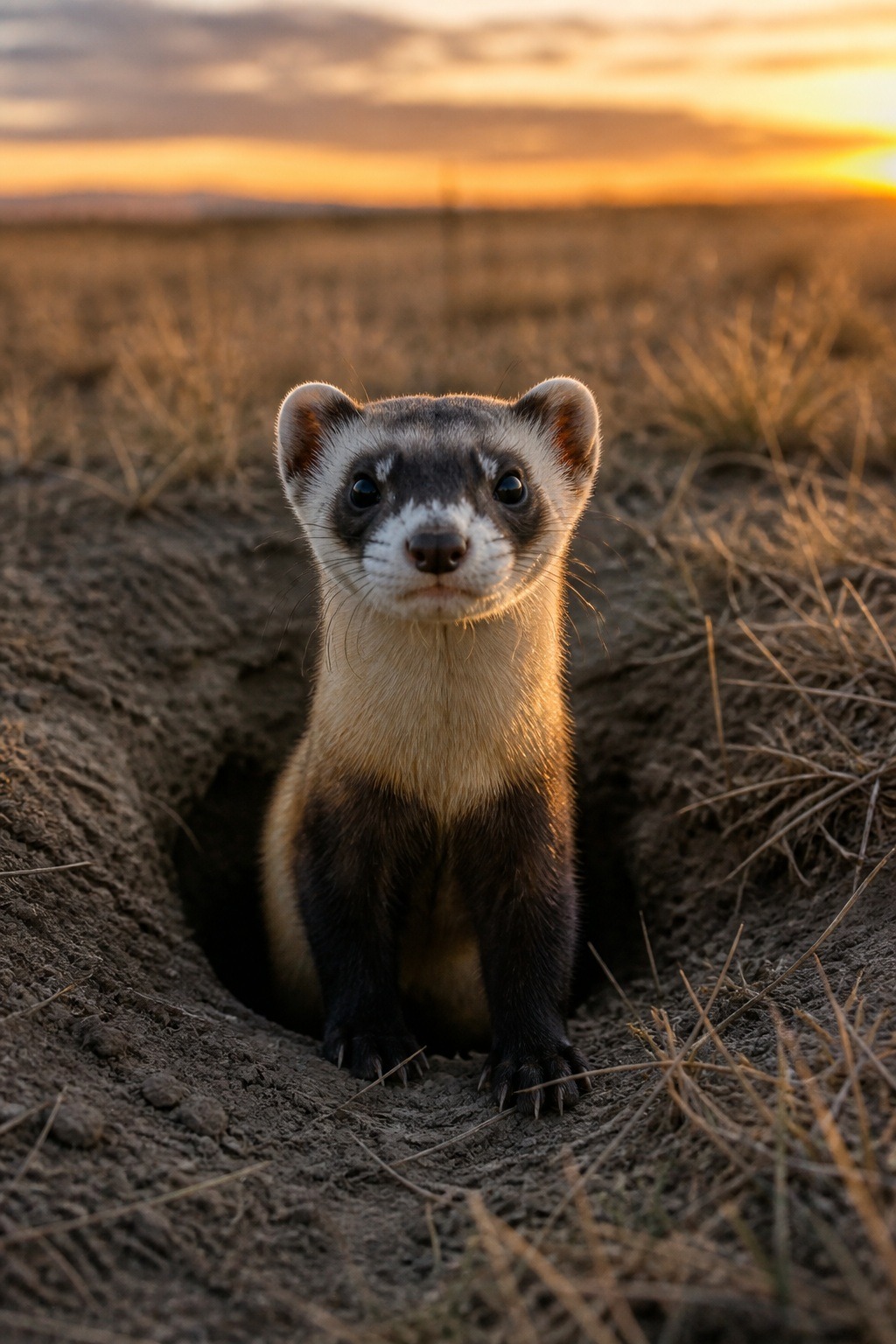
The story of how the black-footed ferret was saved from extinction begins not in a laboratory but on a ranch porch in Meeteetse, Wyoming, on a September night in 1981, when a cattle dog named Shep dropped a dead animal at his owners’ door. John and Lucille Hogg didn’t recognize it. They nearly threw it in the trash. Instead — on a whim — they had it looked at, and a taxidermist recognized the masked face of a species most biologists had already written off as gone forever.
Key Facts
- The black-footed ferret was rediscovered near Meeteetse, Wyoming, in 1981 after a cattle dog named Shep dropped a dead specimen at his owners’ door
- By 1987, only 18 wild ferrets were captured, but just seven of them ever bred successfully, forming the true genetic foundation of the species
- Today’s population retains only about 86% of the genetic diversity its ancestors had
- The captive-breeding program has produced more than 8,000 kits, with roughly 4,500 released across about 28-29 reintroduction sites in eight U.S. states plus Mexico and Canada
- A single black-footed ferret eats on the order of 100 prairie dogs a year, making the species entirely dependent on prairie dog colonies
In short: The black-footed ferret, presumed extinct, was rediscovered in Wyoming in 1981. After disease crashed the colony, 18 animals were captured by 1987 but only seven bred. A decades-long program has bred over 8,000 kits and released roughly 4,500, aided by cloning frozen tissue.
A dead ferret on a Wyoming doorstep, 1981
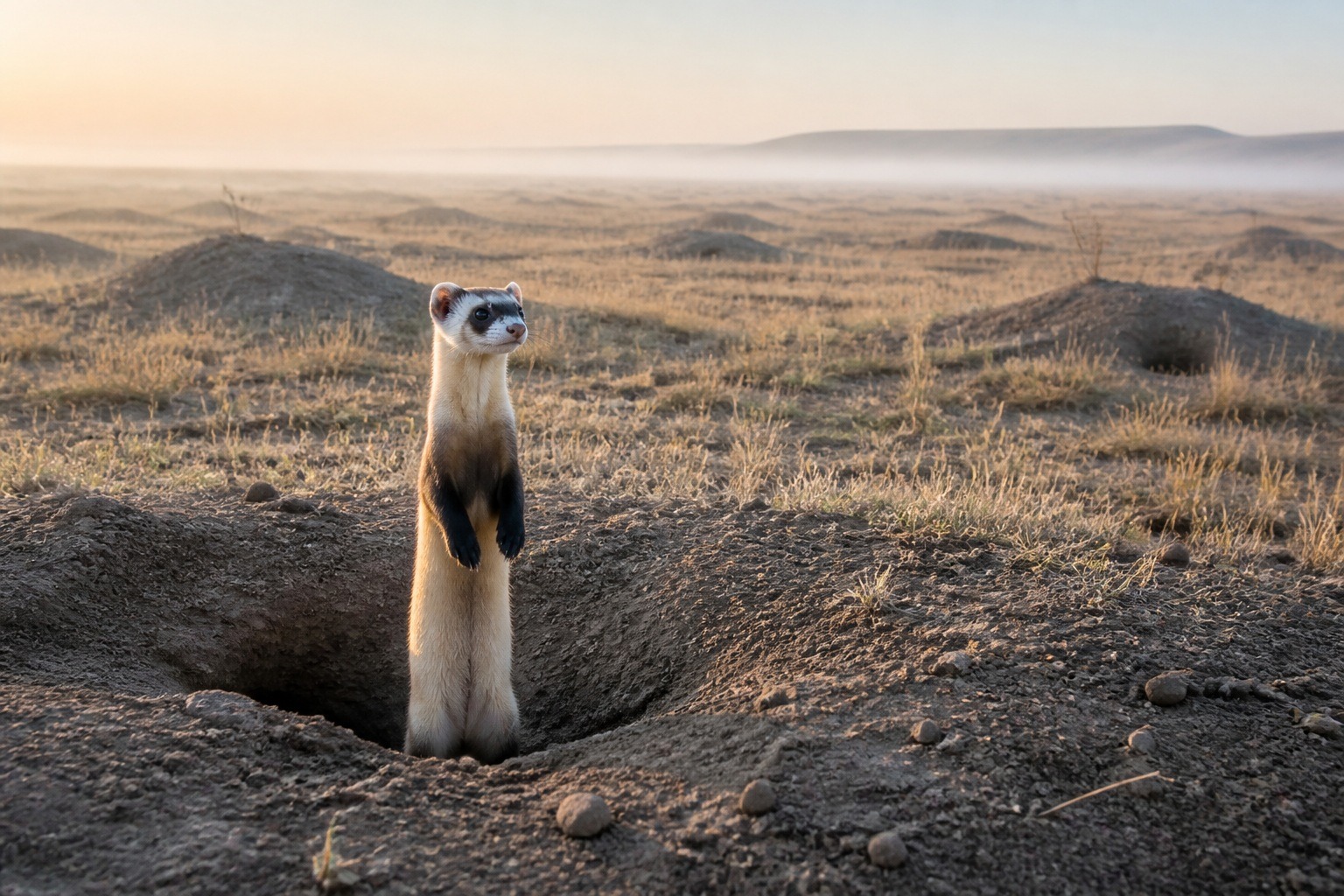
The black-footed ferret (Mustela nigripes) is North America’s only native ferret, a slender nocturnal predator with a black bandit mask and a life almost entirely underground. By the late 1970s it was presumed extinct. The last known captive animals had died, and no wild colony could be found. For a species that had once ranged across the Great Plains from Canada to Mexico, that was supposed to be the end.
Shep’s grim delivery changed everything. Following the dog’s lead, researchers found a living colony nearby — roughly 120 ferrets at its peak. For a few years it looked like a straightforward rescue: study the animals, protect the burrows, let the population grow. Nature had other plans.
Between 1985 and 1987, two diseases tore through the Meeteetse colony almost simultaneously. Sylvatic plague — the same bacterium, Yersinia pestis, behind the human Black Death — swept through the prairie dogs the ferrets depend on. Then canine distemper, lethal to ferrets, finished the job. The colony collapsed. Biologists faced a brutal choice: leave the last animals in the wild to die, or capture every single one.
Eighteen survivors — and only seven that mattered
They chose capture. In a race against the outbreak, teams brought in the final wild black-footed ferrets — 18 animals in total by 1987. Every black-footed ferret alive today is descended from that tiny group. That “down to 18” figure is the one most accounts stop at.
Here’s the part they usually leave out. Of those 18, only seven ever successfully bred. The rest were too old, too closely related, or simply never produced surviving young. So the true genetic foundation of the entire species is not 18 animals — it is seven. Geneticist Samantha Wisely and colleagues, writing in the Journal of Heredity, documented just how narrow that squeeze was, comparing DNA from before and during the bottleneck and confirming the species passed through one of the tightest genetic funnels ever recorded for a mammal recovery.
The consequence follows the species to this day: the living population retains only about 86% of the genetic diversity its ancestors had. That missing sliver isn’t trivial. Low diversity means weaker immune responses, reduced fertility, and vulnerability to exactly the kind of disease outbreak that nearly killed them in the first place.
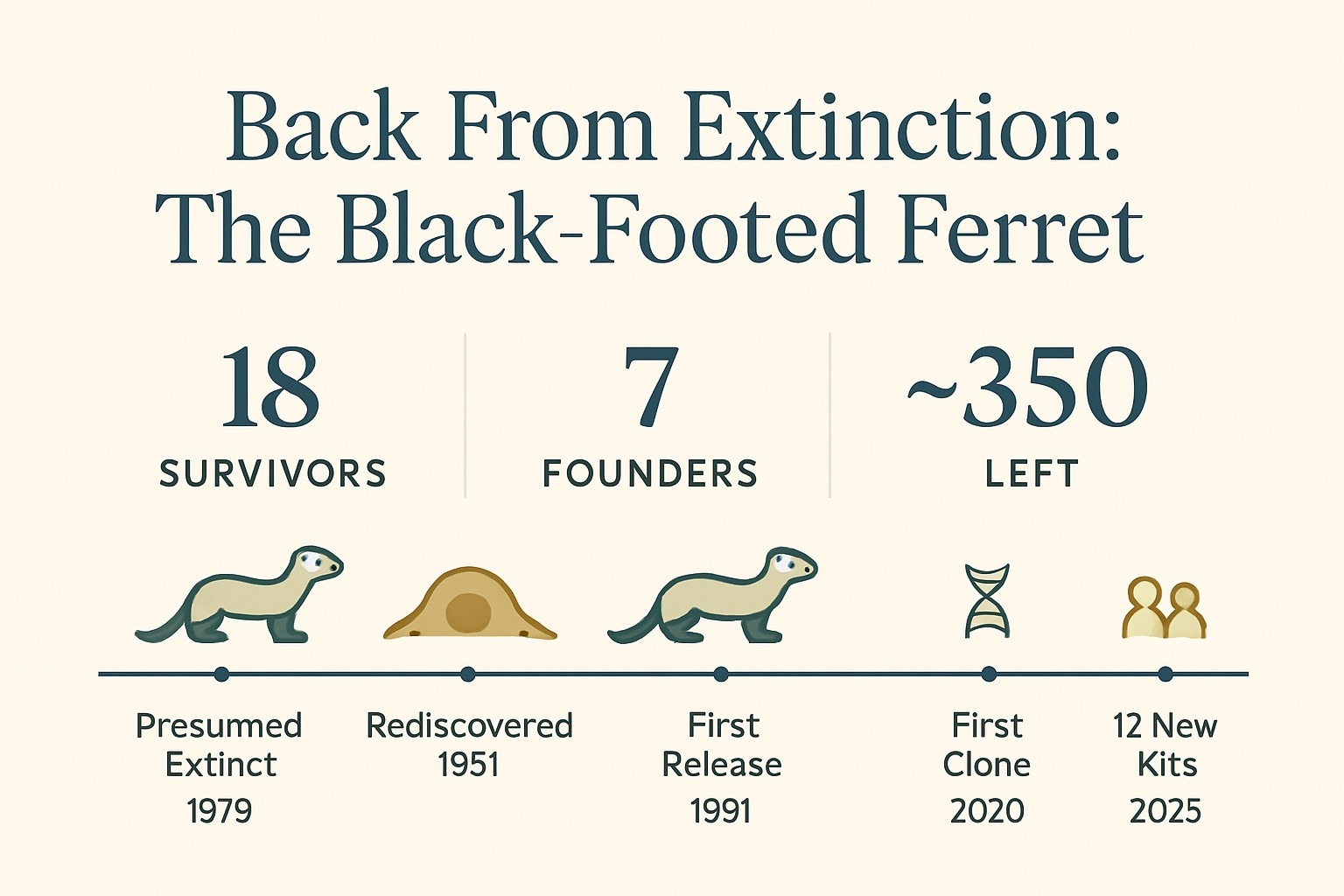
{IMAGE_2}
- 1979 — Species presumed extinct
- 1981 — Rediscovered near Meeteetse, Wyoming
- 1985–87 — Plague + distemper; last 18 captured
- 1991 — First reintroduction, Shirley Basin, Wyoming
- 2020 — Elizabeth Ann, first cloned U.S. endangered species
- 2023 — Clones Antonia and Noreen born
- 2024 — Antonia’s kits: the 8th founder line
- 2025 — 4 more litters, 12 cloned-lineage kits
The breeding program that bred 8,000 ferrets
What happened next is one of conservation’s great long-haul efforts. Starting from those seven breeders, the U.S. Fish and Wildlife Service and a coalition of zoos built a captive-breeding program designed to squeeze every viable pairing out of a shrinking gene pool. The Smithsonian’s National Zoo and Conservation Biology Institute in Front Royal, Virginia, became a cornerstone of it.
The numbers are staggering for a species that once fit inside a few cages. Over the decades, the program has bred more than 8,000 kits. The Smithsonian alone reported 1,029 born at its facility by May 2021 — including 139 produced through artificial insemination, a technique used partly to draw on frozen sperm from long-dead males and stretch the genetics further.
From that captive stock, roughly 4,500 ferrets have been released back into the wild across some 28 to 29 reintroduction sites, spanning eight U.S. states plus Mexico and Canada. The first release came in 1991, at Shirley Basin, Wyoming — the same state where Shep had found his ferret a decade earlier.
The enemy that never quit: prairie dogs and plague
You cannot save a black-footed ferret without saving a prairie dog. The two are locked together. Ferrets live in prairie dog burrows, hunt prairie dogs almost exclusively, and can’t survive without them — a single ferret eats on the order of 100 prairie dogs a year. No prairie dogs, no ferrets. It’s that direct.
And the same plague that helped crash the Meeteetse colony still stalks both animals. Sylvatic plague can wipe out an entire prairie dog town in weeks, and when the prey vanishes, the ferrets starve or catch the disease themselves. Reintroduction sites that looked stable have collapsed this way, again and again — which is the honest, unglamorous reason recovery has taken forty years and isn’t finished.
There is a genuinely clever countermeasure, though. Researchers developed an oral sylvatic plague vaccine, formulated into bait pellets and scattered across prairie dog colonies for the animals to eat. It won’t erase the threat, but it buys the ferrets something they’ve never reliably had: time.
Cloning Willa: adding an eighth founder
Now the story turns strange, in the best way. Back in the 1980s, before anyone knew whether cloning a wild animal would ever be possible, tissue from a black-footed ferret named Willa was frozen and stored at the San Diego Zoo Wildlife Alliance’s “Frozen Zoo.” Willa left no living descendants. Her genes simply sat in liquid nitrogen for more than thirty years.
That turned out to matter enormously. When scientists finally sequenced her preserved cells, they found Willa carried roughly three times the unique genetic variation of the entire living population. She was, in effect, a lost eighth founder — one whose DNA had vanished from the gene pool the moment she died without breeding.
So a partnership of Revive & Restore, the U.S. Fish and Wildlife Service, ViaGen Pets & Equine and San Diego Zoo Wildlife Alliance cloned her. Elizabeth Ann, born December 2020, became the first cloned individual of any endangered species native to the United States. She couldn’t reproduce herself — a reproductive condition ruled that out — but the proof of concept held. In 2023 two more clones of Willa followed: Antonia and Noreen.
2025–2026: a new, more diverse generation
Antonia did what Elizabeth Ann could not. In June 2024 she gave birth, becoming the first cloned endangered animal ever to reproduce — and, crucially, the first to put genuinely lost genetic variation back into a living species. Her two kits, Sibert and Red Cloud, descend from eight founders instead of seven. On paper that’s a single digit. In population genetics, it’s a lifeline.
Then came the wave the older articles miss entirely. In the summer of 2025, four more litters arrived — 12 kits, six female and six male — born to Antonia, to Noreen, and to Antonia’s own offspring, with three of the litters born at the Smithsonian’s Front Royal campus. For the first time, the cloned line is breeding through multiple generations on its own.
Together, these cloned ferrets and their kits are now the most genetically diverse black-footed ferrets alive. That is the quiet revolution here: not “we made a copy of a dead animal,” but “we reopened a gene pool that had been closed for four decades.” As of early 2026, coverage of the program frames the clones not as a novelty but as a working part of the recovery toolkit.
So how the black-footed ferret was saved from extinction — and is it, really?
Put plainly, how the black-footed ferret was saved from extinction comes down to four things stacked on top of each other: dumb luck (a ranch dog), a hard call (capturing the last 18), forty years of patient captive breeding, and a genetic Hail Mary pulled out of a freezer. Remove any one and the species is gone.
But calling this a finished success story is premature — and a little dangerous, because it invites us to look away. There are still only about 300 to 350 black-footed ferrets in the wild. That’s fewer animals than fit in a single school gymnasium, spread across three countries. Plague still resets colonies. Prairie dog habitat is still shrinking. The species remains formally endangered, and by the numbers it is nowhere near self-sustaining.
What’s genuinely new is the direction of travel. For the first time since 1987, the black-footed ferret’s gene pool is growing rather than eroding — deliberately, through cloning a ghost. Whether that’s enough depends on decades of work still ahead: more vaccine, more habitat, more releases that survive their first winter.
Shep, of course, had no idea what he’d started. He just brought home something interesting.
Common Questions
Is the black-footed ferret still endangered in 2026? Yes. It remains listed as endangered, with roughly 300–350 individuals in the wild — recovering, but not secure.
Why does cloning help genetically? Because Willa, cloned from 1980s tissue, carries genetic variation that had disappeared from every living ferret. Her clones add a lost founder line back into the gene pool.
Sources and Notes
- U.S. Fish and Wildlife Service — Black-footed Ferret Recovery Program (rediscovery, last 18 captured, ~4,500 released, reintroduction sites, plague vaccine)
- Smithsonian’s National Zoo and Conservation Biology Institute (captive breeding figures, artificial insemination, 2024–2025 cloned kits)
- Revive & Restore, with ViaGen Pets & Equine and San Diego Zoo Wildlife Alliance (Willa, Elizabeth Ann, Antonia, Noreen, cloning lineage)
- Wisely, S.M. et al., “Genetic Diversity and Fitness in Black-Footed Ferrets Before and During a Bottleneck,” Journal of Heredity (2002)
Four decades on, the black-footed ferret is neither the tragedy it seemed in 1979 nor the triumph headlines sometimes claim. It is something rarer and more instructive: a species held in existence by human effort, one litter at a time — a reminder that saving a life form is not a moment but a commitment that doesn’t end.
Frequently Asked Questions
Q: How was the black-footed ferret rediscovered?
In September 1981, a cattle dog named Shep dropped a dead animal at the door of John and Lucille Hogg on their ranch near Meeteetse, Wyoming. They nearly discarded it, but a taxidermist recognized the masked face of a species most biologists believed extinct. Following the dog’s lead, researchers found a living colony nearby that peaked at roughly 120 ferrets, changing everything for the species’ survival.
Q: Why is the species so genetically fragile?
Every living black-footed ferret descends from just seven breeding animals among the final 18 captured by 1987. This is one of the tightest genetic funnels ever recorded for a mammal recovery. The population now retains only about 86% of its ancestors’ genetic diversity. Low diversity means weaker immune responses, reduced fertility, and vulnerability to disease outbreaks like the ones that nearly caused extinction in the first place.
Q: How does cloning help the recovery effort?
In the 1980s, tissue from a ferret named Willa, who left no living descendants, was frozen at the San Diego Zoo Wildlife Alliance’s Frozen Zoo. Her preserved cells carried roughly three times the unique genetic variation of the living population. Clones including Elizabeth Ann (2020), Antonia, and Noreen (2023) were produced, and in 2024 Antonia’s kits established an eighth founder line, adding vital new genetics to the species.
Q: Why are prairie dogs essential to saving ferrets?
Black-footed ferrets live in prairie dog burrows and hunt prairie dogs almost exclusively, with a single ferret eating around 100 per year. Without prairie dogs, ferrets cannot survive. Sylvatic plague can wipe out an entire prairie dog town in weeks, causing ferrets to starve or catch the disease. Researchers developed an oral plague vaccine formulated into bait pellets scattered across colonies to buy the ferrets more time.
Illustrations are AI-generated. Article fact-checked and human-edited. Our editorial standards.