How Scientists Track the Vaquita With Sound
This is how scientists track the vaquita with sound: a drum-shaped logger hangs on a mooring line in the murky green water of the upper Gulf of California, and it listens. It cannot see. Neither can the researchers on the boat above — the vaquita is a porpoise the size of a nine-year-old child, it surfaces for a breath so brief you would miss it in a blink, and there may be fewer than ten of them left on Earth. So the science of saving the world’s most endangered marine mammal has come down to a strange, patient act: waiting for a burst of clicks too high for a human ear, and proving from that alone that a ghost is still out there.
Key Facts
- The vaquita (Phocoena sinus) is the smallest cetacean alive, a porpoise about 1.5 metres long and roughly 50 kilograms, with fewer than ten possibly left on Earth
- The vaquita was described only in 1958 and lives nowhere else but a roughly 4,000-square-kilometre pocket of the northern Gulf of California off San Felipe and El Golfo de Santa Clara
- Vaquitas produce narrow-band high-frequency clicks centred around 130 to 140 kilohertz, far above the roughly 20 kilohertz ceiling of human hearing
- Scientists use passive acoustic monitoring with C-POD detectors built by British firm Chelonia Ltd, tuned to roughly 20 to 160 kilohertz
- In the 2025 effort, teams deployed more than 1,200 detectors across nearly 500 sites, gathering over 8,000 days of acoustic data in a single season
In short: Scientists track the critically endangered vaquita, the world’s smallest cetacean with possibly fewer than ten left, using passive acoustic monitoring. Because the porpoise is nearly impossible to spot, seabed C-POD detectors listen for its high-frequency click trains, providing proof of survival where human eyes fail entirely.
A ghost the size of a child
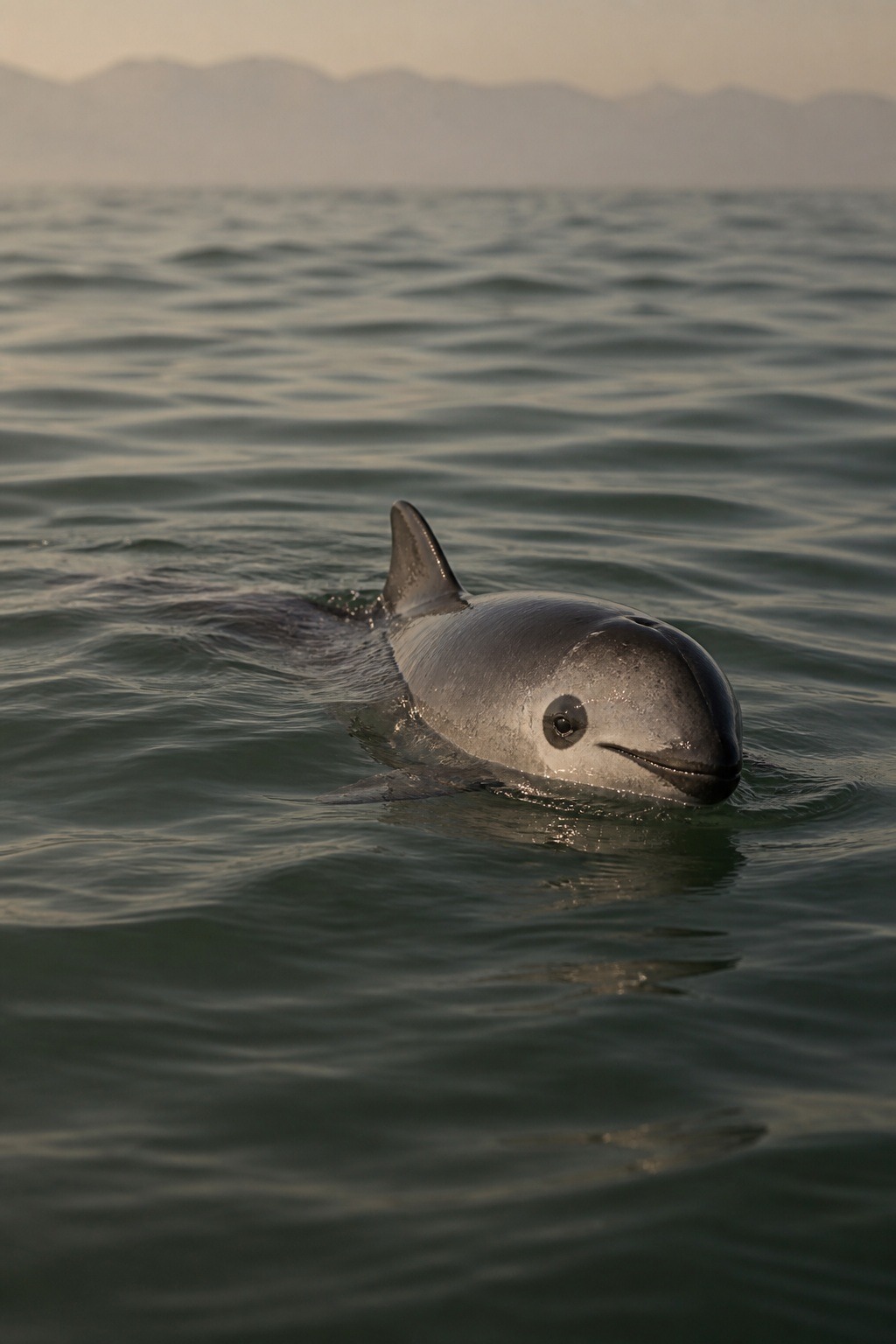
The vaquita (Phocoena sinus) is the smallest cetacean alive — a porpoise about 1.5 metres long and roughly 50 kilograms, with dark rings around its eyes and a smudge of dark pigment along its lips that give it a permanently startled, almost cartoonish expression. People call it the “panda of the sea” for those markings, the same badge-like dark eye patches you see on a giant panda. It was described only in 1958, from a few sun-bleached skulls found on a beach. It lives nowhere else but a small pocket of the northern Gulf of California, an area of maybe 4,000 square kilometres of turbid, nutrient-rich water off the Mexican towns of San Felipe and El Golfo de Santa Clara.
Here is the cruel part. The animal is not dying because anyone is hunting it. It drowns in gillnets set illegally for the totoaba, a large fish whose swim bladder sells for enormous sums in parts of Asia, where it is prized in traditional soup. The vaquita is bycatch — an accident of a black market that has nothing to do with it. That single threat has driven the collapse, and it is the same wildlife-trade machinery that has hammered other species, from the totoaba to the pangolin, the most trafficked mammal on the planet.
By any normal measure, an animal this rare should already be gone from our knowledge before it is gone from the sea. We should have lost track of it. We haven’t — and the reason is a microphone.
Where eyes fail, and ears do not
Counting a whale is usually a job for eyes. Scientists stand on a high deck with 25-power “big eye” binoculars and scan the horizon for a blow, a fin, a splash. That works for animals that are big, that breach, that travel in noisy pods. It fails almost completely for the vaquita.
Think about what you are asking a spotter to do. Find a grey animal barely taller than a briefcase, in grey-green water, under the glare of a desert sun, in a place where afternoon wind kicks up chop and morning brings haze. The vaquita is shy — it avoids boats, it rarely leaps, it lifts its little triangular fin and rolls under with almost no wake. In poor light, in fog, in murk, or the moment it dives, it is simply invisible.
But the vaquita is never truly silent. Like all porpoises, it “sees” with sound. It produces a near-constant stream of narrow-band, high-frequency clicks — pulses centred around 130 to 140 kilohertz, far above the roughly 20 kilohertz ceiling of human hearing — and reads the echoes to navigate and to hunt fish and squid in water where its own eyes are nearly useless. The animal that our eyes cannot find spends its whole life broadcasting. You just need the right ear.
{IMAGE_2}
How scientists track the vaquita with sound, one click train at a time
The whole method rests on a single, almost philosophical idea: one signal is enough. A researcher does not need to see a vaquita, photograph it, or even know how many are nearby. If an instrument on the seabed records one unmistakable train of vaquita clicks, then at that place, at that hour, a living vaquita swam past. That is a data point no fog can erase.
This is passive acoustic monitoring — PAM for short. “Passive” because the instruments make no sound of their own; they only listen, the way a security camera only watches. Scientists anchor a grid of autonomous click-detectors across the animal’s range, leave them for weeks, then haul them up and read what they heard. Every confirmed click train is a heartbeat of proof.
The elegance is that it scales through time in a way eyes never can. A survey ship can look for a few daylight hours in good weather. A moored detector listens through the night, through storms, through the researchers’ own sleep — thousands of listening-days that no human crew could ever match. The uncomfortable truth of vaquita conservation is that we can now hear the animal far more reliably than we have managed to protect it.
Inside the C-POD: a machine that listens for 8,000 days
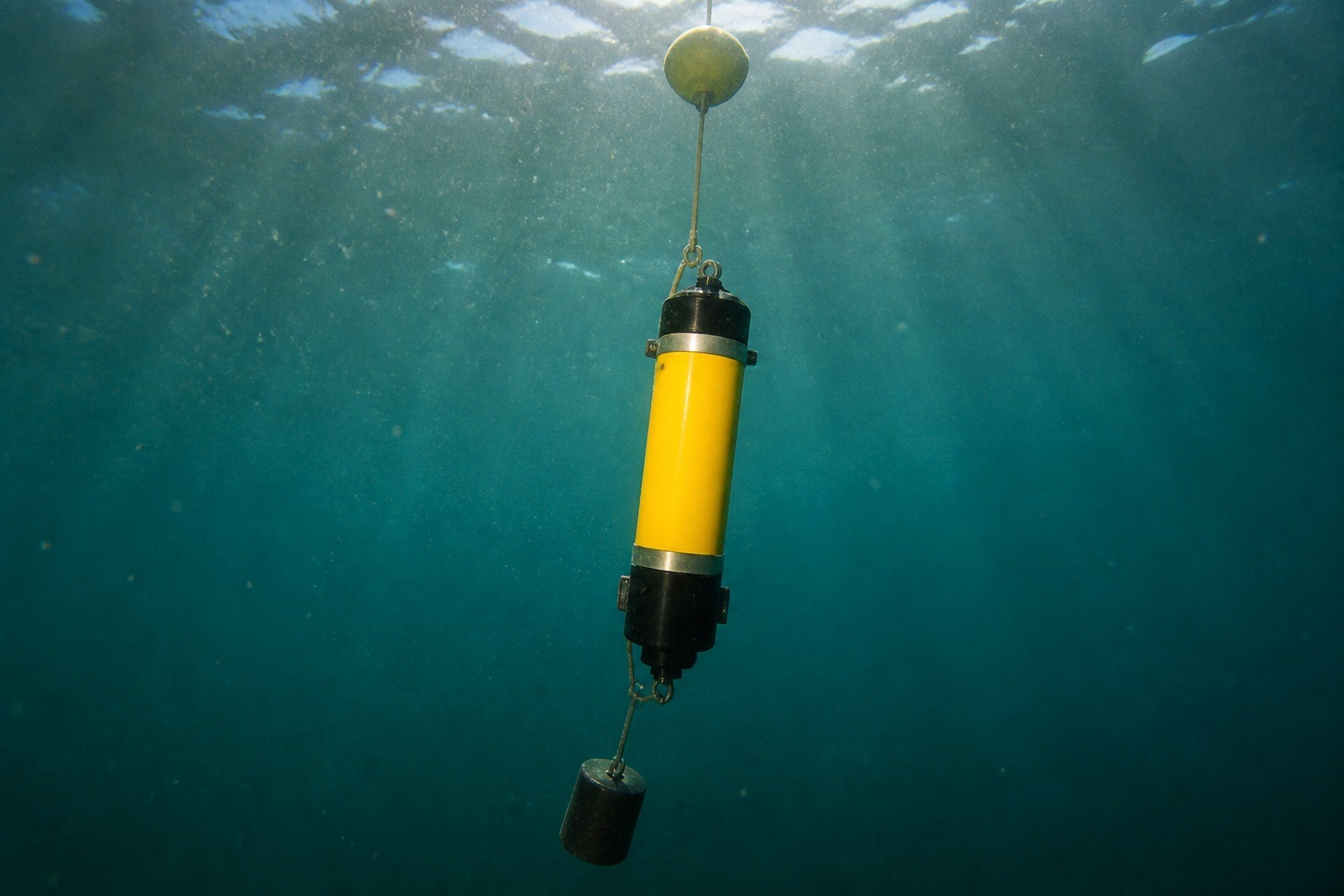
For most of the vaquita monitoring era, the ear in the water has been a device called a C-POD, built by the small British firm Chelonia Ltd. It is not glamorous — a sealed plastic tube about the length of your forearm, packed with batteries, a memory card, and a single omni-directional hydrophone that hears in every direction at once. Moored to the seabed with a weight and a float, it can sit and work for months.
Inside, it is tuned to the frequency band where porpoises and dolphins live, roughly 20 to 160 kilohertz. It does not record raw audio — that would fill any memory card in days. Instead it does something cleverer: for every click it detects, it logs the time, the frequency, the loudness and the duration, and it keeps only those digital fingerprints. Then an algorithm scans the log for “click trains” — the rhythmic, tell-tale runs of pulses that an echolocating animal produces, as opposed to the random snap of a shrimp or the clang of a boat.
Deploy dozens of these across the range and the numbers get big fast. In the 2025 effort, teams put out more than 1,200 detectors across nearly 500 sites and gathered over 8,000 days of acoustic data in a single season. No fleet of observers on Earth could deliver that.
And here is the thing about a machine that never blinks — it also records absence. A C-POD that hears nothing for a month is not broken. It is telling you, coldly and precisely, that the water it guarded was empty. That silence became the most important measurement in the whole story.
Telling a porpoise from a dolphin
An algorithm flagging click trains is only step one, and it is not allowed the last word. Automated detection is fast but fallible; it can mistake one species’ clicks for another, or fire on noise. So every promising detection goes to a second, slower court: a trained human analyst.
What does the human look for? A vaquita’s voice is distinctive. Its clicks are narrow-band and high-frequency — a tight cluster of energy up around 130 to 140 kilohertz, with a fairly consistent shape and rhythm. Common dolphins and bottlenose dolphins that also roam the Gulf produce broadband clicks that spread across a much wider range of frequencies and often come in faster, more variable buzzes. On a spectrogram — a picture of sound, frequency up the side, time along the bottom — a vaquita train and a dolphin train look genuinely different, once you have learned to read them.
This two-step design, algorithm then expert eye, is deliberate. It is the difference between “the sensor beeped” and “a scientist certifies a vaquita was here.” On a species with single-digit numbers, the cost of a false positive — celebrating a ghost that was really a dolphin — is a mistake no one can afford.
The sound of a collapse
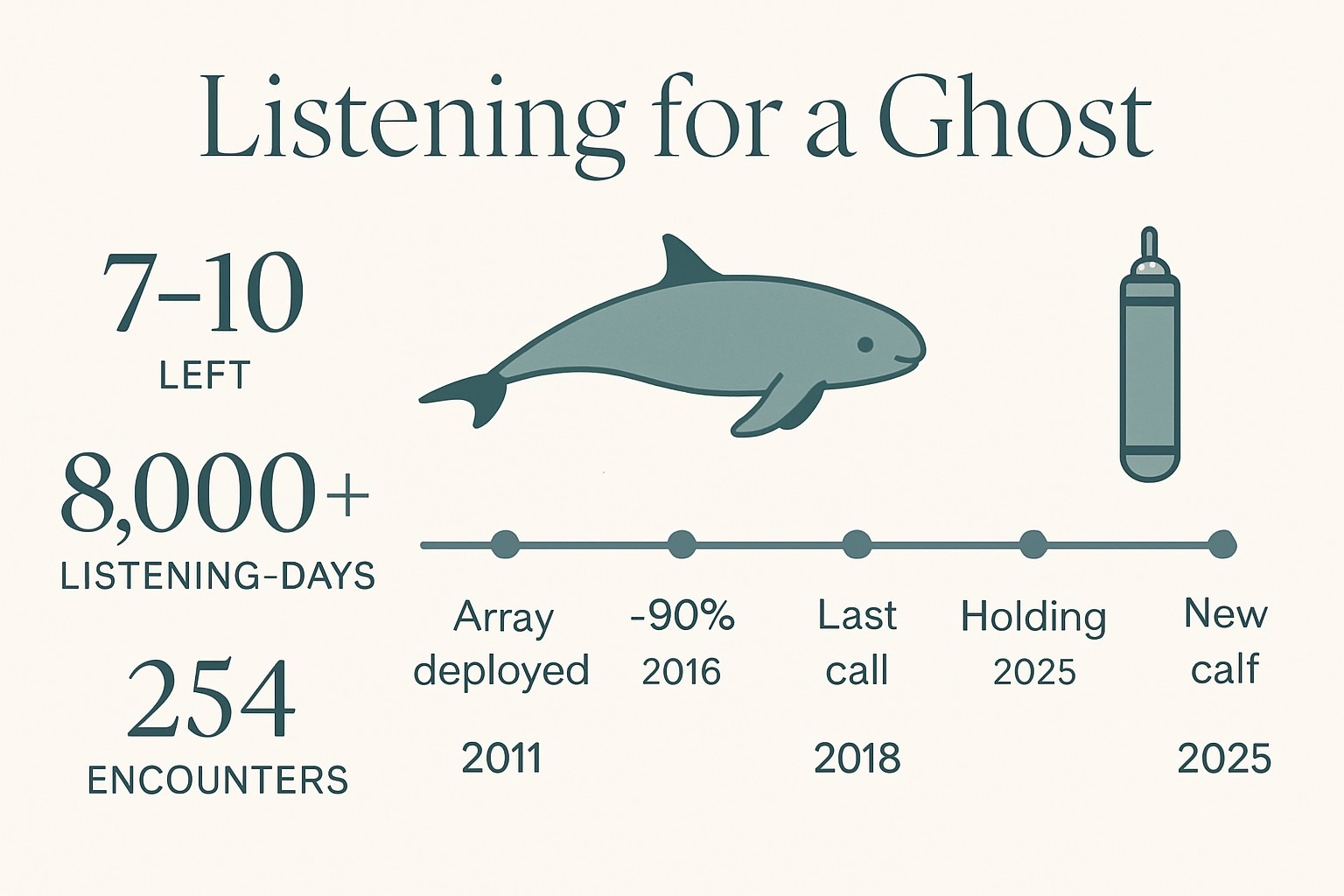
A systematic C-POD array went into the vaquita’s range in 2011, and for the first time the decline stopped being a guess and became a graph you could hear going quiet. The results were devastating. The acoustic detection rate fell by more than 90 percent between 2011 and 2016. Then it accelerated: in the 2017 study grimly titled Last call, researchers led by Armando Jaramillo-Legorreta and colleagues, working with Barbara Taylor of NOAA’s Southwest Fisheries Science Center, documented drops of about 62 percent in a single year (2016 to 2017) and roughly 70 percent the next (2017 to 2018).
Read those numbers slowly. A population does not just shrink at that pace — it falls off a cliff, losing something like half of what remains every year. The clicks that had once been a steady chorus across the detector grid thinned to a handful, then to near nothing. The team’s own phrase captures it: they were listening to the sound of an extinction in progress, in real time, and the graph was a straight line pointed at zero.
For a while, most of the world’s coverage froze at that moment — “fewer than 15 left,” “fewer than 30” — as if the story had ended in 2018. It hadn’t.
2025: the signal that came back
Between late May and the end of September 2025, Mexican agencies and the Sea Shepherd Conservation Society ran the first range-wide acoustic survey since 2015, paired with a visual expert team on the water. What the hydrophones heard was, against every projection, encouraging.
- 254 acoustic encounters with vaquitas (24 May – 29 Sept 2025)
- 1,228 detectors deployed across 497 sites
- 8,000+ days of acoustic listening in one season
- 7–10 vaquitas confirmed alive by the joint visual-and-acoustic team
- At least 1 (possibly 2) new calf — the animals are still breeding
- 93 vaquita sightings logged since 2017
Source: Vaquita Research Campaign 2025, IUCN/SSC Cetacean Specialist Group (Nov 2025). Full abundance estimates due early 2026.
The most important line is not any single figure — it is the shape of the trend. After the free-fall of 2016 to 2018, the surveys of recent years have found no substantial further decline. A tiny population, cornered in and around a protected “zero-tolerance” sanctuary, appears to be holding on. And a new calf means the survivors are not merely aging out. They are reproducing.
None of this is a rescue. Seven to ten animals is still a whisker from extinction, and it is entirely because determined humans keep pulling illegal nets out of the water that any vaquita drew breath in 2025 at all. But it is the first genuinely hopeful signal in a decade — and, fittingly, it came in as sound.
F-PODs and the people behind the hydrophones
The technology is moving on. Chelonia Ltd now makes a successor to the C-POD called the F-POD, which captures far more detail about the waveform of each click. More detail means cleaner discrimination — a better chance of telling a vaquita from a dolphin automatically, fewer detections that need slow human review, and more confidence squeezed from every listening-day. For a species where a single missed or mis-called signal matters, sharper ears are not a luxury.
But it would be a mistake to imagine any of this runs itself. Behind the instruments are named, working scientists — Armando Jaramillo-Legorreta and Mexican acousticians who have spent careers on this animal, Barbara Taylor and colleagues at NOAA, Sea Shepherd crews who deploy the detectors and haul the nets, and local fishers who now help collect the very acoustic data that maps where the vaquitas still swim. The hydrophone is only as good as the hands that place it and the trained eye that reads the trace.
Turns out the fate of the world’s rarest marine mammal hangs on one of the quietest instruments in conservation: a plastic tube in the dark, and the people patient enough to listen to it.
Common Questions
How many vaquitas are left in 2025? The 2025 joint visual-and-acoustic survey confirmed roughly 7 to 10 vaquitas, with at least one new calf. Full abundance estimates from that survey are expected in early 2026. Encouragingly, recent years show no substantial further decline after the 2016–2018 collapse.
How do scientists count vaquitas without seeing them? They use passive acoustic monitoring: grids of underwater detectors log the high-frequency clicks vaquitas make to echolocate. An algorithm flags likely “click trains,” then a trained analyst confirms whether each one is truly a vaquita and not a dolphin or noise. Each confirmed train proves an animal was present.
What is a C-POD? A C-POD is a self-contained underwater click detector made by Chelonia Ltd. It carries an omni-directional hydrophone sensitive from about 20 to 160 kHz, runs autonomously for months on batteries, and logs the time, frequency and character of every click it hears — the raw material for tracking porpoises by sound. Its successor is the more detailed F-POD.
Why don’t scientists just look for vaquitas from boats? They do, but the vaquita is tiny, shy, surfaces briefly with almost no splash, and is easily hidden by fog, glare, chop or murky water. Visual surveys work only in good conditions and daylight, while acoustic detectors listen through night and weather for thousands of days.
Sources and Notes
- Vaquita Research Campaign 2025 — Report of the September Vaquita Survey, IUCN/SSC Cetacean Specialist Group (November 2025)
- Rojas-Bracho, Jaramillo-Legorreta, Taylor et al., “Last call: Passive acoustic monitoring shows continued rapid decline of critically endangered vaquita,” Journal of the Acoustical Society of America (2017)
- Jaramillo-Legorreta et al., “Decline towards extinction of Mexico’s vaquita porpoise (Phocoena sinus),” Royal Society Open Science
- Discovery of Sound in the Sea (DOSITS) — passive acoustic monitoring explainer
- Chelonia Ltd — C-POD and F-POD acoustic click-detector specifications
- NOAA Southwest Fisheries Science Center — vaquita conservation and abundance
The vaquita may still slip away; honesty demands we admit that seven to ten animals is a razor’s edge, not a recovery. But if it survives, we will owe that survival partly to a humble idea — that a creature we cannot see is not the same as a creature that is gone, so long as something in the dark is patient enough to keep listening for its voice.
Frequently Asked Questions
Q: Why can’t scientists simply count vaquitas by sight?
The vaquita is a shy grey porpoise barely taller than a briefcase, living in grey-green turbid water under desert glare. It avoids boats, rarely leaps, and rolls under with almost no wake. In poor light, fog, murk, or the moment it dives, it is effectively invisible. Traditional big-eye binocular surveys work only for large, breaching animals in noisy pods, so counting this rare, elusive porpoise by sight fails almost completely.
Q: What is passive acoustic monitoring?
Passive acoustic monitoring, or PAM, rests on the idea that one signal is enough. Since the vaquita constantly broadcasts high-frequency clicks to navigate and hunt, researchers anchor a grid of autonomous click-detectors across its range, leave them for weeks, then retrieve and read the recordings. Every confirmed click train proves a living vaquita swam past that place at that hour. The instruments make no sound themselves, only listening the way a security camera only watches.
Q: How does the C-POD detector work?
The C-POD is a sealed plastic tube about a forearm long, built by British firm Chelonia Ltd, containing batteries, a memory card, and an omni-directional hydrophone. Moored to the seabed, it works for months. Tuned to roughly 20 to 160 kilohertz, it does not record raw audio but logs each click’s time, frequency, loudness, and duration. An algorithm then scans for rhythmic click trains that echolocating animals produce, distinguishing them from random shrimp snaps or boat noise.
Q: What actually threatens the vaquita?
The vaquita is not hunted. It drowns as bycatch in gillnets set illegally for the totoaba, a large fish whose swim bladder sells for enormous sums in parts of Asia, where it is prized in traditional soup. This single threat, driven by a black market that has nothing to do with the vaquita itself, has caused the species’ collapse. It is the same wildlife-trade machinery that has hammered other trafficked species around the world.
Illustrations are AI-generated. Article fact-checked and human-edited. Our editorial standards.