The Ocellated Turkey: Mesoamerica’s Most Stunning Bird
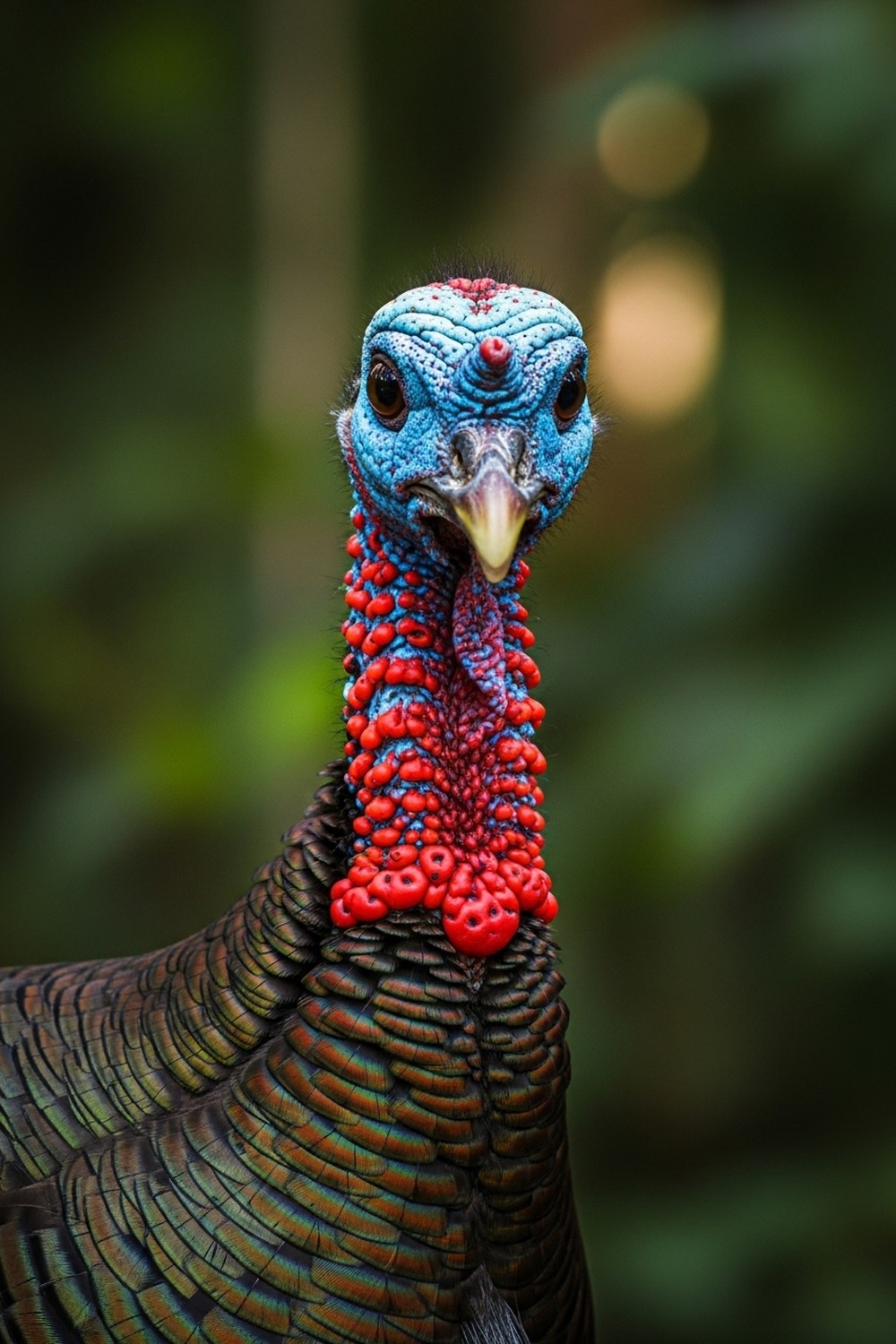
Here’s the thing about the Ocellated Turkey: it shouldn’t look like this. Electric blue skin pulled tight over bare bone. Orange nodules blazing along the neck. A tail that refracts jungle light into bronze and copper and something closer to green fire. Most birds evolve toward camouflage. This one evolved toward spectacle — and it’s been doing it, in these same Yucatán forests, for five million years.
Fewer than 50,000 of these extraordinary birds are believed to survive in the wild today, tucked into the shrinking forests of Mexico’s Yucatán Peninsula, Belize, and northern Guatemala. The Maya, who shared this landscape with them for millennia, considered them sacred. Most people today have never heard of them — and that gap between ancient reverence and modern ignorance is worth sitting with for a moment.
Key Facts
- Fewer than 50,000 Ocellated Turkeys are estimated to survive in the wild as of BirdLife International’s 2020 assessment, classified as Near Threatened on the IUCN Red List.
- The Ocellated Turkey diverged from the Wild Turkey approximately 5 million years ago, per molecular phylogenetic studies published in 2010.
- Its range is restricted to roughly 175,000 square kilometres across Mexico’s Yucatan Peninsula, Belize, and Guatemala.
- Deforestation in Guatemala’s Peten department increased by roughly 34% between 2001 and 2019, according to Global Forest Watch data.
- Adult males can weigh up to 5 kilograms and stand about 90 centimetres tall, far smaller than the Wild Turkey’s possible 11 kilograms.
In short: The Ocellated Turkey, a dazzling iridescent bird of the Yucatan revered by the Maya, has been evolving in these forests for 5 million years. Fewer than 50,000 remain across a 175,000 square kilometre range in Mexico, Belize, and Guatemala, as deforestation in the Peten rose 34% between 2001 and 2019.
The Ocellated Turkey’s Ancient Mesoamerican Origins
Sharing a genus with the familiar Wild Turkey of North America, *Meleagris ocellata* parts ways with its relative somewhere around the eyes — and everything else. Phylogenetic studies conducted by the Smithsonian Institution and published in 2010 confirmed that the two species diverged approximately five million years ago, long before the first humans set foot in the Americas. That’s enough evolutionary distance to account for some truly spectacular differences. The Wild Turkey is mottled brown and built for blending in. The Ocellated Turkey is built for something else entirely — a creature that looks, in full display, less like a game bird and more like a living iridescent sculpture, its feathers refracting light into shifting pools of bronze, copper, green, and blue.
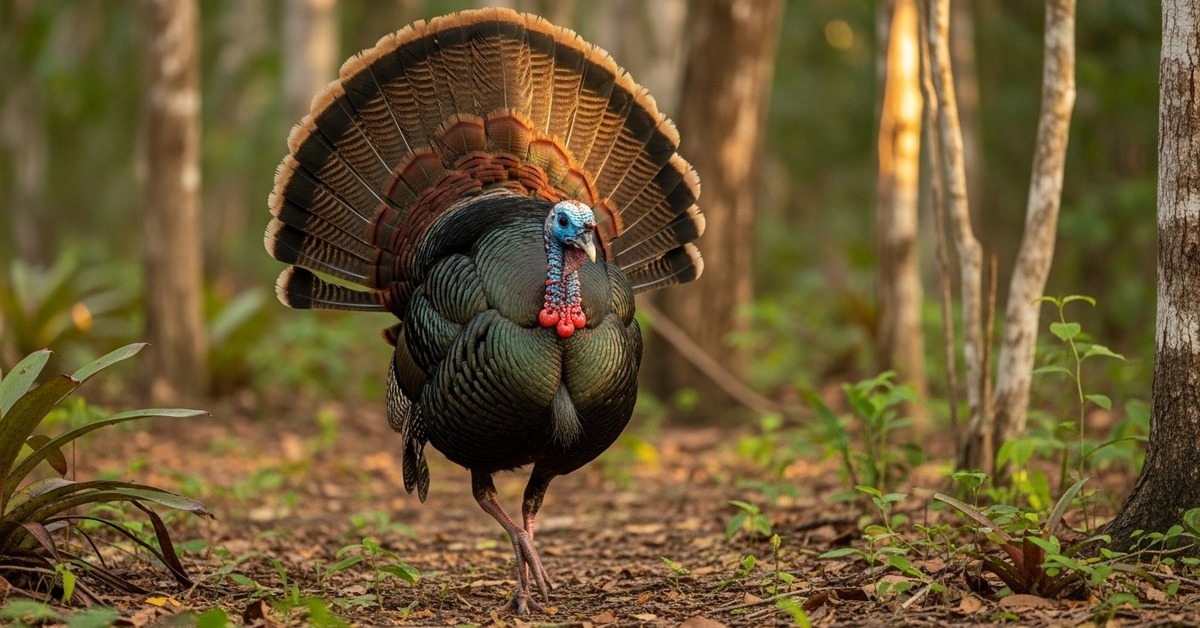
The name “ocellated” comes from the Latin *ocellus*, meaning “little eye.” It refers to the bird’s tail feathers, each tipped with a vivid peacock-like eyespot — a circle of blue-bronze that seems to watch you as the male fans and tilts his display. These spots aren’t just decorative. They’re signals in a complex visual language that ornithologists are still working to decode fully.
Males don’t gobble the way their North American relatives do. Their call opens with deep, rhythmic thumping — a percussive beat that vibrates through the forest floor before climbing into a strange, almost mechanical churning that researchers have compared to an engine turning over. Hear it once in the dark, before dawn, and you don’t forget it. The sound arrives before the bird does. It fills the space between the trees like something prehistoric waking up.
What the Maya Knew That We’ve Forgotten
Why does this matter? Because the Maya didn’t just coexist with the Ocellated Turkey — they elevated it, and understanding that relationship reframes everything about how we’ve treated this species since.
Archaeological evidence from sites across the Yucatán, Belize, and Guatemala shows that this bird appeared on ceramics, murals, and in ritual contexts stretching back more than two thousand years. Unlike the Wild Turkey, which was domesticated extensively in pre-Columbian Mesoamerica for food and feathers, the Ocellated Turkey appears to have held a primarily ceremonial status. Researchers at the University of Florida’s Florida Museum of Natural History have documented skeletal remains at Maya sites suggesting the bird was kept, possibly bred, and almost certainly revered rather than eaten as a daily staple. It’s a relationship that echoes other ancient human-animal bonds — the kind of deep attention a civilization pays to a creature it recognizes as something beyond ordinary, much like the way early Arab cultures tracked and prized the rarest predators in their landscape as symbols of status and spiritual power.
What’s striking is how that reverence simply evaporated. The Spanish colonization of the Yucatán in the sixteenth century brought a wholesale restructuring of the landscape — not just politically, but ecologically. Forests were cleared. Agricultural patterns shifted. The sacred geometry of Maya land use, which had accommodated large wildlife in ways that European farming models didn’t, began to collapse. By the time ornithologists started formally documenting the Ocellated Turkey in the nineteenth century, it was already retreating into the deep forest.
A civilization that once carved this bird into stone had been replaced by one that didn’t know the bird existed. History has a way of treating the people who ignored this kind of evidence unkindly.
There are Maya communities in the Yucatán today where elders still know this bird’s call by name. They’ll hear it described and nod quietly, as if someone has just mentioned an old relative nobody else remembers.
A Display That Rivals the Peacock
Breeding season runs roughly from March through May across the Yucatán, and during those months, male Ocellated Turkeys transform in ways that are difficult to overstate. The bare blue skin of the head and neck intensifies. The orange-red nodules (researchers actually call these caruncles) swell and brighten. The tail fans to a full vertical spread, those iridescent eyespots catching light from every angle. According to research published by the National Geographic Society, the males perform a slow, deliberate strutting display, rotating in place, letting the visual spectacle do the heavy lifting alongside their vocalizations. It’s a mating strategy that places enormous evolutionary pressure on plumage quality, which explains why the species has developed one of the most visually complex feather arrangements of any bird in the Western Hemisphere.
Females select mates based on display intensity and duration, not just appearance. The best performers breed more. The result, over millions of years, is a bird that looks almost deliberately overdressed for the jungle — as if evolution handed it a budget and said, spend all of it.
And the feathers themselves are worth understanding separately. The Ocellated Turkey’s plumage achieves its color not through pigment alone, but through structural coloration — microscopic layers in the feather barbs that bend and reflect light. This is the same mechanism that makes a soap bubble iridescent, or the inside of an abalone shell shift from green to blue to violet as you tilt it. It means the bird’s appearance changes with the angle of light, with the time of day, with the density of the canopy overhead. In open clearing at noon, it blazes. Under the filtered green light of deep jungle, it shimmers more subtly, almost cooling its own display down to something softer and stranger.
The Ocellated Turkey Is Running Out of Forest
Fewer than 50,000 individuals. That number, widely cited by conservation organizations including BirdLife International as of their 2020 assessment, represents a species balanced on a narrowing ledge. The Ocellated Turkey’s range is one of the most geographically restricted of any large bird in the Americas — essentially a triangle drawn between the Yucatán Peninsula, northern Belize, and the Petén lowlands of Guatemala.
That triangle is shrinking. A 2019 analysis by the Wildlife Conservation Society documented accelerating deforestation across the Petén, driven by cattle ranching, illegal logging, and the expansion of African palm plantations. The Petén holds some of the last contiguous lowland forest in Mesoamerica. It’s also one of the Ocellated Turkey’s last strongholds. Deforestation in Guatemala’s Petén department increased by roughly 34% between 2001 and 2019, according to Global Forest Watch data — and the bird has nowhere else to go.
Unlike the Wild Turkey, which has proven remarkably resilient in second-growth forests and even suburban edges across North America, the Ocellated Turkey requires intact, mature lowland forest. It forages along the forest floor for seeds, berries, insects, and small lizards. Its entire life cycle is stitched into the vertical architecture of old-growth jungle — and when that architecture is cut down and replaced with monoculture or cattle pasture, the bird doesn’t simply find another neighborhood. Hunting pressure compounds the problem. In some rural communities across the Yucatán and Guatemala, the bird is still taken as a food source, despite legal protections in Mexico and Belize.
Community-based conservation programs in the Calakmul Biosphere Reserve in Campeche, Mexico, have begun working directly with local ejidos — communal landholding communities — to build awareness and reduce hunting. It’s slow work. But in areas where it’s taken hold, local sightings have stabilized. The forest, if left alone, does its part.
Where to See This
- Calakmul Biosphere Reserve, Campeche, Mexico — one of the largest protected tropical forests in Mesoamerica, and among the most reliable locations for Ocellated Turkey sightings; best visited between February and May during breeding season when males are actively displaying.
- Tikal National Park, Petén, Guatemala — this UNESCO World Heritage Site offers early-morning sightings of Ocellated Turkeys foraging near the base of ancient Maya temples, with guided birding tours available through the park authority.
- BirdLife International’s species profile for *Meleagris ocellata* (birdlife.org) provides updated range maps, conservation status data, and links to regional monitoring programs for readers who want to go deeper.
By the Numbers
- Fewer than 50,000 individuals estimated in the wild as of BirdLife International’s 2020 assessment — classified as Near Threatened on the IUCN Red List.
- Range restricted to approximately 175,000 square kilometres across Mexico, Belize, and Guatemala — one of the smallest ranges of any large galliform bird in the Americas.
- Divergence from the Wild Turkey (*Meleagris gallopavo*) occurred approximately 5 million years ago, according to molecular phylogenetic studies published in 2010.
- Deforestation in Guatemala’s Petén department increased by roughly 34% between 2001 and 2019, according to Global Forest Watch data — placing the bird’s primary stronghold under sustained pressure.
- Adult males can weigh up to 5 kilograms and stand approximately 90 centimetres tall — significantly smaller and lighter than the Wild Turkey, which can exceed 11 kilograms.
Field Notes
- In 2016, researchers conducting a camera-trap survey in the Calakmul Biosphere Reserve captured footage of an Ocellated Turkey investigating and briefly responding to its own reflection in a piece of equipment casing — a behavior that prompted renewed discussion among ornithologists about the species’ capacity for self-recognition, though no formal study has followed up on the observation.
- Turns out the Ocellated Turkey’s courtship is one of the most multi-sensory performances in Mesoamerican birdlife: unlike most birds that rely on either visual displays or vocalizations as their primary mating signal, males deploy both simultaneously — the deep pre-dawn drumming call and the full visual display occurring together in the same moment.
- *Cutz* — the Yucatec Maya word for the Ocellated Turkey — is still used in rural communities across the peninsula today, the same word that described this bird in ancient inscriptions.
- Researchers still can’t fully explain why the species never expanded its range northward into the broader forests of southern Mexico, despite apparently suitable habitat — whether this reflects some ancient biogeographic barrier or an ecological preference that hasn’t been fully characterized remains an open question in the field.
Frequently Asked Questions
Q: What makes the Ocellated Turkey different from a regular Wild Turkey?
Five million years of separate evolution, for a start. The Ocellated Turkey is smaller, brighter, and structurally more complex in its plumage — featuring iridescent bronze and green feathers, a bare blue head covered in orange caruncles, and distinctive peacock-like eyespots on its tail. Vocally, it uses a deep percussive drumming call rather than the familiar gobble of its North American relative — a difference that becomes very apparent if you hear one before dawn.
Q: Why is the Ocellated Turkey endangered, and what’s being done?
Classified as Near Threatened by the IUCN, the species faces two converging pressures: deforestation and hunting. Its range is geographically small and almost entirely dependent on intact lowland forest — habitat that’s disappearing rapidly across the Yucatán and Petén regions. Conservation efforts include protected area management in Mexico’s Calakmul Biosphere Reserve and community engagement programs working with local landholders to reduce hunting pressure and preserve the forest corridors that connect isolated populations.
Q: Did the Maya really keep Ocellated Turkeys as sacred birds?
Evidence strongly suggests it. Archaeological analysis of Maya sites across the Yucatán, Belize, and Guatemala has recovered skeletal remains of Ocellated Turkeys in ritual contexts, and the bird appears on murals and ceramics throughout the Classic and Postclassic periods. Researchers at the Florida Museum of Natural History have documented findings consistent with the bird being kept for ceremonial purposes rather than as a primary food source — a distinction that sets it apart from the Wild Turkey, which was domesticated for consumption across much of Mesoamerica.
Editor’s Take — Sarah Blake
What strikes me most about the Ocellated Turkey isn’t the plumage — it’s the silence around it. This bird has been living in the same forests as some of the most sophisticated civilizations in human history. The Maya knew it, named it, carved its image into stone. And somewhere between that world and ours, we collectively forgot to look. We’re at a point now where fewer than 50,000 remain, and most people couldn’t pick this bird out of a lineup. That’s not a conservation failure. It’s a failure of attention — and those are harder to fix.
The Ocellated Turkey has never needed our validation. It’s been doing this — the display, the drumming, the slow turn in the jungle light — for five million years without an audience that understood what it was watching. But it does need our forests. It needs the old-growth canopy and the unbroken ground and the kind of silence that lets a drumming call carry half a kilometre through the trees. The question isn’t whether this bird is worth saving. The question is whether we’ll still be able to hear it — that low, mechanical pulse rising through the dark before dawn — fifty years from now.
Illustrations are AI-generated. Article fact-checked and human-edited. Our editorial standards.