The Amazon’s Dirty Secret: Its Soil Is Nearly Worthless
You’d think the world’s most biodiverse ecosystem would sit atop soil rich enough to feed itself. Instead, the Amazon rainforest soil deforestation paradox reveals something almost inverted: the forest isn’t growing *on* rich ground — it *is* the ground. Clear the trees, and within three years, what remains isn’t degraded farmland. It’s functionally dead.
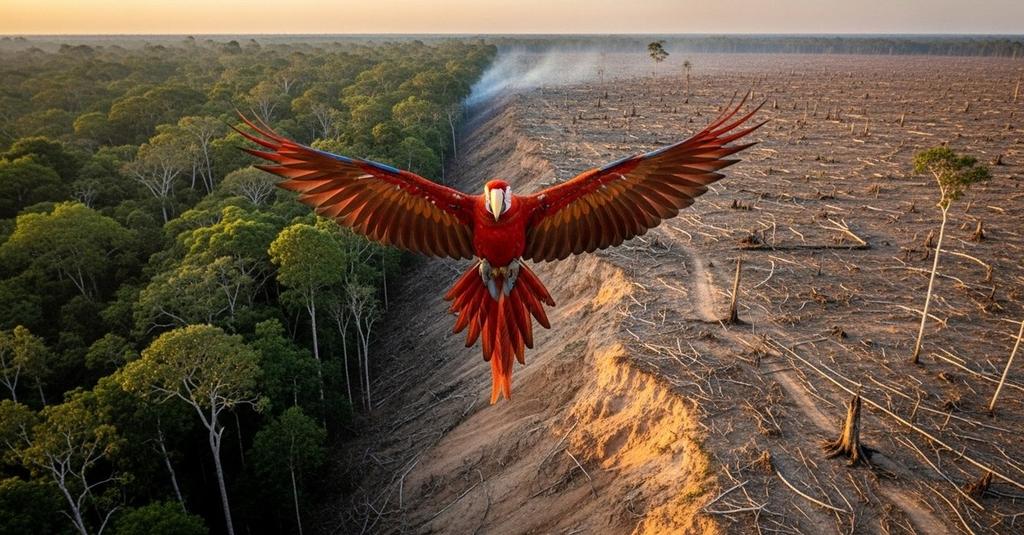
In the state of Pará, somewhere deep in the Brazilian Amazon, a farmer burns the last cleared brush. The rains arrive—sometimes 3 meters a year in the basin’s deepest zones. First season: something grows. Second season: less. By the third, yields collapse entirely and the family moves on, deeper into the forest. Behind them sits a wound that may never close, a scar that won’t accept another crop, another forest, anything that asks the ground to provide.

Key Facts
- Oxisol, the ancient leached substrate beneath roughly 50% of the Amazon basin, is highly acidic and nutrient-poor.
- Up to 90% of nitrogen and phosphorus from decomposing litter is reabsorbed before reaching 10 cm soil depth, per Amazon-FACE / INPA, 2019.
- By year three on unfertilized cleared land, crop yields collapse to less than 20% of original output, per University of Sao Paulo, 2020.
- An estimated 17% of the Amazon was deforested as of 2023, roughly 800,000 square kilometers.
- Terra Preta, ancient human-made dark earth, retains elevated fertility for at least 2,000 years and covers only 0.1 to 0.3% of the basin.
In short: The Amazon rainforest soil deforestation paradox is that the world’s most biodiverse forest sits on nutrient-poor Oxisol; its fertility lives in standing biomass, not the ground. Clear the trees and within three years yields collapse below 20%. About 17% of the Amazon was deforested by 2023, nearing a 20 to 25% tipping point.
Why This Ground Cannot Feed Anything
Soil scientists call it Oxisol — the ancient, leached substrate that underlies roughly 50% of the Amazon basin. Millions of years of rainfall have stripped it of soluble minerals, leaving chemistry so acidic and nutrient-poor that a conventional agronomist would look and walk away without speaking. A landmark 2006 assessment by Brazil’s Empresa Brasileira de Pesquisa Agropecuária (Embrapa) confirmed what soil scientists had long suspected: the nutrient capital in most Amazonian soils is vanishingly thin. It concentrates almost entirely in the top few centimeters — organic matter generated by decomposing leaf litter, nothing deeper.
Remove the trees. Expose the ground to direct rainfall.
That thin layer washes away in months, not decades. What remains is often called laterite — a hard, iron- and aluminum-rich substrate that bakes in tropical sun into something closer to brick than earth. Crops can’t penetrate it. Roots can’t anchor. Here’s the thing: the land that looks, from a plane window, like an inexhaustible green resource turns out to be balanced on the biological equivalent of a house of cards.
The richness is vertical. It lives in the standing biomass — in the canopy, the understory, the bark, the fungi threading through root systems — not in the ground beneath. A single hectare of Amazon canopy holds over 400 species of tree. Every one of them is both beneficiary and engine of the nutrient loop. Dead leaves fall and are consumed almost instantly by fungi, bacteria, and invertebrates that return nutrients directly back to root systems. The cycle is so efficient it leaves almost nothing in reserve.
That efficiency is also its fatal vulnerability.
A Closed Loop Built Over Millions of Years
What makes this system astonishing — and so fragile — is age. The Amazon basin has been forested, in various forms, for at least 55 million years. Over that time, the ecosystem developed what biologists call a closed nutrient cycle: almost nothing leaks out, almost nothing needs to come in. Leaf fall is consumed within days on the forest floor. Mycorrhizal fungi form direct chemical pipelines between decomposing organic matter and living root networks. The whole machine runs on recycled material, over and over and over. It’s the same efficiency you find in other ancient forest ecosystems — like the centuries-old oak woodlands of Europe, where centuries of undisturbed leaf litter and fungal networks create an underground economy invisible to the eye but essential to every organism above. But in the Amazon, that underground economy operates across 5.5 million square kilometers.
In 2019, the Amazon-FACE project — a joint initiative between Brazil’s National Institute for Amazonian Research (INPA) and the UK’s Natural Environment Research Council — quantified this loop’s tightness. Field measurements showed that up to 90% of the nitrogen and phosphorus released by decomposing litter is reabsorbed by root systems before it can migrate deeper than 10 centimeters into the soil profile. This means almost none of the forest’s fertility ever reaches the subsoil. There’s no reservoir waiting below. It’s all at the surface, locked in circulation, dependent on the trees staying upright.
Stand in old-growth Amazon forest. Dig down 30 centimeters. The dark, rich topsoil — the kind you’d recognize from a temperate forest or productive farm — is almost gone by 10 centimeters. Below that, the soil is pale, almost orange, and dense. It doesn’t smell of earth. It smells of nothing at all. That absence of scent is the absence of microbial life — the smell of land that’s already been left behind.
Collapse Happens in Seasons, Not Decades
The University of São Paulo tracked what happens after Amazon rainforest soil deforestation across deforested zones in Mato Grosso between 2010 and 2018. A team measured soil nutrient levels, microbial density, and crop yield on former forest land over successive agricultural seasons. Their results, published in Nature Ecology & Evolution in 2020, showed a consistent pattern:
- Year one: Crops on freshly cleared land drew down the residual organic layer rapidly, producing near-normal yields.
- Year two: Nitrogen and phosphorus availability had dropped by more than 60%.
- Year three: Yields on unfertilized land had collapsed to less than 20% of their original output.
Even with heavy fertilizer inputs — which most smallholder farmers can’t afford — the degraded physical structure of laterized soil makes sustained productivity nearly impossible without continuous chemical intervention. The system doesn’t repair itself. It compounds.
Farmers clear new land because old cleared land has stopped producing. Industrial soy and cattle operations use fertilizer to prop up yields on degraded soil, but this creates its own problem: fertilizer runs off into waterways, driving algal blooms and aquatic dead zones in tributaries of the Amazon river system. Brazil’s National Institute for Space Research (INPE) has used satellite monitoring since the early 1990s to track the advancing frontier of cleared land, and the pattern it reveals is relentless forward motion. Productivity doesn’t stay where the clearing was.
It requires constant expansion into forest that hasn’t yet been touched.
The local human cost runs parallel to the ecological one. Communities that depended on forest products — Brazil nuts, açaí, medicinal plants, clean water from forest-regulated watersheds — lose those resources faster than they gain agricultural income. In Pará state alone, more than 2 million people live in municipalities where deforestation has exceeded 40% of original cover. The trade is rarely as profitable as it appears from the outside.
The Numbers at Scale
An estimated 17% of the Amazon has been deforested as of 2023 — roughly 800,000 square kilometers, an area larger than France and Germany combined. But the damage to soil extends well beyond the cleared zones. A 2018 study by Brazil’s Amazon Environmental Research Institute (IPAM) found something more troubling: degraded forest — forest that has been selectively logged, repeatedly burned, or fragmented but not technically “cleared” — shows measurable soil nutrient depletion over an additional area equivalent to the formally deforested zone.
The effective area of compromised Amazon rainforest soil, in other words, may be closer to twice what deforestation maps suggest. Why does this matter? Because it means we’re measuring the problem at half its actual size.
In 2021, Thomas Lovejoy of George Mason University and Carlos Nobre of the University of São Paulo — two of the most cited Amazon scientists alive — updated their long-standing model of Amazon dieback. Their revised estimate placed the tipping point, the point at which large-scale deforestation triggers self-sustaining forest loss through reduced rainfall and soil feedback, at between 20% and 25% of total Amazon area cleared. At 17%, the forest is closer to that edge than most people understand.
The soil system doesn’t degrade gradually. It can flip. And watching a forest system that took 55 million years to build teeter on the edge of a state shift that might happen in decades — that’s when the magnitude of what’s happening becomes difficult to deny.
The word “flip” isn’t metaphor. It describes a real-world state change — from self-sustaining closed-cycle forest to open degraded savanna — that may be difficult or impossible to reverse on any human timescale. Once the mycorrhizal networks collapse, once the microbial communities in the soil disperse, once the seed banks bake out in laterized ground exposed to direct sun, the conditions for forest regeneration cease to exist. The trees can’t come back because the ground that would receive them is no longer the ground they evolved to grow in.
The Soil That Broke the Rule
Scattered across the Amazon basin, archaeologists and soil scientists have found patches of extraordinarily dark, fertile soil — soil so different from the surrounding Oxisols that early researchers assumed it must have been naturally deposited. It wasn’t. The soil is called Terra Preta do Índio — “dark earth of the Indians” — and pre-Columbian Amazonian peoples deliberately created it over centuries using managed burning, organic waste incorporation, and what appears to have been an early, sophisticated form of biochar application. Researchers at Wageningen University in the Netherlands, studying Terra Preta sites in 2003 and in follow-up work through 2017, found that these soils retain exceptional fertility for at least 2,000 years after creation.
Their microbial communities are distinct from surrounding forest soils and resist degradation even after the forest above them is cleared. Terra Preta covers an estimated 0.1% to 0.3% of the Amazon basin — a tiny fraction, but large enough to represent billions of tons of anthropogenically enriched soil created without industrial inputs. The discovery rewrote assumptions about pre-Columbian population density in the Amazon.
And it raised an urgent applied question: if ancient peoples figured out how to make Amazonian soil permanently fertile, why can’t we reverse-engineer the process at scale? The answer is time. Creating Terra Preta appears to have taken generations of consistent organic matter application and managed, low-temperature burning. Scaling it fast enough to offset the rate of deforestation — which removes tens of thousands of square kilometers of forest per year in peak periods — is a mathematical mismatch. But something unexpected has emerged from recent work: small-scale projects in Pará and Amazonas state are now applying biochar and organic amendments to degraded land, and early results are striking. In plots treated over five years, researchers recorded microbial diversity returning to levels measurable against nearby intact forest.
It’s not a solution to Amazon rainforest soil deforestation at continental scale. It’s proof of a principle — that the damage isn’t as final as the science sometimes suggests, if someone chooses to intervene.
How It Unfolded
- 1871 — Brazilian geographer João Barbosa Rodrigues first documented unusually dark soil patches in the Amazon basin, noting their association with pre-Columbian settlement sites.
- 1980 — Soil scientist Wim Sombroek published foundational research linking Terra Preta’s fertility to ancient human activity, challenging the assumption that Amazonian soils were uniformly poor.
- 2006 — Embrapa’s comprehensive Amazonian soil assessment confirmed that deforestation collapses the nutrient cycle within years, bringing Amazon rainforest soil deforestation into mainstream agricultural and policy debate.
- 2021 — Lovejoy and Nobre updated the Amazon tipping-point model, placing the deforestation threshold at 20–25%, prompting renewed international pressure on Brazilian environmental enforcement.
By the Numbers
- 17% of the Amazon deforested as of 2023 — approximately 800,000 km² (INPE / MapBiomas, 2023)
- Up to 90% of nitrogen and phosphorus reabsorbed before reaching 10 cm soil depth (Amazon-FACE / INPA, 2019)
- Crop yields on unfertilized cleared land drop to less than 20% of first-year output by year three (University of São Paulo, 2020)
- Terra Preta patches retain measurable elevated fertility for at least 2,000 years after creation (Wageningen University, 2017)
- Estimated 3 meters of annual rainfall in the deepest Amazon basin — enough to strip exposed topsoil in a single wet season
Field Notes
- In 2012, researchers from Embrapa surveying abandoned cattle pasture in southern Pará found that after 15 years without cattle or crops, the land had not reverted to forest — it had stabilized as low-diversity shrubland, with soil compaction levels too high for tree seedling root penetration. Recovery, if it happens at all, may require centuries.
- The Amazon’s mycorrhizal fungal networks — the underground chemical pipelines that make the closed nutrient cycle possible — are host-specific. When tree species disappear from a patch, their associated fungi disappear with them, and the network can’t simply reconnect with whatever species attempts to colonize the cleared ground.
- Amazon rainforest soil deforestation and rainfall are directly linked: the forest generates roughly half its own rainfall through transpiration. Large-scale clearing in one region measurably reduces rainfall hundreds of kilometers downwind, including over agricultural zones in Brazil’s interior.
- Researchers still can’t fully explain why Terra Preta’s microbial communities are so resilient across millennia. The specific species composition of the ancient applied organic matter — what exactly was burned, in what sequence, over what period — remains unresolved, making precise replication difficult even with modern tools.
Frequently Asked Questions
Q: Why is Amazon rainforest soil deforestation considered irreversible?
Because the fertility of Amazonian soil is held in the standing forest itself, not the ground. Once trees are removed, tropical rainfall strips the thin organic layer within one to three years. The underlying laterite soil — iron- and aluminum-rich Oxisol — is too compacted and nutrient-poor to support natural forest regeneration. Without the mycorrhizal networks and seed banks that intact forest maintains, the conditions for recovery simply don’t exist at any practical timescale.
Q: Can fertilizer fix degraded Amazon soil?
Chemical fertilizer can prop up crop yields on degraded Amazon land in the short term — but it doesn’t fix the underlying problem. The physical structure of laterized soil degrades over time regardless of chemical inputs: compaction increases, water infiltration decreases, and the microbial communities that make nutrients biologically available don’t return with fertilizer alone. Industrial soy operations in Mato Grosso use continuous heavy inputs to maintain yields, but this creates runoff pollution and does nothing to restore the original soil system. It’s a holding pattern, not a solution.
Q: Does the Amazon have any naturally fertile soil?
A common misconception is that the Amazon’s lush growth signals rich soil beneath it. It doesn’t. The growth is powered by the recycling system above the soil, not reserves within it. Terra Preta — ancient, human-made dark earth found at pre-Columbian settlement sites — is the exception, genuinely and durably fertile. But it covers only 0.1–0.3% of the basin. The vast majority of Amazonian soil is among the least fertile on Earth by conventional agricultural metrics (and researchers actually call this the “fertility paradox”). The forest’s trick is making that almost irrelevant — as long as the forest stands.
Editor’s Take — Alex Morgan
The thing that stays with me isn’t the deforestation statistics — it’s the Terra Preta. Ancient people figured out, without laboratories or peer review, how to permanently enrich soil that geologists classify as nearly useless. They did it over generations, with fire and organic waste and time. We have all of their knowledge, reconstructed and improved, and we’re still clearing the forest faster than we could ever restore it. That gap — between what we know how to do and what we actually do — is the real story here.
The Amazon doesn’t need us to save it in the abstract. It needs us to stop doing the thing that takes three years to destroy what took 55 million years to build. Every cleared hectare isn’t just a tree loss — it’s a soil loss, a rainfall loss, a fungal network loss, a species loss that ripples outward in every direction. Somewhere right now, a farmer is watching a third-season crop fail in ground that should never have been farmed. The forest knew something about that ground that we’re still trying to learn. What happens when there’s no forest left to teach us?
“
Illustrations are AI-generated. Article fact-checked and human-edited. Our editorial standards.