The Wild Cat Ancient Egyptians Mummified But Never Tamed
The Egyptians mummified it. Buried it beside their dead. And it still never let them in. The jungle cat ancient Egypt preserved in linen and natron was, genetically speaking, never theirs to keep.
Somewhere in the Nile Delta, around three thousand years ago, a small cat moved through papyrus reeds at the river’s edge. Not a lion. Not the African wildcat that would eventually become the thing sleeping on your couch. Something else — wider-ranging, wilder, and somehow still walking through those same kinds of reed beds today, in countries that no longer remember what it meant to the civilization that mummified it.
Key Facts
- Mummified Felis chaus specimens have been recovered from Egyptian sites dating as far back as 2000-3000 BCE (IUCN Cat Specialist Group, 2016).
- The jungle cat’s current range spans about thirty countries across Asia and North Africa, broader than almost any other small felid.
- A jungle cat can cover up to six kilometers in a single night of hunting, three to six times a domestic cat’s one-to-two kilometer nocturnal range.
- The jungle cat is a separate species from the domesticated African wildcat (Felis silvestris lybica) and was never truly domesticated.
- Nile Delta wetland loss has accelerated since the Aswan High Dam was completed in 1970, with some estimates of marshland loss exceeding 30%.
In short: The jungle cat ancient Egypt mummified and buried beside its dead was never truly domesticated, unlike the African wildcat that became the house cat. Felis chaus, found in tombs dating to 2000-3000 BCE, ranges across thirty countries, hunts up to six kilometers nightly, and now faces shrinking wetlands across its entire range.
The Jungle Cat Ancient Egypt Knew and Feared
The jungle cat (Felis chaus) has one of the widest distributions of any small wild cat on Earth. We’re talking about a single species stretching from the Nile Delta, across the Middle East and the Indian subcontinent, all the way to southern China. That’s not a range. That’s a migration story written across thirty countries over thousands of years.
Mummified specimens have been recovered from Egyptian tombs dating back to 2000–3000 BCE. Researcher Claudio Ottoni, who spent years tracing the genetic history of domestic cats, has noted that wild felids in ancient Egypt occupied a genuinely strange cultural position — worshipped, hunted, occasionally kept. Not pets. Not enemies. Something the Egyptians clearly noticed, clearly respected, and clearly couldn’t quite file away neatly.
Which, honestly, is the most interesting thing about any animal.
It Hunts Like Nothing You’ve Seen Before
Six kilometers. In a single night.
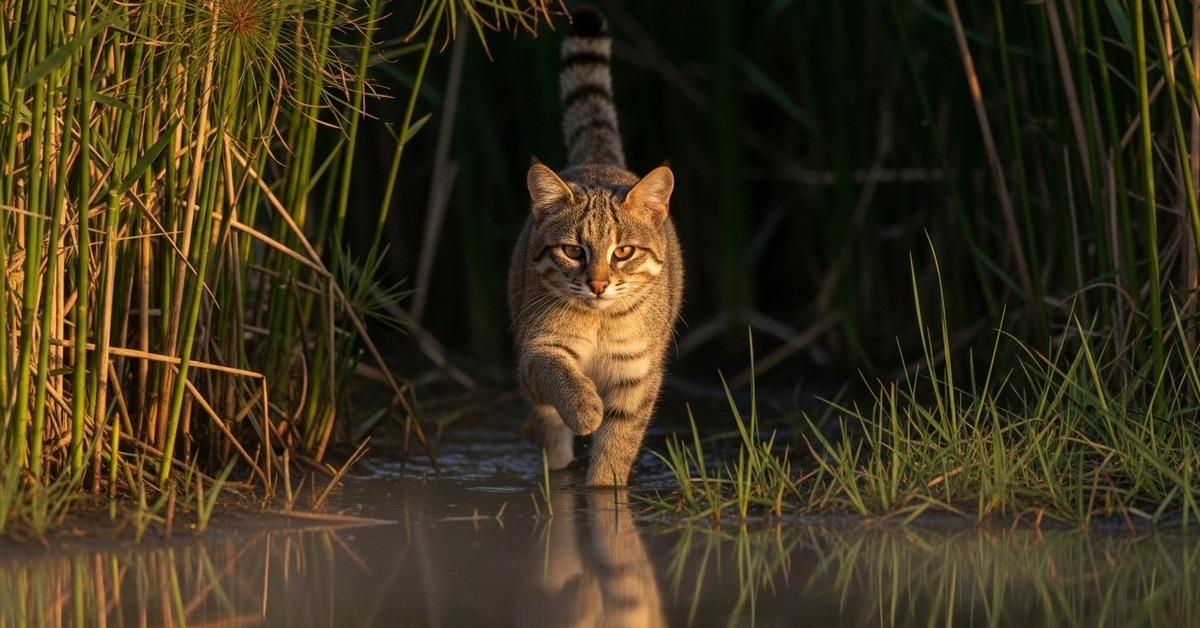
That’s the number that stopped me cold when I first found it — I ended up reading about wetland predator behavior for another hour just trying to understand how a small cat covers that kind of ground through terrain most humans would find impassable. Moving in near-total silence, through reed beds and marsh edges, guided by ears that rotate independently and can triangulate prey in complete darkness. Small mammals, birds, reptiles, fish — whatever the water’s edge is offering. The hunting style is stalk, freeze, pounce, and the whole operation runs without a sound.
For comparison, a typical domestic cat’s nocturnal range is roughly one to two kilometers. The jungle cat is doing three to six times that. Through wetlands. In the dark.
It’s a very specific kind of extraordinary. You can read more about how wetland ecosystems shape predator behavior over at this-amazing-world.com.
Don’t Let the Name Fool You About This Cat
The jungle cat doesn’t live in jungles. Full stop. The name is a genuine taxonomic red herring.
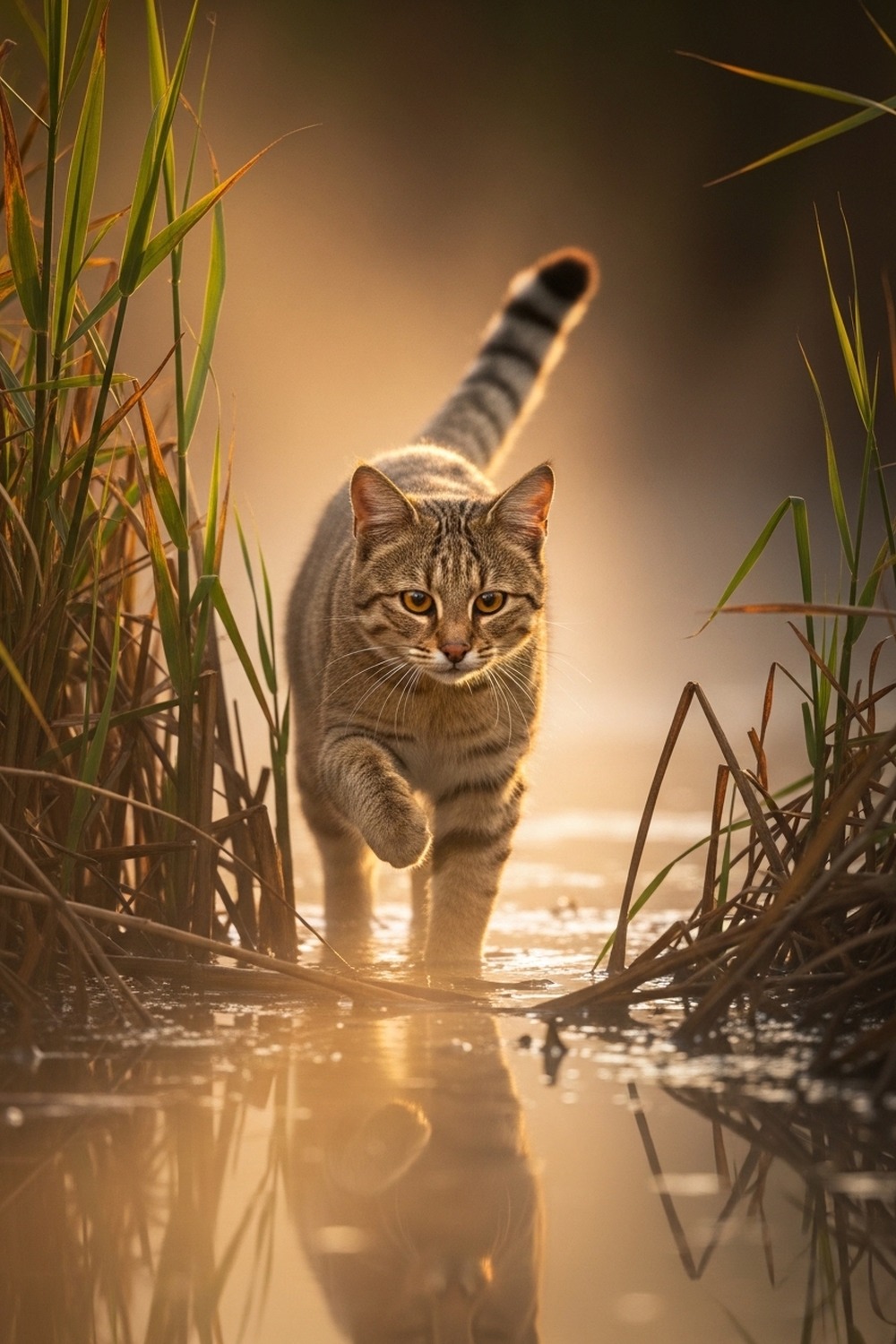
What it actually lives in: canal banks, river deltas, marshes, tall grass bordering water, sugarcane fields in India, papyrus margins along the Nile. Dense, waterlogged, tangled places where the ground shifts and the vegetation grows over your head. In Egypt, it was the animal of the river’s edge — a ghost in the reeds. The jungle cat, for all its dramatic name and massive range, is really a reed specialist. A marsh creature. A water’s-edge animal that got stuck with the wrong label somewhere along the way.
And that specificity is exactly what makes its situation precarious now. But we’ll get to that.
Mummified, But Never Truly Domesticated
It is somewhere around 1350 BCE. A jungle cat is placed in an Egyptian tomb, wrapped, preserved, made sacred. And yet, something in its lineage never crosses the line the African wildcat crossed.
That’s the strange twist in the domestication story. The cat that became your house pet — Felis silvestris lybica, the African wildcat — was domesticated gradually through a mutual relationship with grain-storing settlements. Rodents near the grain, wildcats near the rodents, humans tolerating the wildcats, and slowly, over millennia, something changed on both sides. The jungle cat’s story didn’t go that way. Mummified specimens in tombs and temples, yes. Possibly kept in controlled settings, yes. But the genetic and archaeological record suggests the leap into true domestication never happened.
This animal sat at the edge of human civilization for thousands of years — close enough to be wrapped in linen, close enough to be buried with pharaohs — and still chose the reed beds.
That’s not a failed domestication. That’s a preference, expressed consistently across three millennia.
By the Numbers
- Mummified Felis chaus specimens found at Egyptian sites date as far back as 2000–3000 BCE, placing them among the earliest wild cats with documented human association (IUCN Cat Specialist Group, 2016).
- Thirty countries. That’s the jungle cat’s current range across Asia and North Africa — broader than almost any other small felid on the planet.
- Up to six kilometers covered in a single night of hunting, compared to roughly one to two kilometers for a domestic cat’s nocturnal range.
- Wetland loss in the Nile Delta — the jungle cat ancient Egypt depended on — has accelerated sharply since the Aswan High Dam was completed in 1970. Some estimates put the alteration or loss of original delta marshland at over 30%. The habitat that made this animal sacred to an entire civilization is quietly disappearing.
Field Notes
- Jungle cats swim readily — and will dive for fish. Rare behavior for a small cat.
- They’ve hybridized with domestic cats in the wild and in captivity. The result, called the “Chausie,” is now a recognized domestic breed — carrying the genetic echo of an animal that resisted full domestication for thousands of years. There’s something darkly funny about that.
- Sometimes active in daylight, particularly where human disturbance is low — which suggests the nocturnal behavior isn’t pure instinct. It might be learned avoidance. The cat adjusting to us, not the other way around.
Why This Cat’s Vanishing World Should Worry Us
The jungle cat doesn’t trend. It’s not a snow leopard. It doesn’t have a viral moment or a documentary narrated by anyone famous. It’s a medium-sized wetland specialist with rotating ears and an Egyptian mummification record, and it is quietly losing ground across its entire range.
Wetland drainage. Agricultural expansion. Water diversion projects that reroute the rivers these habitats depend on. The jungle cat ancient Egypt preserved in its tombs now faces a world where the reed beds are shrinking, the marsh edges are drying up, and the very specific kind of wild it needs is being dismantled one irrigation project at a time. Its decline doesn’t make headlines. But it is a precise signal about the health of every wetland system across thirty countries.
When a species that’s held its range from Egypt to China for thousands of years starts losing it, something fundamental is going wrong.
And it’s going wrong quietly. That’s the part worth paying attention to.
Somewhere tonight, if the habitat holds, a jungle cat is moving through reeds that have been there since the pharaohs. Six kilometers of darkness. Independent ears turning. Paws finding the waterline without a sound. It survived the rise and fall of one of history’s greatest civilizations. It was mummified by people who couldn’t quite tame it. It never needed us — and that, strangely, might be exactly why we should be paying attention now. More of this kind of story lives at this-amazing-world.com. The next one is stranger.
Frequently Asked Questions
Q: Was the jungle cat domesticated in ancient Egypt?
No. Although the jungle cat (Felis chaus) was mummified and buried in Egyptian tombs dating back to 2000-3000 BCE, the genetic and archaeological record suggests true domestication never happened. The animal that became the house cat was a different species, the African wildcat (Felis silvestris lybica), domesticated gradually through grain-storing settlements that attracted rodents. The jungle cat sat at the edge of human civilization for thousands of years, close enough to be wrapped in linen, yet consistently chose the reed beds over a domesticated life.
Q: Why is the jungle cat called a jungle cat if it doesn’t live in jungles?
The name is a taxonomic red herring. The jungle cat does not live in jungles at all. It is a wetland and water’s-edge specialist, inhabiting canal banks, river deltas, marshes, tall grass bordering water, sugarcane fields in India, and papyrus margins along the Nile. In ancient Egypt it was the animal of the river’s edge, a ghost in the reeds. Its dependence on these specific waterlogged habitats is exactly what makes its situation precarious now as wetlands shrink.
Q: How far can a jungle cat travel in one night?
A jungle cat can cover up to six kilometers in a single night of hunting, moving in near-total silence through reed beds and marsh edges. That is three to six times the roughly one-to-two kilometer nocturnal range of a typical domestic cat. It hunts using ears that rotate independently to triangulate prey in complete darkness, taking small mammals, birds, reptiles, and fish with a stalk, freeze, and pounce style. Jungle cats also swim readily and will even dive for fish, rare behavior for a small cat.
Illustrations are AI-generated. Article fact-checked and human-edited. Our editorial standards.