Flossie the Cat Turns 30: The Feline Defying Time
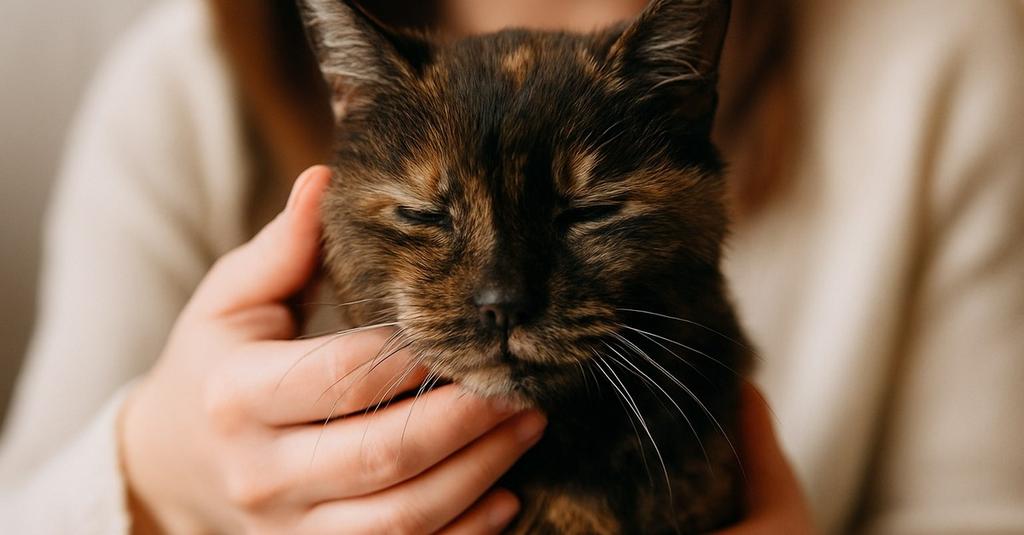
At 30 years old, Flossie is the oldest cat in the world 2025 has officially witnessed — a fact that breaks almost every assumption we hold about feline mortality. Born in 1995 near a hospital on Merseyside, England, she spent three decades moving quietly through ordinary households, asking nothing of science, offering everything to the question of how a creature survives that long without anyone quite understanding why.
A hospital worker brought her home first. Then another family. Then another. She has outlived people who loved her, moved through houses that aged around her, and kept existing through decades that should have broken her biology. Most domestic cats live between 12 and 15 years. Twenty is extraordinary — the kind of milestone that earns a brief mention in a local newspaper. Thirty is something else entirely.
At that age, Flossie is the biological equivalent of roughly 136 human years, a conversion based on the nonlinear aging model proposed by researchers at the Salk Institute for Biological Studies in California. The all-time record still belongs to Creme Puff of Austin, Texas, who died in 2005 at 38 years old — a Guinness World Record that has stood for two decades. Flossie sits eight years behind that mark. She’s also very much alive.
Key Facts
- Flossie, a tortoiseshell born near a Merseyside hospital in England in 1995, turned 30 on December 29, 2025 and is the oldest living cat per Guinness World Records
- At 30, Flossie is roughly equivalent to 136 human years under nonlinear feline aging models
- The all-time record belongs to Creme Puff of Austin, Texas, who died in 2005 at 38 years old
- Most domestic cats live 12 to 15 years, with 20 or more considered exceptional
- Flossie lived with 3 separate families across her 30-year life, all in the Merseyside area
In short: Flossie, the oldest cat in the world, is a tortoiseshell born in Merseyside, England in 1995 who turned 30 on December 29, 2025, roughly 136 human years. Confirmed by Guinness World Records, she trails the all-time mark of Creme Puff, who died at 38, and her longevity is credited to durable genetics and stable, low-stress homes.
The Accumulation of Impossible Time
What’s striking isn’t just the number. It’s what the number actually contains. Flossie was alive when the Channel Tunnel opened in 1994, though she was born a year later. She witnessed three British royal weddings, the entire career of Adele, the rise and fall of several U.S. presidents. She saw five different iPhones enter cultural relevance and then exit it. She did all of this while most of the cats born the same year she was had already turned to dust.
Cats, unlike dogs, have a reputation for independence and inscrutability — they don’t perform their age the way other animals do. Flossie simply kept not dying, quietly, in a series of warm houses, through a series of winters that should have worn her out.
Her current owner, Vicki Green, adopted Flossie from her late brother’s estate. Green has described Flossie as partially blind and deaf — which is expected at this age — but still eating well, still seeking warmth, still present. That detail matters. Appetite, in geriatric cats, is often the first thing to go. To reach 30 in cat years is to have crossed a threshold that vets encounter perhaps once in a career, if at all.
What Biology Actually Says About Extreme Feline Age
Feline longevity research is a younger field than you’d expect, and the mechanisms behind extreme cat age are still being untangled. Here’s the thing: what researchers at the University of Edinburgh’s Roslin Institute — the same institution behind Dolly the sheep — have identified is that telomere length, the protective caps on chromosomes that shorten with each cell division, deteriorates far more slowly in some cat lineages than others.
This isn’t unique to cats. It’s the same mechanism linked to longevity in naked mole rats, certain bat species, and Greenland sharks, all of which show dramatically compressed rates of cellular aging compared to their body size. In 2021, a study published in the journal Aging Cell confirmed that domestic cats experience what’s called a “telomere maintenance advantage” in certain genetic lines — essentially, some cats are built to age more slowly at the molecular level.
Genetics isn’t the whole story, though. Why does environment matter so much? Because low-stress settings consistently appear in the case histories of long-lived cats. Indoor life, stable household, consistent feeding, minimal exposure to other animals and the diseases they carry — these variables track with Flossie’s trajectory perfectly. She moved through a small number of private homes, never saw a shelter, never faced outdoor exposure. Stress hormones like cortisol accelerate cellular aging in mammals, including cats. A life without territorial conflict, predation anxiety, or food scarcity removes several of the most powerful biological clocks from the equation.
And here’s what’s remarkable: just as the unexpected power of attachment and security shapes survival in primate research, consistent caregiving in cats appears to be one of the most underestimated longevity variables we have. This kind of survival isn’t dramatic. That may be exactly the point.
Flossie’s owners across the decades didn’t do anything exotic. No special diet, no supplements, no clinical intervention beyond routine veterinary care. The most likely explanation is the least satisfying one: she was born with unusually durable biology, and then she happened to land in homes that didn’t break it.
The Record Books and What Lies Behind Them
Guinness World Records has been tracking extreme animal ages since the 1950s, but feline longevity records are notoriously difficult to verify. Documentation requirements are strict — birth records, veterinary history, photographic evidence across time — and many genuinely old cats simply aren’t submitted, or can’t be proven. National Geographic’s reporting on feline longevity has noted that unofficial claims of cats reaching their late 30s surface periodically, particularly in rural communities where veterinary documentation was less consistent in earlier decades.
The record, in other words, may not reflect the biological ceiling. It may reflect the administrative one. Creme Puff’s case was unusually well-documented because her owner, Jake Perry, kept meticulous records and was himself a known figure in Austin’s community of long-lived cats — he also owned a 34-year-old cat named Granpa Rex Allen. A fact that raises its own intriguing genetic and environmental questions.
Flossie’s recognition as the oldest cat in the world 2025 was confirmed by Guinness World Records after her 30th birthday, based on documentation her current owner Vicki Green was able to compile across the chain of previous owners. That chain of custody is itself unusual — most cats with multiple owners lose their paper trails. The fact that Flossie’s history was recoverable speaks to the care taken by each family who held her. She wasn’t lost between households. She was handed on deliberately, with records, with love, with the quiet seriousness that comes from recognizing something rare. Watching a species reach this age through nothing but consistent attention and stable environment, you stop calling it luck.
If a cat born in a hospital car park in Merseyside can reach 30 with no extraordinary intervention, the question stops being “how did this happen?” and starts being “how often might this happen without anyone noticing?”
How It Unfolded
- 1995 — Flossie is born near a hospital in Merseyside, England; a hospital worker adopts her as a kitten.
- 2005 — Creme Puff of Austin, Texas dies at 38, setting the Guinness World Record for oldest cat ever verified — a record that still stands.
- 2022 — Flossie, at age 27, is adopted by Vicki Green after the death of her previous owner; Guinness World Records begin reviewing her documentation.
- December 29th, 2025 — Flossie turns 30 and is confirmed by Guinness World Records as the oldest living cat in the world.
By the Numbers
- 30 years — Flossie’s verified age as of December 29th, 2025 (Guinness World Records)
- 136 human years — approximate equivalent of a 30-year-old cat, based on nonlinear feline aging conversion models
- 38 years — the age of Creme Puff of Austin, Texas, still the oldest cat ever officially recorded (died 2005)
- 12–15 years — average lifespan of a domestic cat; 20+ is considered exceptional by most veterinary benchmarks
- 3 separate families — the number of households Flossie lived with across her 30-year life, all in the Merseyside area of England
Field Notes
- Tortoiseshell cats like Flossie are almost exclusively female — the coloring requires two X chromosomes, making males extraordinarily rare (roughly 1 in 3,000). Some feline geneticists at the University of California Davis have speculated since 2019 that the double-X configuration may carry incidental longevity advantages (and this matters more than it sounds), though direct causal evidence remains limited.
- Jake Perry, the Austin man who owned both the record-holding Creme Puff and 34-year-old Granpa Rex Allen, reportedly fed his cats a diet that included bacon, eggs, and cream — a finding that has confounded every nutritional model veterinary researchers have tried to apply to feline longevity.
- Flossie was partially blind and deaf at the time of her 30th birthday confirmation — both conditions are common in geriatric cats and don’t significantly affect quality of life when the environment remains familiar and consistent.
- Researchers still can’t answer why some cats from the same litter, raised in nearly identical conditions, show such dramatically different lifespans. The gap between the shortest and longest-lived sibling cats in documented studies sometimes spans a decade — suggesting genetic variation operating at a level that current sequencing tools haven’t fully resolved.
Frequently Asked Questions
Q: Who is the oldest cat in the world 2025?
Flossie, a tortoiseshell cat born in Merseyside, England in 1995, holds the distinction of oldest living cat documented by Guinness World Records. On December 29th, 2025, she turned 30. The all-time record still belongs to Creme Puff of Austin, Texas, who died in 2005 at 38 years old — a distinction that required verified records across three separate owners to establish.
Q: How is a cat’s age converted to human years?
The old “multiply by seven” rule has been largely retired by researchers. Modern feline aging models, including one published in the journal Cell Systems in 2020 using DNA methylation data, show that cats age rapidly in kittenhood and early adulthood, then slow down significantly. A one-year-old cat is roughly equivalent to a 15-year-old human. By age 10, the equivalent is around 60 human years. At 30, Flossie sits at approximately 136 human years — deep into territory no human has ever reached.
Q: What do people get wrong about why cats live long lives?
Diet alone doesn’t explain extreme feline longevity (researchers actually call this the “Creme Puff problem”). Genetics appear to be the primary driver, with low-stress indoor environments as a significant secondary factor. The famous case of Creme Puff — who reportedly ate bacon and heavy cream — should permanently dismantle the idea that nutrition is the controlling variable. What the longest-lived cats share most consistently isn’t a special food regimen. It’s stable, low-stimulation environments and a genetic architecture that simply doesn’t wear out at the usual rate.
Editor’s Take — Sarah Blake
What gets me about Flossie isn’t the number. It’s the chain of people. Three families, across three decades, each one recognizing something worth preserving and passing it forward with records intact. Most pets don’t get that kind of institutional memory. The caregiving here was quiet and consistent — no interventions, no celebrity vets, just people who paid attention. That’s not a minor detail. In longevity research, low-stress consistency repeatedly outperforms aggressive intervention. Flossie’s life might be the cleanest controlled experiment on that hypothesis we’ve ever accidentally run.
Flossie will almost certainly never know she holds a record. She can’t hear the noise around her name, and her clouded eyes don’t track the camera flashes. She sits in a warm room in Merseyside and does what she has always done — occupies time with extraordinary patience, outlasting everything that was supposed to outlast her. If there’s a lesson somewhere in thirty years of that, it might be this: the longest lives aren’t necessarily the loudest ones. Sometimes endurance looks exactly like stillness. What would we find, if we looked more carefully, at all the animals we’ve stopped watching?
Illustrations are AI-generated. Article fact-checked and human-edited. Our editorial standards.