The Wolves That Swim the Ocean and Eat Like Sharks
A wolf slides into freezing Pacific water off British Columbia and swims seven miles through open ocean. Alone. At night. When it reaches the island on the other side, it doesn’t hunt the way wolves are supposed to hunt — it cracks open shellfish and waits for the tide.
That’s the actual behavior. Not a hypothesis. Not a “researchers suggest.” Documented fact.
Somewhere in the Great Bear Rainforest, a wolf is hunting like something between an otter and a seal. It times the tides. It flips rocks. It gorges on salmon in spawning streams alongside bears that didn’t realize they’d be sharing. And when the food on one island runs thin, it swims to the next one, crossing channels where the water temperature hovers near freezing and the current could kill most land animals in minutes.
Key Facts
- Marine food sources accounted for over 90% of some sea wolves’ annual diet in Raincoast Conservation Foundation studies between 2008 and 2015
- Sea wolves have been documented swimming open-ocean crossings of up to 7.4 miles (12 kilometers) between islands off British Columbia
- The Great Bear Rainforest covers approximately 6.4 million hectares — one of the largest intact temperate rainforests left on Earth
- Coastal wolves consume roughly 135 species of wildlife across land and sea, compared with around 30–40 prey species for inland North American wolf populations
- Indigenous peoples of the British Columbia coast, including the Heiltsuk and Kitasoo/Xai’xais Nations, have documented sea wolves in cultural stories long before Western science classified them genetically
In short: Coastal ‘sea wolves’ of British Columbia’s Great Bear Rainforest are genetically distinct from inland wolves and eat over 90% marine food. They swim ocean channels up to 7.4 miles between islands, hunt shellfish and salmon, and consume around 135 species. Their territory covers roughly 6.4 million hectares of temperate rainforest. Chris Darimont’s Raincoast research has tracked their unique diet since 2008.
Sea Wolves British Columbia: The Animal That Shouldn’t Exist This Way
Researchers studying the Great Bear Rainforest found something that bent their entire framework. The coastal wolves here — sea wolves of British Columbia — carry genetic markers that diverged from inland populations thousands of years ago. Chris Darimont and his team at the Raincoast Conservation Foundation tracked their diets. In some territories, marine food made up over 90% of what they ate annually. In a year. Think about that.
These aren’t recent arrivals. They haven’t accidentally discovered beaches.
Their bodies have bent toward the ocean. Their fur darkened. Their genetics drifted so far they’re becoming something recognizably different from their mountain cousins. The selective pressure — thousands of years of it — shaped them into predators that look like wolves but hunt like nothing we have a clean category for.
The Hunting Strategy Gets Genuinely Strange
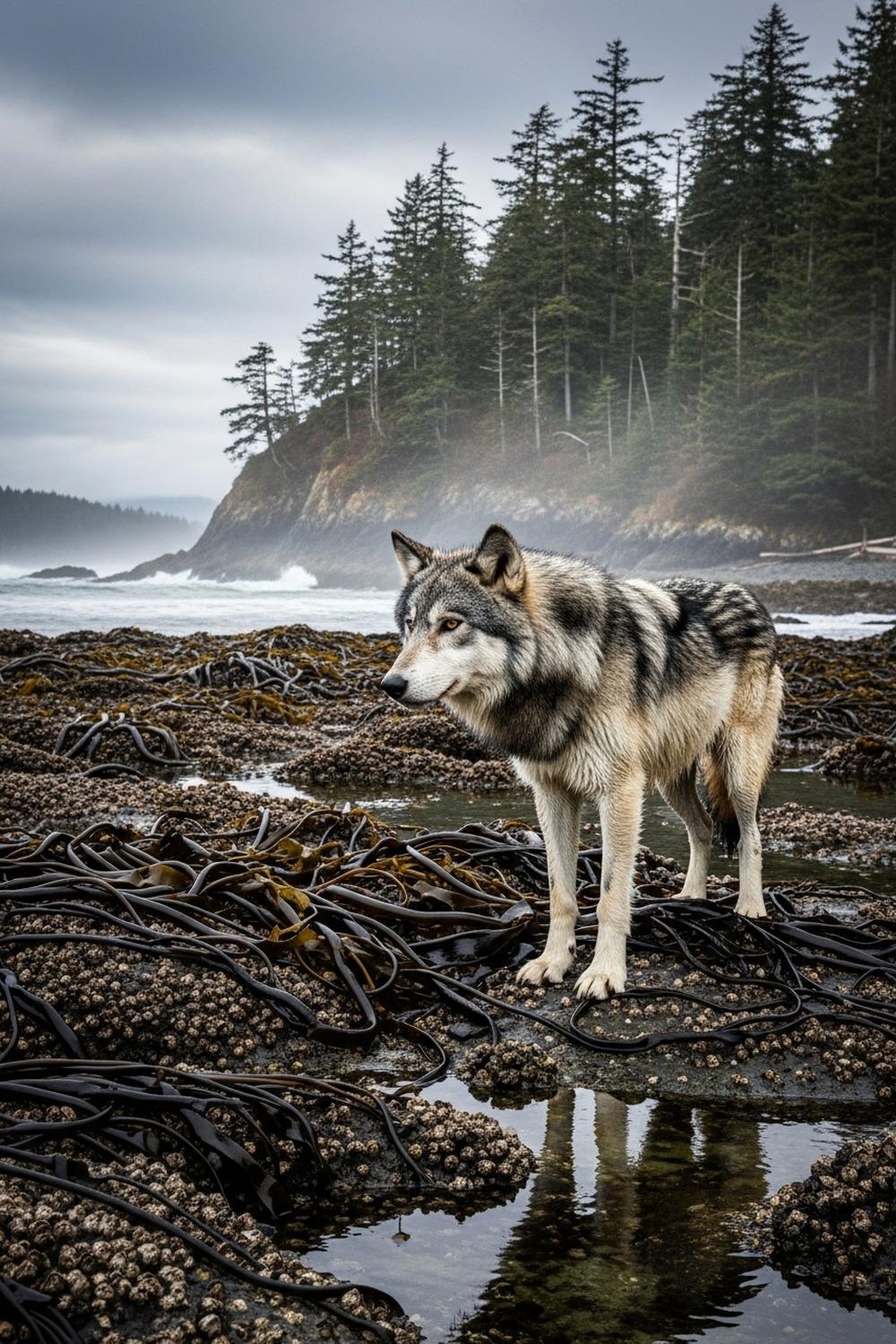
When the tide drops, the rocky intertidal zones open up. Barnacles. Clams. Herring spawn coating the kelp in thick, shimmering layers. The wolves work the shoreline methodically. Flipping rocks. Nosing through tidepools. Crunching shell in their jaws with the precision of something that’s been doing this for generations — which it has.
Salmon season escalates everything.
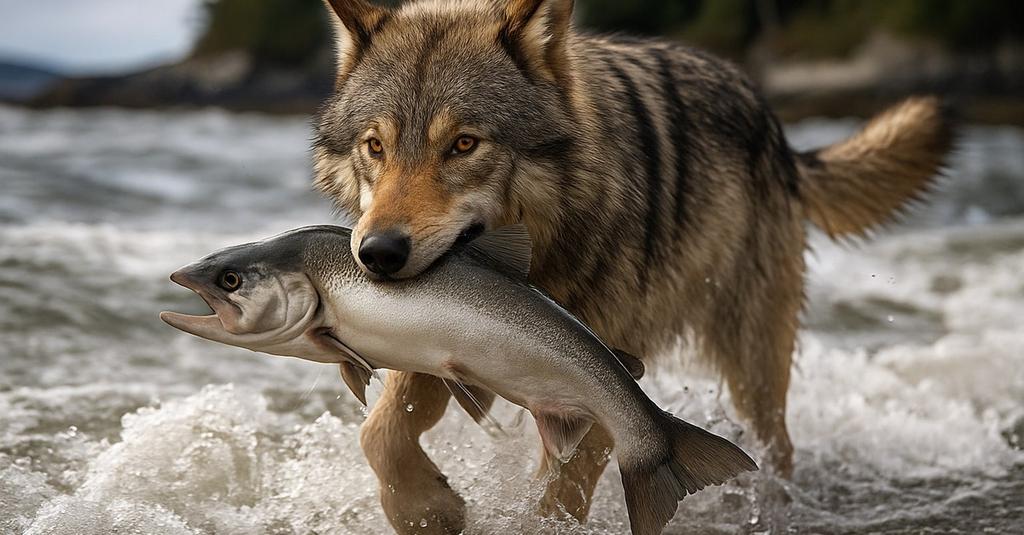
Dozens of wolves line the spawning streams, gorging the way brown bears do. Except nobody told the wolves they were supposed to leave the salmon to the bears. They didn’t get that memo. And so they feast alongside them, sometimes in the same streams on the same days, acting like the ocean-fed ecosystem was always meant to work this way. That last fact kept me reading for another hour because it reframes what “normal” predator behavior even means.
When the feast ends, they carry salmon carcasses deep into the forest — not to eat immediately, but leaving them scattered across the forest floor. Inadvertently fertilizing old-growth trees with marine nitrogen. The forest feeds the fish. The fish feed the wolves. The wolves feed the forest back.
The Ocean Crossing That Breaks the Model
Here’s where sea wolves of British Columbia stop fitting any existing framework entirely. These animals have been documented swimming more than seven miles across open ocean channels. Deep, cold, current-driven straits. Water temperature near freezing. They navigate the archipelago — Vancouver Island, Haida Gwaii, hundreds of smaller islands — treating the ocean like a trail system instead of a barrier.
Alone.
At night.
Nobody fully knows why. Territory? Food pressure? Something older, written into them before we started watching? The research hasn’t answered that question yet, and that uncertainty is almost more interesting than if it had.
Their Genome Tells a Story That Surprised Everyone
When geneticists ran the analysis, these wolves didn’t just look different from inland populations — they were genetically different in measurable ways. The islands themselves acted as a selective filter, separating coastal wolves from their mountain cousins over thousands of years. Their fur often runs darker. Their bodies lean and long. Researchers described them as island-adapted, shaped by selective pressures completely unlike anything studied in Yellowstone or the Rockies.
The chemical signature is what gets strange. Measurable isotopes in their tissue — markers from the ocean food chain — create a record. A sea wolf’s bones tell the story of a thousand salmon. Of herring. Of seal meat eaten on cold mornings in November. It’s written in calcium and carbon.
It doesn’t lie.
By the Numbers
- Marine food sources accounted for over 90% of some sea wolves’ annual diet in Raincoast Conservation studies (2008–2015) — matching coastal bear populations in the same region.
- Sea wolves documented swimming open-ocean crossings up to 7.4 miles (12 kilometers) between islands.
- The Great Bear Rainforest covers approximately 6.4 million hectares. One of the largest intact temperate rainforests left on Earth.
- Coastal wolves consume roughly 135 species of wildlife across land and sea. Inland wolf populations studied in North America: around 30–40 prey species.
Field Notes
- Coastal wolf packs average 3–5 animals, likely because their prey — shellfish, salmon, individual seals — doesn’t require the coordinated group strategy needed to bring down an elk. Smaller groups actually work better here.
- Indigenous peoples of the British Columbia coast, including the Heiltsuk and Kitasoo/Xai’xais Nations, have known about these wolves for generations. They appear in cultural stories and oral traditions describing wolves as beings connected to both land and sea, long before Western science gave them a genetic classification.
- Sea wolves carry salmon carcasses deep into forest.
Why Losing These Wolves Would Unravel Everything Connected to Them
The sea wolves of British Columbia aren’t just a fascinating edge case. They’re a keystone species for an entire coastal ecosystem running on deeply interconnected cycles. Salmon feed wolves. Wolves spread marine nutrients through the forest as carcasses and waste. Old-growth trees, fertilized by ocean nutrients, shade the streams and keep water cold enough for salmon to spawn. Pull one thread and the system frays. These wolves aren’t separate from the forest or ocean — they’re the living link between them.
And they’re under pressure. Logging reduces salmon stream quality. Hunting and trapping, still occurring in parts of British Columbia, can collapse small island packs quickly. A pack of four wolves swimming their islands, eating their tides — resilient, but not invincible. Lose a breeding pair and an entire island’s wolf lineage can vanish in a season.
What keeps emerging from stories like this is that nature refuses our categories. Wolves aren’t supposed to swim oceans or eat like sharks or fertilize rainforests with fish bones. And yet. The sea wolves have been doing all of it, quietly, for thousands of years — long before anyone was watching. They’re a reminder that the world is stranger and more tangled than any diagram can capture. If this keeps you up at night, there’s more at this-amazing-world.com — and the next one is even stranger.
“
Frequently Asked Questions
Q: What makes sea wolves different from regular wolves?
Sea wolves are coastal wolves of British Columbia’s Great Bear Rainforest with measurable genetic differences from inland populations. Chris Darimont and his Raincoast Conservation Foundation team documented that marine food made up over 90% of some sea wolves’ annual diet between 2008 and 2015. Their fur often runs darker, their bodies lean and long, and they consume roughly 135 species of wildlife — compared with 30–40 prey species for inland wolves. They have been hunting like this for thousands of years.
Q: How do sea wolves hunt in the ocean?
They work the rocky intertidal zones at low tide, flipping rocks and nosing through tidepools for barnacles, clams, and herring spawn. They crunch shell with the precision of generations of practice. During salmon season, dozens of wolves line spawning streams, gorging the way brown bears do — sometimes feeding alongside bears in the same streams. They carry salmon carcasses deep into the forest, leaving them scattered across the floor and inadvertently fertilizing old-growth trees with marine nitrogen.
Q: How far can sea wolves swim?
Sea wolves have been documented swimming open-ocean crossings of up to 7.4 miles (12 kilometers) between islands. They navigate British Columbia’s archipelago — Vancouver Island, Haida Gwaii, and hundreds of smaller islands — treating the ocean like a trail system rather than a barrier. They swim alone, at night, through cold currents where water temperature hovers near freezing. Researchers do not yet fully know what drives the crossings — territory, food pressure, or something written into them before observation began.
Q: How was their unique status confirmed?
Geneticists found that coastal wolves diverged from inland populations thousands of years ago, with the islands themselves acting as a selective filter. Measurable isotopes in their tissue record their marine diet — calcium and carbon markers that don’t lie. Indigenous peoples of the British Columbia coast, including the Heiltsuk and Kitasoo/Xai’xais Nations, have known about these wolves for generations and described them in cultural stories long before Western science assigned them a genetic classification. Coastal wolf packs average 3–5 animals.
Illustrations are AI-generated. Article fact-checked and human-edited. Our editorial standards.