Why Dolphins Are Born Tail-First (And It’s Brilliant)
Dolphins don’t do what every other mammal does when a baby’s on the way. The calf comes out backwards — tail first, head last — and nobody bothered to ask why until fairly recently.
In the open ocean, you don’t get a do-over. There’s no shallow water to practice in, no mother to catch you if you mess up the first sixty seconds of life. A bottlenose dolphin calf enters a world that’ll drown it if it hesitates for more than a few breaths. Evolution had to solve that problem, and the solution it landed on is so specific, so perfectly calibrated to the ocean environment, that once you see it, you can’t unsee how weird it actually is.
Key Facts
- Bottlenose dolphins are born tail first, with the head and blowhole emerging last so the calf can surface to breathe within seconds
- A dolphin calf reaches the surface for its first breath within 10 seconds of being fully born, under 5 seconds in some observed cases
- Newborn calves weigh roughly 25 to 45 pounds (11 to 20 kg) and measure about 3 feet long, capable of swimming immediately
- Dolphin gestation runs approximately 12 months, close to human pregnancy length
- Dolphins split from land-dwelling ancestors around 50 million years ago
In short: Dolphins are born tail first, an evolutionary reversal that keeps the calf’s blowhole tucked inside the mother until the last second so it can surface and breathe within 10 seconds. Studied by Janet Mann at Georgetown in Shark Bay, this adaptation, paired with alloparent aunties and synchronized nursing, solves the danger of giving birth in open ocean.
Why Dolphin Birth Tail First Breaks Every Rule
Most mammals — us included — arrive headfirst. That’s the default setting. It protects the airways, speeds things up, reduces suffocation risk during labor. Makes sense on land. Makes sense in a hospital room. Researcher Janet Mann at Georgetown University has spent decades in Shark Bay, Australia, watching bottlenose dolphins do their thing, and she’ll tell you that birth is maybe the least-observed critical event in dolphin life. Nobody’s around to see it.
But here’s the thing about being a mammal in the ocean:
You have lungs, not gills.
That means the environment that gave you life is also the thing trying to kill you the moment you’re born. Water is everywhere. Air is nowhere. And evolution didn’t compromise — it flipped the entire script.
The Head Stays Inside as Long as Possible
When a bottlenose calf exits tail-first, the blowhole — that’s the breathing hole on top of the head — stays tucked inside the mother’s body until the last possible second. The moment the calf clears completely, it’s already pointing upward. No reorientation needed. No figuring out which way is the surface. No time wasted. Just: emerge, orient, swim up. First breath happens in under five seconds if everything goes right.
That’s not an accident.
That’s millions of years of refinement doing exactly what it’s supposed to do. You can read more about how ocean mammals have adapted their biology in surprising ways over at this-amazing-world.com.
A newborn weighing up to 45 pounds full-body clears the canal and immediately surges toward light and air. Most humans take longer to tie their shoes than a dolphin calf takes to complete its first breath sequence.
The Dolphins Everyone Forgets to Mention
This is where it gets genuinely strange.
Dolphins don’t birth in isolation. They live in pods — tight social structures where multiple females work in concert during labor. When a birth’s happening, you get what researchers call “alloparents” hovering nearby. Call them auntie dolphins. Almost always, they’ve given birth before. They know what’s supposed to happen. They know what looks wrong.
These females don’t just stand by. According to research across the bottlenose dolphin research community, alloparental behavior in cetaceans suggests a level of learned social knowledge that rivals some primates. If the calf needs guidance to the surface, the aunties provide it. If something goes sideways, they’re there. It’s midwifery. Underwater. And for decades, scientists watched it happen without fully understanding how the females knew a birth was imminent in the first place.
That last fact kept me reading for another hour.
The First Breath: Those Critical Seconds
A bottlenose calf is roughly 3 feet long at birth and already capable of independent swimming within seconds of delivery. The mother nudges it upward — a gentle push from below toward the surface — and in some observed cases, an auntie takes that role instead. Either way, the calf breaks the surface.
Blowhole opens.
Lungs that’ve never seen air inflate for the first time.
It works almost every time. Then the real challenge begins.

Two Years of Perfect Synchronization
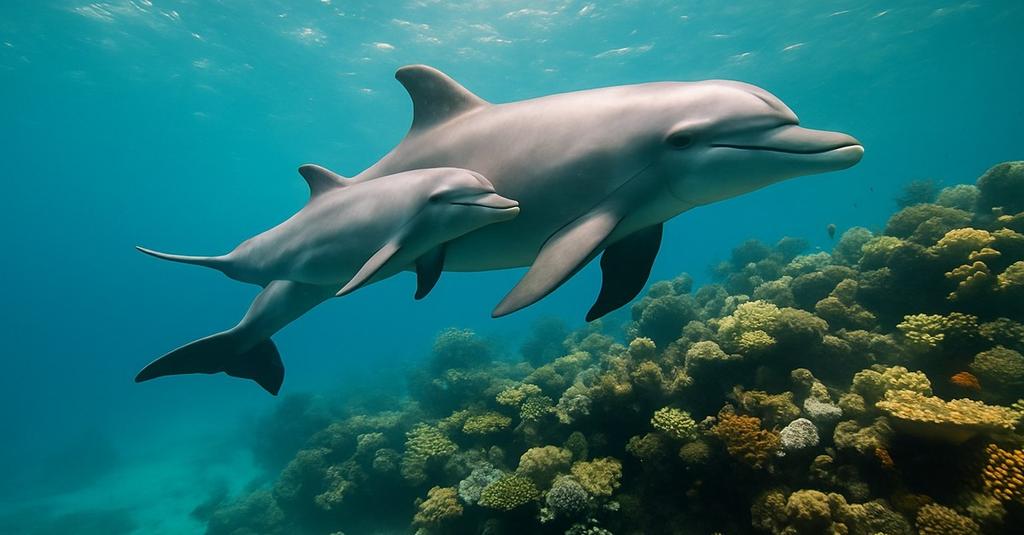
The bond between a dolphin mother and calf after birth is one of the most intense relationships in the animal kingdom. Researchers describe them moving as a single hydrodynamic unit — the calf positions itself just behind and slightly to the side of its mother, riding the pressure wave her body creates as she swims. This isn’t cute. It’s survival math. The calf doesn’t have to work as hard to move because the mother’s motion pulls it along, almost like drafting in cycling or racing.
For up to two years, the calf nurses underwater, surfacing in sync with the mother to breathe. Every breath coordinated. Every dive matched. Separation in those early weeks can be fatal. Sharks hunt calves specifically, and the pod’s formation around a new mother isn’t social warmth — it’s a defensive perimeter.
By the Numbers
- Calves arrive weighing 25–45 pounds (11–20 kg) and measuring roughly 3 feet — already built to swim immediately.
- A dolphin calf reaches the surface for its first breath within 10 seconds of being fully born — under 5 seconds in some observed cases.
- Gestation runs approximately 12 months, close to human pregnancy length.
- Nursing continues for 2 years on average in most wild populations, though some individuals in Shark Bay have been observed nursing for up to 3–6 years — far longer than most marine mammals.
Field Notes
- Newborn calves carry faint horizontal stripes called fetal folds — creases from being curled in the womb. These disappear within days.
- Dorsal fins and flukes are soft and pliable at birth, stiffening within hours. A protective measure so the mother isn’t injured during delivery.
- Some dolphins have been observed babysitting calves while the mother hunts — behavior that suggests social trust and memory extending well beyond simple instinct.
What This Really Tells Us About Evolution
The dolphin birth tail-first phenomenon is a masterclass in how evolution doesn’t follow a playbook. It follows pressure. The ocean created a specific problem — a lung-breathing mammal that has to surface immediately after birth — and over millions of years, the solution emerged. Not through planning. Through survival. The calves born in better positions lived. They passed that advantage to their offspring. Repeat five million times and you get here.
What’s genuinely remarkable isn’t just the tail-first adaptation. It’s everything that had to shift alongside it.
The alloparental behavior. The hydrodynamic nursing position. The stiffening of the fins. All coordinated. All pointing toward one outcome: one life, one first breath, every single time.
Dolphins split from land-dwelling ancestors around 50 million years ago. Fifty million years of refinement produced a newborn that can swim, surface, and breathe within seconds of entering a world designed to kill anything that hesitates. That’s not just biology. That’s a story about how impossibly specific solutions become invisible once they work.
Evolution rarely makes sense until you trace it backwards — from that first breath to the tail-first entry to the aunties standing guard. Then it clicks. Dolphins didn’t get lucky. They got adapted, and the ocean kept the pressure on until only the perfectly calibrated survived. If this kind of thing keeps you up wondering, there’s more at this-amazing-world.com.
Frequently Asked Questions
Q: Why are dolphins born tail first?
Dolphins are born tail first because they are lung-breathing mammals giving birth in open water, where a newborn must surface to breathe almost immediately. By emerging tail first, the calf’s head and blowhole stay tucked inside the mother’s body until the last possible second. The moment the calf clears completely it is already pointing upward toward the surface, eliminating any need to reorient. This reverses the headfirst default of nearly all other mammals, including humans.
Q: How quickly does a newborn dolphin take its first breath?
Very quickly. A bottlenose calf reaches the surface for its first breath within 10 seconds of being fully born, and under 5 seconds in some observed cases. The newborn, weighing roughly 25 to 45 pounds and measuring about 3 feet, is capable of independent swimming within seconds of delivery. The mother, or sometimes an alloparent, nudges it upward from below. The blowhole opens, and lungs that have never seen air inflate for the first time.
Q: What role do other dolphins play during birth?
Dolphins do not give birth in isolation. They live in pods where multiple females assist during labor, acting as alloparents, often informally called auntie dolphins, that have usually given birth before. These females help guide the calf to the surface if needed and form a defensive perimeter, because sharks specifically hunt newborn calves. Researchers note this alloparental behavior in cetaceans reflects learned social knowledge that rivals some primates.
Q: How long does a dolphin calf stay with its mother?
The bond is among the most intense in the animal kingdom. After a gestation of roughly 12 months, the calf nurses underwater for about 2 years on average, surfacing in sync with the mother to breathe, with every dive matched. Some individuals in Shark Bay have been observed nursing for 3 to 6 years, far longer than most marine mammals. The calf rides the pressure wave of the mother’s body to save energy, moving as a single hydrodynamic unit.
Illustrations are AI-generated. Article fact-checked and human-edited. Our editorial standards.