Lunar Lava Tubes: The Moon’s Hidden Underground World
What lies beneath the Moon’s surface might be the most naturally sheltered real estate in the entire solar system — and we nearly missed it entirely. Billions of years ago, rivers of molten rock carved tunnels through the lunar crust. The lava drained. The ceiling remained. Hollow, sealed, waiting. In 2017, Japan’s SELENE spacecraft confirmed what planetary scientists had begun to suspect: lunar lava tubes stretch across the subsurface like architecture built by fire itself, and they could change everything about how humans survive beyond Earth.
Most people picture the Moon as a barren, cratered shell — hostile on the outside, solid all the way through. That picture is incomplete. Beneath the volcanic plains of the Marius Hills region, evidence emerged of a void stretching potentially over 50 kilometers. But the real question isn’t what these tunnels are. Why does this matter? Because what they reveal about living beyond Earth collapses assumptions we’ve held about the entire solar system.
Key Facts
- Japan’s SELENE spacecraft confirmed a major subsurface void near the Marius Hills in 2017
- The detected void is estimated at over 50 kilometers long and up to 1 kilometer wide
- Lunar lava tube interiors are modeled to stay stable near 17 degrees C year-round (University of Bologna / NASA JPL, 2022)
- Lunar surface radiation is roughly 200 times higher than Earth’s surface (Science Advances, 2020)
- Major lunar lava tubes are estimated to be 3-4 billion years old, formed during the Moon’s peak volcanic period
In short: Lunar lava tubes are hollow tunnels carved by ancient lava flows, confirmed near the Marius Hills by Japan’s SELENE spacecraft in 2017 at over 50 kilometers long. With interiors modeled to stay near 17 degrees C and rock shielding against radiation, they may become humanity’s first sheltered habitats on the Moon.
How Lunar Lava Tubes Were Born From Fire
Between roughly 3 and 4 billion years ago, the Moon was volcanically ferocious — rivers of low-viscosity basaltic lava carved channels across its surface in the same way that lava tubes on Earth form in places like Hawaii and the Canary Islands. The outer edges of these flows cooled rapidly in the vacuum of space, hardening into a solid roof and walls. The interior lava, insulated by that crust, kept moving. When the volcanic eruption eventually stopped, the lava drained away entirely — leaving a long, hollow tube sealed under solid rock.
Japan Aerospace Exploration Agency (JAXA) used radar data from the SELENE orbiter, published in the journal Geophysical Research Letters in 2017, to identify an enormous void near the Marius Hills. The structure measured roughly 50 kilometers in length and up to 1 kilometer in width. A kilometer-wide tunnel is not a cave in any ordinary sense. It’s a cathedral multiplied a hundred times over — a geological structure so large that an entire city district could fit inside it.
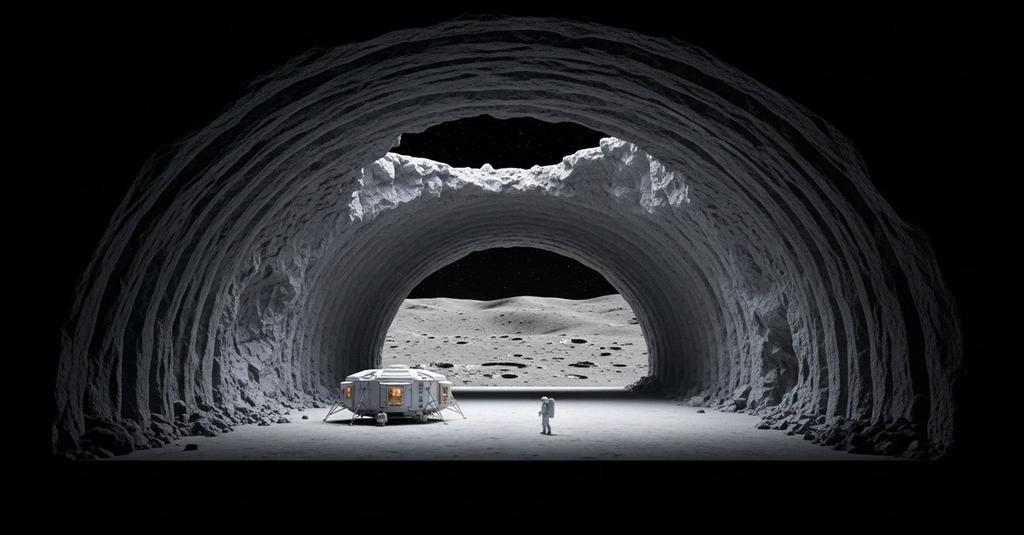
The Moon’s lower gravity — about one-sixth of Earth’s — meant lava could flow faster and farther than equivalent eruptions on Earth, potentially producing tubes of extraordinary size. That same low gravity may be why the ceilings have stayed intact for billions of years without collapsing under their own weight.
Think about what billions of years of preservation means. No weather. No tectonic shifts. No water to erode. These structures have been sitting in near-perfect stillness since before complex life existed on Earth.
That’s not geology. That’s a time capsule.
Why the Moon’s Surface Makes Human Life Impossible
The lunar surface offers no atmospheric protection of any kind — no ozone layer, no magnetic field worthy of the name. Galactic cosmic rays and solar particle events penetrate freely. Micrometeorites arrive continuously, unimpeded by any atmosphere to burn them up. The Moon doesn’t want you alive, and the physics makes the case plainly.
Temperature swings alone are enough to destroy most unshielded equipment: surface readings push above 120°C in full sunlight and plunge below -130°C in darkness — a range of over 250 degrees within a single lunar day. For context, engineers designing equipment for Mars still benefit from a thin atmosphere that provides some thermal buffering. The Moon offers nothing. Every kilogram launched from Earth costs extraordinary sums to deliver, which is why the shielding requirements for a surface habitat capable of protecting astronauts for months or years would be enormous and deeply uncertain.
A person living on the lunar surface without shielding would receive radiation doses roughly 200 times higher than someone on Earth’s surface — according to measurements taken by NASA’s Lunar Reconnaissance Orbiter and published in 2020 in the journal Science Advances. On a six-month mission, that exposure would accumulate rapidly towards career dose limits for astronauts. This is why NASA’s Artemis program and the European Space Agency have both emphasized the need to find or create protected environments before permanent habitation becomes realistic.
The engineering solutions proposed for surface habitats involve burying structures under meters of lunar regolith — the loose rocky soil of the surface. It’s workable in theory. But it requires equipment, time, and energy that doesn’t yet exist on the Moon. A lava tube doesn’t require any of that. The work was done by volcanic fire, three billion years ago.
The Natural Shield That Science Didn’t Expect
Here’s the thing: the physics of lunar lava tubes as shelters works out almost too well. The rock overhead — potentially several meters to tens of meters thick — provides natural shielding against cosmic radiation and solar energetic particles without any construction required. Studies published in Nature Astronomy in 2022, led by researchers at the University of Bologna and NASA’s Jet Propulsion Laboratory, modeled temperature conditions inside lunar pits — the likely skylights that open into lava tubes — and found that temperatures within these structures remain remarkably stable at around 17°C year-round.
That number is striking: while the surface swings through a 250-degree temperature range, the interior stabilizes at a temperature a human being could survive in without a heated suit. Not comfortable. But survivable. And in the context of lunar engineering, that’s a revolution.
Lunar lava tubes also offer protection from micrometeorite impacts — a hazard that accumulates silently over time. On the surface, micrometeorites sandblast equipment, degrade solar panels, and pose a constant low-level threat to spacesuit integrity. Inside a tube, the rock ceiling absorbs all of it.
The floor of a lava tube may also contain features of scientific value: layered basalt, preserved volcanic features, possibly even traces of volatiles like water ice in the deeper, permanently shadowed sections (and this matters more than it sounds — ice means fuel, means oxygen, means self-sufficiency). What researchers can’t yet determine is exactly what’s down there, because no probe has ever entered one. The first direct exploration will require a new class of robotic scout, small enough to descend through a skylight opening and tough enough to navigate an unmapped underground environment.
This changes the design logic for lunar habitation entirely. Instead of engineering a habitat that can survive the Moon’s surface, you engineer a habitat that fits inside a structure that already does the hardest work for you. That’s not a minor convenience. That’s a fundamental shift in what’s possible.
Lunar Lava Tubes as the Foundation for Human Settlement
In 2020, the JAXA-supported SELENE follow-up analysis refined estimates of the Marius Hills void’s dimensions and confirmed its structural integrity as a potential habitat candidate. NASA’s interest in lunar lava tubes as habitation sites isn’t speculative anymore. The agency’s Innovative Advanced Concepts (NIAC) program has funded multiple studies examining how future missions could locate, map, and eventually inhabit these structures. The European Space Agency has run parallel design studies — including the concept of inflatable habitat modules that could be delivered through a lava tube’s skylight opening and deployed within its interior, protected on all sides by the surrounding rock.
Between 2020 and 2023, NASA published roadmap documents that explicitly identify subsurface access as a priority for sustainable human presence on the Moon. These aren’t sketches on a whiteboard. Some of the world’s most rigorous aerospace engineers are working on the specific engineering challenges involved: skylight entry mechanisms, pressurization strategies, power delivery systems, and surface-to-tube communication relays.
A robotic precursor mission would enter the tube first — mapping the interior, measuring structural stability, testing atmospheric composition and radiation levels at the floor level. If conditions match models, a second mission would deliver infrastructure components. Pressurized inflatable sections would create breathable zones within the tube. Solar power from surface arrays would feed through cable systems down the skylight shaft. Water, if found as ice in shaded sections, could be electrolyzed to produce oxygen and hydrogen. The tube itself becomes not just a shelter but a potential resource — a geological structure that provides radiation shielding, thermal stability, physical protection, and possibly raw materials, all at once.
Researchers at the Massachusetts Institute of Technology have modeled colony architectures based on lunar tube dimensions. Their findings suggest that a single large tube could house thousands of people in a pressurized environment — not in the near future, but within a plausible multi-generational timeline. The math is extraordinary. The engineering is not simple. But neither is it impossible.
What the Silence Down There Might Still Contain
Beyond the habitability question lies something that planetary scientists find equally compelling: what’s preserved inside. The floors of lunar lava tubes haven’t been touched by solar wind, cosmic ray bombardment, or meteorite impact since the volcanic fires went silent billions of years ago. On the surface, the regolith is constantly churned — a process called “gardening” by impacts both large and microscopic. It destroys fine-scale stratigraphy. It mixes the record.
But inside a sealed lava tube, the original volcanic floor may be intact. Lava structures — flow features, lava stalactites, volcanic glass formations — could exist in a state of preservation that surface geology simply can’t offer. By comparison, scientists studying Mars have long hoped that subsurface environments might preserve biosignatures or chemical records that the surface has long since destroyed. The same logic applies here, with an added advantage: the Moon is close enough to reach, study, and sample within existing mission architecture. Watching a species of hypothesis transform into a species of verified data, you stop calling it speculation and start calling it reconnaissance.
There’s also the possibility of water ice. Permanently shadowed regions at the Moon’s poles have already yielded confirmed ice deposits, detected by multiple orbital instruments and confirmed by the NASA LCROSS impact experiment in 2009. Lunar lava tubes in mid-latitude regions aren’t permanently shadowed in the same way — but their deep interiors, never exposed to direct sunlight, could trap volatiles. If ice exists within tube systems, the implications compound quickly. Water means oxygen. Water means hydrogen fuel. Water means the Moon stops being a destination you must supply entirely from Earth and starts being a place that contributes to its own survival.
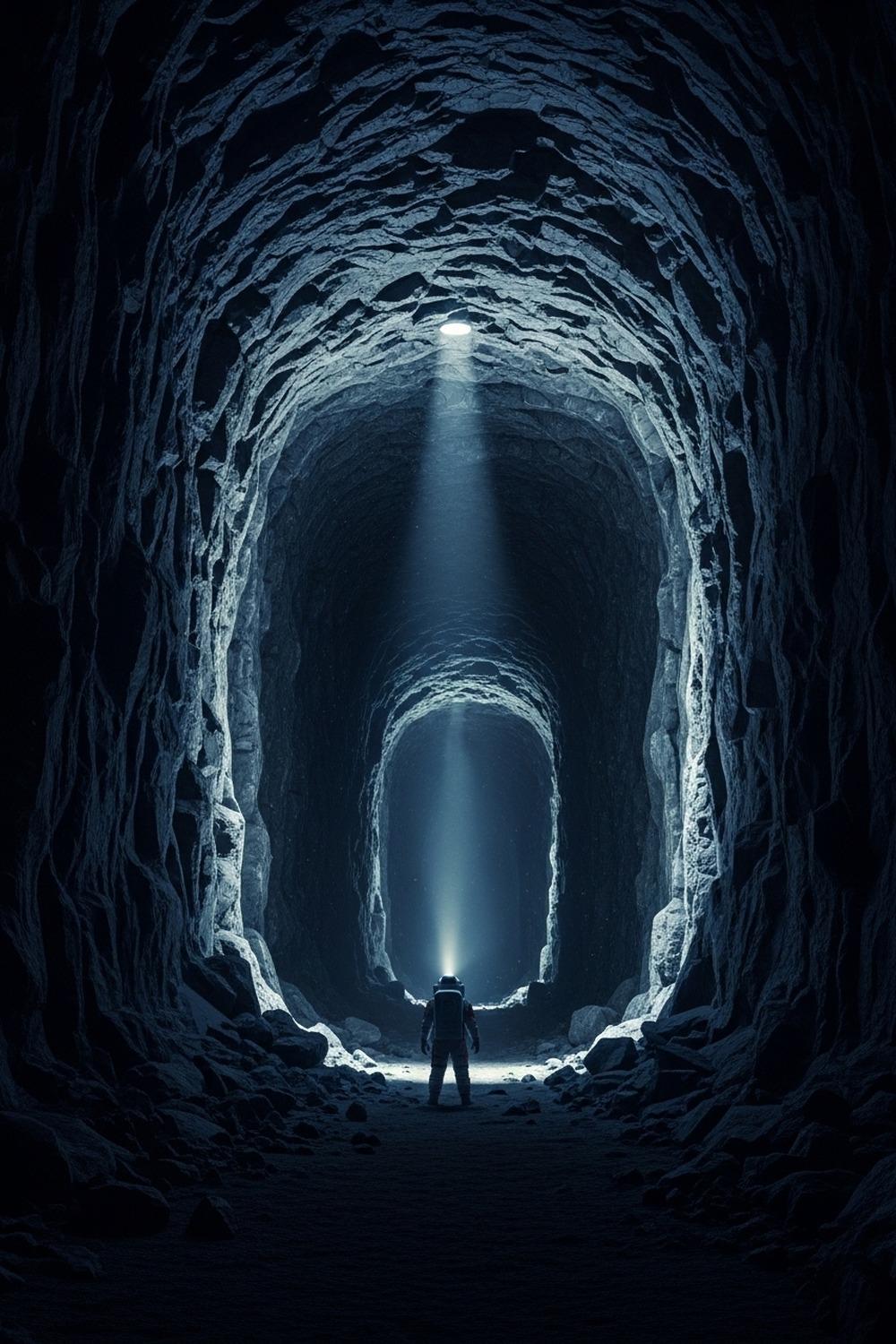
Picture the floor of a lava tube as it might look: basalt smooth as poured concrete in places, fractured and jagged in others, walls arching overhead in the dark. Somewhere in that darkness, geological time sits undisturbed. A record written in rock and silence, waiting for the first light that anyone has ever brought into it.
How It Unfolded
- 1969: Apollo mission seismic data first hints at potential subsurface voids on the Moon, though not identified as lava tubes at the time.
- 2009: NASA’s Lunar Reconnaissance Orbiter (LRO) begins imaging the Moon’s surface in high resolution, identifying pit entrances — potential lava tube skylights — in the Marius Hills and Mare Tranquillitatis regions.
- 2017: JAXA’s SELENE radar data confirms a major subsurface void near the Marius Hills, potentially 50 kilometers long and up to 1 kilometer wide — the strongest direct evidence of a lunar lava tube to date.
- 2022: University of Bologna and NASA JPL researchers publish thermal modeling in Nature Astronomy showing stable temperatures near 17°C inside lunar pits, triggering renewed international interest in tube habitation studies.
By the Numbers
- 50+ kilometers: estimated length of the Marius Hills void detected by JAXA SELENE radar in 2017.
- Up to 1 kilometer: estimated width of the same structure — comparable in scale to some of the largest cave systems on Earth.
- ~17°C: modeled stable temperature inside lunar pit interiors, compared to surface swings from +120°C to -130°C (University of Bologna / NASA JPL, 2022).
- 200×: approximate increase in radiation exposure on the lunar surface compared to Earth’s surface, as measured by NASA’s Lunar Reconnaissance Orbiter (Science Advances, 2020).
- 3–4 billion years: estimated age of major lunar lava tube formations, coinciding with the Moon’s peak volcanic period.
Field Notes
- In 2010, NASA’s Lunar Reconnaissance Orbiter photographed a pit in the Mare Tranquillitatis region measuring roughly 100 meters across — its interior wall was illuminated enough to show a possible cave floor roughly 14 meters below the opening, the first visual glimpse of what a lava tube entrance might look like from above.
- Lunar lava tubes are thought to be far larger than their Earth equivalents because the Moon’s weaker gravity — about 16% of Earth’s — allows molten rock flows to maintain structural roofs at much greater spans without collapse.
- Some researchers have proposed that future robotic scouts entering lunar lava tubes should be designed to operate without GPS — the tubes would block satellite signals entirely, requiring autonomous navigation using onboard lidar and terrain mapping.
- Scientists still can’t determine whether any lunar lava tubes contain water ice in their interiors — or whether the geological conditions that preserved volatiles at the poles could also preserve them in mid-latitude tube systems. That question won’t be answered without direct exploration, and no mission has yet been funded specifically to enter one.
Frequently Asked Questions
Q: What exactly are lunar lava tubes, and how are they different from caves on Earth?
Lunar lava tubes are hollow underground channels formed when rivers of molten basalt flowed across the Moon’s surface billions of years ago. The outer edges cooled and hardened into a ceiling and walls while lava continued flowing inside; when the eruption stopped, the interior drained, leaving a hollow tunnel. Unlike caves on Earth, they weren’t formed by water erosion — and the Moon’s lower gravity means they can exist at scales far larger than anything found on our planet.
Q: Could humans actually live inside a lunar lava tube?
Potentially, yes — and that’s exactly what engineers and space agencies are studying. The rock overhead provides natural shielding against cosmic radiation and solar particles. Temperatures inside are modeled to stabilize around 17°C, compared to the brutal swings on the surface. Pressurized inflatable habitats could in principle be deployed through a skylight entrance. The challenges are real — power supply, air, water — but the tube itself solves the two hardest problems: radiation protection and thermal stability.
Q: Is there any proof that lunar lava tubes actually exist, or is this still theoretical?
The evidence is strong, though no probe has yet entered one directly. Japan’s SELENE spacecraft used radar sounding in 2017 to detect a subsurface void near the Marius Hills measuring over 50 kilometers in length — a void consistent with a collapsed or intact lava tube. NASA’s Lunar Reconnaissance Orbiter has also imaged multiple pit entrances that are widely interpreted as skylights into tube systems. Direct confirmation will require a robotic mission that descends through one of these openings — something no agency has yet accomplished.
Editor’s Take — Dr. James Carter
What stops me is the temperature number: 17°C. Not a rough estimate or a hopeful projection — a modeled figure from a peer-reviewed study, stable year-round, sitting a few meters below a surface that swings 250 degrees in a single day. That one data point quietly collapses the assumption that the Moon is uniformly hostile.
The Moon has never been as simple as it looked from Earth. What appeared to be a barren, undifferentiated shell turns out to contain architectural structures older than anything alive on our planet — structures that may one day shelter the first humans to call another world home. The story of lunar lava tubes isn’t just about geology or engineering. It’s about the possibility that the most inhospitable-looking environments sometimes contain exactly the conditions that make survival possible. What else has the solar system hidden in plain sight, waiting for someone to think to look underneath?
Illustrations are AI-generated. Article fact-checked and human-edited. Our editorial standards.