When Andromeda Hits the Milky Way: What Really Happens
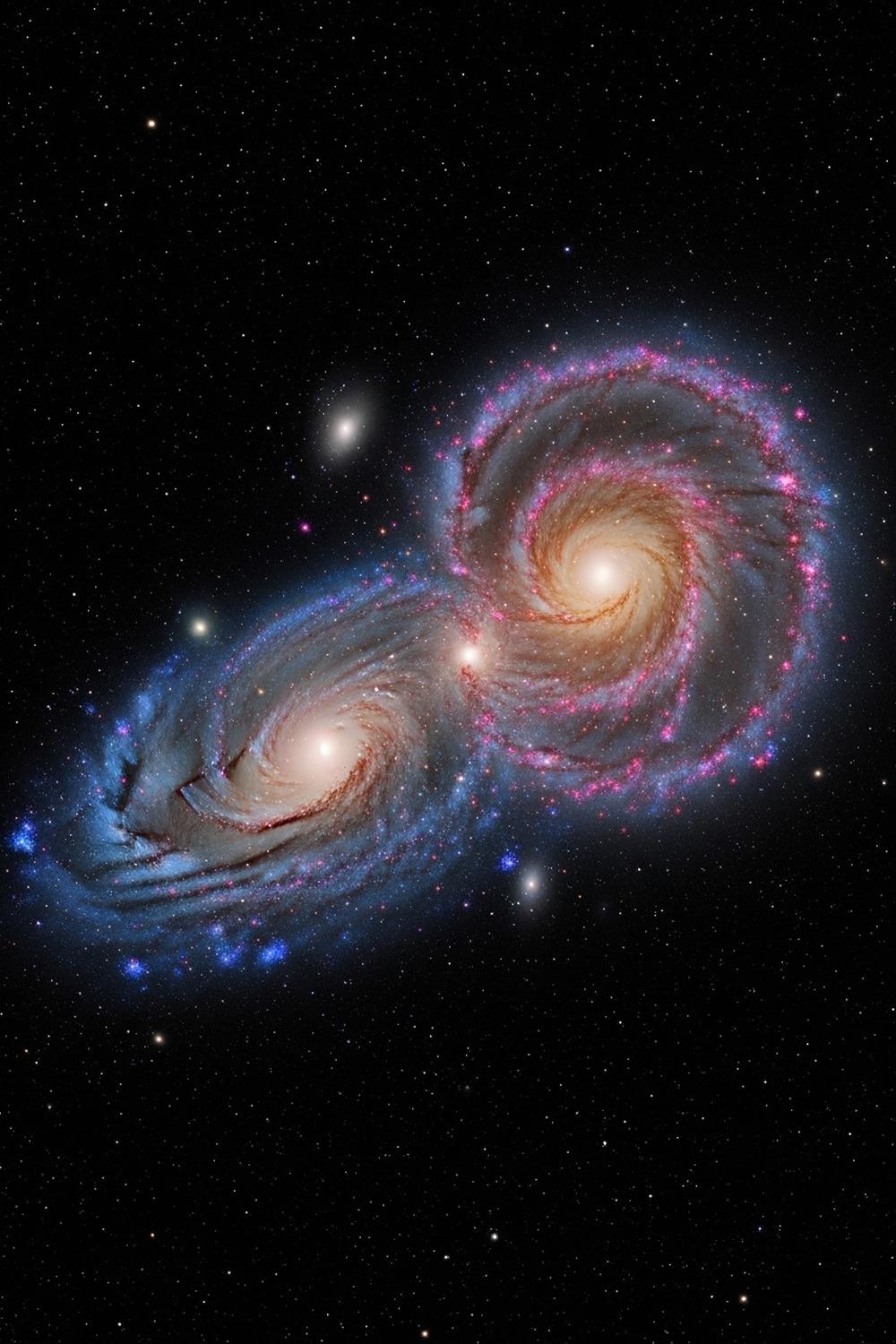
Gravity doesn’t announce itself. It just pulls — silently, inexorably, across 2.5 million light-years of vacuum — and the Andromeda Milky Way collision has already begun. The Milky Way and Andromeda are moving toward each other at 110 kilometers per second, and nothing in the observable universe will interrupt that trajectory. In roughly 4 to 5 billion years, they will meet.
What happens next violates every intuition about what collisions mean. Stars won’t detonate. Planets won’t ignite. Instead, the two galaxies will interpenetrate each other in a slow, gravitationally orchestrated reshaping that leaves behind something unprecedented in the universe’s history — at least from our vantage point.
Key Facts
- The Milky Way and Andromeda are approaching each other at 110 kilometers per second
- First galactic contact is estimated in approximately 4.5 billion years, refined by 2019 ESA Gaia data
- The current distance between the galaxies is 2.537 million light-years (NASA/ESA, 2005)
- NASA Goddard simulations give roughly a 12% chance the Sun is ejected to the merger remnant’s outer regions
- In 2012, Roeland van der Marel’s team used Hubble to confirm Andromeda is on a near head-on collision course
In short: The Andromeda Milky Way collision describes how two spiral galaxies, closing at 110 km/s, will merge in roughly 4.5 billion years into an elliptical galaxy nicknamed Milkomeda. Stars almost never collide because galaxies are mostly empty; instead gravity, gas, and dark matter reshape both systems entirely.
Two Spiral Giants Falling Toward Each Other
Certainty about this event arrived in 2012. A team led by astronomer Roeland van der Marel at the Space Telescope Science Institute in Baltimore used the Hubble Space Telescope to measure Andromeda’s proper motion — the actual sideways drift across the sky — with a precision that had never been achieved before. The results settled a question that had lingered for decades: Andromeda isn’t going to miss. It’s coming almost directly at us. The Andromeda–Milky Way collision is now considered one of the most certain predicted events in observational astronomy, and the timeline — approximately 4.5 billion years from now — has been refined repeatedly since that study appeared in The Astrophysical Journal.
One trillion stars orbit Andromeda. The Milky Way contains between 100 and 400 billion. And yet here’s the part that stops most people cold: the probability of any two stars physically colliding is astronomically small. Typical separation between stars measures several light-years. Galaxies are, for practical purposes, empty. What collides isn’t the stars. It’s the gravity.
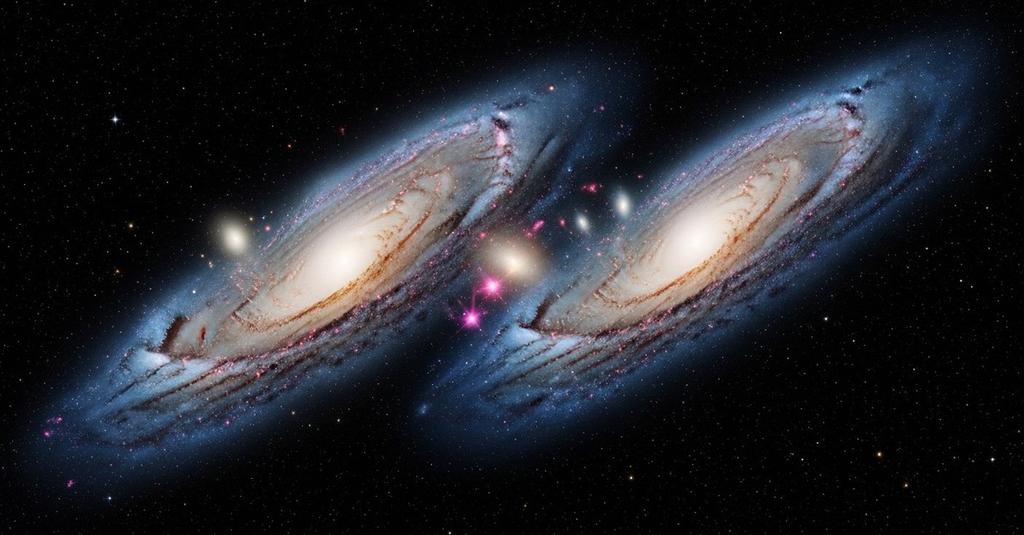
Think of two enormous swarms of bees flying through each other. The individual bees never touch. But the swarms are never the same afterward. That’s the Andromeda Milky Way collision in its most honest form.
What Gravity Does When No One’s Watching
Gravitational tides are the real engine of destruction and creation simultaneously. As Andromeda approaches, its gravitational field will begin pulling differentially across the Milky Way’s disk, warping the spiral arms, flinging stars into trajectories bearing no resemblance to their current orderly orbits. Some stars will be ejected entirely into the intergalactic void. Others will swing into enormous new orbits thousands of light-years from where they started. This process — tidal stripping — has already been observed happening to other galaxy pairs across the universe.
It’s worth comparing this to another cascade effect: the way a single reintroduction can ripple through an entire ecosystem and reshape the physical landscape itself. Gravity plays the same role here, a single force rewriting every relationship in the system.
The collision won’t happen in one clean pass.
Simulations run by the Harvard-Smithsonian Center for Astrophysics suggest the two galaxies will pass through each other, pull apart slightly, and then swing back for a second encounter — possibly a third — before finally merging into a single structure. Over that span, which could last another 2 billion years after first contact, gravitational compression of interstellar gas clouds will trigger enormous bursts of star formation. In some merger simulations, starburst events produce new stars at rates 100 times higher than in a typical quiet galaxy. Destruction and creation are the same event here, just separated by a few billion years.
The Starburst Aftermath: Fire From Chaos
The universe is generous with examples of what this looks like. Astronomers have been studying galaxy mergers in various stages for decades, and some of the most visually spectacular objects in the sky result from exactly this process. The Antennae Galaxies — a pair of colliding spirals about 45 million light-years away in the constellation Corvus — are one of the most studied merger systems in astronomy. Over a thousand new star clusters were triggered by that collision, according to a landmark 1996 paper by Brad Whitmore and François Schweizer based on Hubble Space Telescope observations. Many of those clusters contain tens of thousands of young, hot, blue stars born directly from the compressed gas between the two merging systems. National Geographic’s deep-sky coverage of galaxy formation has repeatedly highlighted how these merger-driven starbursts represent some of the most intense stellar nurseries in the observable universe.
The Andromeda Milky Way collision should produce something similar. Why does this matter? Because it means the universe doesn’t just rearrange what already exists — it builds new things. As gas clouds in both galaxies compress under gravitational stress, temperatures and densities will rise until nuclear ignition becomes inevitable. Regions that are today dark and cold — vast molecular clouds drifting between the stars — will suddenly blaze with thousands of new suns. New stars, possibly new planetary systems, will be seeded by the chemical inventory of two separate galaxies that spent billions of years building up different elemental abundances.
What emerges could be richer in heavy elements than either parent galaxy alone. Some of those newly minted worlds, if any form, may have access to chemistry that neither galaxy could offer independently.
The Andromeda Milky Way Collision and Our Solar System’s Fate
Here’s the question everyone actually wants answered: what happens to us? To Earth, to the Sun, to the small rocky world that is the only home life has ever confirmed? NASA’s own modeling, updated significantly in 2019 using data from the European Space Agency’s Gaia satellite mission, gives a surprisingly reassuring answer — at least in relative terms. The Sun is almost certainly not going to be involved in a direct stellar collision. The odds are vanishingly small. According to simulations run at NASA’s Goddard Space Flight Center, there’s roughly a 12 percent chance that our solar system will be flung far out into the outer reaches of the merger remnant — effectively exiled to the galactic suburbs. What’s far more likely is a gentler relocation, but relocation nonetheless.
Here’s the thing: by the time first contact happens, approximately 4.5 billion years from now, the Sun will itself be aging significantly. Currently about 4.6 billion years old, it’s in its middle-age phase. In 4.5 billion more years, it will be swelling toward a red giant state — and Earth’s surface conditions will have already become hostile to life long before Andromeda arrives. The Sun’s own evolution ends the story of life on Earth first. Andromeda is the spectacular final act of a stage that will already be empty.
That realization shifts the emotional weight of the whole event. We won’t be there to see it.
But the universe will go on remaking itself without us, indifferent and magnificent.
What the Merged Galaxy Will Look Like
Astronomers have already named what the collision will produce: Milkomeda, or sometimes Milkdromeda. The name is casual, almost whimsical, but the object it describes is neither. Computer simulations — including high-resolution models run by the Heidelberg Institute for Theoretical Studies in Germany in 2018 — show that the merged galaxy will almost certainly not be a spiral. Both the Milky Way and Andromeda are classic barred spiral galaxies right now, with elegant rotating arms trailing behind a central bar of stars. That structure will be destroyed by the merger.
What remains will be an elliptical galaxy: a smooth, featureless, roughly egg-shaped cloud of stars, devoid of the organized rotation that spirals depend on. Ellipticals are the elder statesmen of galaxies — old, gas-depleted, their star-forming days largely behind them. Once the starburst phase burns through the available gas, Milkomeda will quiet down. New star formation will slow to a trickle. The galaxy will redden as its hottest blue stars burn out and only cooler, longer-lived red and orange stars remain. It will look, to any observer far enough away, like the most ancient and exhausted galaxies we observe at the fringes of the known universe — the ones formed when the universe was young and already spent their fuel in violent, spectacular youth.
Two spirals in their prime, burning bright with new stars, colliding, creating one final furious generation of suns — and then settling into a long, slow twilight. That trajectory, watching a species of galaxy transform through its own merger from order to elliptical exhaustion, tells the universe’s biography in a single event. This isn’t just physics. It’s biography written in gravitational terms.
How It Unfolded
- 1929 — Edwin Hubble confirms that Andromeda is a separate galaxy, not a nebula within the Milky Way, revolutionizing our understanding of cosmic scale.
- 1994 — Early computer simulations by Joshua Barnes and Lars Hernquist at the Harvard-Smithsonian Center for Astrophysics model tidal tail formation during galaxy mergers, laying groundwork for Milky Way–Andromeda collision modeling.
- 2012 — Roeland van der Marel’s team at the Space Telescope Science Institute uses Hubble data to confirm Andromeda is on a near head-on collision course, publishing definitive trajectory measurements.
- 2019 — ESA’s Gaia satellite provides refined proper motion data for Andromeda, allowing NASA’s Goddard Space Flight Center to update collision timing and solar system displacement probabilities with greater precision than ever before.
By the Numbers
- 2.537 million light-years — current distance between the Milky Way and Andromeda, measured using Cepheid variable stars (NASA/ESA, 2005)
- 110 km/s — Andromeda’s approach velocity toward the Milky Way, confirmed by Hubble Space Telescope proper motion studies (van der Marel et al., 2012)
- ~4.5 billion years — estimated time until first galactic contact, based on updated Gaia satellite models (ESA, 2019)
- 12% probability that our solar system will be ejected to the outer regions of the merger remnant, according to NASA Goddard simulations
- ~2 billion years — additional time required after first contact for both galaxies to fully merge into the Milkomeda elliptical structure
Field Notes
- 2006 observations using the Hubble Space Telescope discovered a massive stellar stream — a river of stars — already being pulled out of the Andromeda galaxy by gravitational interactions with its satellite galaxies, offering a preview of the tidal disruption the full Milky Way collision will produce on a far larger scale.
- Despite Andromeda’s mass of roughly one trillion solar masses, it may actually be less massive than the Milky Way when dark matter halos are accounted for — a finding that challenges the long-held assumption that Andromeda is the larger of the two galaxies.
- Within about 3.75 billion years, the night sky as seen from Earth will begin to change noticeably, as Andromeda grows large enough to appear as a bright, elongated structure rivaling the Milky Way band — a second galaxy visible to the naked eye, growing visibly larger over millions of generations.
- Astronomers still can’t determine with certainty whether the Triangulum Galaxy — a smaller third spiral in our Local Group — will be drawn into the Milky Way–Andromeda merger or flung away; its fate depends on gravitational variables that current models can’t fully resolve.
Frequently Asked Questions
Q: Will the Andromeda Milky Way collision destroy Earth?
Almost certainly not through direct impact. Stars are so widely spaced that the chance of a stellar collision involving our Sun is less than one in a million. The real threat to Earth comes much earlier: the Sun itself will expand into a red giant in about 5 billion years, making the planet uninhabitable long before Andromeda arrives. The collision reorganizes the galaxy, but it doesn’t incinerate it.
Q: How do astronomers know exactly when the Andromeda Milky Way collision will happen?
By measuring Andromeda’s velocity toward us using the Doppler effect — which shows how fast it’s moving in our direction — and its sideways drift across the sky using extremely precise astrometry from Hubble and the ESA’s Gaia satellite. Both velocity components combine to give the full three-dimensional trajectory. The 2019 Gaia data refined the collision timing to approximately 4.5 billion years, though small uncertainties in the galaxies’ dark matter distributions still introduce a margin of error of a few hundred million years.
Q: Is it true that the Milky Way and Andromeda won’t actually “collide” the way most people imagine?
Yes. This is the most common misconception about the Andromeda Milky Way collision. Most people picture two solid objects smashing together, but galaxies are overwhelmingly empty space. The average distance between stars in both galaxies is measured in light-years. The galaxies will interpenetrate each other, their gravitational fields interacting and distorting everything in both systems, without the stars themselves ever making contact. What “collides” is the gravity, the gas, and the dark matter — not the stars.
Editor’s Take — Dr. James Carter
What strikes me most about this event isn’t the scale — it’s the timing. The Sun will already be killing Earth before Andromeda arrives. We’ve spent decades framing this collision as humanity’s ultimate fate, when really it’s a postscript to a story that ends much sooner and much more quietly. The most violent event in our galaxy’s future will happen in an empty theater. History has a way of treating the people who ignored this kind of asymmetry unkindly.
The Andromeda Milky Way collision is a reminder that the universe operates on schedules that dwarf anything biology can produce. Every civilization that has ever looked up at the night sky — every culture that named the stars, mapped the Milky Way’s pale band, told stories about the darkness between them — did so during a narrow window of cosmic calm that will eventually be replaced by something far more dramatic. Whether anything is alive to witness it is the only real question. And the universe, characteristically, hasn’t promised us an answer.
“
Illustrations are AI-generated. Article fact-checked and human-edited. Our editorial standards.