Nepal’s Wild Tigers Have Nearly Tripled Since 2010
Three times as many tigers now roam Nepal’s protected forests compared to 2010 — 355 instead of 121. While the rest of Asia watches its tiger populations vanish into history, one landlocked country managed to reverse the collapse entirely. How a nation of 30 million people, wedged between India’s massive tiger range and global poaching networks, became the century’s most unlikely conservation success story is a question that keeps reshaping what we think possible.
This wasn’t statistical luck or a counting error. It was camera trap grids, field teams hiking thousands of miles through the Terai Arc Landscape, and a national commitment that required real money and real political sacrifice. The mechanics are straightforward. The execution was not.

Key Facts
- Nepal confirmed 355 wild tigers in the 2022 National Tiger Survey, up from 121 in 2010 (Department of National Parks and Wildlife Conservation).
- The 2022 survey covered more than 1,700 miles of terrain using camera-trap grids, line transects, and occupancy modeling.
- Nepal’s count represents a 193% population increase over twelve years, the largest proportional growth of any tiger range state in the TX2 period.
- Each Bengal tiger requires roughly 25 square miles of territory to maintain a viable home range with sufficient prey.
- The IUCN revised its global wild tiger estimate to approximately 4,500 in 2023, with Nepal holding about 8% of that total.
In short: The Nepal wild tiger population reached 355 in the 2022 National Tiger Survey, up from 121 in 2010, a 193% rise and the largest proportional recovery of any tiger range state. Achieved through camera-trap surveys, anti-poaching enforcement, and community buy-in across the crowded Terai Arc Landscape, it now holds about 8% of the world’s wild tigers.
How Nepal’s Tiger Numbers Defied Global Decline
The 2022 Nepal Tiger Survey, coordinated by the Department of National Parks and Wildlife Conservation in partnership with the National Trust for Nature Conservation, deployed camera traps across more than 1,700 miles of terrain inside protected areas and the wildlife corridors that connect them — a vast, sometimes flooded, sometimes sweltering stretch of lowland known as the Terai. Field teams used a combination of camera-trap grid stations, line transect methods for estimating prey density, and occupancy modeling to arrive at that headline figure of 355 individual tigers. Each animal was identified from its unique stripe pattern, the same way a human fingerprint is unique — a technique that has been standard practice in camera trap wildlife surveys since the 1990s.
The margin of error was tight. This wasn’t a guess.
What makes the number so striking isn’t just its size — it’s the trajectory. In 2009, Nepal had roughly 121 tigers. By 2013, that had climbed to 198. The 2018 survey recorded 235. Each census showed growth, but the jump to 355 by 2022 was sharper than anyone had projected. Tigers are not fast breeders. A female Bengal tiger reaches sexual maturity around three to four years old and typically raises two to three cubs per litter, with high cub mortality in the wild.
Growing a population by nearly 200% in twelve years means the losses stayed low while the births kept coming.
Rangers in Chitwan and Bardia national parks reported something different happening in the corridors. For years, those passages between parks had gone silent. Then fresh pugmarks appeared — not scattered tracks from transiting animals, but the territorial markers of residents. Tigers were claiming space and staying put. The forests were filling back up.
The Conservation Infrastructure Behind the Recovery
Tiger conservation doesn’t happen in a vacuum. It happens when governments fund ranger salaries, communities don’t retaliate after livestock kills, and the prey base — deer, wild boar, gaur — stays healthy enough to support large predators. Nepal built all three of those things simultaneously, and it shows.
The parallel is instructive: when wolves were reintroduced to Yellowstone and the ecosystem around them was protected, the entire food chain responded in ways that reshaped the landscape — the same cascade dynamic that Nepal’s Terai is now experiencing as tiger numbers climb. Prey species have rebounded. Vegetation structure in some buffer zones has shifted. The presence of a top predator rearranges everything below it.
But here’s the thing: Nepal’s government increased the anti-poaching budget substantially after signing onto the Global Tiger Recovery Program in 2010 — a 13-country commitment aimed at doubling wild tiger numbers by 2022. Armed patrol units were deployed to key corridors. In 2011, Nepal recorded zero tiger poaching for the first time in the modern census era. That record didn’t hold every subsequent year, but it signaled what was possible when enforcement was taken seriously. By 2020, Nepal’s tiger range habitat had expanded to approximately 4,027 square kilometers of core protected area, not counting the buffer zones and community forests that connect the parks.
Community forest user groups became unexpected allies in ways that standard conservation doctrine didn’t predict. Local bodies managing forested land adjacent to parks were brought in rather than fenced out. Ranger jobs, tourism revenue sharing, and compensation schemes for livestock losses gave people a financial stake in keeping tigers alive. It’s a simple idea. Getting it to work at scale is anything but.
What the Terai Arc Landscape Actually Looks Like
Nearly seven million people live in and around the Terai Arc Landscape — a 810-mile stretch along Nepal’s southern border with India, encompassing eleven protected areas on the Nepal side and seven on the Indian side. This is one of the most biologically significant transboundary ecosystems in Asia, and one of the most pressured. The lowland forests here are not remote wilderness. Tigers, one-horned rhinos, Asian elephants, and gharial crocodiles depend on the same soil that farmers work.
According to a 2021 report published by the World Wildlife Fund on the Terai Arc, the corridor network is critical not just for tigers but for maintaining genetic exchange between populations that would otherwise become isolated. Without those connections, small subpopulations start inbreeding. Within a few generations, the fitness costs become measurable and eventually fatal.
Why does this matter for understanding Nepal’s success? Because the country’s protected areas alone couldn’t hold 355 tigers at current density. Each Bengal tiger requires roughly 25 square miles of territory to maintain a viable home range with sufficient prey. Fitting that many animals into a landscape shared with millions of people means tigers are moving through community forests, crossing agricultural land, and occasionally walking into villages. That’s not a conservation failure. That’s what success at scale looks like — and it creates its own set of tensions that the numbers alone don’t capture.
During the 2021 monsoon season, communities in the Bardiya corridor reported more frequent tiger sightings along forest edges than at any point in living memory. Not just in Bardiya National Park itself — in the buffer zones. On the margins. Where people grow crops and graze animals at dusk. Watching a species disappear at this speed, you stop calling it a trend; you start wondering how long the neighbors will tolerate it.
Nepal Wild Tiger Population Growth: What Happens Next
More tigers means more territory needed, more prey consumed, and more potential conflict with the communities that made the recovery possible in the first place. The Department of National Parks and Wildlife Conservation now faces a carrying-capacity problem that didn’t exist a decade ago. A 2020 study by the Wildlife Conservation Society’s Nepal Program found that human-tiger conflict incidents increased proportionally with tiger density in buffer zones — not dramatically, but measurably.
The WCS analysis covered data from 2010 to 2019 and identified Chitwan’s northern buffer zone and the Banke-Bardia corridor as the highest-risk areas for conflict escalation if tiger density continued to rise without corresponding expansion of habitat and prey availability. The study recommended increasing investment in corridor protection between Nepal and India, enabling tigers to disperse southward into the Terai lowlands of Uttar Pradesh and Uttarakhand.
Dispersal is, in fact, already happening. A young male tagged in Chitwan in 2019 was photographed by camera traps in India’s Valmiki Tiger Reserve just fourteen months later, having crossed more than 60 miles of fragmented habitat. Individual tigers have been tracked crossing the open India-Nepal border — a porous, unfenced frontier along much of its length. That kind of movement is exactly what the TX2 goal was designed to encourage: not just growing populations within protected areas, but rebuilding the connectivity between them. When tigers move, genes move. When genes move, populations stay healthy.
Nepal’s wildlife authorities are now piloting what they call “co-existence zones” — formally designated buffer areas where livestock insurance programs, rapid response compensation teams, and community warning systems operate together. Early data from three pilot districts is promising. Retaliatory killings dropped by an estimated 30% in those zones between 2020 and 2022.
The Global Stakes of One Small Country’s Success
When the Global Tiger Recovery Program launched in 2010, the worldwide estimate of wild tigers stood at roughly 3,200 animals — a collapse from an estimated 100,000 at the start of the twentieth century. By 2023, the IUCN revised its global estimate upward to approximately 4,500 tigers, the first sustained increase in over a century. Nepal contributed disproportionately to that number.
A country covering less than 0.1% of global land area now holds nearly 8% of the world’s wild tiger population. For comparison, India — with roughly 70% of the global population — has vastly more habitat and resources dedicated to tiger conservation. Nepal’s per-hectare return on conservation investment may be the highest of any tiger range state.
The Nepal wild tiger population has become a reference point in international conservation policy precisely because it disproves a comfortable excuse. The argument that tiger recovery requires vast, uninhabited wilderness — that it’s simply incompatible with dense human settlement — doesn’t hold up against Nepal’s Terai numbers. The landscape is crowded, fragmented, and economically stressed. And yet the trajectory is upward, the communities are engaged, and the prey base is stable.
Other range states — Bangladesh, Myanmar, Laos — face similar landscapes and have so far produced very different results. Nepal’s model isn’t magic. It’s money, enforcement, and genuine community buy-in, sustained over more than a decade.
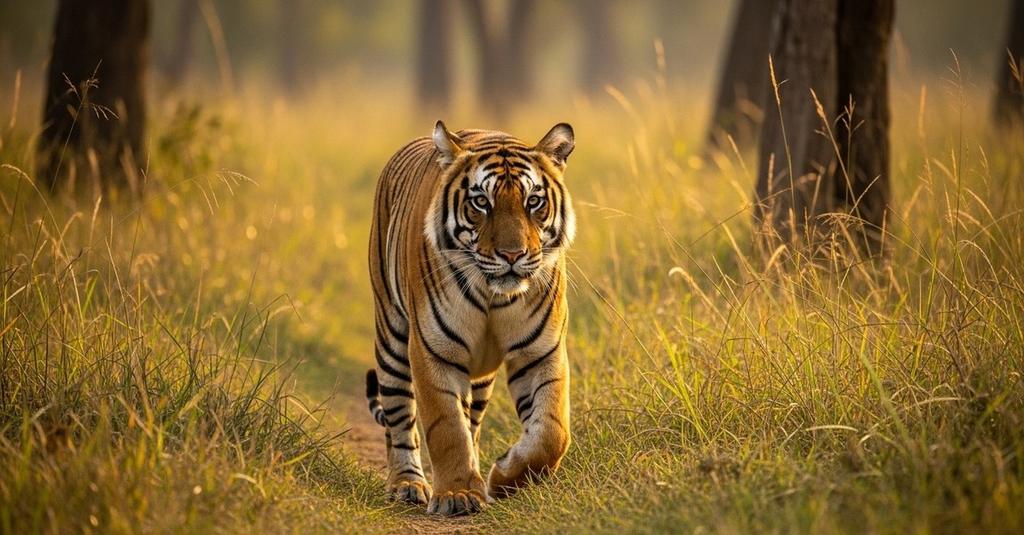
Stand at the edge of Chitwan’s buffer zone at first light, when the sal trees are still damp and the grassland beyond them is barely visible in the haze, and you can understand what’s at stake. Somewhere in there, a tigress is teaching cubs to hunt. That used to be a thing people said about the past.
Where to See This
- Chitwan National Park, Nepal — the country’s oldest national park and home to the highest tiger density; best visited October through March when the grasslands are cut and visibility improves dramatically.
- Bardia National Park, Far-Western Nepal — less visited than Chitwan, but increasingly cited by wildlife researchers as the more rewarding tiger habitat; the Babai Valley corridor is exceptional.
- The National Trust for Nature Conservation (NTNC) runs community-based wildlife monitoring programs and eco-tourism initiatives tied to buffer zone communities; its published surveys are freely accessible at ntnc.org.np.
How It Unfolded
- 1973 — Nepal passed the National Parks and Wildlife Conservation Act and established Chitwan as the country’s first national park, creating the legal foundation for protected habitat.
- 2010 — Nepal signed the St. Petersburg Declaration alongside 12 other tiger range countries, committing to the TX2 goal of doubling wild tiger populations by 2022.
- 2016 — Nepal recorded 198 tigers in its national census, becoming the first TX2 signatory to demonstrate consistent year-on-year population growth across two full survey cycles.
- 2022 — The national tiger survey confirmed 355 wild tigers, making Nepal the first country to nearly triple its tiger population within the TX2 timeframe.
By the Numbers
- 355 — confirmed wild tigers in Nepal as of the 2022 National Tiger Survey, up from 121 in 2010 (Department of National Parks and Wildlife Conservation, Nepal).
- 1,700+ miles of terrain covered by field teams during the 2022 survey, spanning protected areas and connecting wildlife corridors.
- 193% population increase over twelve years — the largest proportional growth of any tiger range state in the TX2 period.
- ~25 square miles — minimum viable home range required per tiger, making habitat connectivity as critical as the parks themselves.
- 4,500 — revised global wild tiger estimate from the IUCN in 2023, the first confirmed increase in over 100 years; Nepal holds approximately 8% of that total.
Field Notes
- In 2019, a male tiger tagged in Chitwan National Park was photographed by camera traps in India’s Valmiki Tiger Reserve fourteen months later — having crossed more than 60 miles of fragmented agricultural and community land without a single reported conflict incident along the route.
- Nepal’s ranger corps includes a dedicated all-female unit, the “Kaali” patrol teams, operating in Chitwan’s buffer zone; their deployment zones have shown measurably lower poaching pressure than mixed-unit areas, according to internal park data from 2021.
- Tiger prey density — the population of deer, wild boar, and gaur inside a park — is now considered a more reliable early indicator of future tiger population health than direct tiger counts, because it reveals the ecosystem’s carrying capacity before tigers hit it.
- Researchers still can’t fully explain why tiger occupancy expanded so rapidly into Nepal’s community forest zones between 2018 and 2022; whether it reflects genuine habituation, prey following vegetation recovery, or a response to reduced human movement during COVID-19 lockdowns remains an open and actively studied question.
Frequently Asked Questions
Q: What is the current Nepal wild tiger population, and how was it counted?
The current Nepal wild tiger population stands at 355 individuals, confirmed in the 2022 National Tiger Survey. Camera traps deployed across a grid covering more than 1,700 miles of habitat, combined with line transect surveys for prey density and occupancy modeling, produced the count. Each tiger was identified individually by its unique stripe pattern. The Department of National Parks and Wildlife Conservation conducted the survey in partnership with the National Trust for Nature Conservation.
Q: Why are tigers still declining in most of Asia if Nepal has succeeded?
Nepal’s recovery relied on a specific combination of sustained government funding, community incentive structures, and anti-poaching enforcement that most tiger range states haven’t maintained consistently. Countries like Laos and Vietnam face severe poaching pressure tied to illegal wildlife trade networks that operate at a scale Nepal’s terrain and governance have so far contained more effectively. Nepal also benefits from a relatively intact prey base and a national parks system that predates the modern conservation push. Those structural advantages aren’t easily replicated, but the policy model can be.
Q: Does a higher Nepal wild tiger population mean more danger for local communities?
Simple tiger counts can mislead on this question. More tigers in a landscape does increase the probability of human-tiger encounters, particularly in buffer zones where people farm and graze livestock. But “danger” is too blunt a word. Nepal’s co-existence zone programs — livestock insurance, rapid response compensation, community warning systems — are specifically designed to reduce the costs that communities bear when tiger numbers rise. Data from three pilot districts between 2020 and 2022 showed a roughly 30% drop in retaliatory killings, suggesting that when communities are compensated quickly and fairly, tolerance for tigers increases even as density rises.
Editor’s Take — Alex Morgan
What I keep coming back to is that 355 number as a policy argument, not just a wildlife statistic. Every time a government says tiger recovery is incompatible with human settlement — too expensive, too disruptive, too politically costly — Nepal’s Terai is the answer. Not a wilderness. Not an uninhabited park. A landscape with seven million neighbors, where a committed national program and genuine community buy-in produced the biggest tiger recovery on record. The question isn’t whether it’s possible anymore. The question is why so few governments are actually doing it.
The Bengal tiger came within a single policy cycle of functional extinction in Nepal. In 1970, the country’s tiger population was estimated to have already collapsed from historical highs of several thousand. What’s been built since then — slowly, expensively, imperfectly — is a living argument that extinction isn’t always the foregone conclusion it’s presented as. Somewhere in the tall grasslands of the Terai, a tigress that didn’t exist fifteen years ago is raising cubs that will need territory she doesn’t have yet. What happens when they go looking for it is the next chapter, and it’s being written right now.
“
Illustrations are AI-generated. Article fact-checked and human-edited. Our editorial standards.