He Moved His 89-Year-Old Neighbor In. Here’s Why It Matters
A 31-year-old opened his apartment door to his elderly neighbor. She moved in. Nobody expected what came next to matter this much — but it did, and the internet noticed in a way that felt less like viral content and more like collective recognition of something we’d been missing.
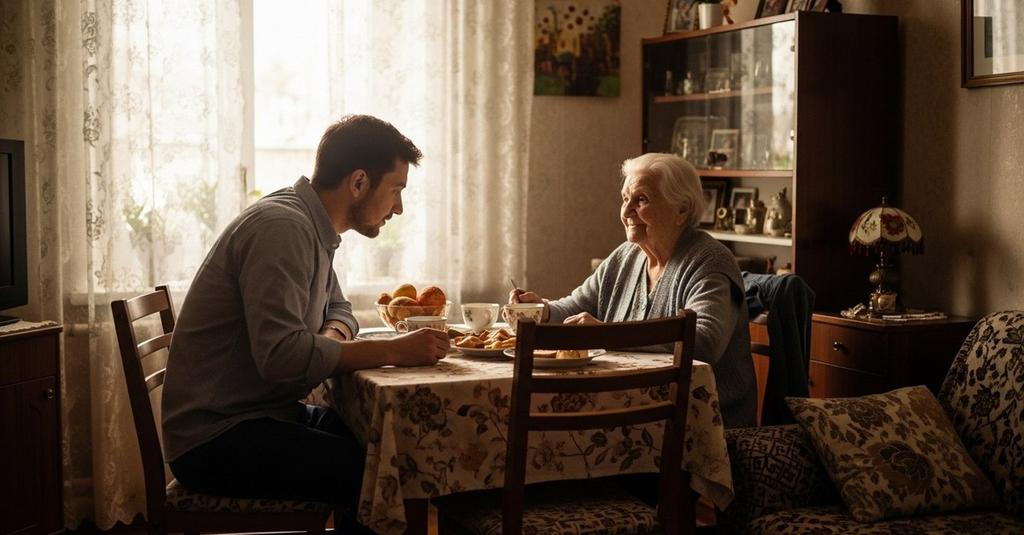
Norma was 89. Chris Salvatore was young, busy, pulling in a hundred directions the way everyone in their thirties is. They lived in a Los Angeles apartment building a few feet apart. She was declining. He was present. Most people in that situation nod politely and keep their doors closed. Chris opened his.
Key Facts
- Chris Salvatore, age 31, took in his 89-year-old Los Angeles neighbor Norma for her final months; she passed in 2017.
- Chronic loneliness carries health risks equivalent to smoking 15 cigarettes a day, per epidemiologist Julianne Holt-Lunstad.
- Holt-Lunstad’s 2015 meta-analysis in Perspectives on Psychological Science found chronic loneliness increases premature death risk by 26%.
- 28% of American adults over 65 live alone according to the U.S. Census Bureau (2023), more than double the 1960 rate.
- The U.S. Surgeon General declared loneliness a public health epidemic in 2023, the first declaration of its kind.
In short: This story of elderly neighbor compassion follows Chris Salvatore, 31, who took in 89-year-old Norma for her final months until she passed in 2017. It illustrates a public health crisis: chronic loneliness raises premature death risk 26%, 28% of over-65 Americans live alone, and the Surgeon General declared loneliness an epidemic in 2023.
What Elderly Neighbor Compassion Actually Looks Like
Norma had been managing alone for years. The way people do. Quietly, stubbornly, with small daily compromises that stack up into genuine danger.
When things got worse, Salvatore didn’t just notice — he cooked for her, sat with her, made space in his own life for her final months. According to research on social isolation, what he gave her probably extended her life in measurable ways. But here’s the thing nobody really talks about: what did it cost him?
Time. Privacy. The freedom to come home and do nothing. Spontaneity. The ability to leave for a weekend without thinking about another person’s needs. Those aren’t small trade-offs for someone in their thirties, and Salvatore made them anyway — which tells you something about who he is, and maybe something uncomfortable about who most of us aren’t.
Loneliness Kills. Actually.
Chronic loneliness carries health risks equivalent to smoking 15 cigarettes a day.
That’s not poetry. That’s what epidemiologist Julianne Holt-Lunstad found, and it reshaped how public health experts think about social connection. Loneliness accelerates cognitive decline. It weakens your immune system. It raises mortality risk significantly. Norma wasn’t just living alone — she was living at risk in a way most of her neighbors never thought about.
But here’s where it gets specific: The solution was thirty feet away. It wasn’t money. It wasn’t resources. It was someone choosing to cross a hallway.
You can read more about extraordinary human connections at this-amazing-world.com.
Dignity vs. Charity — The Part That Actually Matters
There’s a version of this story where Salvatore is the hero. Where Norma is the grateful recipient of his goodness. That framing gets it completely wrong, and the distinction matters more than most people realize when we talk about elderly neighbor compassion as something real rather than something inspirational. Charity puts one person above another. Dignity treats someone as fully human — worthy of actual conversation, actual presence, actual care. Salvatore wasn’t dropping off casseroles and leaving. He was showing up, day after day, as a person who wanted to be there.
Norma had wit. She had personality. She wasn’t a burden to manage. She was a woman who deserved company.
And that difference is exactly why this story didn’t fade.
Why People Couldn’t Stop Sharing It
When Salvatore started posting about their friendship, something unexpected happened. People didn’t just share it like a feel-good story. They commented like they’d been waiting for permission to care about someone. Comments filled with people writing about their own elderly neighbors, their grandparents, the person down the street they’d been meaning to check on. The story worked as a mirror — uncomfortable, clarifying, gentle in a way that made you sit with the question it posed.
Elderly neighbor compassion isn’t niche. Most people already believe in it. They just don’t do it.
That’s the part that stayed with me.
What Happens When Nobody Shows Up
Millions of Americans over 65 live alone. The U.S. Census Bureau has been tracking this for decades, and the number keeps climbing. But statistics hide what really matters: living alone and being isolated aren’t the same thing. The difference depends entirely on whether someone nearby decides to pay attention. For every Norma who found a Chris, there are thousands aging invisibly in apartments that go dark for days at a time.
This isn’t just a failure of social services. It’s a failure of proximity. We live next to people and treat that closeness as coincidence instead of opportunity. Modern apartment buildings are designed for privacy, not community — and we’ve accepted that design as inevitable when it’s actually a choice we keep making without discussion.

By the Numbers
- 28% of American adults over 65 live alone according to the U.S. Census Bureau (2023) — more than double the rate from 1960.
- Chronic loneliness increases the risk of premature death by 26%. Holt-Lunstad’s 2015 meta-analysis in Perspectives on Psychological Science documented this across thousands of studies — a finding that changed how researchers think about public health entirely.
- The U.S. Surgeon General declared loneliness a public health epidemic in 2023. First declaration of its kind.
- Older adults with strong social connections have 50% better survival odds compared to those isolated. That margin rivals most medical interventions.
Field Notes
- Salvatore’s posts weren’t polished. That’s why they worked. Millions of views because the footage was plainly, obviously real — no filter, no narrative arc designed for engagement, just two people existing together.
- Norma passed in 2017. Salvatore has spoken about how caring for her changed what he thinks a meaningful life means. That part — how caregiving transforms the caregiver — barely gets discussed in conversations about eldercare.
- Research on intergenerational friendships shows younger people who spend time with older adults report lower depression and higher sense of purpose. The benefit flows both directions, even when nobody’s looking.
The Story We Keep Not Telling
What Chris Salvatore did is unusual only because we’ve made it unusual. For most of human history, the idea of an older person dying alone, ignored by the people physically nearest to them, would have been considered a community failure too obvious to name. Elderly neighbor compassion was just what you did when you lived near someone. We’ve drifted far enough that one man caring for one woman makes international news — and the fact that it does probably tells us something important.
The story isn’t about Chris. It’s about a gap. Between who we think we are and what we actually do. Between proximity and presence. Between noticing something and deciding it matters to you.
Norma deserved better than what the world was offering. One person closed that distance. Most of us haven’t been asked yet. But we will be.
Norma spent her final months known, seen, and cared for by someone who didn’t have to do any of it. She wasn’t alone. That matters more than headlines could capture. It’s a small story about something enormous — the choice to treat the person nearest you as someone worth your actual time. There’s more at this-amazing-world.com, and the next one gets even stranger.
Frequently Asked Questions
Q: Who were Chris Salvatore and Norma in the elderly neighbor compassion story?
Chris Salvatore was a 31-year-old living in a Los Angeles apartment building a few feet from Norma, an 89-year-old woman declining alone. Rather than keep his door closed, he cooked for her, sat with her, and ultimately moved her into his own life for her final months. Norma passed in 2017. Salvatore has since spoken about how caring for her changed his understanding of a meaningful life, and the story spread widely online as a mirror of what most people believe but rarely do.
Q: How dangerous is loneliness for older adults, according to research?
The health risks are severe. Epidemiologist Julianne Holt-Lunstad found chronic loneliness carries a mortality risk equivalent to smoking 15 cigarettes a day, and her 2015 meta-analysis in Perspectives on Psychological Science documented a 26% increase in premature death risk. Conversely, older adults with strong social connections have 50% better survival odds than isolated peers, a margin that rivals most medical interventions. In 2023 the U.S. Surgeon General declared loneliness a public health epidemic.
Q: How many older Americans live alone and why does it matter?
According to the U.S. Census Bureau in 2023, 28% of American adults over 65 live alone, more than double the rate in 1960. The figure matters because living alone and being isolated are not the same thing: the difference depends on whether someone nearby chooses to pay attention. With millions aging in apartments that can go dark for days, proximity without presence leaves countless people at the same medical risk Norma faced before a neighbor crossed the hallway.
Illustrations are AI-generated. Article fact-checked and human-edited. Our editorial standards.