The Yellow-Bellied Puffing Snake That Rules the Canopy
A snake nine feet long hangs in the canopy, utterly still. Then prey approaches — or a predator. In less than a second, the yellow-bellied puffing snake’s throat balloons outward, its mouth splits open, and a blaze of yellow floods the forest air. Everything about that response is a living warning sign, and everything about how little we understand it is a mystery.
Meet Spilotes sulphureus. One of the Americas’ largest arboreal snakes. Arguably one of its most theatrical. From Trinidad south through Central America and deep into the Amazon basin, it threads silently through rainforest canopies that few researchers have studied closely.
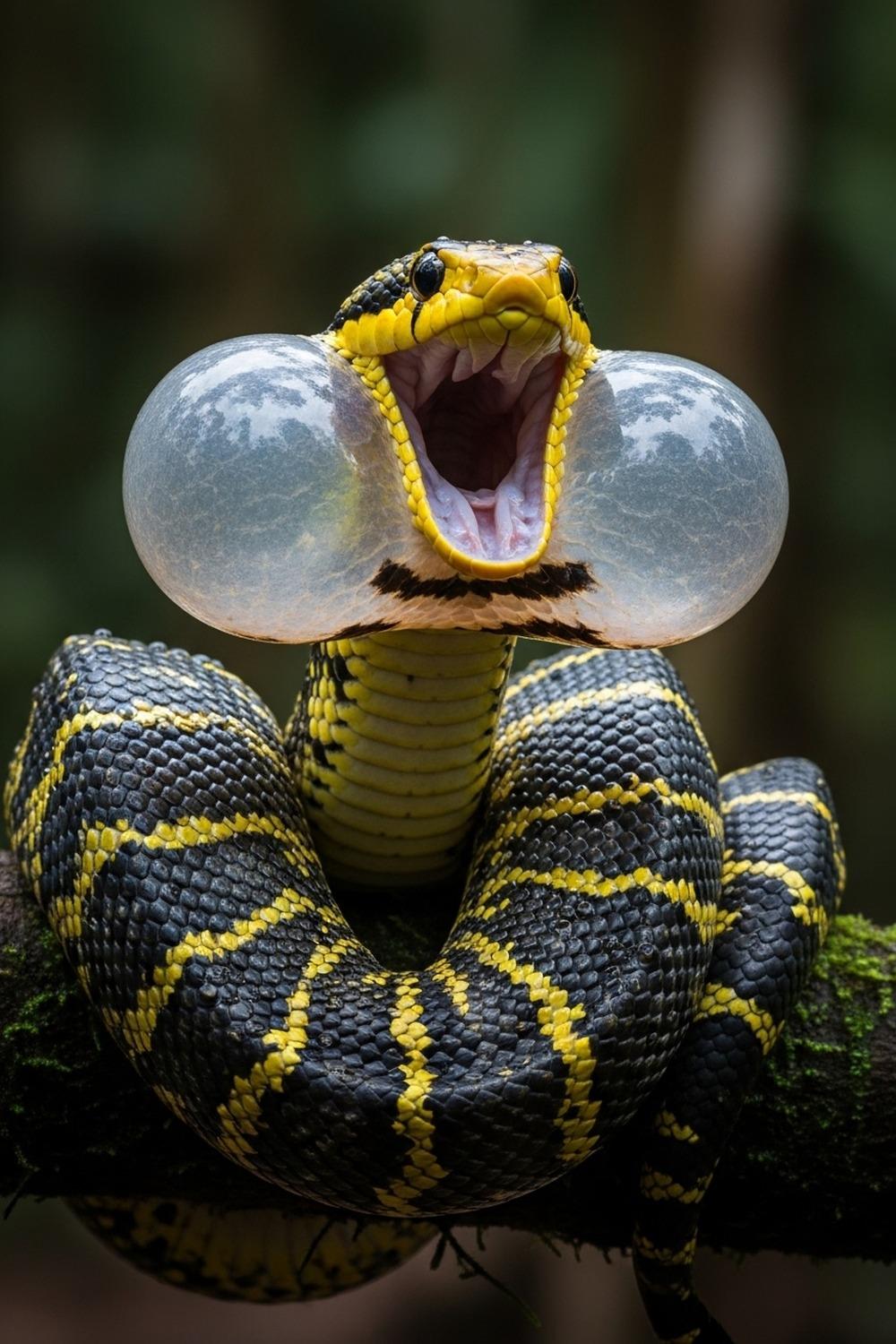
That’s the paradox: a snake this large, this dramatic, and this behaviorally complex remains so poorly understood that we’re still arguing about basic ecology.
Key Facts
- The yellow-bellied puffing snake (Spilotes sulphureus) reaches up to 3 meters (9.8 feet), among the longest arboreal snakes in the Western Hemisphere.
- It belongs to Colubridae, the largest snake family on Earth, containing roughly 1,900 described species.
- A 2012 taxonomic revision formally separated Spilotes sulphureus from Spilotes pullatus after over 150 years of classification ambiguity.
- Its geographic range spans at least 8 countries across Central and South America, covering an estimated 5 million square kilometers.
- Fewer than 30 peer-reviewed studies specifically address its ecology, compared to over 400 for the green anaconda.
In short: The yellow-bellied puffing snake, Spilotes sulphureus, is an arboreal Neotropical species reaching up to 3 meters that defends itself by inflating its throat to flash vivid yellow skin within half a second. Despite ranging across 8 countries, fewer than 30 peer-reviewed studies cover its ecology.
The Yellow-Bellied Puffing Snake’s Aerial World
Most heavyweight snakes live low. Anacondas cruise rivers. Boa constrictors favor the forest floor or low branches. Spilotes sulphureus defied that script long ago. It’s a confirmed arboreal specialist, spending much of its life navigating the mid-to-upper canopy of humid tropical forests. Its range stretches from Trinidad and Tobago through Venezuela, Colombia, Ecuador, Peru, and Bolivia, and north into parts of Central America. The species belongs to the family Colubridae, the largest snake family on Earth, containing roughly 1,900 described species.
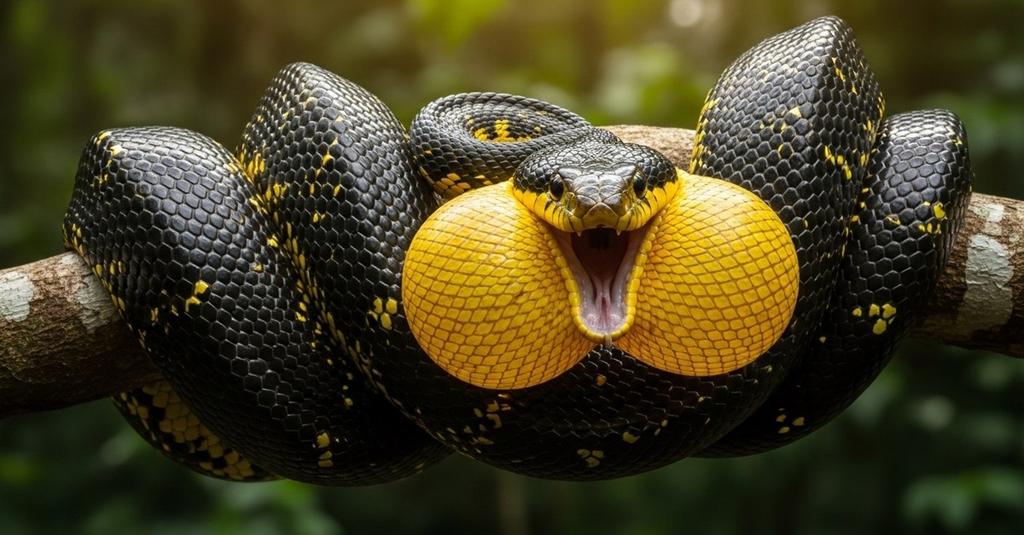
Herpetologists at the Museu Paraense Emílio Goeldi in Belém, Brazil — one of the oldest natural history institutions in Latin America — contributed key specimens and locality data during a taxonomic review completed in 2016. Their work helped map the yellow-bellied puffing snake’s range more precisely, filling gaps in distribution knowledge that had persisted for decades.
Up in the trees, S. sulphureus is a different animal from what you’d expect a three-meter snake to be. Slender for its length, with a laterally compressed body that lets it distribute weight across thin branches. Observers have noted active, wide-ranging foraging behavior — moving through the canopy with what one field researcher described as “directional confidence,” following bird activity and tracking lizard movement through the foliage. It doesn’t ambush the way a pit viper does.
It pursues.
That’s metabolically expensive. But the canopy rewards it with dense prey populations that ground-dwellers rarely access. Watch one move and you’ll understand why local names vary so widely across its range — “tiger snake,” “caninana,” “serpiente tigre.” Nobody who sees this animal moving through the branches mistakes it for something ordinary.
The Puff: How Intimidation Becomes a Weapon
When threatened, Spilotes sulphureus doesn’t coil defensively or retreat. It inflates. The loose skin along the throat and neck expands dramatically — the scales spreading apart and separating to reveal vivid yellow patches of skin between them. The snake flattens its body vertically, gapes its mouth wide to flash a stark dark interior, and frequently vibrates its tail against whatever surface is available. The combined effect is an animal that looks suddenly, unsettlingly larger than it did a moment ago. Unlike the eyelash viper of Costa Rica, whose cryptic stillness is its primary defense, the yellow-bellied puffing snake relies on active, escalating spectacle to deter predators and curious mammals alike. It’s a masterclass in aposematic theater.
Here’s the thing: the mechanism behind the inflation is pure physiology. The ribs in the cervical region can splay laterally, expanding the cross-section of the neck visibly. Thin connective tissue between the scales — normally invisible — becomes a canvas for the yellow coloration that gives the species its common name.
Researchers at the Instituto Nacional de Pesquisas da Amazônia (INPA) in Manaus have noted the intensity of this display scales with perceived threat level. A slow approach from a distance might produce only partial inflation. A fast lunge produces the full theatrical performance — full gape, maximum inflation, tail vibration — within roughly half a second.
What makes this behavior even more interesting? Documented predation attempts on adult S. sulphureus are rare in the literature. Potential predators — raptors, large mammals — appear to recalibrate when the snake transforms itself. The yellow-bellied puffing snake doesn’t need venom. (And this matters more than it sounds: a snake that relies on bluffing rather than toxins can afford to hunt in densely populated prey patches without risk of injuring competitors or kin.) It has theater.
A Hunter That Reshapes the Canopy Food Web
What does prey selection tell us? Because Spilotes sulphureus eats broadly — lizards, small birds and their eggs, small mammals, and occasionally other snakes. That generalist diet, combined with its large body size and arboreal range, places it near the top of the canopy food web across much of its range. A 2020 review published through the Smithsonian Tropical Research Institute’s databases on Neotropical vertebrate ecology identified large colubrid predators like S. sulphureus as underappreciated regulators of bird and lizard populations in humid lowland forests.
Animals whose removal could trigger cascading effects on prey population dynamics — effects that researchers are only beginning to model. You can read the broader context of how apex predators structure Amazonian ecosystems in Smithsonian Magazine’s coverage of predator ecology.
Subduing prey, the yellow-bellied puffing snake uses constriction and sheer jaw strength. It’s not venomous in any clinically significant way — Duvernoy’s glands produce mild secretions, but there’s no documented medically serious envenomation in humans. What it has instead is speed and grip. Bird predation is particularly notable: the snake has been observed ascending directly toward nesting cavities and epiphyte clusters where small passerines breed, suggesting it has learned — or evolved — to target these predictable prey concentrations. That behavioral flexibility is what keeps the species stable even as forest composition changes. Resilience, in a forest system under pressure, is everything.
Why the Yellow-Bellied Puffing Snake Deserves More Science
Despite its size, its range, and its behavioral complexity, Spilotes sulphureus remains largely understudied compared to other large Neotropical snakes. A search of the herpetological literature reveals a striking disparity: the green anaconda (Eunectes murinus) has generated hundreds of peer-reviewed studies over the past three decades. S. sulphureus appears in only a handful of systematic surveys, mostly as a byline in broader Colubridae inventories. Watching a species this conspicuous remain this invisible, you start to understand how much we’ve organized science around the things that bite us, not the things that hide.
Canopy snakes are hard to study, in part because of methodology. You can’t track them easily with traditional radio telemetry designed for ground-dwelling animals, and visual surveys in dense tropical canopy are notoriously unreliable. The Universidade Estadual de Campinas (UNICAMP) in São Paulo state has developed canopy-access research protocols specifically for arboreal herpetofauna — but funding for large colubrid projects remains thin compared to work on venomous species or conservation-critical taxa.
The taxonomy itself has shifted in recent decades. Spilotes sulphureus was long lumped with Spilotes pullatus — the tiger ratsnake — under a broader species concept. A 2012 morphological revision separated them formally. That split matters because it means some older ecological studies may have conflated data from two distinct species, making it harder to draw firm conclusions about either. It’s the kind of taxonomic complication that quietly undermines a decade of fieldwork.
But momentum is building. Researchers in the field are pushing for camera-trap arrays deployed in the mid-canopy — a technique borrowed from mammal surveys — to generate reliable encounter-rate data for large arboreal snakes. Early results from pilot projects in the Peruvian Amazon suggest detection rates are low but consistent. The data will come. It just takes time, money, and someone willing to haul equipment thirty meters up a cecropia tree in the rain.
Where to See This
- Yasuni National Park in Ecuador and Manu National Park in Peru offer some of the highest documented biodiversity for arboreal reptiles in South America; guided canopy walkway tours during the dry season (June through October) offer the best chance of encountering Spilotes sulphureus in its natural habitat.
- The Instituto Nacional de Pesquisas da Amazônia (INPA) in Manaus, Brazil, maintains active herpetology research programs and occasionally offers public education events; their specimen collections and field stations are among the best points of contact for researchers seeking collaboration on Amazonian snake ecology.
- Start with Mark Lapin and Laurie Vitt’s Ecology and Natural History of Tropical Lizards for context on the prey communities this snake inhabits — it reframes canopy food webs in ways that make the puffing snake’s role much clearer.
By the Numbers
- Up to 3 meters (9.8 feet) in total length — among the longest arboreal snakes in the Western Hemisphere (Museu Paraense Emílio Goeldi specimen records, 2016).
- Approximately 1,900 species belong to Colubridae, making it the largest snake family on Earth — S. sulphureus is among the top 2% by body length within that family.
- The 2012 taxonomic revision formally separated Spilotes sulphureus from Spilotes pullatus after more than 150 years of classification ambiguity.
- Geographic range spans at least 8 countries across Central and South America, covering an estimated 5 million square kilometers of tropical forest habitat.
- Fewer than 30 peer-reviewed studies specifically address S. sulphureus ecology or behavior — compared to over 400 for the green anaconda over the same period.
Field Notes
- In 2019, a field team surveying epiphyte communities in the Ecuadorian Amazon recorded a Spilotes sulphureus individual at approximately 22 meters above the forest floor — higher than any previously documented canopy observation for the species, suggesting it may access the upper canopy more regularly than assumed.
- The yellow patches revealed during defensive inflation aren’t scales — they’re bare skin exposed when scales splay apart. Most people assume the color is always visible. It isn’t. The snake’s resting coloration is dominated by dark blotches on a yellow-olive ground, and the full display only appears under threat.
- Despite its impressive size and aggressive bluffing display, S. sulphureus is not on the IUCN Red List as a species of concern — not because it’s thriving beyond doubt, but because there’s simply not enough population data to assess it.
- Researchers still can’t agree on how this snake navigates canopy-level orientation over distances. Does it maintain a mental map of its range, or does it respond opportunistically to scent trails? No telemetry study has tracked an individual long enough to answer that definitively.
Frequently Asked Questions
Q: Is the yellow-bellied puffing snake dangerous to humans?
Not in any medically serious way. The yellow-bellied puffing snake possesses Duvernoy’s glands — which produce mild, weakly toxic saliva — but there are no documented cases of serious envenomation in humans from this species. Its primary defense is the theatrical puffing display, not a venomous bite. That said, a three-meter snake with a powerful jaw is capable of delivering a painful bite if handled carelessly, and wild individuals should always be treated with respect.
Q: How does the puffing display actually work physically?
Three simultaneous mechanisms drive the display. First, the ribs in the cervical and anterior body region splay outward, dramatically widening the snake’s profile. Second, the skin between scales — which contains vivid yellow pigmentation — becomes visible as the scales separate. Third, the snake gapes its mouth wide, revealing a dark oral lining that contrasts sharply with the yellow inflation. The entire sequence takes less than a second to initiate and can be sustained for several minutes. It’s a wholly muscular performance — no air is actually inhaled to produce the inflation.
Q: What’s the difference between the yellow-bellied puffing snake and the tiger ratsnake?
Until 2012, many sources — and much of the scientific literature — treated these two animals as one species. The tiger ratsnake (Spilotes pullatus) tends to occupy drier and more open habitats, ranges further into Central America, and shows different dorsal scale counts and coloration patterns. The yellow-bellied puffing snake (Spilotes sulphureus) is more strongly associated with humid lowland Amazonian forest. Natera-Mumaw and colleagues formally established them as separate species through morphological revision, though some regional field guides still haven’t caught up with the updated taxonomy.
Editor’s Take — Alex Morgan
What strikes me most about this animal isn’t the puffing display — spectacular as that is. It’s the research gap. We’re talking about a three-meter snake living near the tops of some of the most studied forests on Earth, and we genuinely don’t know how it navigates, how large its home range is, or whether its populations are stable. That’s not a minor oversight. Large arboreal predators shape the communities below them in ways we can’t model if we don’t study them. This one has been hiding in plain sight, nine feet up, waiting for someone to look.
The canopy is still the least-understood layer of the tropical forest — more accessible than the deep sea, but only just. Enormous animals move through it daily, reshaping prey communities, responding to deforestation pressures, adapting to a forest that’s changing faster than science can track. The yellow-bellied puffing snake is one of those animals: large, capable, behaviorally complex, and quietly going about its life in a world thirty meters above the ground. The question isn’t whether it deserves more attention. The question is what else up there we’re missing entirely.
Illustrations are AI-generated. Article fact-checked and human-edited. Our editorial standards.