The Two-Headed Turtle That Defied Every Odd to Survive
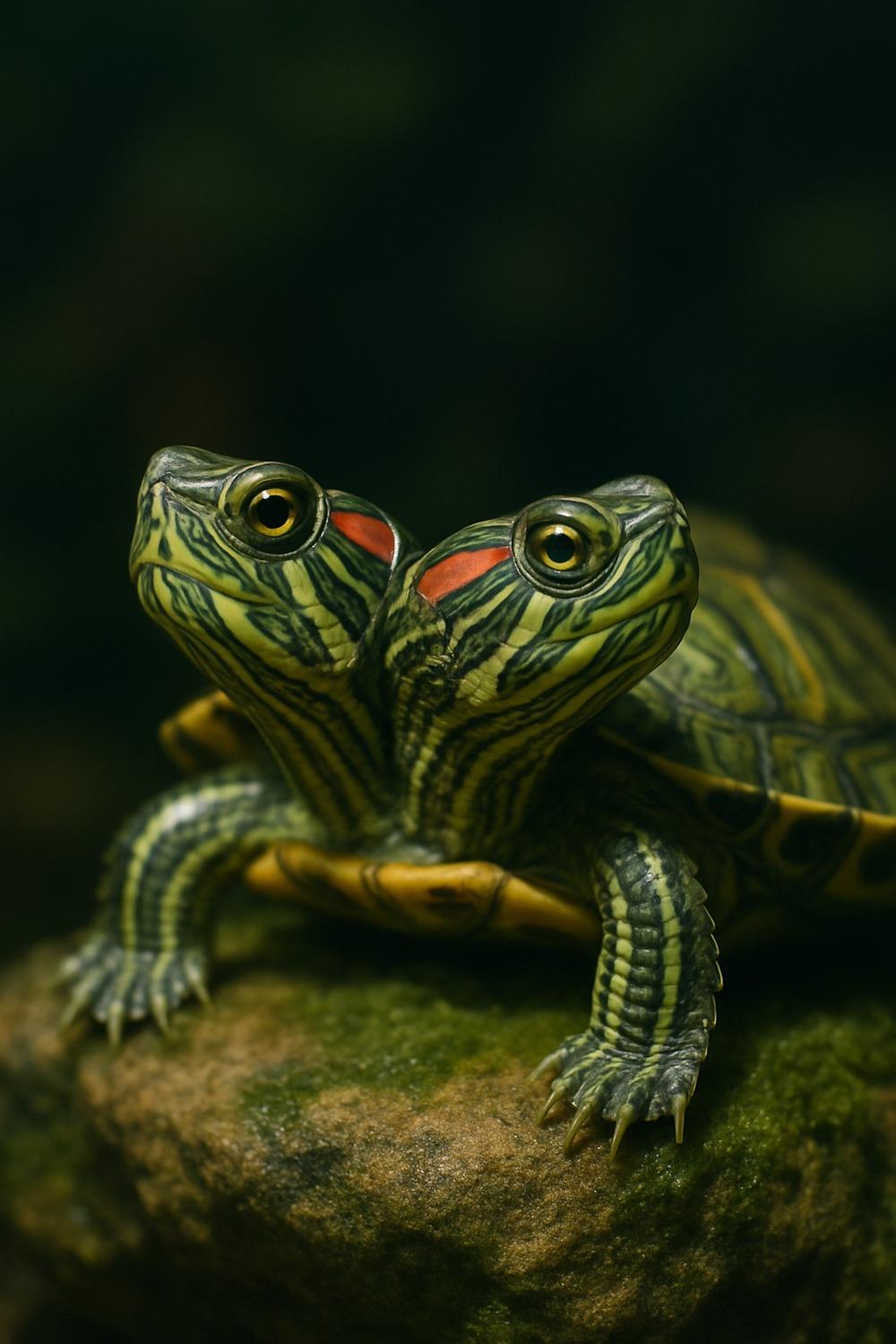
Thelma and Louise turned 25 last year. Nobody expected her to make it past the first week. She’s a turtle with two heads, two brains, and according to every biological rule we thought we understood, she should’ve been dead decades ago.
That she’s alive at all is the weird part. That she’s thriving — that’s where the story gets interesting.
She lives at the San Antonio Zoo, where the staff has spent a quarter century learning how to keep two personalities fed, healthy, and mostly cooperative inside one small, determined body. Most animals born with this condition don’t survive their first day in the wild. Thelma and Louise didn’t just survive — she became something researchers still can’t fully explain. Here’s what we know, and what we’re still trying to figure out.
Key Facts
- Thelma and Louise, a bicephalic red-eared slider, turned 25 in 2022, one of the oldest documented bicephalic reptiles in zoological history.
- She hatched in 1997 and lives at the San Antonio Zoo, which developed specialized care protocols for her two independent heads.
- Bicephaly occurs in approximately 1 in every 100,000 reptile hatchlings.
- Most bicephalic turtles do not survive past 24 hours in the wild, and two-headed snakes rarely survive more than a few months even in captivity.
- Red-eared sliders in captivity average a 20-30 year lifespan, which Thelma and Louise has now matched.
In short: A case of two-headed turtle bicephaly is a developmental accident where one fertilized egg fails to fully split, producing two heads with separate brains on one body. Thelma and Louise, a red-eared slider hatched in 1997, turned 25 in 2022 at the San Antonio Zoo despite wild bicephalic turtles rarely surviving 24 hours.
What Two-Headed Turtle Bicephaly Actually Means
Bicephaly isn’t magic. It’s a developmental accident that happens in the earliest hours of embryonic life, when a single fertilized egg begins dividing and something goes wrong. The cells that should fully separate into two distinct embryos don’t quite finish the job. You get two heads instead — each with its own brain, its own nervous system, its own instincts — all connected to one shared body.
According to research on polycephaly, the condition shows up across dozens of species. Sharks. Cattle. Snakes. Frogs. But turtles? Turtles seem to have a strange advantage.
Herpetologist Dr. Kenneth Dodd has spent decades studying chelonian development, and he’s found something interesting: turtle embryos appear particularly susceptible during early incubation. Temperature fluctuations might trigger it. Genetic anomalies. Sometimes it’s just randomness — the kind of developmental accident that shouldn’t happen but does anyway. The exact cause is still debated, which means every surviving case becomes scientifically invaluable.
Because survival? That’s the exception.
Two Brains, One Body — The Daily Negotiation
Imagine trying to walk when your left leg wants to go north and your right leg wants to go east. That’s not a metaphor for what a bicephalic turtle experiences. That’s the actual reality.
Each head sends its own signals down the shared nervous system. Movement becomes a constant negotiation between two independent decision-makers, each convinced it knows where the body should go. In the wild, this kind of neurological conflict is usually fatal — predators don’t wait for consensus to be reached.
Zoo staff at San Antonio figured out pretty quickly that Thelma and Louise’s two heads operate almost independently. One might want to eat. The other might want to explore. One prefers lettuce. The other goes for fish. Feeding time requires patience, strategy, and a deep understanding of two very distinct personalities sharing one shell. That last fact kept me reading for another hour — because it means the caretakers have spent 25 years learning not just the biology, but the psychology of two minds in one animal.
They rotate feeding positions. They monitor which head is more dominant in different situations. They track health markers for each head independently, because what affects one doesn’t always affect the other.
How Thelma and Louise Beat the Survival Odds
In the wild, a bicephalic turtle’s life expectancy is measured in hours. Maybe days if they’re incredibly lucky and find shelter immediately. The condition creates such severe movement limitations that finding food, escaping threats, and even basic thermoregulation become nearly impossible.
Then you put that same animal in captivity.
Thelma and Louise hatched in 1997. The San Antonio Zoo was already experimenting with specialized care protocols, learning in real-time what it would take to keep her alive. Decades of decisions — some right, some wrong, many discovered through trial and error — accumulated into something unprecedented. A 25-year survival record.
The Science Behind Why Turtles Can Survive This
Here’s the thing — and this is where it gets genuinely strange — turtles might actually be uniquely suited to survive bicephaly longer than any other vertebrate. Red-eared sliders have a remarkably slow metabolism. That matters. A lot. It means the body’s resources stretch further between two heads than they would in a mammal (where the condition is essentially unsurvivable). Their immune systems are also surprisingly robust. Turtles can withstand physiological stresses that would kill other animals outright.
Dr. Elliott Jacobson, a pioneer in reptile medicine, has documented cases where the shared circulatory system in a bicephalic turtle actually functions with relative efficiency — especially if one heart manages to become dominant. The two heads still compete for oxygen. For nutrients. For neurological priority. But the turtle’s fundamental biology gives it a fighting chance that a two-headed mammal simply wouldn’t have.
It’s why bicephaly in turtles shows up in long-term captivity cases far more often than in any other vertebrate group.
By the Numbers
- Thelma and Louise turned 25 in 2022 — one of the oldest documented bicephalic reptiles in recorded zoological history. Most don’t survive past 24 hours in the wild.
- Red-eared sliders in captivity have an average lifespan of 20-30 years, meaning Thelma and Louise has lived a completely normal turtle lifespan despite having two heads competing for the same resources.
- Bicephaly occurs in approximately 1 in every 100,000 reptile hatchlings.
- Two-headed snakes rarely survive more than a few months even in captivity, which makes Thelma and Louise’s 25-year record even more striking by reptile standards.
Field Notes
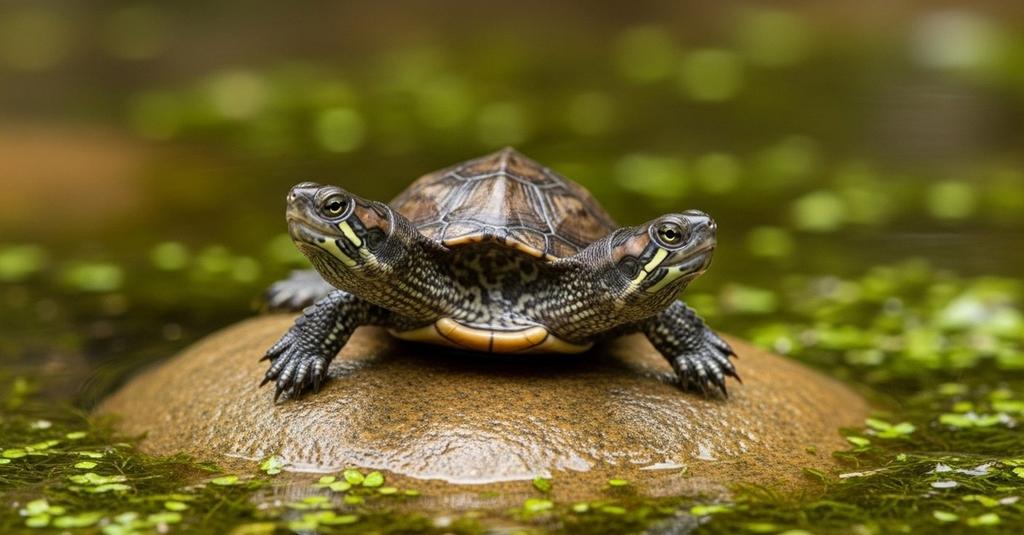
- Thelma and Louise’s two heads have distinctly different personalities. One tends to be aggressive at feeding time. The other is noticeably more passive. Zoo staff have documented this behavioral split over 25 years.
- In bicephalic reptiles, each head can fall asleep independently — it’s possible for one head to be completely unconscious while the other is alert and processing the world, which creates bizarre behavioral patterns that took keepers years to understand.
- Two-headed animals appear throughout human history in mythology and religious symbolism, but modern science has only recently begun understanding the embryological mechanisms that cause two-headed turtle bicephaly, and researchers are still working out why some cases survive far longer than others.
What Thelma and Louise Taught Us
The story of two-headed turtle bicephaly isn’t just a curiosity. It’s a window into how life finds a way even when biology seems to be working against it. Every year Thelma and Louise survives adds to a body of knowledge about developmental anomalies, about reptile physiology, about the adaptability of animals under human care. Vets and researchers have learned things from her that couldn’t have been studied any other way — about neurological coordination, about shared metabolism, about what two minds mean when they share one existence.
There’s something genuinely moving about the staff at San Antonio Zoo who’ve spent decades learning her rhythms, her preferences, her moods.
They didn’t just keep an animal alive. They figured out how to let two personalities thrive inside one small, determined body.
She’s also a reminder that the animals we think of as fragile — small, slow, ancient — carry a kind of resilience we’re only beginning to understand. The shell isn’t just protection. For 200 million years, it’s been carrying life through impossible circumstances. It’s not going to stop now because the odds look bad.
Thelma and Louise didn’t survive because the world made it easy. She survived because the right humans paid attention, stayed curious, and refused to give up on something strange and rare and worth protecting.
That’s the story underneath the story — the one that keeps showing up in biology, in medicine, in every corner of the natural world where something impossible turns out to be just barely possible. If this kind of thing keeps you reading at 2am, there’s more at this-amazing-world.com. The next one’s even stranger.
Frequently Asked Questions
Q: What exactly is two-headed turtle bicephaly?
Bicephaly is a developmental accident that occurs in the earliest hours of embryonic life, when a single fertilized egg begins dividing but the cells that should separate into two embryos do not finish the job. The result is two heads, each with its own brain and nervous system, connected to one shared body. The condition appears across dozens of species including sharks, cattle, snakes, and frogs, and occurs in roughly 1 in every 100,000 reptile hatchlings.
Q: How has Thelma and Louise survived 25 years?
Thelma and Louise, a bicephalic red-eared slider, hatched in 1997 and turned 25 in 2022 at the San Antonio Zoo, where staff developed specialized care protocols. Most bicephalic turtles do not survive past 24 hours in the wild because two heads sending conflicting movement signals make finding food and escaping predators nearly impossible. In captivity, keepers rotate feeding positions, track each head’s health independently, and manage two distinct personalities.
Q: Why do turtles survive bicephaly better than other animals?
Turtles appear uniquely suited to surviving bicephaly. Red-eared sliders have a remarkably slow metabolism, so the body’s resources stretch further between two heads than they would in a mammal, where the condition is essentially unsurvivable. Their immune systems are also robust, letting them withstand physiological stresses that would kill other animals. Two-headed snakes, by contrast, rarely survive more than a few months even in captivity, making Thelma and Louise’s 25-year record striking.
Illustrations are AI-generated. Article fact-checked and human-edited. Our editorial standards.