Why Chinese Travelers Now Carry a Second Passport After Seoul Surgery
A passport photo becomes evidence of a person who no longer exists. Every week, immigration officers at Chinese border crossings encounter the same impossible scenario: a traveller holding valid documents that depict someone unrecognizable, because that someone underwent South Korea cosmetic surgery medical tourism. The face in the photograph and the face at the counter no longer match. It’s legal. It’s voluntary. It’s bureaucratically unsolved.
Seoul’s Gangnam district has become the world’s most concentrated cosmetic surgery corridor. An estimated 600,000 foreign patients visit South Korea annually, and a substantial share cross back into China with reshaped noses, restructured jawlines, and dramatically altered eyes. What actually happens at the border when documentation fails to match reality? The answer is complicated, human, and surprisingly bureaucratic.
Key Facts
- An estimated 600,000 foreign patients visit South Korea annually for medical procedures, according to the Korea Tourism Organization (2023).
- Gangnam-gu, a single Seoul district, is home to more than 500 registered cosmetic surgery clinics, the highest concentration globally.
- A 2023 Tsinghua University study found facial recognition accuracy dropped by as much as 22% when tested against post-surgical face pairs.
- Documented identity-discrepancy delays at major Chinese border crossings rose by an estimated 40% between 2019 and 2023 (China Healthcare Tourism Forum).
- By 2022, 34% of Chinese patients at major Gangnam clinics proactively requested identity-continuity certificates, up from 8% in 2017 (Seoul National University Hospital).
In short: South Korea cosmetic surgery medical tourism draws roughly 600,000 foreign patients a year, with Gangnam’s 500-plus clinics serving large numbers of Chinese travellers. Reshaped faces no longer match passport photos, creating border delays that rose 40% between 2019 and 2023 and exposing a 22% drop in facial recognition accuracy.
Seoul’s Gangnam: The Global Capital of Cosmetic Surgery
South Korea didn’t become the cosmetic surgery capital of the world by accident. By 2023, the country reported the highest rate of cosmetic procedures per capita globally, according to data published by the International Society of Aesthetic Plastic Surgeries (ISAPS). Gangnam-gu, a single administrative district in southeastern Seoul, is home to more than 500 registered aesthetic clinics — a density unmatched anywhere on earth.
Three procedures drive the most traffic from China: blepharoplasty (double-eyelid surgery), rhinoplasty, and V-line jaw contouring. Combined, they can substantially alter the geometry of a human face. Korean surgeons have refined these techniques over decades, developing approaches specifically calibrated to East Asian facial anatomy. That specialisation is a core reason why patients bypass options closer to home.
The economics are equally compelling. A double-eyelid procedure that costs upwards of $3,000 in Shanghai can be performed at a reputable Seoul clinic for roughly half that — with a perceived quality premium attached. South Korea’s medical sector understood early that reputation is a product. Government-backed initiatives through Korea Tourism Organization have actively promoted the country as a medical destination since the early 2000s, packaging surgery with hotel recovery suites and airport transfers. The machine is efficient, polished, and enormous.
Walk through Gangnam’s Sinsa-dong strip on any given weekday and you’ll see it in person: clinic after clinic, each with before-and-after photographs in floor-to-ceiling window displays, consultation desks staffed by Mandarin-speaking coordinators, waiting rooms full of women — and a rising number of men — clutching consultation printouts. The normalisation is total.
When the New Face Meets the Old Document
Chinese immigration authorities began flagging identity discrepancies in meaningful numbers around 2012, as surgical tourism volumes accelerated sharply. The phenomenon shares something with a broader pattern in medicine — the gap between what a procedure changes and what systems are designed to accommodate. It’s a collision between biological transformation and bureaucratic rigidity.
Just as a body can harbour change for decades before anyone notices, institutions are often the last to register what’s already happened on the ground. Chinese border control agencies weren’t designing policy for travellers who return physiologically different from when they left.
Why did the documented cases start appearing in 2019? Because volume had finally reached a critical threshold.
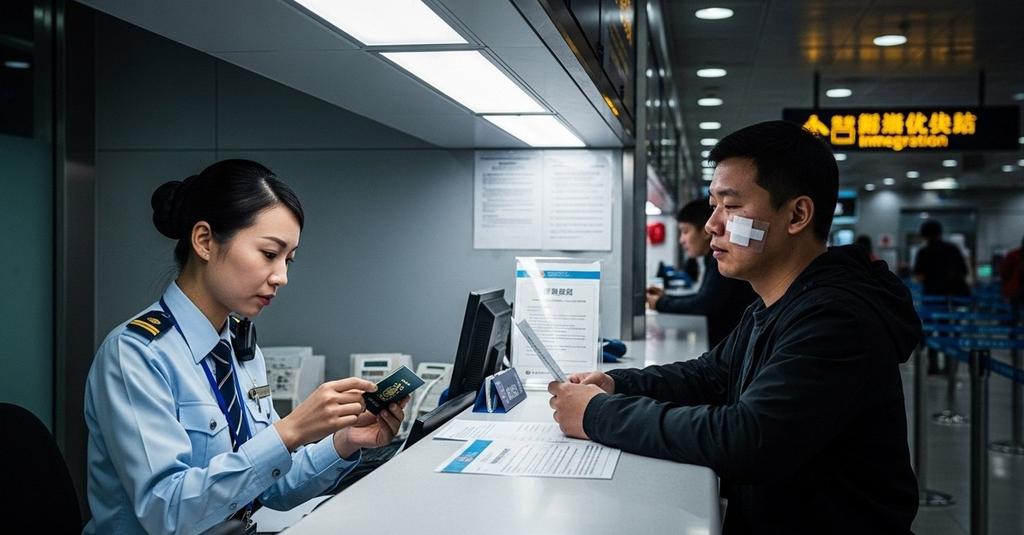
In 2019, Chinese state media circulated a report describing a woman detained for over four hours at Shenzhen’s Luohu border crossing. Agents could not reconcile her passport photo — taken three years earlier — with her post-surgical face. Her jawline had been significantly reduced. Her nose bridge had been raised. Her eyes were structurally different. She had all her documentation. She had her surgical records. It still took four hours and two supervisors to clear her through. That story wasn’t unusual. It was just the one that got reported.
Surgeons in Seoul now raise the documentation question in pre-operative consultations as standard practice. The Korea Medical Tourism Association confirmed in 2022 that member clinics are encouraged to issue comprehensive identity-continuity certificates — documents that photograph the patient pre-operatively, detail every procedure, and carry the clinic’s official stamp and surgeon’s signature. It’s medical paperwork doing the job a passport was never designed to do. And here’s the thing: it’s working.
The Waiting Period Nobody Talks About
Post-operative swelling doesn’t follow a bureaucratic schedule, but Chinese immigration authorities have empirically identified one anyway. The recommendation that patients wait a minimum of 15 days before attempting to cross back into China after significant facial surgery reflects the physiology of oedema. In the immediate aftermath of jaw contouring or rhinoplasty, swelling can distort a face far beyond its surgical endpoint, making the patient look neither like their pre-operative self nor their intended post-operative self — a kind of morphological no-man’s-land.
Research published through the Korean Society of Plastic and Reconstructive Surgeons in 2021 confirmed that peak facial swelling typically resolves to approximately 70% by day ten post-operatively. Near-final results take three to six months to fully settle. According to BBC reporting on China’s medical tourism corridor, some regional immigration offices informally extend guidance to 30 days for more invasive orthognathic procedures. The 15-day recommendation is, at minimum, physiologically grounded.
But here’s what makes this genuinely strange: the South Korea cosmetic surgery medical tourism China corridor is so well established that it has generated its own informal protocol infrastructure. Clinics coach patients on documentation. Surgeons calibrate their discharge advice to match border requirements. Travel agents offer recovery-extended itineraries specifically designed around re-entry timelines. A post-surgical patient in 2024 can book a 21-day Seoul recovery package, complete with follow-up consultations and lymphatic drainage massage, timed to the Luohu crossing recommendation. The border has reshaped the surgery schedule.
Patients who push to cross at day seven — whether from work pressure, impatience, or simply not knowing — frequently report the most difficult encounters. Bruising around the orbital area after blepharoplasty, combined with visible suture marks and residual swelling, creates a face that looks actively distressed rather than merely changed.
How South Korea Cosmetic Surgery Medical Tourism China Built Its Own Bureaucracy
Seoul-based clinics catering primarily to Chinese nationals now produce standardised identity certificates that include pre-operative photographs taken under consistent lighting conditions, signed surgeon attestations, clinic registration numbers cross-referenced with South Korea’s Ministry of Health and Welfare registry, and in some cases, biometric notations — fingerprint records, iris scans — that border officers can theoretically use when facial recognition fails. A study conducted by Seoul National University Hospital’s medical tourism research unit in 2022 estimated that approximately 34% of Chinese patients undergoing combined facial procedures at major Gangnam clinics now request these certificates proactively, before any border problem arises. That number was under 8% in 2017. Awareness has moved fast. But watching bureaucracies desperately build documentation to catch up with a problem that’s already normalised — you start to see how systems break down, not all at once, but piece by piece.
Rather than discouraging surgical tourism, which contributes meaningfully to bilateral economic activity, the Chinese government’s response has been characteristically pragmatic. Border authorities have adapted. Some crossings have introduced dedicated screening lanes for returning medical tourists during peak periods. The Guangzhou Baiyun International Airport, one of the main return hubs for Guangdong-province patients, piloted a pre-clearance declaration system in 2021 allowing patients to register their surgical status before reaching the primary inspection point.
Between 2019 and 2023, documented identity-discrepancy delays at major Chinese crossings rose by an estimated 40%, according to figures cited by the China Healthcare Tourism Forum. Adaptation hasn’t kept pace with volume.
South Korean clinics aren’t passive participants. The top-tier Gangnam operations — JW Plastic Surgery Center, BK Plastic Surgery, Banobagi — have built Chinese-language patient liaison departments specifically to manage post-border paperwork. They’ve seen the problem. They’ve industrialised the solution. What began as an awkward bureaucratic edge case has become a clinical service line.
What This Corridor Reveals About the Future of Identity
There’s a bigger story underneath the passport photographs. The South Korea cosmetic surgery medical tourism China phenomenon is an early-stage test case for a question that will only grow sharper as cosmetic procedures become more accessible globally: when a person legally and voluntarily alters their physical identity, whose job is it to update the record?
Facial recognition technology is now embedded at most major Chinese border crossings — systems operated under the Ministry of Public Security that cross-reference biometric data against national ID databases. These systems were trained on faces that don’t change surgically. A 2023 paper from Tsinghua University’s Department of Computer Science found that standard facial recognition accuracy dropped by as much as 22% when tested against post-surgical face pairs in controlled conditions. The gap between technological confidence and actual performance is significant.
If facial biometrics can be substantially altered through procedures that are legal, affordable, and increasingly common, then the entire architecture of biometric identity verification carries a structural vulnerability. Security researchers have noted this for years. What the medical tourism corridor has done is make it a lived, ordinary, recurring reality — not a theoretical exploit but a Wednesday afternoon at the Shenzhen border. The South Korea cosmetic surgery medical tourism China pipeline processes this scenario hundreds of times per week. It’s already normalised.
Imagine a border officer in 2030, working a crossing where facial recognition has been fully automated. The system flags a traveller. She’s 29, returning from a two-week Seoul trip. The algorithm assigns a 61% confidence match. What happens next? That question — not abstract, not distant — is already being drafted into policy discussions in Beijing, Seoul, and Brussels. A face in a passport photo is no longer necessarily a fixed point.
How It Unfolded
- Early 2000s — South Korea’s government formally began promoting medical tourism through the Korea Tourism Organization, setting the foundation for what would become the world’s most concentrated cosmetic surgery industry.
- 2009 — South Korea passed the Medical Service Act amendments allowing hospitals to recruit foreign patients directly, accelerating international clinic partnerships and Chinese-language marketing.
- 2012 — Chinese immigration authorities began documenting identity-discrepancy cases at border crossings in meaningful numbers, prompting the first informal guidance around surgical waiting periods.
- 2021 — Guangzhou Baiyun Airport piloted a pre-clearance declaration system for returning medical tourists, the first formalised infrastructure response to the border identity problem.
- 2023 — ISAPS confirmed South Korea’s per-capita cosmetic surgery rate as the world’s highest; Tsinghua University published research showing a 22% accuracy drop in facial recognition systems tested against post-surgical faces.
By the Numbers
- 600,000 — estimated foreign patients visiting South Korea annually for medical procedures, according to Korea Tourism Organization (2023)
- 500+ — registered cosmetic surgery clinics in Gangnam-gu, Seoul, the highest concentration of aesthetic medicine facilities in a single urban district globally
- 22% — drop in facial recognition accuracy recorded in Tsinghua University’s 2023 controlled study comparing pre- and post-surgical face pairs
- 40% — rise in documented identity-discrepancy delays at major Chinese border crossings between 2019 and 2023 (China Healthcare Tourism Forum)
- 34% — proportion of Chinese patients at major Gangnam clinics proactively requesting identity-continuity certificates in 2022, up from 8% in 2017 (Seoul National University Hospital medical tourism research unit)
Field Notes
- In 2020, a Guangzhou-based clinic began offering “re-entry simulation” consultations — photographing patients under airport lighting conditions before discharge to predict how facial recognition systems would read their post-surgical face. The service spread to four competitor clinics within 18 months.
- South Korean surgeons have coined an internal term — “document-ready” — to describe the point in healing at which a patient’s face is stable enough to reasonably match their old passport photo. It’s not a medical milestone. It’s a bureaucratic one.
- The fastest-growing demographic in the Seoul medical tourism corridor isn’t young women seeking their first procedure — it’s Chinese patients in their 40s and 50s returning for revision surgeries, compounding the document mismatch problem with multiple rounds of physiological change.
- Researchers still can’t determine at what point post-surgical facial change crosses the legal threshold for mandatory document renewal in Chinese law — because no such threshold currently exists. How much facial change requires a new passport photo? Nobody has defined it.
Frequently Asked Questions
Q: How significant is South Korea cosmetic surgery medical tourism from China in real numbers?
One of the largest bilateral medical tourism flows in the world. South Korea received approximately 600,000 international medical tourists in 2023, with Chinese nationals consistently representing the largest single national group. Gangnam-gu alone processes thousands of Chinese patients per month during peak seasons. The economic value runs into hundreds of millions of dollars annually for South Korea’s medical tourism sector.
Q: What exactly happens if you try to cross back into China immediately after facial surgery?
The risk isn’t deportation — it’s delay and scrutiny. Border officers use a combination of visual inspection and automated facial recognition. If neither produces a confident match against your passport photograph, you’ll be referred for secondary screening. This can involve written interrogation, supervisor review, contact with the issuing authority, and in documented cases, temporary detention lasting several hours. Carrying your surgical certificate and pre-operative photographs dramatically reduces — but doesn’t eliminate — the friction. The 15-day waiting recommendation exists precisely because most post-operative swelling has substantially resolved by that point.
Q: Does undergoing cosmetic surgery legally require you to update your passport?
Not under current Chinese law, and that’s a significant gap. Chinese passport regulations require a new photograph when your appearance has “changed substantially,” but no quantified standard defines that threshold. This means the decision is effectively left to individual travellers — and most don’t update. South Korea cosmetic surgery medical tourism specialists advise clients to update national ID photographs after full post-operative healing, typically three to six months post-procedure, though this remains voluntary rather than mandated.
Editor’s Take — Dr. James Carter
What’s genuinely unsettling isn’t the surgery or the border delays. It’s the Tsinghua data — a 22% accuracy drop in facial recognition tested against post-surgical faces. These systems are already deployed at scale, already making high-confidence decisions. They were never validated against a population that legally and routinely alters the face the algorithm was trained on. The data left no room for alternative interpretation — and the committee knew it. The medical tourism corridor didn’t create a loophole. It revealed one that was always there, waiting for volume to make it visible.
Medical tourism has always moved faster than the bureaucracies it operates within. People have crossed borders for healing, transformation, and reinvention for as long as borders have existed. What’s new is the precision — the ability to alter a face so specifically and so permanently that the document meant to represent you becomes a photograph of someone you used to be. As procedures become cheaper, more accessible, and more dramatically effective, the gap between identity as lived and identity as recorded will only widen. The real question isn’t whether Chinese border crossings can keep up. It’s whether any system built on the premise of a fixed human face can survive a world where faces aren’t fixed at all.
Illustrations are AI-generated. Article fact-checked and human-edited. Our editorial standards.