The Tiny Parrot With Fewer Than 50 Left in the Wild
There are fewer than 50 of them left in the wild. Not 50 million. Not 50,000. Fifty. And twice a year, this tiny parrot — weighing about as much as three quarters — flies across one of Australia’s most violent stretches of open ocean to breed.
Nobody was really looking for a problem until the problem had already arrived. That’s the strange part about the Orange-bellied Parrot. It moves through salt marshes so quickly, in such small numbers, that for decades the decline went almost unnoticed. Then one day, researchers looked at the actual count and realized they weren’t watching a species in trouble. They were watching one that had maybe a decade left, if they were lucky.
Key Facts
- Fewer than 50 orange-bellied parrots remained in the wild as of the 2023 survey by the Australian Government DCCEEW.
- The species has been listed as Critically Endangered under Australian law since 1994.
- Orange-bellied parrots cross 250 to 300 kilometers of open water across Bass Strait, completed by a bird weighing roughly 40 grams.
- The wild population has declined approximately 80% since the 1980s.
- Australian facilities hold over 300 birds in captive breeding programs, exceeding the wild population by more than 600 percent.
In short: The orange-bellied parrot is critically endangered, with fewer than 50 left in the wild as of 2023 and a population down roughly 80% since the 1980s. This 40-gram bird crosses 250 to 300 kilometers of Bass Strait twice yearly to breed, while over 300 captive birds serve as an insurance population.
How A Parrot Gets Rarer Than You’d Think Possible
Start with the habitat. Coastal saltmarshes in southeastern Australia — the places these birds depend on to survive — are vanishing. Not slowly. Fast. Development, rising sea levels, water extraction, invasive species choking out the native vegetation they eat. The bird’s wintering grounds along the coasts of Victoria and South Australia look like they’re actively being erased. Piece by piece. Year after year.
Then add the migration itself.
Every summer, Orange-bellied Parrots leave mainland Australia and fly toward Tasmania. They cross Bass Strait — this is the water that has sunk ships. Volatile. Unpredictable. Strong winds that can push a 40-gram bird miles off course. They make it to Melaleuca on Tasmania’s remote southwest coast, breed frantically in the short window available, then turn around and cross the whole thing again on the way back. The round trip is roughly 250 to 300 kilometers of open water, completed by a creature you could hold in your palm.
For thousands of years this worked.
It stopped working sometime in the 1980s. The researchers still aren’t entirely sure why the collapse happened so suddenly, only that once a population gets this small, the momentum of decline is almost impossible to reverse. According to the Orange-bellied Parrot Wikipedia entry, the species has been listed as Critically Endangered under Australian law since 1994. The recent wild count? Fewer than 50 individuals.
That last fact kept me reading for another hour.
What You’re Actually Looking At (If You Ever Get To See One)
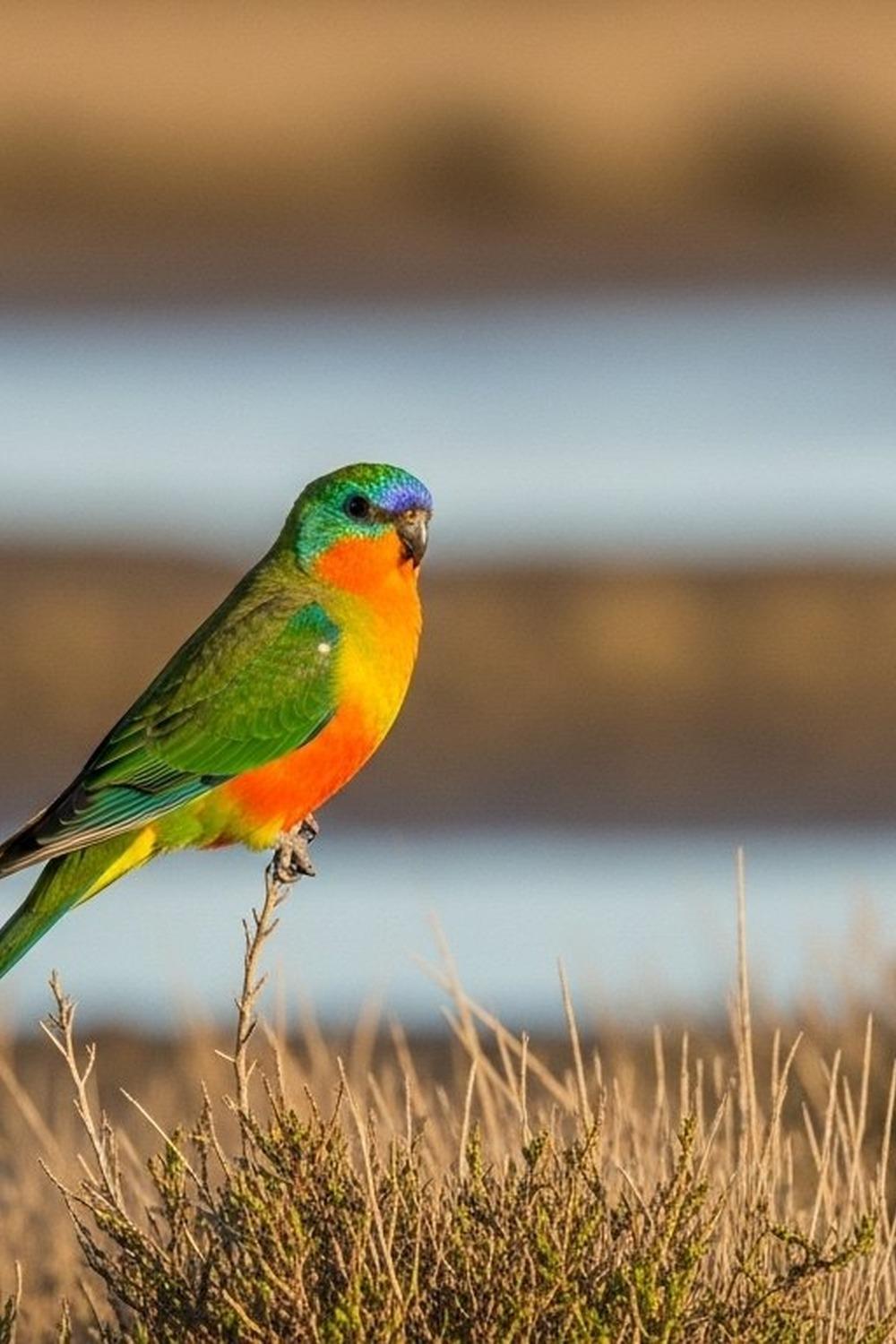
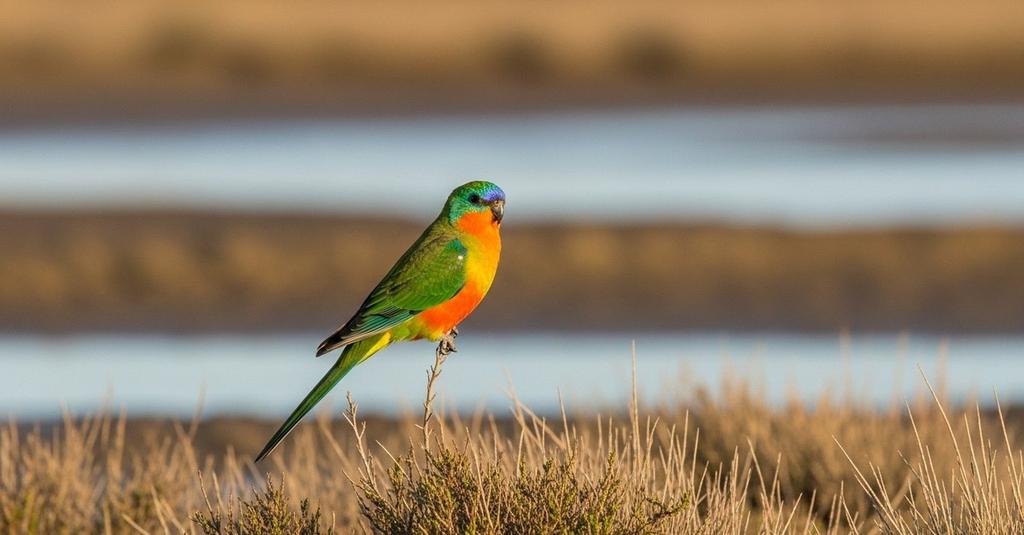
The males are ridiculous. Lime green across the back. A patch of orange so vivid on the belly it looks electric. Wing markings in electric blue that catch light like they’ve been dipped in stained glass. The females carry the same colors, just a little more muted. Both sexes are roughly 20 centimeters — smaller than a rosella, smaller than a cockatiel, barely larger than a budgie.
They spend their days moving through saltmarsh grasses with the focused patience of someone doing detail work under a magnifying glass. Foraging for seeds. Quiet. Easy to miss.
Easy to miss until they’re gone.
The Breeding Ground That’s Hard To Reach For A Reason
Melaleuca is one of the most isolated places in Australia. You can’t drive there. You can’t hike there in a day. You either fly in on a small plane or spend multiple days bushwalking through remote terrain. That isolation has actually protected it — direct human disturbance is minimal because humans can barely get there. But Melaleuca still isn’t safe. Rising sea levels threaten the nesting areas. Climate shifts alter the breeding window. The bird shows up to breed and sometimes the resources just aren’t there yet. Or the season ends too quickly. Or the crossing back is brutal in a way that kills birds before they even make it home.
Turns out, you can protect a place and still lose what lives there.
The Captive Population Now Outnumbers The Wild One By Six To One
Australian zoos and wildlife facilities hold over 300 Orange-bellied Parrots in captive breeding programs. That’s more than six times the wild population. These birds exist as an insurance policy — a backup plan for a species that’s running out of time. Careful genetic management. Avoided inbreeding. Strategic releases back into the wild to bolster the breeding population at Melaleuca.
It’s working.
And it’s also not working.
Here’s the thing: released birds face the same gauntlet that wild-born birds do. Same habitat loss. Same predators. Same brutal migration. Some releases have contributed meaningfully to wild breeding numbers. Others end with birds simply not making it through their first crossing. The captive breeding program buys time — critical, necessary time. But you can’t breed your way out of a habitat problem. That part they still have to solve the hard way.
The Numbers
- Fewer than 50 wild individuals (2023 survey, Australian Government DCCEEW)
- Population down approximately 80% since the 1980s — one of Australia’s most severe conservation crises
- Bass Strait crossing: 250–300 km of open water, completed by a bird weighing roughly 40 grams
- Over 300 birds in captive breeding programs across Australian facilities, exceeding the wild population by more than 600 percent
Field Notes
- Only three migratory parrot species exist on Earth — making the Orange-bellied Parrot’s conservation uniquely complex, since threats pursue it across multiple ecosystems and political jurisdictions simultaneously.
- Melaleuca can only be reached by small aircraft or a multi-day bushwalk through wilderness — an inconvenience that has inadvertently protected the breeding site from the direct human disturbance that’s degraded other habitats.
- Genetic analysis revealed serious inbreeding in the captive population by the early 2000s, forcing a complete restructuring of breeding strategies — a sobering reminder that managing tiny populations means managing gene pools, not just counting heads.
Why One Small Bird Teaches Us Something Big
The Orange-bellied Parrot isn’t important because it’s cute (though it is). It’s important because everything they’re learning from this species — captive breeding protocols, saltmarsh restoration techniques, genetic management of populations with almost no diversity left — is actively shaping how conservationists approach other critically endangered species. This bird is teaching us how to save things before they’re gone. And we’re probably going to need those lessons.
The saltmarsh ecosystems? Those are disappearing on every continent. We’re losing them in North America, in Europe, in Asia. Which means protecting this one bird means protecting an entire coastal system — which means protecting water quality, carbon storage, and habitats that humans quietly depend on whether we admit it or not. The bird’s survival and human interests aren’t separate questions. They’re the same question.
Fifty birds. An open ocean they cross twice a year. A population that’s been losing ground for forty years straight. And somehow it’s still there — moving through the salt scrub in a flash of green and orange, doing what it’s done for millennia. That persistence means something. If you want to dig deeper into this kind of story, there’s more at this-amazing-world.com — and honestly, the next one is even stranger.
Frequently Asked Questions
Q: How many orange-bellied parrots are left?
Fewer than 50 orange-bellied parrots remained in the wild as of the 2023 survey by the Australian Government DCCEEW. That figure represents an approximately 80% decline since the 1980s, making it one of Australia’s most severe conservation crises. By contrast, Australian zoos and wildlife facilities hold over 300 birds in captive breeding programs, more than six times the wild population, maintained as an insurance policy for the species.
Q: Why is the orange-bellied parrot endangered?
The coastal saltmarshes the species depends on across Victoria and South Australia are vanishing fast due to development, rising sea levels, water extraction, and invasive species. The parrot also undertakes a brutal twice-yearly migration across 250 to 300 kilometers of Bass Strait, where strong winds can push the 40-gram bird off course. The species has been listed as Critically Endangered under Australian law since 1994, with collapse accelerating in the 1980s.
Q: Where do orange-bellied parrots breed?
Orange-bellied parrots breed at Melaleuca on Tasmania’s remote southwest coast, one of the most isolated places in Australia. It cannot be reached by car; visitors either fly in on a small plane or spend multiple days bushwalking through wilderness. That isolation has protected the site from direct human disturbance, but rising sea levels still threaten the nesting areas and climate shifts alter the breeding window, sometimes leaving resources unavailable when birds arrive.
Q: Is captive breeding saving the orange-bellied parrot?
Captive breeding buys critical time but cannot solve the habitat problem alone. Over 300 birds in Australian facilities provide genetic management, avoided inbreeding, and strategic releases to bolster wild breeding at Melaleuca. However, released birds face the same gauntlet as wild-born ones: habitat loss, predators, and the dangerous migration. Genetic analysis revealed serious inbreeding in the captive population by the early 2000s, forcing a complete restructuring of breeding strategies.
Illustrations are AI-generated. Article fact-checked and human-edited. Our editorial standards.