When a Whale Dies, the Ocean Floor Comes Alive
Somewhere right now, in the absolute blackness between 1,000 and 4,000 meters down, a whale is dying — and it’s about to feed an entire civilization of creatures that’ll never see sunlight. One dead animal. A hundred years of life built on top of it.
The weird part? Nobody even knew this ecosystem existed until the 1980s. Scientists were studying hydrothermal vents when they stumbled across chemosynthetic bacteria thriving in unexpected places. Turns out those bacteria weren’t just living near volcanic vents. They were living on whale bones. On whale bones that had been sitting on the seafloor for years, sometimes decades, sustaining entire communities of creatures that depend on nothing but the corpse itself.
Here’s what’s happening down there right now.
Key Facts
- A whale carcass sinks to depths between roughly 1,000 and 4,000 meters, where it can sustain communities for decades.
- Whale-fall ecosystems were first discovered in the 1980s, when scientists found chemosynthetic bacteria living on whale bones.
- Scavengers such as hagfish and sleeper sharks strip the soft tissue of a roughly 150,000-kilogram whale within months, sometimes weeks.
- Marine biologist Craig Smith at the University of Hawaiʻi has documented whale falls for decades.
- In 2002, researchers from the Monterey Bay Aquarium Research Institute discovered bone-eating worms drilling into whale bone with root-like structures.
In short: When a whale dies and sinks to 1,000–4,000 meters, it fuels an ecosystem that can last decades. Scavengers like hagfish strip the tissue, then chemosynthetic bacteria—first noted in the 1980s—harvest energy from hydrogen sulfide in the fatty bones, supporting mussels, clams, tube worms and, discovered in 2002, bone-eating worms.
First Come the Eaters
Within hours of a 150,000-kilogram whale hitting the bottom, things start moving. Hagfish arrive. Sleeper sharks arrive. These aren’t delicate feeders — they’re here to eat, and they’re fast about it. The soft tissue is gone in months. Sometimes weeks. Marine biologist Craig Smith at the University of Hawaiʻi has spent decades watching this play out in time-lapse video and deep-sea footage, and he describes it with this dry understatement: “It’s as dramatic as it sounds.”
The seafloor here is normally almost empty. Nearly barren. The only food that drifts down is marine snow — tiny particles, barely enough to keep anything alive. Then a whale arrives and suddenly it’s the richest meal some of these creatures will ever encounter. In their entire lives.
And then it gets stranger.
Why a Dead Whale Even Reaches the Bottom
It’s worth pausing on a detail that seems trivial but actually decides everything: the whale has to sink in the first place. When most marine animals die, they decompose near the surface, gases build up inside the body, and the carcass floats — picked apart by gulls, sharks, and surface scavengers long before it can descend. A whale is different precisely because it is enormous. A large carcass that escapes the surface zone can become waterlogged enough, and cold enough, that it loses buoyancy and begins the long fall through the water column.
That fall matters because of where it ends. Below roughly 1,000 meters the water is perpetually near freezing, the pressure is crushing, and oxygen is low. Decomposition that would take days at the surface stretches into months and years in the deep. The cold and the dark are not obstacles to the ecosystem — they are the reason it lasts. A whale that rotted away in warm shallow water would simply be gone. A whale that lands in the abyss becomes a slow-release deposit of fat, protein, and minerals that the surrounding desert has no other way to obtain.
And the deep sea is genuinely a desert in terms of energy. Almost all life on Earth ultimately runs on sunlight, but no sunlight reaches these depths. Everything down there lives on scraps that sift from above — the marine snow of dead plankton and fragments of larger animals. A single whale delivers, in one event, a quantity of carbon that an equivalent patch of seafloor might otherwise take centuries to accumulate.
Bacteria Take Over
Once the scavengers finish, something unexpected happens. Bacteria colonize the bones. But these aren’t normal decomposition bacteria. They practice chemosynthesis — pulling energy from sulfur compounds locked inside the whale’s fat, not from sunlight. They produce hydrogen sulfide. That’s a toxic gas. That’s poison.
And somehow that poison becomes food.
White bacterial mats bloom across the skeleton like someone spread frost across the bones. Mussels show up. Clams. Tube worms. The exact same creatures you’d find living near hydrothermal vents thousands of kilometers away, and they’re here, in the middle of nowhere, feeding on bacteria that eat poison. It’s a whole ecosystem built on the corpse of a whale, powered by something toxic. The whale fall ecosystem mirrors the vent ecosystems so closely that scientists initially thought they were the same thing. They’re not. One is built on volcanic heat. One is built on a dead whale.
How Poison Becomes Food: The Chemosynthesis Trick
The chemistry behind a whale fall is worth slowing down on, because it overturns something most of us learned in school. The standard story of life is photosynthesis: plants and algae capture sunlight, turn it into sugar, and everything else eats the plants or eats the things that ate the plants. Chemosynthesis flips the energy source entirely. Instead of light, certain bacteria harvest the chemical energy stored in inorganic molecules — and on a whale fall, the key molecule is hydrogen sulfide.
Whale bones are unusually rich in lipids — fats and oils that can make up a remarkable fraction of the skeleton’s weight, especially in the dense bones of the skull and jaw. As that fatty marrow breaks down without oxygen, one group of microbes produces sulfide as a waste product. A second group of bacteria then oxidizes that sulfide, capturing the energy released and using it to build organic compounds. Those bacteria become the base of a brand-new food web. They form the visible mats; they live inside the tissues of mussels and tube worms in cooperative arrangements where the host shelters the microbes and the microbes feed the host.
This is the same fundamental engine that powers hydrothermal vent communities, where the sulfide comes from superheated mineral-laden water rather than rotting fat. That shared chemistry is exactly why the same families of clams, mussels, and tube worms turn up in both places. A whale fall, in effect, is a portable chemosynthetic oasis — a vent without a volcano, fueled by biology instead of geology, and built to dissolve away once the fat runs out.
Meet the Bone-Eating Worms (They’re Only 20 Years Old as a Discovery)
In 2002, researchers from the Monterey Bay Aquarium Research Institute found something they’d never seen before: tiny worms drilling into whale bone using root-like structures that secrete acid. They named them Osedax. Bone devourer. Zombie worms. For the entire history of human science before 2002, we didn’t know these existed.
The biology is unsettling. The females are visible — actual worms on the bone surface, tunneling through the lipids. The males? Microscopic. Dozens of them live inside the female’s body, existing entirely to reproduce. That last fact kept me reading for another hour just trying to understand how that even evolved.
What makes Osedax stranger still is how it feeds. The worms have no mouth and no gut. Their root-like “roots” burrow into the bone, and inside those roots live symbiotic bacteria that break down the bone’s fats and proteins, releasing nutrients the worm absorbs directly through its body. It’s the same partnership-with-microbes strategy that runs the whole whale fall — outsourced digestion, no stomach required. The acid the roots secrete slowly etches the skeleton, and over years a heavily colonized whale bone can be tunneled into a porous, crumbling lattice.
By 2020, researchers had identified over 25 species of Osedax. Probably dozens more that we haven’t named yet. The deep ocean does this constantly — it produces organisms that sound invented.
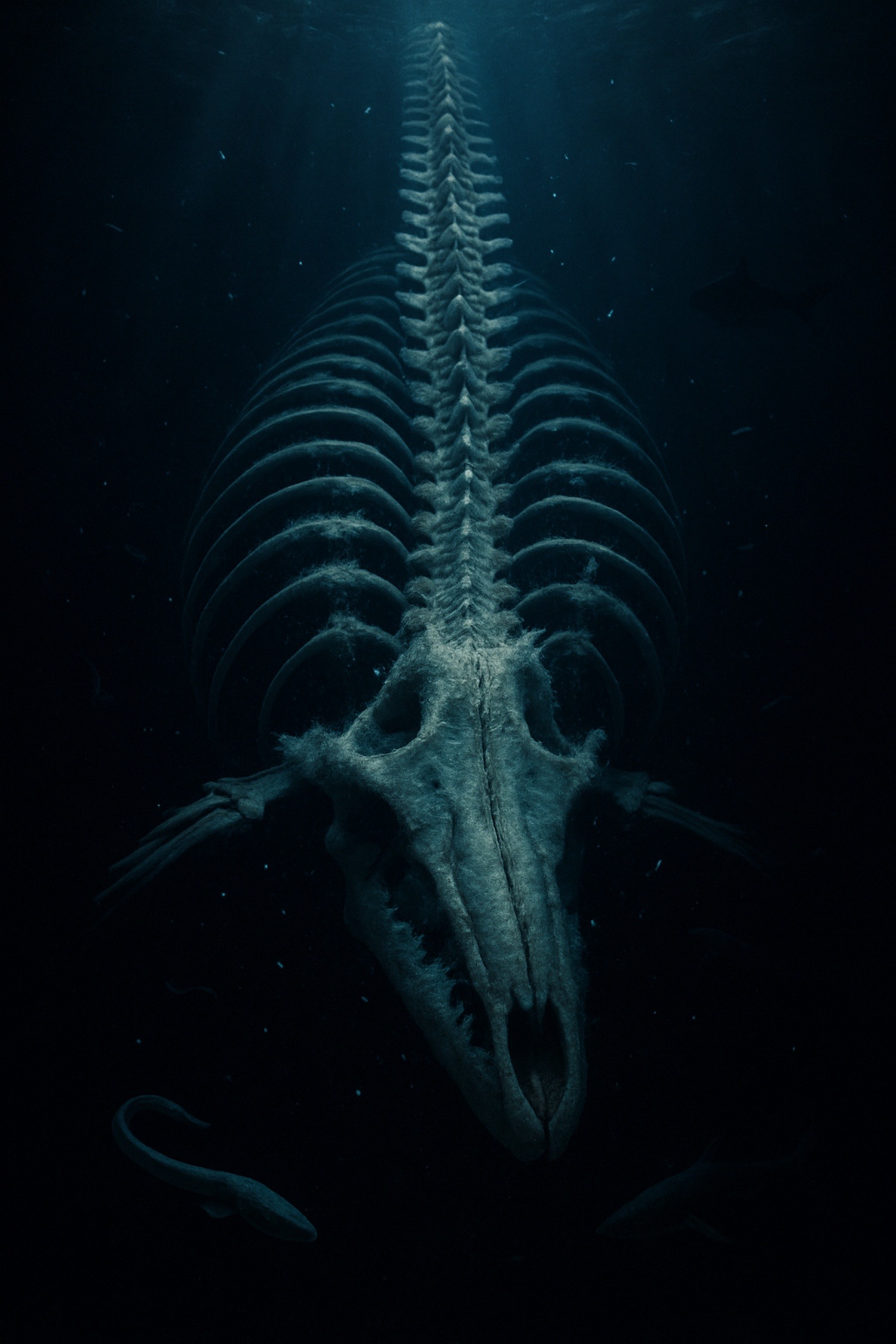
The Stages of a Whale Fall
Scientists have mapped out at least four overlapping phases:
- The mobile scavenger stage — hagfish, sharks, eating rapidly.
- Enrichment opportunists move in next. Polychaete worms and crustaceans swarm what’s left of the tissue. This can last for years.
- The sulfophilic stage — chemosynthetic bacteria, mussels, tube worms. Years or decades.
- Possibly a final reef stage, where the mineral-rich bones themselves become hard substrate for filter feeders.
A single large whale can sustain this for a full century.
A hundred years.
The phases don’t fire like a switch flipping; they bleed into one another and their length depends on the whale. Size is the obvious variable — a blue whale carries far more fuel than a minke — but depth, temperature, oxygen levels, and even the local scavenger population all shift the timeline. A carcass in cold, low-oxygen water may stall in the enrichment stage for years while one in slightly warmer, well-oxygenated water races through it. The sulfophilic stage, where the chemosynthetic community blooms, is the slow, patient heart of the whole process, and it persists exactly as long as the bones keep leaking energy.
Most scientists who study whale falls will never see the same site across all its stages. The timeline is too long. The ocean floor is too remote. The research funding doesn’t last that long.
They May Connect the Entire Deep Ocean
Here’s the thing that rewired my understanding of the deep ocean: whale falls might actually be stepping stones. Evolutionary stepping stones. Chemosynthetic species need sulfur-rich environments — those are rare, scattered, mostly found near hydrothermal vents and cold seeps. But whale falls? They’re distributed across every ocean, at depths that match the vent habitat range.
A species could migrate, slowly, across millions of years, using whale falls as rest stops. Like birds island-hopping across an archipelago. The species we find living near volcanic vents didn’t start there. They may have drifted across the ocean floor on a map drawn in bones.
The ocean floor as a history of ancient migrations.
Why Whale Falls Matter Beyond the Spectacle
It would be easy to file whale falls under “fascinating but irrelevant” — a macabre curiosity from a part of the planet almost nobody visits. They’re more important than that, for a few concrete reasons.
First, carbon. When a whale dies and sinks, the carbon stored in its enormous body is locked away on the seafloor instead of returning to the atmosphere. A single great whale represents a substantial parcel of carbon, and across an entire ocean of whales over time, those carcasses form one strand of the long-term carbon cycle. This is one reason marine scientists argue that protecting whale populations has knock-on effects far beyond the animals themselves — fewer whales means fewer whale falls, and a thinner trickle of energy and carbon reaching the abyss.
Second, biodiversity accounting. Each new whale fall studied has tended to reveal species new to science. If a single category of habitat keeps producing unnamed organisms, the real total of deep-sea species is almost certainly far higher than current catalogs suggest.
Third, the practical stakes are rising. The same deep seafloor that hosts whale falls is also where companies hope to mine polymetallic nodules and where bottom trawling reaches. Understanding how isolated, slow-growing deep-sea communities assemble and connect helps scientists predict what’s lost when that habitat is disturbed — and how long, if ever, recovery would take. A whale fall is, conveniently for researchers, a natural experiment in deep-sea colonization that begins on a known date.
By the Numbers
- A blue whale carcass weighs up to 150,000 kilograms — roughly 20 adult African elephants worth of organic matter. That’s more food than would normally accumulate on that patch of seafloor over 2,000 years.
- Osedax worms discovered: 25+ species by 2020. Probably dozens more still unnamed.
- The deepest confirmed whale fall was at roughly 3,000 meters — a pressure environment over 300 times greater than at sea level.
- Scientists estimate approximately 690,000 whale falls exist on the deep ocean floor right now, based on whale mortality rates and decomposition timelines. Almost none have ever been observed by humans.
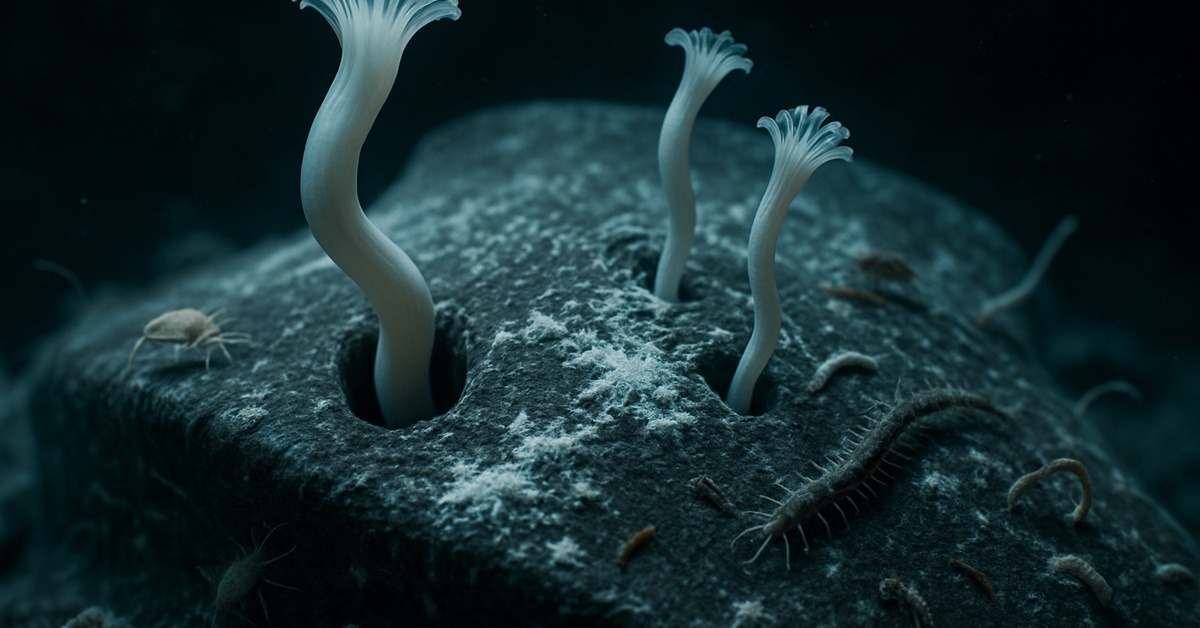
Things We’ve Actually Observed
- In 1998, researchers at MBARI placed an artificial whale skeleton on the Monterey Bay seafloor. Over 30 invertebrate species colonized it within 18 months — confirming it’s the chemical signature of the bones that attracts life, not just the whale itself.
- Sleeper sharks at whale falls bite large chunks of blubber and spin rapidly to tear them free. That’s a technique surface predators use. It evolved independently in creatures that live in complete darkness with no visual cues to guide it.
- Osedax species have shown up on the bones of large fish and sea turtles, not just whales. The deep ocean probably has far more “mini-falls” than we currently account for — thousands of small corpses creating tiny ecosystems we’ll never document.
What We’re Missing
For decades scientists thought the deep ocean was a desert. Sparse. Slow. Resource-starved. The whale fall ecosystem destroyed that assumption. The deep ocean isn’t sparse. It’s dynamic. It evolves. It remembers the bodies of animals that died millions of years ago through the genetic lineages that still live in their bones.
But here’s the honest part: we’ve mapped less than 20% of the ocean floor in detail. The estimate of 690,000 whale falls? That’s an estimate. The species counts are incomplete. Most of the evolutionary connections are still being drawn.
Every year, whales die in waters too deep to observe. They sink. They become worlds.
Frequently Asked Questions
Q: How long does a whale fall last? A single large whale can support life on the seafloor for years to decades, and in the case of a very large whale, scientists estimate the full sequence — from scavengers stripping the flesh to bacteria slowly draining the bones — can stretch toward a century. The exact timeline depends on the whale’s size, the depth, and the temperature and oxygen of the surrounding water.
Q: What are Osedax “zombie worms” and how do they eat without a mouth? Osedax are bone-eating worms first described in 2002. They have no mouth or gut. Instead, root-like structures burrow into the bone, and symbiotic bacteria living inside those roots break down the bone’s fats and proteins, releasing nutrients the worm absorbs through its body. The visible worms are female; tiny dwarf males live inside the females.
Q: Why do whale falls matter to people on the surface? Beyond their sheer strangeness, whale falls lock carbon away on the seafloor, keep producing species new to science, and serve as natural experiments in how isolated deep-sea communities form. That makes them relevant to the carbon cycle, to our count of Earth’s biodiversity, and to debates about deep-sea mining and other disturbances to the ocean floor.
The ocean floor is covered in slow-motion feasts that last longer than human institutions, powered by creatures that never knew what they’d become after death. It’s happening right now, unseen, in the dark. Most whale fall ecosystems will never be found. Some of them probably shelter species without names. And some of those species might carry answers to questions we haven’t thought to ask yet. If this kind of thing gets under your skin, there’s more at this-amazing-world.com — and the next one goes even deeper.
Illustrations are AI-generated. Article fact-checked and human-edited.