How Petrified Wood Forms in Arizona’s Petrified Forest
How petrified wood forms in Arizona starts with a tree that fell roughly 200 million years ago and never finished falling. It became stone instead. Across the desert floor of the Petrified Forest, these aren’t logs anymore. They’re solid quartz, frozen mid-decay since the Late Triassic.
Walk the painted badlands of northeastern Arizona and you step over a fossilized forest. The logs run from deep crimson to bruised purple to the dull yellow of old bone. They look like wood. They feel like rock. The landscape that buried them was once a lush tropical floodplain, roamed by early dinosaurs and giant amphibians. So how does an entire tree turn to crystal and keep its shape across two geological eras?
Key Facts
- The fossil logs date to the Late Triassic, roughly 200 to 225 million years ago.
- Petrified Forest National Park protects over 220 square miles of fossil-rich badlands.
- The wood is replaced almost entirely by silica, hardening into a quartz mineral called chalcedony.
- Trace iron and manganese create the red, yellow, and purple colors in the crystal.
- The park was designated a National Monument in 1906 and a National Park in 1962.
In short: How petrified wood forms in Arizona comes down to mineral replacement. Silica-rich groundwater seeped into buried Triassic logs and substituted quartz for plant tissue, cell by cell, over millions of years. The original wood is gone, but its internal structure, including growth rings and bark, survives in stone.
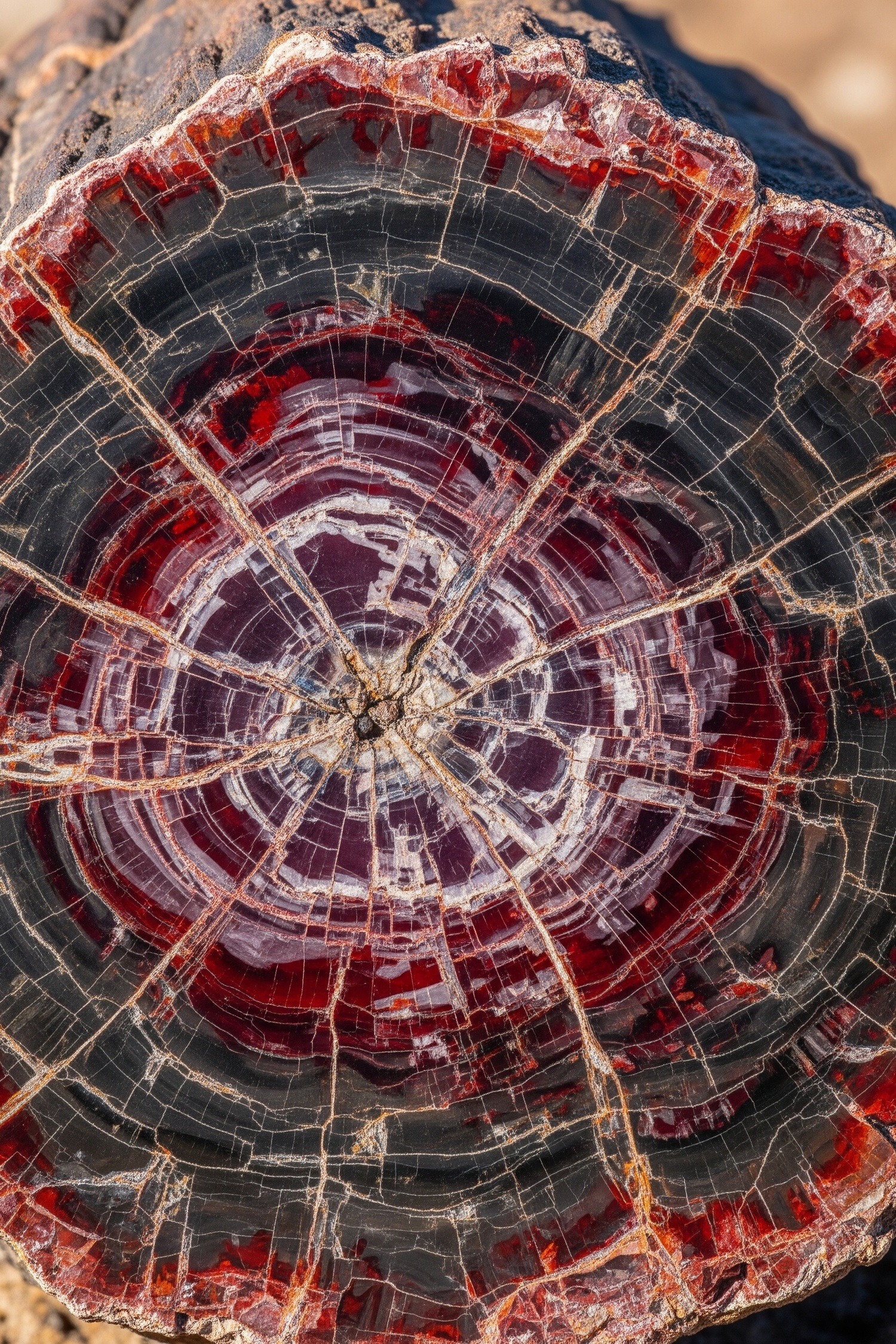
How does petrified wood form, cell by cell?
The process is called permineralization, and it’s slower and stranger than the word “fossil” usually implies. When a tree fell into the Triassic floodplain that is now Arizona, it was buried fast by sediment and volcanic ash, which sealed it away from oxygen and the bacteria that normally rot wood. Groundwater carrying dissolved silica then percolated through the buried trunk. The U.S. Geological Survey describes how that silica precipitated into the wood’s cellular spaces and gradually crystallized as quartz. You can trace the chemistry of petrifaction from there.
What makes it so precise is the fidelity. Because silica filled each cell individually before the original tissue fully decayed, the mineral took on the exact internal architecture of the wood. Growth rings remain countable. Bark patterns persist. In the best specimens, microscopic cell walls are still visible under magnification, replaced atom for structure in stone. The volcanic ash blanketing the Triassic floodplain was no accident of preservation either; its glassy particles dissolved easily, flooding the groundwater with the very silica that did the copying.
Timing was everything. Petrify too slowly and decay wins, leaving a featureless void; too fast and the structure collapses before silica can map it. The Chinle logs hit the narrow window where mineral and tissue coexisted just long enough for one to template the other. That balance is why these specimens preserve detail that most fossil wood elsewhere on Earth simply lacks.
The tree didn’t fossilize in the loose sense people mean. It was copied, in quartz, one cell at a time.
Why the petrified logs glow with color
Pure silica is colorless, like clear glass, so the spectacular reds, purples, and yellows come from impurities mixed into the crystal as it grew. Iron oxides tint the wood crimson and gold; manganese and iron together produce the bruised purples and blacks. The effect is closest to pigment suspended in glass. Scientists at the park have catalogued these mineral signatures for decades, and you can find more strange geology stories that hinge on the same trick of trace chemistry.
The color is also a record of conditions. Different mineral concentrations in the ancient groundwater produced different hues, so a single log can shift from red at one end to purple at the other. Each band is a chemical timestamp from a slightly different moment in the slow flooding of silica through the trunk. Geologists read those bands the way they read sediment layers, as a sequence frozen in place.
It’s a fossil and a watercolor at once, painted from the inside out.
How petrified wood forms in Arizona’s deep time
The Petrified Forest sits inside the Chinle Formation, a band of colorful rock that stretches across the Colorado Plateau and preserves one of the richest Late Triassic ecosystems on Earth. The Smithsonian notes that the same beds yielding petrified logs also hold fossils of early dinosaurs, armored reptiles called phytosaurs, and giant amphibians, painting a full picture of life roughly 220 million years ago. You can read the Smithsonian’s account of the deposit.
Here’s the thing about scale: the trees themselves were conifers, some towering over 200 feet, that grew upstream and were washed into the floodplain by ancient rivers. The dominant species, an extinct conifer called Araucarioxylon arizonicum, was named from these very logs and once formed forests across the region. They piled up as logjams, were buried, and only resurfaced when erosion stripped away the overlying rock millions of years later. What you see scattered on the surface today is just the exposed fraction of a far larger buried forest.
The Late Triassic floodplain bore no resemblance to today’s badlands. Rivers braided across a humid lowland near the equator, fed by seasonal monsoons, and the climate swung between wet and arid in cycles that the wood itself recorded. Volcanic eruptions periodically smothered the landscape in ash, which is exactly why so many trees were buried fast enough to petrify rather than rot away unrecorded.
Erosion giveth and taketh. The same wind and water that reveal the logs slowly grind them down to gravel.
What can petrified wood tell us that bones can’t?
Most people picture fossils as bones, and bones dominate the public idea of paleontology. But petrified wood forms a different and arguably richer archive, because plants record climate. The width and density of preserved growth rings let researchers at institutions including Petrified Forest National Park reconstruct ancient seasons, droughts, and growth rates from the Late Triassic, a window that skeletons rarely provide.
Cause and effect run deep here. A wide ring means a wet, productive year; a narrow one signals stress or drought. Stacked across a single trunk, those rings sketch decades of Triassic weather, evidence of a climate roughly 200 million years before any thermometer existed. The wood is a passive instrument that recorded conditions and then, conveniently, turned to stone for safekeeping.
Park scientists now map newly exposed logs each season, racing erosion to study them before the same forces that revealed them wear them down.
The buried forest we still haven’t seen
The most striking part of the story is what remains underground. The National Park Service estimates that the logs visible at the surface represent only a small share of what the Chinle Formation still holds. Erosion exposes new specimens constantly, and geologists believe vast quantities of petrified wood lie buried beneath the painted desert, untouched and uncatalogued. Each storm and flash flood that scours the badlands can lift the lid on material no human has ever seen.
That makes the park a slow-motion excavation run by weather rather than shovels. Future researchers won’t dig so much as wait, returning after each erosion season to record what the desert has surrendered. The forest hasn’t finished revealing itself, and at the pace of geology, it never will in any single lifetime.
Somewhere below the surface, more Triassic trees are still waiting their turn to become stone made visible.
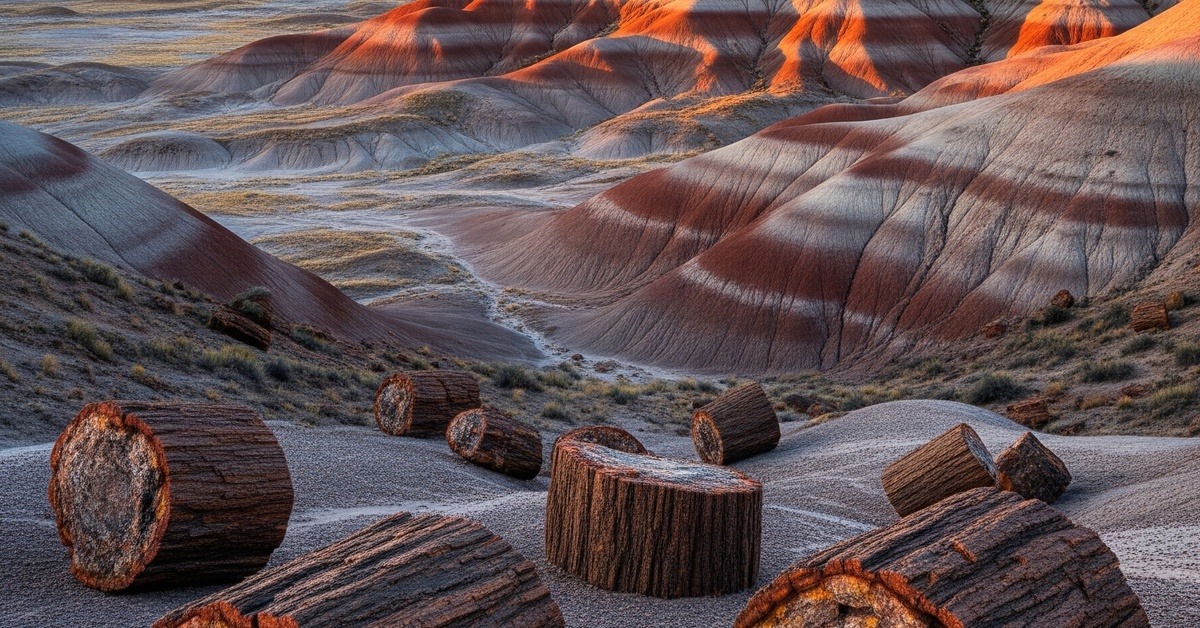
Where to See This
- Petrified Forest National Park, northeastern Arizona, USA, best visited spring or autumn to avoid summer heat.
- The park’s Rainbow Forest Museum and research staff study and catalogue newly exposed logs each season.
- A practical tip: never take a piece home, removing petrified wood is illegal and erodes the very deposit you came to see.
By the Numbers
- ~200–225 million years — the Late Triassic age of the fossil logs.
- 220+ square miles — the area protected by Petrified Forest National Park.
- 1906 — the year the area was first protected as a National Monument.
- Over 200 feet — the estimated height of some of the original conifers.
- ~7 (Mohs) — the hardness of the quartz that replaced the wood, hard enough to scratch glass.
Field Notes
- Some logs show clean breaks at regular intervals, fractured not by saws but by ground stress over millions of years, snapping the brittle quartz into near-uniform sections.
- The yellow hue most people overlook comes from iron in a different oxidation state than the iron producing the reds, a single element wearing two colors.
- The Chinle Formation that holds the logs also yields some of the earliest known dinosaur fossils in North America, dating the same era.
- Researchers still can’t fully explain why certain logs preserved cellular detail down to the microscopic level while neighbors became featureless quartz, a puzzle of subtle differences in burial chemistry.
Frequently Asked Questions
Q: How does petrified wood actually form?
Petrified wood forms through permineralization. A tree is buried quickly under sediment or volcanic ash, sealing it from oxygen and decay. Groundwater carrying dissolved silica then seeps through the buried trunk, and over millions of years that silica crystallizes into quartz inside each cell space. The original organic material is gradually replaced by mineral, so the finished object is stone shaped exactly like the wood it copied.
Q: Why is the petrified wood in Arizona so colorful?
Pure quartz is colorless, so the color comes from trace minerals mixed into the crystal as it formed. Iron oxides produce the reds and yellows, while manganese and iron together create the purples and blacks. Because the mineral content of the ancient groundwater varied, a single log can display several colors at once. The result looks like pigment suspended in glass.
Q: How old is the petrified wood in the Petrified Forest?
The logs date to the Late Triassic, roughly 200 to 225 million years ago. At that time the Arizona landscape was a humid tropical floodplain crossed by rivers, not the dry badlands you see today. The trees were conifers washed downstream, buried in sediment, and only re-exposed by erosion long after they turned to stone. That makes them tens of millions of years older than the most famous dinosaurs.
Q: Can you take petrified wood from the park?
No. Removing petrified wood from Petrified Forest National Park is illegal under federal law, and rangers enforce it. The rule exists because the fossils are a finite, irreplaceable record, and casual collecting over decades would strip the deposit bare. Commercially sold petrified wood comes from private land outside protected areas, not from the park itself.
Editor’s Take — Dr. James Carter
The instinct is to treat petrified wood as a pretty rock. The data argues otherwise. These logs are high-fidelity recordings of a climate that vanished 200 million years before any instrument existed, and the rings inside them carry weather data we can still read. A bone tells you an animal lived. A petrified trunk tells you what kind of year it was. That second archive is rarer, and we’ve barely started reading it.
Stand in the painted desert at the right hour and the logs catch the low sun like shattered stained glass scattered across the ground. Each one is a tree that fell into a river before the dinosaurs ruled, copied into crystal so slowly that no single generation could have watched it happen. The desert keeps eroding, keeps offering up more. What other forests are lying just beneath the surface, still waiting to become stone made visible?
Illustrations are AI-generated. Article fact-checked and human-edited.