Dinosaur Tail in Amber Still Shows Color After 99 Million Years
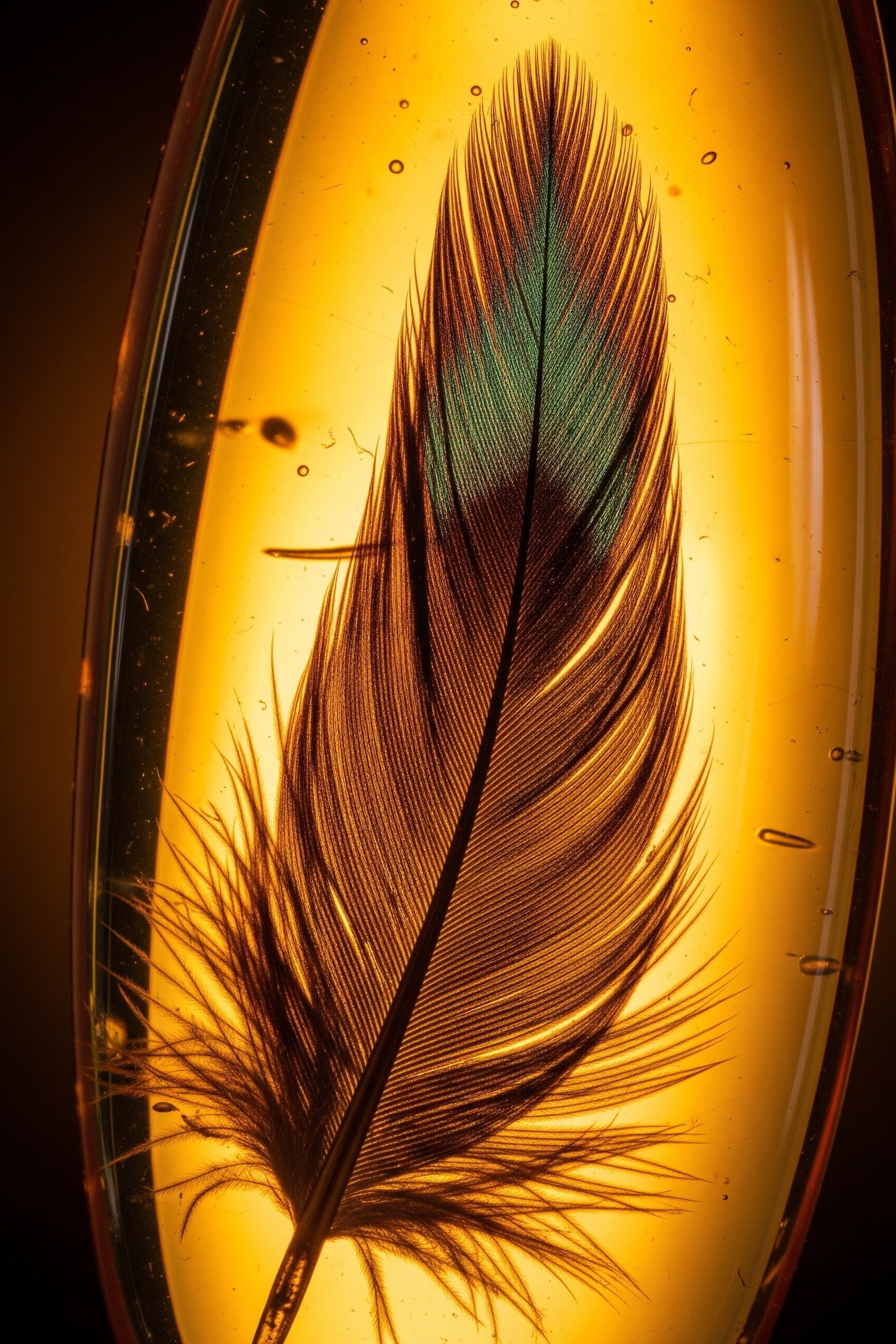
Resin caught a small feathered creature mid-flex 99 million years ago, and what paleontologists found locked inside that amber—smaller than your palm—didn’t just preserve a dinosaur tail in amber with feathers. It preserved something the fossil record had never shown us before: color. Pigment. The biological machinery that made this animal visible to the world it lived in. Everything scientists thought they understood about what stone could tell us suddenly looked incomplete.
Myanmar’s Hukawng Valley has quietly transformed paleontology over two decades. The amber deposits there produce something stone fossils cannot: soft tissue that never fully surrendered to time. Feathers still attached. Melanosomes—the microscopic structures responsible for color—intact enough to analyze. The dinosaur tail in amber with feathers preserved emerged from these deposits in 2015, already mis-labeled in a market stall as plant material. It took a trained eye to recognize what it actually was.
Key Facts
- The feathered dinosaur tail was preserved in Burmese amber about 99 million years old, from Myanmar’s Hukawng Valley.
- Researchers led by Lida Xing (China University of Geosciences) published the analysis in Current Biology in 2016.
- Specimen DIP-V-15103 holds a roughly 3.7-centimeter section of a juvenile non-avian dinosaur’s tail with feathers.
- The feathers were chestnut-brown on top and white beneath — a countershading pattern.
- Melanosomes were confirmed using synchrotron X-ray fluorescence imaging at the Canadian Light Source, University of Saskatchewan.
In short: A 99-million-year-old piece of Burmese amber preserved a juvenile dinosaur’s feathered tail, complete with pigment-bearing melanosomes. Published in Current Biology in 2016 by Lida Xing’s team, specimen DIP-V-15103 showed chestnut-brown and white countershading. Confirmed by synchrotron imaging, it was the first time feather color was read directly from a dinosaur preserved in amber.
The Specimen That Rewrote What Amber Could Tell Us
In 2016, researchers led by Lida Xing of the China University of Geosciences published their analysis in Current Biology. Specimen DIP-V-15103 contained an approximately 3.7-centimeter section of a juvenile non-avian dinosaur’s tail, complete with feathers still arranged exactly as they’d been positioned the moment resin flowed over them. This wasn’t a single feather drifting loose in ancient resin. The feathers were chestnut-brown on top, white beneath—a pattern called countershading that serves behavioral or ecological functions in modern animals, though precisely which one remains open. The discovery of dinosaur tail in amber with feathers preserved to this degree had never been documented before. The specimen is now considered one of the most significant amber fossils ever recovered.
What stopped the research team wasn’t just the feathers themselves—it was what remained inside them. Melanosomes. Not impressions of them. Not mineralized ghosts. The actual structures, identifiable under scanning electron microscopy, still showing their characteristic shapes. Elongated melanosomes produce dark, matte colors. Shorter, rounder ones are associated with iridescence—that shimmering quality visible in a raven’s feather or a hummingbird’s throat.
Why does this distinction matter? Because both shapes were present in this specimen. That single detail changes the entire conversation about what this creature was doing in its environment.
It didn’t just exist. It displayed. It caught light. It had something to show the world, 99 million years ago.
What the Melanosomes Actually Revealed
Paleontologists have only recently learned to read color from ancient melanosomes—the technique itself is barely fifteen years old. Compression fossils from shale deposits, primarily in China, yielded the first successes, but those results are always partial, always filtered through millions of years of chemical alteration. Amber operates differently. The resin creates an anoxic, chemically stable environment almost immediately, sealing soft tissue before decay can dismantle it. Here’s the thing: this is why the Hukawng Valley deposits have yielded ancient insects with their original iridescent wing surfaces intact, spiders mid-strike, even fragments of ancient forest floor with springtails still clustering as they would have in life. If you want to understand the biological complexity that amber can preserve, consider what creatures like velvet worms—soft-bodied predators that have barely changed in half a billion years—look like in the fossil record versus in actual life: amber collapses that gap in ways stone cannot.
The melanosomes in this specimen underwent analysis using synchrotron X-ray fluorescence imaging at the Canadian Light Source, a national research facility at the University of Saskatchewan. That technique maps elemental distributions across the specimen at microscopic resolution—copper, zinc, sulfur, iron—allowing researchers to distinguish original biological chemistry from contamination or mineralization. The results confirmed that the pigment signatures were genuine. Dorsal surface: chestnut-brown. Ventral surface: pale, possibly white. Countershading—darker on top, lighter below—appears functionally common in modern birds, reducing visibility from above and below simultaneously.
One detail rarely mentioned in popular coverage: the specimen was a juvenile, still short of adult size. An animal that hadn’t yet reached full development already possessed complex, structured plumage. That’s not what you’d expect if feathers in this lineage were primarily for insulation alone.
Myanmar’s Amber Deposits and the Soft-Tissue Revolution
Myanmar’s Hukawng Valley, in Kachin State in the country’s far north, has been producing Cretaceous amber for decades—but the scientific world didn’t fully grasp its importance until the early 2000s, when rigorous radiometric dating confirmed that the deposits were approximately 98 to 100 million years old, placing them squarely in the mid-Cretaceous. Those forests were dense, humid, resin-heavy. Organisms brushed against tree wounds. Resin flowed. Things got caught. What makes Burmese amber scientifically extraordinary is the combination of age, tropical origin, and sheer volume of material that reached research institutions intact. The Smithsonian Institution has documented multiple amber specimens from this region that preserve biological structures never before seen in the fossil record.
And yet the ethical dimension of this amber deserves plainness. Much of the material comes from a region with a long history of conflict, and some specimens entered the scientific literature through commercial markets rather than controlled excavations. The Society of Vertebrate Paleontology issued a formal moratorium statement in 2019 urging researchers to stop acquiring newly excavated Burmese amber from post-2017 sources due to concerns about funding armed conflict in the region. The science is extraordinary. The provenance is not always clean. Those two facts coexist.
The specimens already published in the peer-reviewed literature before those concerns peaked represent knowledge that has permanently altered the field.
How Color Evidence Changed Dinosaur Reconstruction
Before melanosomes could be identified in amber-preserved specimens, the most reliable color reconstructions came from compression fossils—feathered dinosaurs pressed flat in fine-grained sediment from China’s Liaoning Province. Paleontologist Jakob Vinther at the University of Bristol pioneered the melanosome-reading technique in 2008, first applying it to fossil bird feathers and then to non-avian dinosaurs. By 2010, the four-winged Anchiornis huxleyi had become the first dinosaur reconstructed in full color using this method. Vinther’s team identified black-and-white barring on body feathers and a reddish-brown crest—a specific, vivid pattern, not speculation. The dinosaur tail in amber with feathers preserved from Myanmar took that methodology further, because amber doesn’t compress. The three-dimensional geometry of the feathers remained intact. Barbules—the tiny interlocking branches that give feathers their structure—were still positioned as they would have been in a living animal, still attached to barbs, still layered correctly.
In compression fossils, melanosome shape often distorts under pressure and heat over geological time. Amber removes those variables almost entirely. What the Canadian Light Source analysis found was a heterogeneous melanosome population—different shapes in different parts of the feather. That pattern matches exactly what you see in modern iridescent feathers, where the optical effect depends on regular, layered melanosome arrangements acting like a diffraction grating. Light hits, scatters, interferes with itself, and the result is a shifting shimmer of color that changes with viewing angle.
Researchers at the Chinese Academy of Sciences, who contributed to the 2016 analysis, were careful not to overclaim iridescence—the preservation is remarkable, but confirming optical iridescence requires the full intact layering geometry, and some of that geometry was disrupted during fossilization. What they could say: the melanosome types present are identical to types associated with iridescence in living birds. That’s not proof, but it’s a strong suggestion.
Watching a species display complex coloration before it could even reproduce, you stop calling it incidental to survival.
How It Unfolded
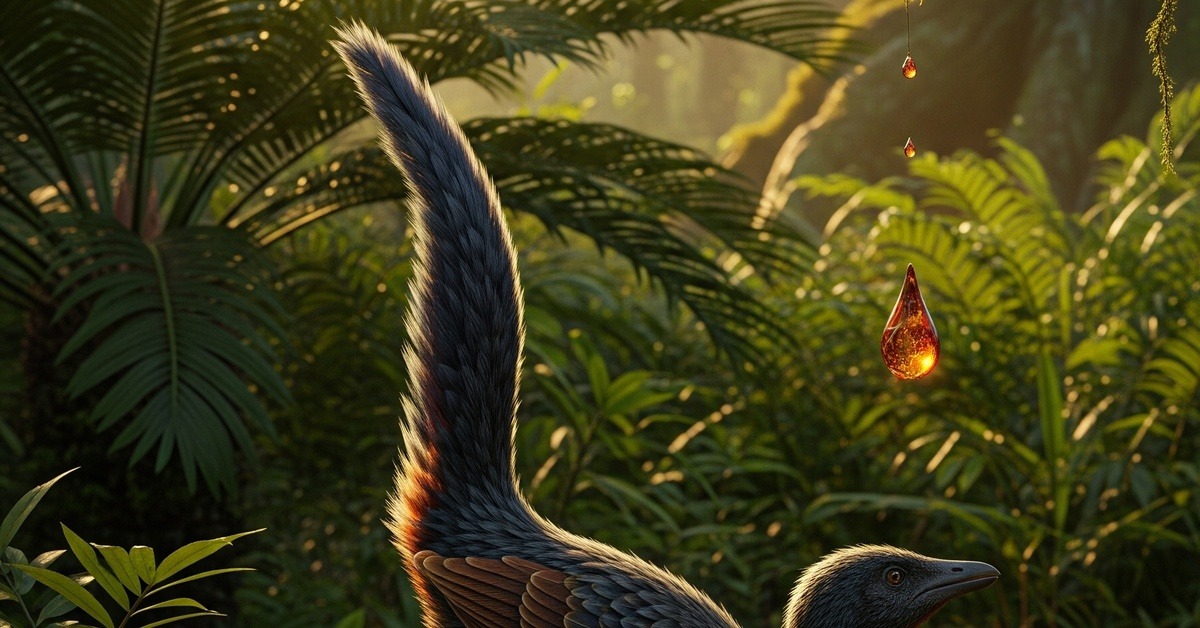
- 2006 — Commercial amber miners in Myanmar’s Hukawng Valley begin recovering unusually large, biologically rich amber pieces that eventually reach paleontological markets in China.
- 2008 — Jakob Vinther at the University of Bristol publishes the first demonstration that melanosomes survive in fossil feathers and can be used to reconstruct original color.
- 2016 — Lida Xing and colleagues publish the formal analysis of specimen DIP-V-15103 in Current Biology, identifying it as the first dinosaur tail in amber with feathers preserved in three dimensions, complete with melanosomes indicating complex coloration.
- 2020 — The Society of Vertebrate Paleontology issues a formal moratorium statement on newly collected Burmese amber specimens, triggering an ongoing debate about access, ethics, and the future of Cretaceous soft-tissue research.
By the Numbers
- 99 million years — the confirmed radiometric age of the Burmese amber deposits where the specimen was recovered (U-Pb zircon dating, 2012)
- 3.7 centimeters — the length of the preserved tail section in specimen DIP-V-15103, containing at least eight intact vertebrae
- ~1,000× — the approximate magnification required by scanning electron microscopy to resolve individual melanosomes in the feather barbules
- Over 300 — the number of significant biologically-bearing amber specimens published from Burmese deposits between 2000 and 2020, across entomology, botany, and vertebrate paleontology
- 2008 — the year melanosome-based color reconstruction was first validated as a technique, fundamentally changing what information the fossil record was considered capable of yielding
Field Notes
- When Lida Xing first examined the specimen in 2015, it had been sitting in a Hukawng Valley amber market in Tengchong, China, labelled as a “plant inclusion.” The vendor believed the dark filaments inside were plant material. It took a trained paleontologist’s eye to recognize them as feathers still attached to vertebrae.
- The feathers in the specimen aren’t proto-feathers—simple filaments like those seen in very early feathered dinosaurs. They’re fully developed pennaceous feathers with differentiated barbs and barbules, structurally identical to modern flight feathers in overall design, even though this animal almost certainly couldn’t fly.
- The same amber deposit has yielded specimens of ancient ticks engorged with what may be dinosaur blood—the biology of Cretaceous parasite-host relationships preserved in a single frozen moment, adding a layer of ecological complexity to what we understand about Mesozoic forest life.
- Researchers still can’t determine with certainty what species this juvenile dinosaur belonged to. The tail alone doesn’t provide enough skeletal information for a definitive taxonomic assignment—it’s likely a coelurosaur, closely related to modern birds, but the exact branch of the family tree remains genuinely unresolved.
Frequently Asked Questions
Q: How was the dinosaur tail in amber with feathers preserved so completely for 99 million years?
Tree resin creates an almost immediate anoxic seal around whatever it traps, cutting off the oxygen and microbial activity that drive decay. In the Hukawng Valley deposits, the chemical composition of the resin—rich in terpenes and other organic polymers—proved unusually stable over geological time. The result is that soft tissue, including feather barbules and the melanosomes inside them, survived essentially intact. No other fossilization process reliably preserves biological structures at this resolution.
Q: What does it mean that the feathers showed possible iridescence?
Iridescence in modern bird feathers isn’t produced by pigment alone—it requires melanosomes arranged in precise, regular layers that interact with light as a physical diffraction structure. The melanosomes found in the tail specimen include the short, platelet-shaped forms associated with iridescence in living species like starlings and hummingbirds. Researchers at the Chinese Academy of Sciences identified these forms in 2016 but stopped short of confirming iridescence outright, because confirming the optical effect requires the full intact layer geometry, which wasn’t entirely preserved. The building blocks are there. Whether the final optical structure survived is still debated.
Q: Does this mean all dinosaurs were colorful?
Not necessarily—and that’s a common overcorrection. The dinosaur tail in amber with feathers preserved belongs to a small, bird-like coelurosaur, a lineage already very close to modern birds. Color complexity in this group doesn’t automatically extend to large-bodied dinosaurs like sauropods or even many theropods. Melanosome evidence from other specimens suggests a wide range of coloration—from cryptic browns and grays to striking iridescent or patterned plumage—but within the feathered dinosaurs specifically. Big, scaly-skinned dinosaurs may well have been drab. We simply don’t yet have enough amber-quality evidence to say definitively either way.
Editor’s Take — Dr. James Carter
What strikes me most about this specimen isn’t the iridescence—it’s the juvenile detail. An animal that hadn’t reached adult size already had structured, differentiated plumage. If feathers at this stage of development were purely functional insulation, you wouldn’t expect that complexity. You’d expect fluff. Instead you get countershading, you get melanosome variation, you get what looks unmistakably like a visual signal. Which means these animals were communicating with each other—or with predators, or with prey—in ways we haven’t begun to fully map. The color was doing work. We just don’t know for what.
Ninety-nine million years is a number too large to feel real—until you’re looking at an image of an actual tail, actual feathers, actual pigment, smaller than your hand. Amber doesn’t care about geological time. It just holds. And somewhere in the Hukawng Valley, and in dozens of other resin-bearing deposits around the world, there are almost certainly more moments like this one—still sealed, still waiting, still holding the color of a creature that lived and moved and caught the light on a morning we’ll never see. What else is still in there?
Illustrations are AI-generated. Article fact-checked and human-edited.