Why Male Seahorses Give Birth: The Brood Pouch Explained
Why male seahorses give birth is one of the ocean’s strangest answers. Hundreds of tiny seahorses drift into open water, fully formed. The exhausted parent watching them go is their father. Male seahorse pregnancy isn’t a metaphor. It’s biology, complete with contractions, labor, and a pouch that behaves like a placenta.
Among the roughly 47 species of seahorse, the rule holds: the male carries the young. He doesn’t just store eggs in a sac and wait for them to hatch. His brood pouch actively feeds, oxygenates, and protects the developing embryos until they’re ready to face the sea on their own. So how did evolution hand pregnancy to the male, and why on earth did it stick around for millions of years?
Key Facts
- Male seahorses carry developing young inside a sealed brood pouch that regulates salinity and delivers oxygen and nutrients.
- A single birth can release anywhere from 100 to 1,500 offspring depending on the species.
- The lined seahorse, Hippocampus erectus, can carry young for up to 45 days before labor begins.
- Seahorses have existed in some form for at least 13 million years, based on fossil evidence.
- The pouch functions with startling similarity to a mammalian placenta, a rare case of convergent evolution in a fish.
In short: Why male seahorses give birth comes down to a specialized brood pouch on the male that works much like a placenta, regulating salinity and feeding embryos. The female deposits eggs into it, the male carries and nourishes the young for weeks, then delivers up to 1,500 offspring through real muscular contractions.
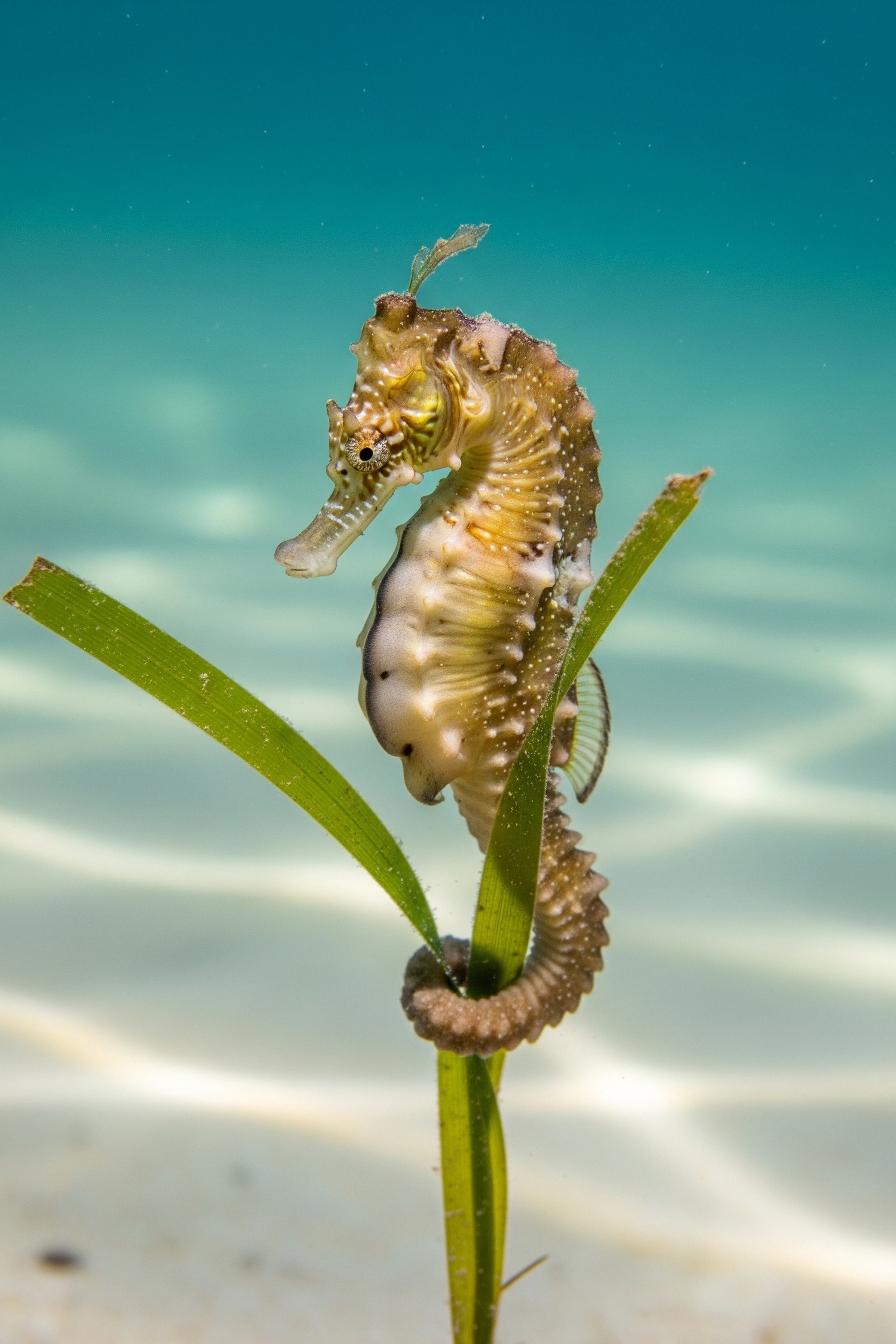
What happens inside the male seahorse’s brood pouch?
The pouch is far more than a holding bag. After the female deposits her eggs, the male’s tissue seals around them and gets to work. Camilla Whittington, a biologist at the University of Sydney, has studied seahorse pregnancy closely and found in research published in 2015 that the pouch wall develops a rich blood supply and tissue changes remarkably like those of a pregnant mammal. It delivers oxygen, removes waste, and fine-tunes the internal salinity so the embryos aren’t shocked when they finally meet the open sea. The closest comparison in the animal world is the placenta, which evolved in mammals along an entirely separate evolutionary path.
Here’s the thing that surprises people. The male doesn’t merely incubate. He provisions. The pouch secretes nutrients directly to the embryos, and it shields them from predators and fluctuating ocean conditions during the most fragile stage of their lives. Inside that warm, controlled chamber, the young develop eyes, snouts, and curling tails. By the time they emerge, they’re miniature adults, ready to grip seagrass and ambush passing prey within minutes of birth.
It’s pregnancy by every functional measure, just relocated to the wrong sex by our expectations.
The handoff itself is a marvel of timing. During a courtship dance that can last hours, the female extends a structure called an ovipositor and transfers her eggs directly into the male’s open pouch. Within moments, his tissue swells shut and begins fertilizing and embedding them. There’s no spawning into the water, no gamble that egg and sperm will find each other in the current. Everything happens inside a sealed, body-temperature chamber, which is precisely why so few eggs are wasted compared with the scattershot spawning most fish rely on.
Is it really labor when a male seahorse gives birth?
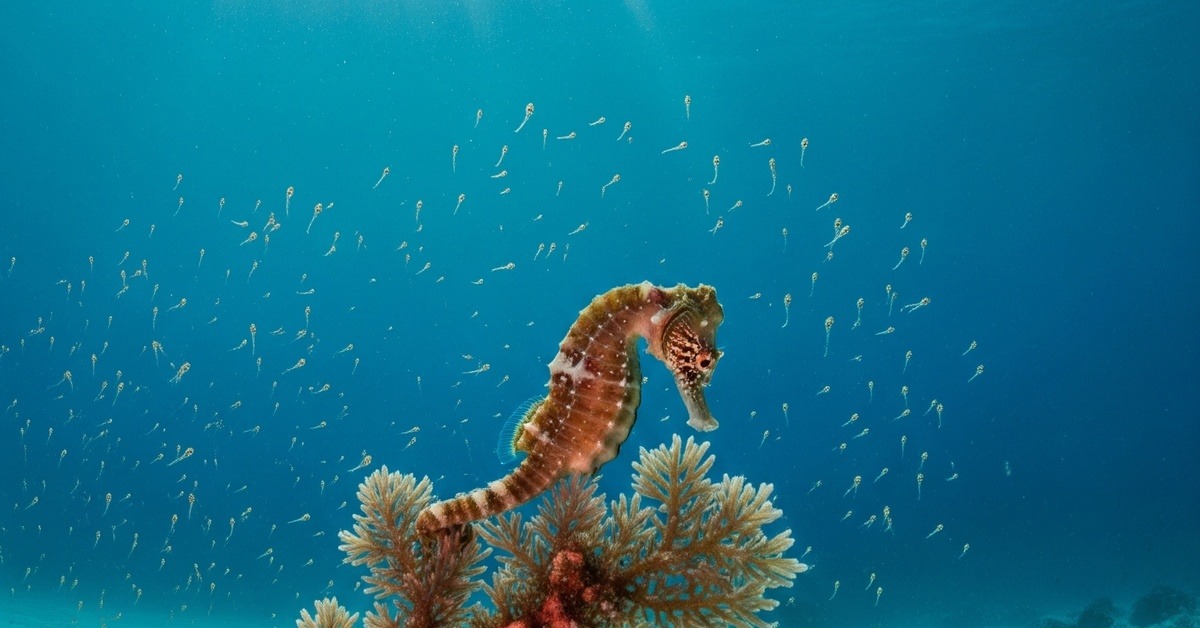
Labor is exactly the word. When the young are ready, the male anchors himself with his prehensile tail and begins a series of visible muscular contractions. He bends, pumps, and strains, sometimes for hours, until the brood is expelled in pulsing clouds of tiny bodies. You can watch his abdomen work with each push. The lined seahorse, Hippocampus erectus, found along the Atlantic coast from Nova Scotia to the Caribbean, may carry young for up to 45 days before this moment arrives. For more on the hidden mechanics of ocean reproduction, see our feature on the strangest parenting strategies in the sea.
The numbers are staggering against the size of the animal. A single male can release between 100 and 1,500 fully formed offspring in one event, each one only a few millimeters long. Most won’t survive their first week, which is exactly why there are so many. It’s a flood-the-zone strategy, betting on sheer volume against a hostile ocean where almost everything larger treats a newborn seahorse as a snack.
And the female? She’s already gone.
Why doesn’t the female stick around?
After depositing her eggs into the male’s pouch, the female typically moves on. He does the rest, alone. But the pair isn’t indifferent to each other. Many seahorse species form pair bonds and perform a daily greeting ritual, a slow, mirrored dance that reinforces their connection morning after morning. According to National Geographic, some species remain monogamous through a breeding season, the female returning each dawn to check on the male even as he carries her young inside him.
The division of labor has a logic. By handing off the eggs, the female can immediately begin producing the next clutch, which is metabolically expensive and time-consuming to manufacture. Meanwhile the male incubates and protects. The result is a faster reproductive cycle than if one parent had to do both jobs in sequence. Two parents, two specialized roles, one efficient biological assembly line that turns out more young per season than a single-parent system ever could.
It looks like role reversal. It’s really role division.
The evolutionary payoff: why male seahorses give birth and it stuck
Seahorses have existed in some recognizable form for at least 13 million years, based on fossil evidence described by researchers at institutions including the Natural History Museum in London. That’s an enormous stretch of evolutionary time for a single, peculiar arrangement to persist. Things that survive that long usually aren’t accidents. They’re strategies that keep paying off, generation after generation, through changing seas and shifting predators.
The leading explanation ties back to that faster reproductive cycle. Male pregnancy lets the pair produce more broods per season than they otherwise could, and the sealed pouch dramatically boosts each embryo’s odds compared with simply scattering loose eggs into the current. Cause and effect are tight here: better-protected young plus quicker turnaround equals more surviving descendants. Evolution rarely argues with success that clear-cut.
So it stuck. Stubbornly, across 13 million years, because it works too well to abandon.
What can male seahorse pregnancy teach human medicine?
The puzzle that fascinates researchers most is immunological. In a mammal, a mother’s immune system must tolerate a fetus that carries foreign genetic material from the father, a balancing act that, when it fails, contributes to miscarriage and pregnancy complications. The male seahorse faces a parallel problem: his pouch holds embryos his body could, in principle, reject as foreign. Yet it doesn’t. Teams at the University of Sydney have been mapping the genes the pouch switches on to suppress that immune attack.
If those mechanisms turn out to echo our own, a fish with a belly full of young could quietly inform how scientists understand reproductive immunology in people. That’s the long game of comparative biology: an answer evolved once in an unlikely animal sometimes illuminates a question we’ve struggled with in ourselves. Nobody is promising a seahorse-derived fertility treatment tomorrow. But the parallels are too precise to ignore.
A tiny fish, it turns out, may be running an experiment medicine has spent decades trying to decode.
Where to See This
- Atlantic seagrass beds and estuaries from the Chesapeake Bay south to Florida, where lined seahorses cling to vegetation year-round.
- Project Seahorse, an international conservation research group, tracks seahorse populations and the global trade in dried specimens.
- Look low and slow. Seahorses are masters of camouflage, so scan seagrass blades and coral branches rather than open water.
By the Numbers
- 100 to 1,500: offspring released in a single male seahorse birth, by species.
- Up to 45 days: gestation in the lined seahorse, Hippocampus erectus.
- At least 13 million years: how long seahorses have existed in some form.
- ~47: the number of recognized seahorse species worldwide.
- Less than 1 percent: the rough share of newborns that typically survive to adulthood.
Field Notes
- The pouch’s placenta-like tissue evolved entirely independently of the mammalian version, a striking case of convergent evolution documented by University of Sydney researchers in 2015.
- Seahorses are among the slowest fish on Earth, propelled by a tiny dorsal fin beating up to 35 times per second.
- Pair-bonded species perform a daily greeting dance, changing color and circling each other to reinforce the bond.
- Researchers still debate exactly how the male’s immune system tolerates the embryos without attacking them, a puzzle that mirrors open questions in mammalian pregnancy.
Frequently Asked Questions
Q: Why does male seahorse pregnancy happen instead of female pregnancy?
Male seahorse pregnancy evolved because it lets a breeding pair reproduce faster. The female transfers her eggs to the male’s brood pouch, then immediately begins forming the next clutch while he incubates the current one. This division of labor produces more broods per season than if one parent handled everything in sequence. The pouch also protects and nourishes the young, boosting survival. Over at least 13 million years, the strategy proved efficient enough to persist.
Q: How does the male seahorse actually feed the embryos?
The brood pouch develops a rich blood supply and specialized tissue that delivers oxygen and nutrients directly to the embryos, much like a placenta. It also regulates the internal salinity, gradually adjusting it toward seawater levels so the young aren’t shocked when released. University of Sydney research in 2015 confirmed these placenta-like functions. The male’s body removes metabolic waste from the pouch as well. By birth, the offspring are fully formed miniatures of the adult.
Q: How many babies can a male seahorse have at once?
A single male can release between 100 and 1,500 offspring in one birth event, depending on the species. The lined seahorse falls in the middle of that range. Each newborn is only a few millimeters long and must fend for itself immediately. Because predation is intense, fewer than 1 percent typically survive to adulthood. The large brood size is evolution’s answer to those steep odds.
Q: Do male seahorses really experience labor?
Yes, in a literal physical sense. When the young are ready, the male anchors himself with his tail and undergoes visible muscular contractions, bending and pumping to expel the brood. The process can take several hours and is physically taxing. Observers can watch his body strain with each push. It is one of the few cases in the animal kingdom where a male undergoes genuine, contraction-driven birth.
Editor’s Take — Alex Morgan
We love seahorses for looking like jewelry, but the real marvel is hidden in the male’s belly. Evolution didn’t reverse the roles for novelty. It built a faster, safer reproductive machine and happened to put the womb on the father. The placenta-like pouch, evolved separately from our own, is the kind of detail that should humble anyone who thinks mammals invented anything. Thirteen million years of strained, hours-long labor say this design simply works.
Watch a male seahorse hunched and pumping at dawn, hundreds of pinprick young spilling out into the current, and the usual categories blur. Pregnancy, labor, parental sacrifice, all of it relocated to the wrong sex by our assumptions, all of it ancient. The sea has been running this experiment for 13 million years without our permission or our applause. What other quiet rules are bending out there, in the seagrass, while we aren’t looking?
Illustrations are AI-generated. Article fact-checked and human-edited.