Why Cats Stretch When They Wake Up: The Pandiculation Reflex
Why cats stretch when they wake up isn’t a quirk of laziness. That cat stretching pandiculation has a name and a purpose. The spine arches. The paws extend. The jaw cracks wide. It looks like indulgence. It’s actually a neurological reset, hardwired and ancient.
Watch a tabby rise from a sunbeam nap and you’re watching a reflex older than cats themselves. The same arch-and-reach plays out in a lioness on the Serengeti, in a newborn human, in nearly every creature with a backbone and four limbs. Biologists call the movement pandiculation. So why does the brain insist on it the instant a body wakes?
Key Facts
- The waking stretch is called pandiculation, a combined muscle contraction and yawn that resets muscle tone.
- Nearly every land vertebrate performs it, from domestic cats to big cats, dogs, horses, and birds.
- Human fetuses pandiculate in the womb, well before birth and any learned behavior.
- Cheetahs, capable of 0 to 112 km/h in under three seconds, pandiculate almost immediately on waking.
- The reflex is governed by the nervous system, not conscious choice, and appears to recalibrate the brain’s map of the body.
In short: Why cats stretch when they wake up comes down to pandiculation, an involuntary contraction-and-release that restores muscle tone and refreshes the nervous system’s sense of where the body is. It’s shared by almost every land vertebrate and appears even in unborn animals, marking it as one of the oldest reflexes in nature.
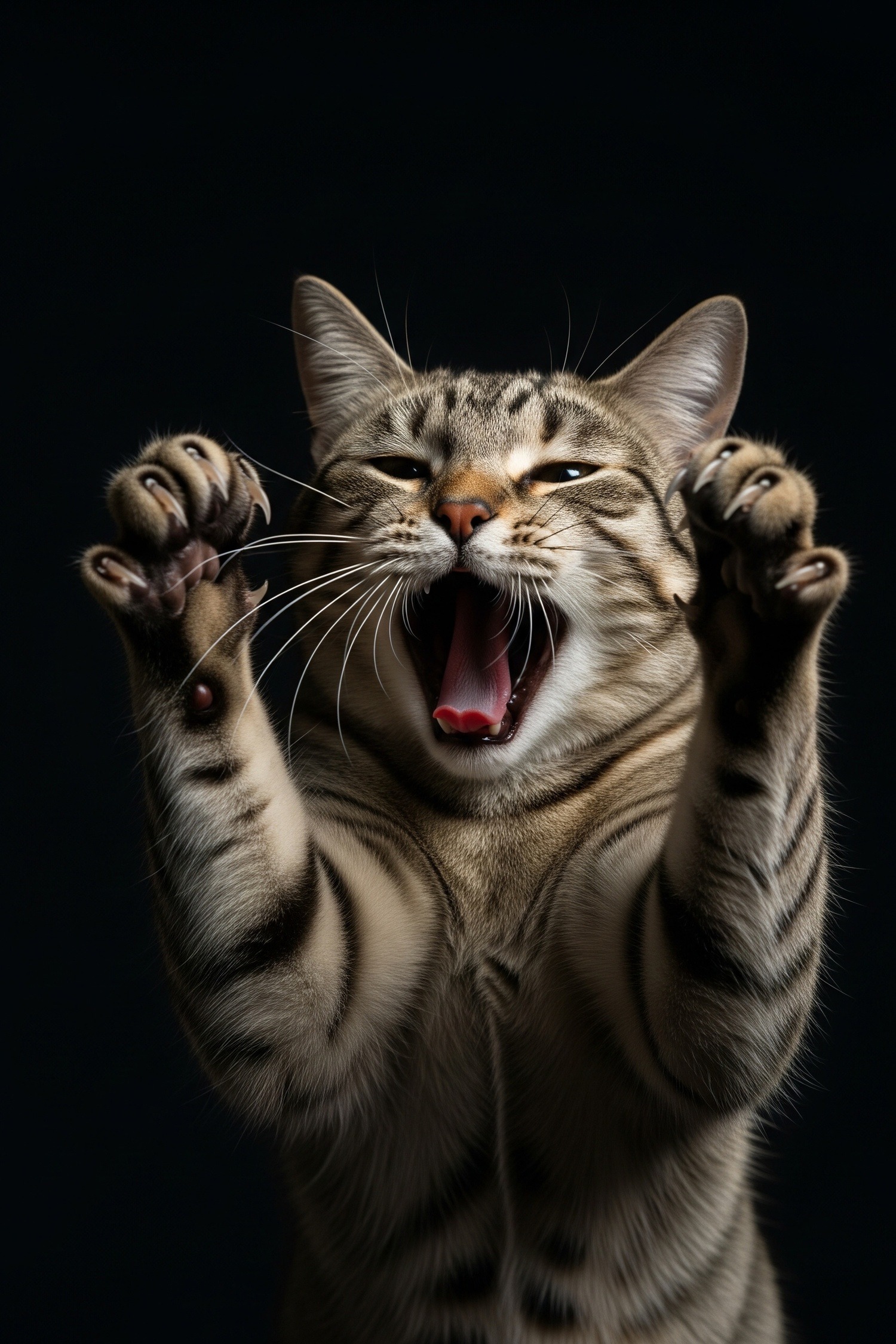
The reset behind why cats stretch when they wake up
The word comes from the Latin pandiculari, to stretch oneself. Giovanni De Sanctis, an early researcher on yawning and stretching, helped formalize the concept in the late nineteenth century, and the term has anchored neurological study ever since. When muscles stay still for hours, the nervous system loses track of them. Tension builds unevenly across the body. Signals between muscle and brain grow fuzzy. Pandiculation is the hard reset, a slow, deliberate contraction followed by a controlled release that flushes that static and snaps muscle tone back almost instantly. You can read more about the mechanics of the stretch reflex and how it keeps the body’s feedback loops calibrated.
Here’s the thing most people miss. A stretch isn’t just lengthening a muscle. It’s the brain re-reading the body, like a system rebooting its sensors. The contraction tightens the muscle spindles, the tiny stretch detectors woven through every fiber, and the release lets them resettle at the correct baseline. The result is restored proprioception, the silent sense that tells an animal where its limbs are in space without looking.
It’s maintenance, performed automatically, the moment sleep ends. And it has to be automatic, because an animal can’t afford to consciously inventory every muscle each time it wakes. The reflex does the audit in the background, faster and more thoroughly than any deliberate movement could, which is why it fires before the brain is even fully alert.
Why does your cat do it so dramatically?
Cats are athletes built around explosive movement, so a sloppy body map is dangerous for them in a way it isn’t for slower animals. A house cat sleeps twelve to sixteen hours a day, often in tight, curled positions that leave muscles cold and signals dulled. The full-body pandiculation, spine bowing, forelegs reaching, claws fanning, yawn splitting the face, recalibrates the whole system at once before the cat moves a single deliberate step. Our deeper look at the hidden logic behind everyday animal behaviors traces how many of these “cute” habits are precision tools in disguise.
The mechanism is elegant. As the cat arches, blood flow surges back into muscle tissue that had gone sluggish during sleep. The yawn pulls a fast slug of oxygen into the brain. Within two or three seconds, the animal goes from groggy to ready. For a predator that may need to launch into a hunt at any moment, that speed isn’t optional. It’s survival timing measured in heartbeats.
What looks like a leisurely stretch is a diagnostic check, run at speed.
Do wild predators stretch the same way?
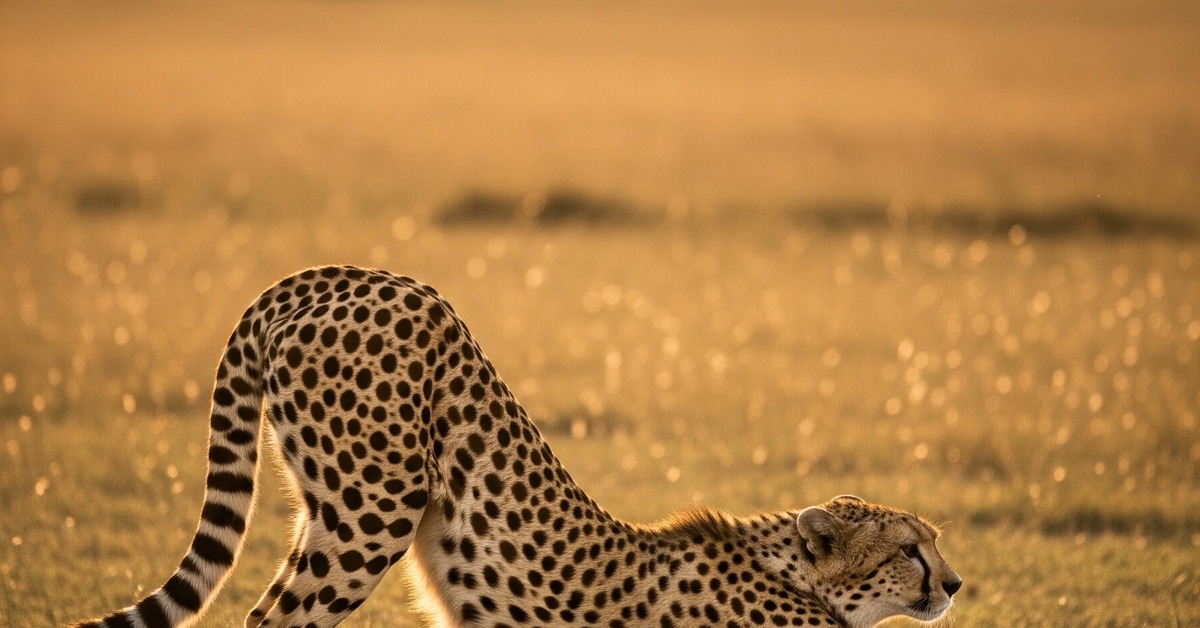
They do, and the stakes are higher. Research into big-cat locomotion, including work associated with the National Geographic cheetah studies, has documented that apex predators pandiculate almost immediately after waking. A cheetah, built to accelerate from 0 to 112 km/h in under three seconds, cannot afford to sprint on a body whose sensors are still half asleep. So before the chase, before even the stalk, comes the stretch, every time, without exception.
The cause-and-effect chain is brutal in its clarity. A misfiring muscle at full sprint means a torn hamstring, a missed kill, and in the long run a starving cat. Pandiculation is the cheetah’s pre-flight check, the equivalent of a pilot running instruments before takeoff. Lionesses rising from a six-hour midday rest on the Serengeti do exactly the same thing before an evening hunt, arching and reaching in the gold light before they take a single hunting step.
The mundane and the magnificent share the same wiring.
How old is the cat stretching pandiculation reflex?
This is where the behavior turns genuinely strange. Human fetuses pandiculate in the womb, arching and yawning months before birth, documented in ultrasound studies at institutions including the University of Parma. They’ve learned nothing about the world. They’ve never moved against gravity. Yet the reflex is already running, which tells researchers it isn’t taught. It’s inherited, written into the deep architecture of the vertebrate nervous system across hundreds of millions of years of evolution.
The implication is humbling. Your tabby on the sofa, the lioness on the plain, and a human infant before its first breath are all performing the same ancient routine, controlled by some of the oldest circuitry in the brainstem. Cause and effect span the entire vertebrate lineage: a behavior this conserved, this universal, this early-appearing, survived because the cost of an uncalibrated body was simply too high to risk. Evolution kept it because it works too well to abandon.
One stretch, encoded across the whole family of backboned life.
What else hides inside this everyday reflex?
Pandiculation sits at a peculiar crossroads of sleep, movement, and the nervous system, which is exactly why it still puzzles researchers. It almost always pairs with a yawn, and the two seem neurologically linked, yet the precise reason they travel together remains unsettled. Some scientists at clinical movement labs now study pandiculation as a possible therapy, using deliberate, slow contraction-and-release sequences to treat chronic muscle tension and restore proprioception in people who’ve lost it to injury or disease.
If that work pans out, a behavior we dismiss as a cat being adorable could quietly inform physical rehabilitation for humans. That’s the pattern with deep reflexes: the older and weirder they are, the more likely they’re solving a problem we haven’t fully named. The waking stretch has been refined for hundreds of millions of years. We’re only beginning to read the instructions it’s been following all along.
Turns out the simplest thing your cat does may be the smartest.
Where to See This
- Anywhere a cat sleeps: watch for the full arch within seconds of waking, especially after a long, curled nap in a warm spot.
- The Cheetah Conservation Fund in Namibia and big-cat reserves across East Africa, where predators visibly pandiculate before evening hunts.
- Try it yourself on waking, a slow, deliberate full-body stretch with a yawn, and notice how fast your sense of balance and coordination sharpens.
Field Notes
- Pandiculation almost always comes paired with a yawn, and the two appear neurologically linked, though researchers still debate exactly why they travel together.
- Dogs, horses, birds, and even reptiles perform versions of the waking stretch, making it one of the most widely shared behaviors among land vertebrates.
- Ultrasound studies have captured human fetuses pandiculating in the womb, proof the reflex is inherited rather than learned.
- Scientists still can’t fully explain why a single contraction-release cycle restores proprioception so quickly. The speed of the reset outpaces current models of muscle physiology.
By the Numbers
- 12 to 16 hours: how long a domestic cat sleeps in a typical day.
- Under 3 seconds: the time a cheetah needs to reach 112 km/h, the reason it can’t sprint cold.
- Hundreds of millions of years: the evolutionary depth of the pandiculation reflex across vertebrates.
- Before birth: the developmental stage at which human fetuses already pandiculate.
- 2 to 3 seconds: roughly how long a full waking stretch takes to recalibrate muscle tone.
Frequently Asked Questions
Q: Why do cats stretch when they wake up?
Cats stretch on waking because of pandiculation, an involuntary reflex that resets muscle tone after hours of stillness. During sleep, the nervous system loses precise track of the muscles, and tension builds unevenly. The deliberate contraction and release of a full stretch flushes that buildup and restores accurate signals between muscle and brain within two or three seconds. For a predator that may need to move instantly, this fast recalibration is essential rather than optional.
Q: Is cat stretching pandiculation the same as human stretching?
Largely, yes. The cat stretching pandiculation reflex is the same neurological routine humans perform when we stretch and yawn on waking. Both involve a controlled muscle contraction followed by release, paired with a yawn, and both restore proprioception, the body’s sense of its own position. Human fetuses do it in the womb before birth. The reflex is shared across nearly all land vertebrates, which is why your stretch and your cat’s look so alike.
Q: Should I be worried if my cat stretches a lot?
Frequent stretching is normal and healthy. Cats pandiculate after almost every nap, and since they sleep up to sixteen hours a day, that adds up to many stretches. The behavior signals a functioning nervous system keeping muscle tone calibrated. You should only be concerned if a cat seems unable to stretch, stretches with obvious pain or stiffness, or suddenly stops the behavior entirely, which can hint at joint problems or injury worth a vet’s attention.
Q: Do all animals pandiculate, or just cats?
Nearly all land vertebrates pandiculate, not just cats. Dogs, horses, big cats, birds, and even some reptiles perform versions of the waking stretch. The reflex appears so consistently across the vertebrate family that biologists consider it one of the oldest shared behaviors, likely conserved for hundreds of millions of years. Its appearance in unborn animals confirms it is hardwired into the deep architecture of the nervous system rather than something each species learns separately.
Editor’s Take — Sarah Blake
We hand out a lot of adjectives to cats, lazy chief among them, and almost all of them are wrong. The waking stretch isn’t indolence, it’s the oldest maintenance routine in nature running on schedule. What gets me is the company it keeps: a sofa tabby and an unborn child performing the identical reflex, separated by millions of years and a species barrier, both obeying the same ancient circuit. The cat isn’t being slow. It’s being precise.
Next time your cat unfurls into that long, shameless stretch, picture the lineage behind it, a lioness on the Serengeti, a cheetah braced before the sprint, a human infant arching in the dark before its first breath. The same reflex, the same circuit, fired across the whole sprawling family of backboned life. What else are we doing every single day, half-asleep and unthinking, that turns out to be far older and stranger than we ever imagined?
Illustrations are AI-generated. Article fact-checked and human-edited.