Child and Canid Footprints in Chauvet Cave, France
The child and canid footprints in Chauvet Cave tell a story no painting could. About 26,000 years ago, a small human walked into the dark. Beside those little prints run the tracks of a large canid. Same direction. Same pace. Two creatures, moving together.
The cave sits in the limestone gorges of the Ardeche region of southern France, sealed for tens of thousands of years by a rockfall. When it reopened, researchers found walls covered in lions and rhinoceroses. But on the floor, almost overlooked, lay something stranger: a trail of footprints. Who walked here, and what walked beside them?
Key Facts
- The child’s footprints measure roughly the size of a modern eight-to-ten-year-old, pressed into soft clay sediment.
- Charcoal from the cave’s paintings has been radiocarbon-dated to around 36,000 years ago, among the oldest known art on Earth.
- The footprint trail itself is dated to roughly 26,000 years before present.
- Chauvet Cave was discovered on 18 December 1994 by three French cavers in the Ardeche.
- The site joined the UNESCO World Heritage List in 2014 as the Decorated Cave of Pont d’Arc.
In short: The child and canid footprints in Chauvet Cave preserve a moment from about 26,000 years ago, when a young human walked deep into a painted cave alongside a large canid. The matched strides hint at trust between species, but researchers still debate whether the animal was a wolf or one of the earliest dogs.
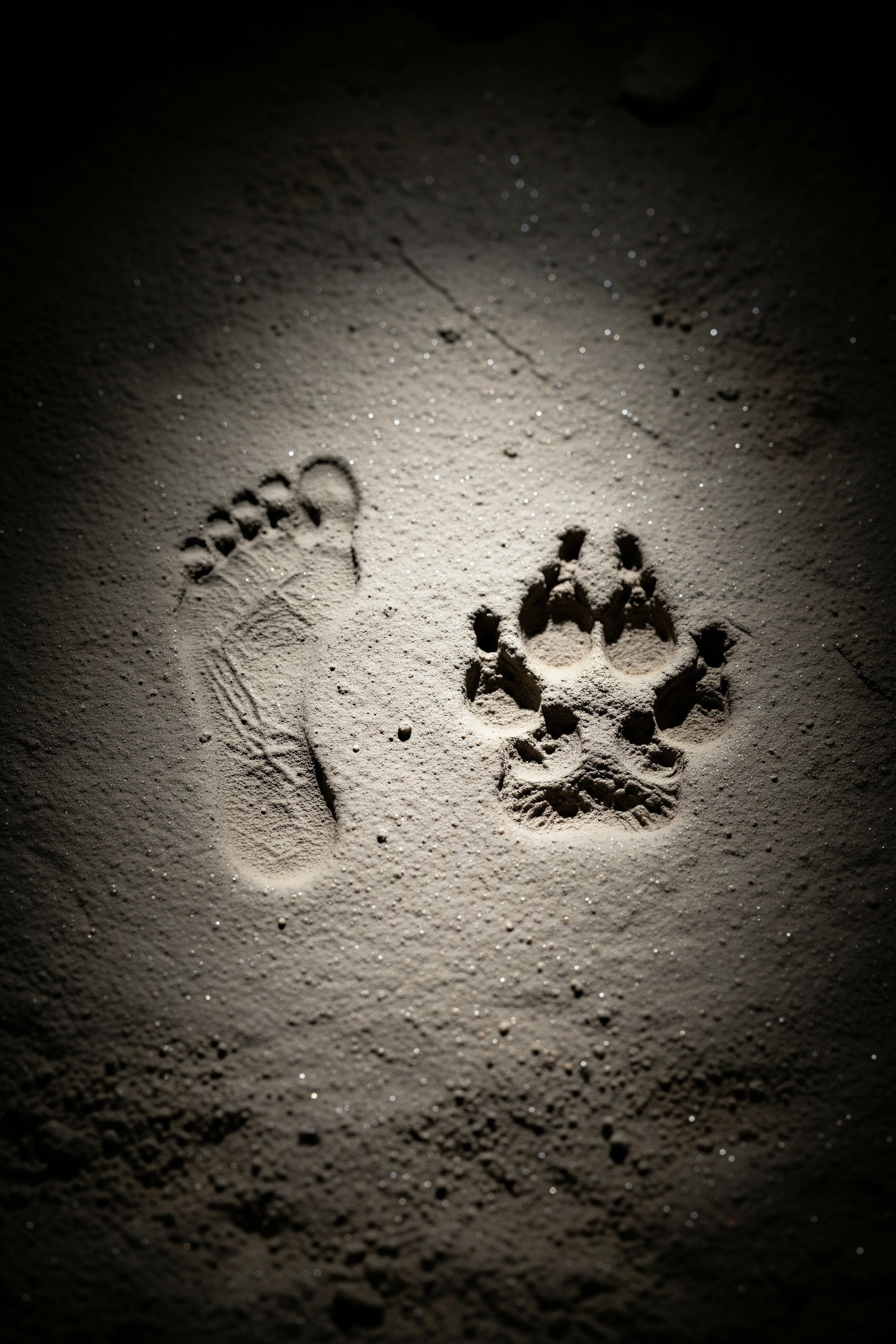
What do the child and canid footprints in Chauvet Cave show?
The trail was first described in detail by the French prehistorian Michel-Alain Garcia, who studied the cave floors in the late 1990s. A single line of small footprints crosses roughly fifty meters of the so-called Gallery of the Crosshatching, one of the deeper chambers. The prints belong to a child, judging by their length and the soft, rounded heel impressions. What caught Garcia’s attention was not the human alone. Running alongside the human tracks, in places almost overlapping them, are the paw prints of a sizeable canid, an animal somewhere between a large wolf and a substantial dog. The two trails do not cross at random. They follow the same path through the dark.
That alignment is the heart of the mystery. When two sets of tracks share a route across fifty meters of uneven cave floor, coincidence becomes hard to defend. The child wasn’t fleeing the animal, and the animal wasn’t stalking the child, or the prints would scatter and overlap differently. Instead they read like company. Here’s the thing about footprints: they record behavior the bones never can.
One detail unsettled the researchers most. In several stretches, the stride lengths fall into rhythm. The child and the canid were keeping pace.
Walking together through the painted dark
Picture the scene as it would have unfolded. The chambers are pitch black, far beyond any reach of daylight. The only light is a torch, probably burning pine resin, throwing orange flicker across the walls. We know torches were used because charcoal smears and scuff marks survive on the rock. The child moves slowly, the way anyone moves carrying fire through unfamiliar dark. The canid moves with them. If you want a sense of how deeply art and animals were entangled in this world, the broader story of humanity’s earliest creative life runs straight through caves like this one.
The torch matters for dating, too. At one point along the trail, the child appears to have stopped and wiped the torch against the cave wall, leaving a charcoal mark that researchers later sampled. That single gesture, frozen for 26 millennia, helped tie the footprints to a moment in deep time. The mechanism is simple: burnt wood holds radiocarbon, and radiocarbon decays at a known rate.
So we have a child, a flame, and an animal at its side. Whatever else this was, it wasn’t fear.
Wolf, or one of the first dogs?
This is where the footprints collide with one of the largest questions in human prehistory: when did we first bring wolves close? The fossil record is genuinely murky here. A famous jawbone from Goyet Cave in Belgium, studied by paleontologist Mietje Germonpre in 2009, has been dated to roughly 36,000 years ago and interpreted by some as an early domesticated dog, though the claim remains contested. As research summarized by the Smithsonian makes plain, the line between late Pleistocene wolves and the earliest dogs is genuinely blurry, partly because behavioral change ran ahead of any visible shift in the skeleton. You can read more about the deep timeline of the origin of the domestic dog and just how unsettled it still is.
The Chauvet Cave footprints can’t settle the debate, and honest researchers admit it. A paw print preserves shape, gait, and rough size, but not genetics. The animal could have been a tamed wolf, a half-domesticated camp follower, or a true early dog. What the prints do show is association, the one thing genetics alone can’t capture. Behavior leaves its own fossils, and this one is walking.
Some specialists urge caution, noting the two trails may not be perfectly contemporaneous, that one could predate the other by hours or years. That skepticism is fair. It also doesn’t erase how striking the overlap is.
Why these Chauvet Cave footprints matter more than the art
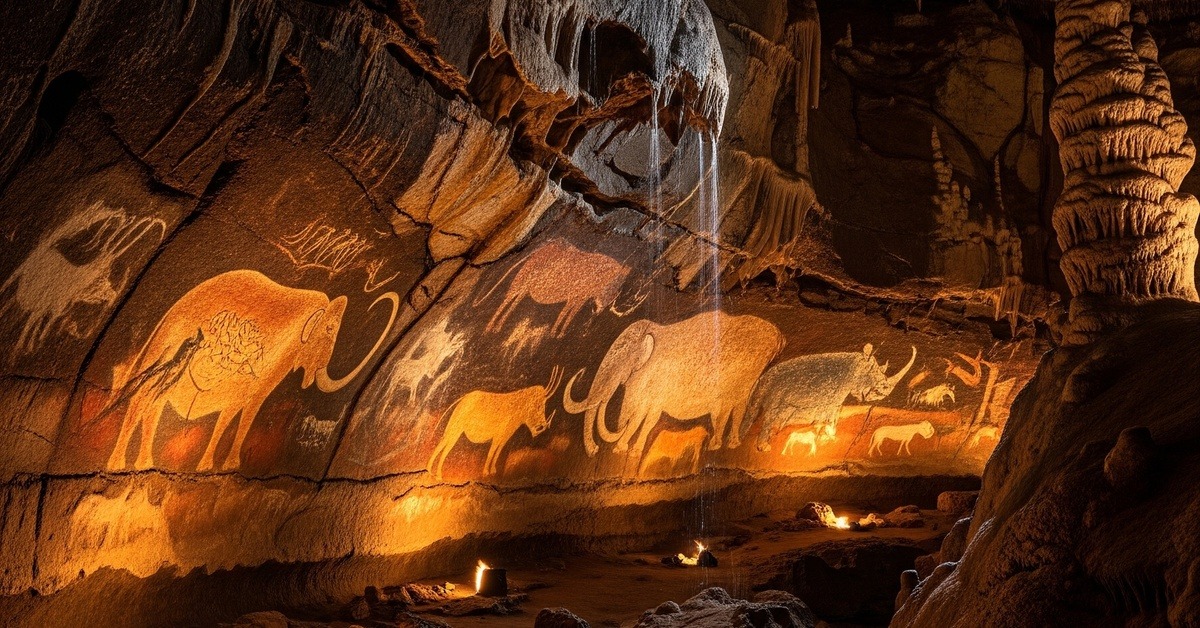
Chauvet’s paintings are rightly famous. The lions, the rhinoceroses, the herd of horses with their overlapping heads, all rendered by the Aurignacian people with a confidence that startled the archaeologists who first crawled in. The art was studied intensively after the cave’s 1994 discovery, and a full replica, the Caverne du Pont-d’Arc, opened to the public in 2015 so visitors could see it without harming the original. But paintings are symbols. They are filtered through intention and style.
Footprints are not. They are the raw, accidental residue of a single afternoon, or night, that no one meant to preserve. Where the lions on the wall tell us what these people thought about, the prints on the floor tell us what they did. A child carried fire into the deepest dark of the earth. Something with four legs and a tail chose to come along.
Researchers continue to map and protect the floor surfaces, treating them as carefully as the paintings above. Every step a modern visitor avoids is a step that survives.
Footprints are rewriting prehistory across the world
Chauvet isn’t alone. Across the last two decades, ancient footprints have quietly become one of archaeology’s richest new sources, precisely because they capture behavior rather than artifacts. At White Sands National Park in New Mexico, fossilized human tracks dated by the U.S. Geological Survey to roughly 21,000 to 23,000 years ago pushed back the timeline for people in the Americas by thousands of years, sparking a debate that still rages. In Britain, the footprints at Happisburgh, recorded in 2013, preserved a family group walking a mudflat nearly 900,000 years ago. Each site tells you not what people made, but what they did, and that turns out to be the harder, rarer record to recover.
The Chauvet trail belongs to that lineage, and it adds the one thing those other sites lack: another species, keeping pace. The mechanism that preserves all of them is the same. A soft, wet surface takes an impression, then dries, hardens, and gets sealed under sediment before anything can scuff it away. Caves are ideal because the air stays still and cool for tens of thousands of years. That a child’s careless afternoon and an animal’s choice to follow could survive that long, intact, is close to a statistical miracle.
Which is why specialists treat every newly found trackway as a chance to watch the past move, not just to read it.
How It Unfolded
- c. 36,000 years ago — Aurignacian artists paint the lions, mammoths, and rhinoceroses on the cave walls.
- c. 26,000 years ago — a child and a canid walk the deep galleries together, leaving paired footprints.
- 1994 — three French cavers rediscover the sealed cave in the Ardeche on 18 December.
- 2014 — UNESCO inscribes Chauvet as a World Heritage Site; a public replica opens the following year.
By the Numbers
- ~26,000 years — age of the child-and-canid footprint trail.
- ~50 meters — length of the shared trackway through the gallery.
- ~36,000 years — radiocarbon age of the oldest charcoal paintings.
- Nearly 15,000 years — gap by which Chauvet’s art predates the paintings at Lascaux.
- 1,000+ — number of painted and engraved figures catalogued in the cave.
Field Notes
- The child apparently paused to wipe a torch on the wall, leaving a charcoal smear that became a datable clock for the whole trail.
- Cave floors preserve tracks because the sediment stays cool, damp, and undisturbed for millennia once a cave is sealed.
- Chauvet’s art was made nearly 15,000 years before Lascaux, collapsing the old idea that cave art grew gradually more sophisticated over time.
- Researchers still can’t say whether the canid was wild, tamed, or an early dog, and a single paw print may never answer it.
Frequently Asked Questions
Q: How old are the child and canid footprints in Chauvet Cave?
The footprint trail dates to roughly 26,000 years ago, placing it firmly in the Upper Paleolithic. That age comes partly from charcoal the child left on the wall when wiping a torch, which researchers radiocarbon-dated. The cave’s paintings are older still, around 36,000 years. So the child walked in long after the great lions and rhinoceroses had already been painted in the dark.
Q: Was the animal beside the child a dog or a wolf?
Nobody can say for certain. The paw prints belong to a large canid, the size of a wolf or a substantial dog, but a footprint records shape and gait, not DNA. Dog domestication likely began somewhere between 20,000 and 40,000 years ago, a window this trail sits inside. The animal may have been a wild wolf, a tamed companion, or one of the earliest true dogs. The evidence simply runs out there.
Q: Why do the Chauvet Cave footprints matter if the art is more famous?
Paintings are deliberate symbols, shaped by style and meaning. Footprints are accidental, the unedited record of real movement on a single occasion. They capture behavior the art and bones cannot: a child and an animal choosing to travel together through total darkness. That kind of direct evidence of a relationship between species is extraordinarily rare in the prehistoric record, which is why specialists treat the cave floor as carefully as the walls.
Q: Can the public visit Chauvet Cave?
Not the original. Chauvet is sealed to protect both the fragile paintings and the floor surfaces, with access limited to a small number of researchers each year. In 2015 France opened a full-scale replica, the Caverne du Pont-d’Arc, near the original site. It reproduces the chambers, the art, and the atmosphere closely enough that visitors can experience the cave without ever endangering the real one.
Editor’s Take — Sarah Blake
We keep asking when wolves became dogs as if a single moment will pop out of the bones. It won’t. But here, in the clay, is the thing the bones can’t give us: a child small enough to fear the dark, walking it anyway, with a four-legged shape keeping step. The relationship came first. The skeletons caught up later. The floor of Chauvet may be the oldest portrait of trust between two species we will ever find.
Bones tell us what an animal was. Footprints tell us what it chose to do. Somewhere in the cold dark of a French gorge, 26,000 years before anyone wrote a word, a small human and a large canid walked the same line through chambers full of painted lions, and neither one turned back. We will never know their names. We know their stride. What else, in all that darkness, did they decide to share?
Illustrations are AI-generated. Article fact-checked and human-edited.