Ancient Roman Technology: 7 Engineering Marvels That Still Work
Ancient Roman technology is the reason a 2,000-year-old harbour wall in the Bay of Naples is still standing in saltwater that eats modern concrete in fifty years — and the reason a stone aqueduct in southern France drops just 7 millimetres in every 100 metres of its winding course, an accuracy that would impress a modern civil engineer with a laser level. Rome’s genius was never a single invention. It was the systematic, empire-wide application of a handful of breakthroughs — concrete, the arch, surveying, water management, and standardised logistics — to problems no earlier civilisation had thought to solve at scale.
Key Facts
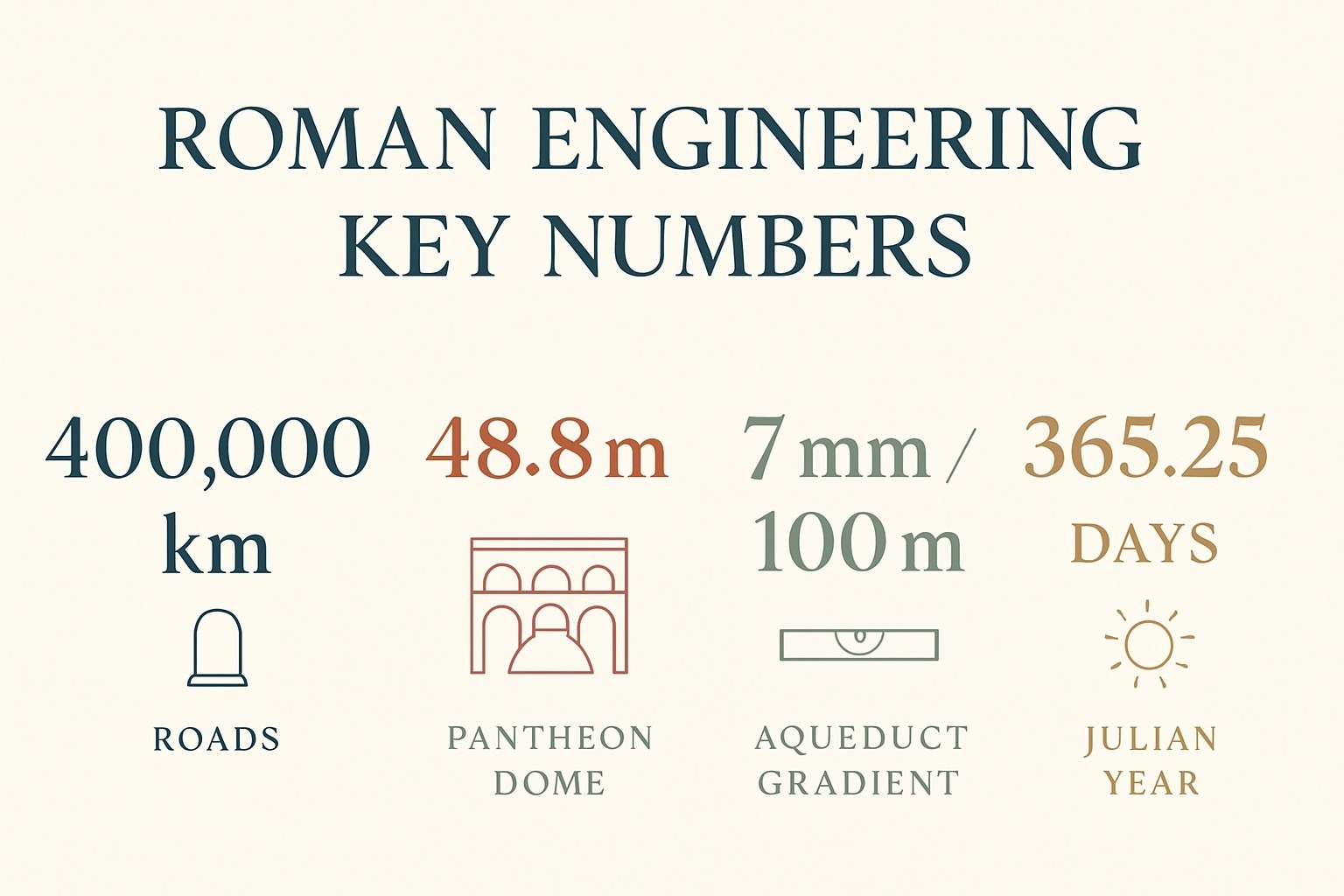
- At its 2nd-century peak, the Roman road network ran roughly 400,000 km in total, with about 80,500 km of paved viae publicae — enough paved highway to circle the equator twice.
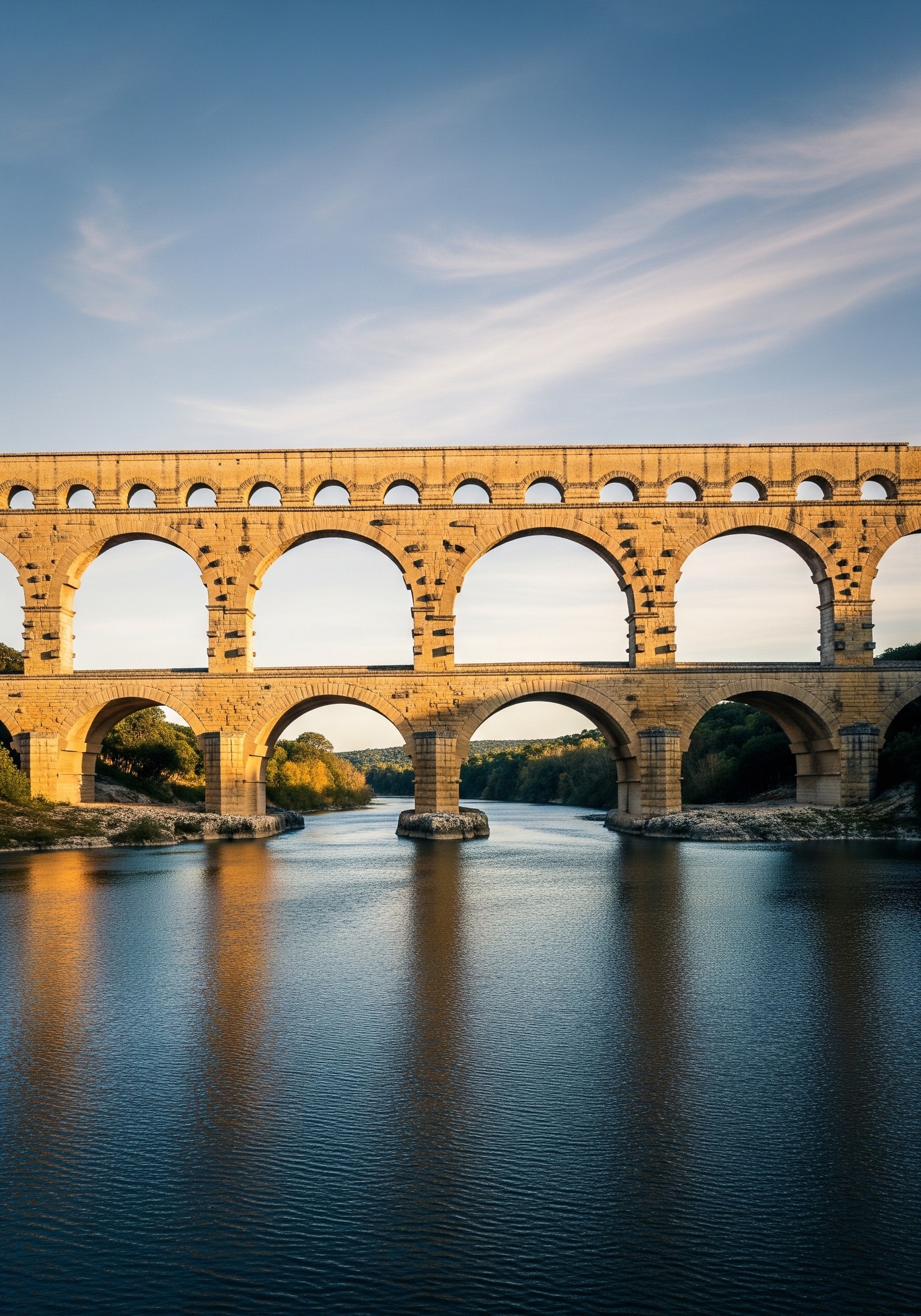
- The Pont du Gard aqueduct bridge in southern France stands 48.8 m high and was part of a 50 km conduit that delivered an estimated 40,000 m³ of water per day to the city of Nemausus (Nîmes).
- Roman concrete (opus caementicium) was made with volcanic ash from Pozzuoli, lime and seawater — a chemistry that produces aluminous tobermorite crystals which actually grow stronger over centuries in marine environments.
- A 2023 MIT-led study identified “lime clasts” formed by hot mixing as the source of Roman concrete’s famous self-healing ability: when water enters a crack, the clast dissolves and reprecipitates calcium carbonate, sealing the gap.
- The Julian calendar, introduced by Julius Caesar in 46 BC, defined a 365.25-day year with a leap day every four years — and governed Europe for more than 1,600 years until the 1582 Gregorian reform.
In short: Roman engineers did not invent the arch, the dome, the water mill or the road, but they were the first to industrialise them — turning local tricks into a continent-wide infrastructure system that fed cities of a million people. Many of their methods were so good that, when Rome fell, parts of them were not equalled again for a thousand years.
Key Facts
- At its 2nd-century peak the Roman road network ran roughly 400,000 km in total, with about 80,500 km of paved viae publicae.
- The Pont du Gard aqueduct bridge in southern France stands 48.8 metres high and was part of a 50 km conduit delivering an estimated 40,000 cubic metres of water per day to Nîmes.
- Roman concrete (opus caementicium) was made with volcanic ash from Pozzuoli, lime and seawater, producing aluminous tobermorite crystals that grow stronger over centuries in marine environments.
- A 2023 MIT-led study identified ‘lime clasts’ formed by hot mixing as the source of Roman concrete’s self-healing ability.
- The Julian calendar, introduced by Julius Caesar in 46 BC, defined a 365.25-day year with a leap day every four years and governed Europe for more than 1,600 years until the 1582 Gregorian reform.
In short: Roman engineers rarely invented their core technologies but were the first to industrialise them, turning concrete, the arch, surveying and water management into a continent-wide infrastructure system. Many methods were so good that after Rome fell, parts of them were not equalled again for a thousand years.
The Engineering Empire: Why Ancient Roman Technology Outclassed Its Rivals
The Greeks had philosophy. The Egyptians had monumental stone. The Persians had administration. Rome had something less glamorous and far more powerful: a culture of useful engineering. Roman thinkers rarely chased pure mathematics or natural philosophy with the obsession of an Archimedes; instead they asked, over and over, the same blunt question — how do we move this army, this water, this grain, this stone, faster and at lower cost? The result was a civilisation in which standardised techniques travelled along with the legions, and the same kind of arch, the same kind of concrete vault, the same brick stamp could appear in Britain, North Africa and Syria within a generation.
Crucially, Roman engineering was built around four force-multipliers that compounded each other: a strong, plastic building material (concrete), a geometric form that channelled compression beautifully (the arch and its descendants the vault and dome), a precise surveying toolkit (the groma, chorobates and dioptra), and a logistical empire that could move skilled crews and standardised materials anywhere. None of those pieces alone was unique. Their combination was.
Roman Concrete: The Material That Outlived Empires
If you had to name the single most important entry in any list of ancient Roman technology inventions, it would be opus caementicium — Roman concrete. Around the 3rd century BC, builders along the Bay of Naples noticed that mixing the local volcanic ash from Pozzuoli (which is why we still call it “pozzolana”) with lime and water produced a paste that hardened into a stone-like mass — and, astonishingly, kept hardening underwater. By the time the Pantheon’s vast 43.3 m unreinforced concrete dome was poured around 126 AD under Hadrian, the Romans had been refining the recipe for four hundred years.
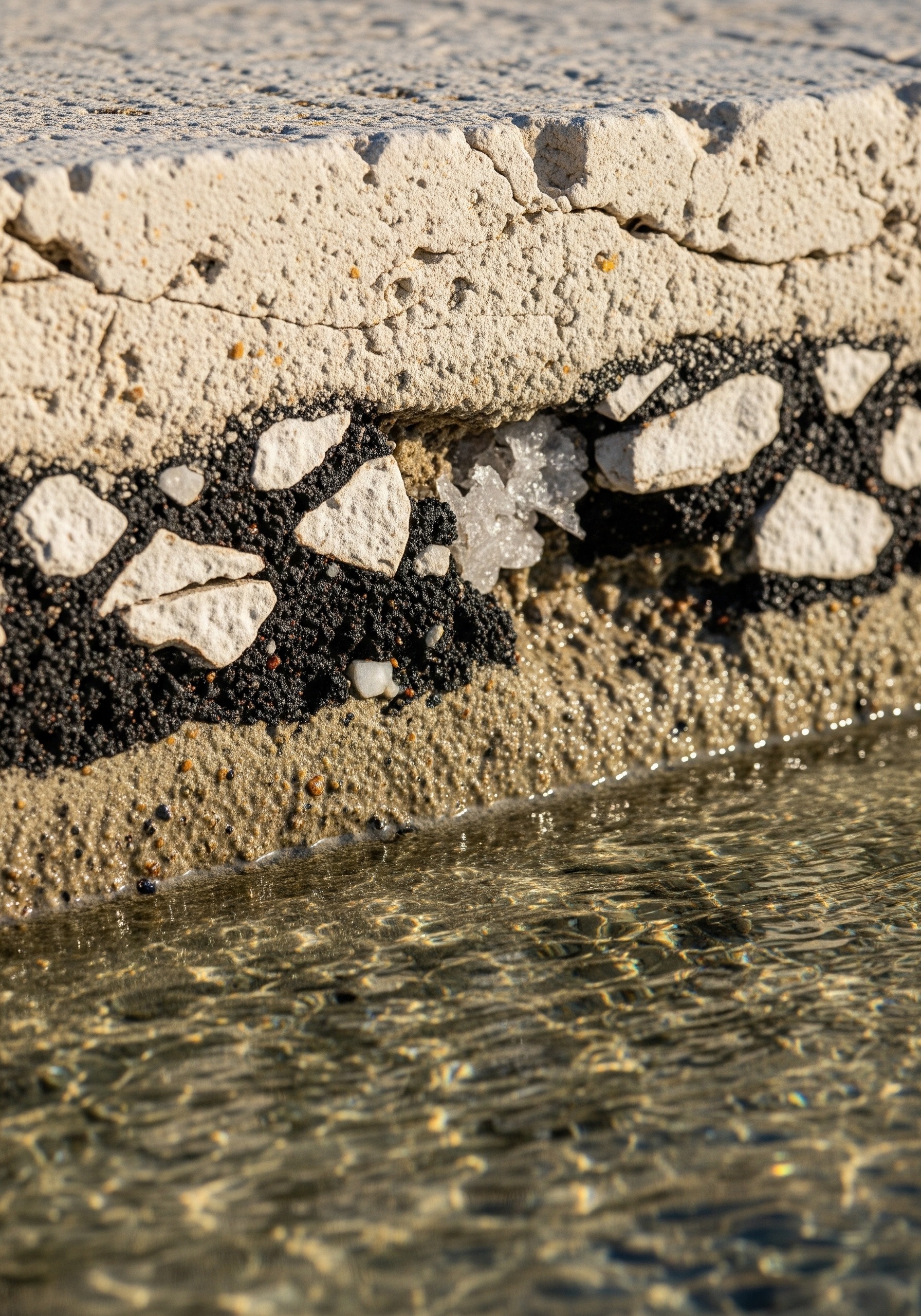
Two features made the material exceptional. First, the pozzolanic reaction: silica and alumina in the volcanic ash combine with calcium hydroxide from the lime to form calcium-aluminate-silicate-hydrate gels that lock the aggregate together with a chemistry very different from modern Portland cement. Second, and only properly understood in the last decade, comes a remarkable self-repair mechanism. In a 2023 study led by MIT’s Admir Masic, researchers showed that Roman builders almost certainly used “hot mixing” with quicklime instead of slaked lime, producing tiny calcium-rich nodules called lime clasts embedded throughout the concrete. When a crack forms and water seeps in, the clast dissolves, the calcium reprecipitates as calcium carbonate inside the crack, and the gap heals itself.
{IMAGE_2}
The marine application is even more remarkable. At Caesarea Maritima in modern Israel, and in the harbour piers around Naples, Roman engineers built breakwaters by lowering wooden forms onto the seabed and pouring concrete directly into seawater. Modern marine concrete corrodes within decades; the Roman version actually grew stronger, because seawater percolating through the matrix nucleated a rare and very stable mineral called aluminous tobermorite, plus phillipsite. Twenty-one centuries of Mediterranean storms have not yet broken them.
Roman Engineering by the Numbers
- 50,000 mi (≈80,500 km) — paved Roman public highways (viae publicae) at peak.
- ~400,000 km — total road network including secondary and military roads.
- 11 aqueducts served Rome itself, delivering an estimated 1 million m³ of water per day to the city.
- 48.8 m — height of the Pont du Gard’s three-tier arched aqueduct bridge over the Gardon river.
- 1 in 3,000 — average gradient of the Nîmes aqueduct; only ~7 mm fall per 100 m in its trickiest section.
- 43.3 m — internal diameter of the Pantheon’s unreinforced concrete dome (still the largest in the world).
- 365.25 days — length of the Julian calendar year, in force from 46 BC until 1582 AD.
Aqueducts: Moving Mountains of Water
Roman aqueducts are the most visible monument to ancient rome technology and innovations, and they were also the most demanding to design. The challenge sounds simple: bring spring water from upland sources to a coastal city. The reality required engineers to maintain a continuous downhill gradient — sometimes only a few millimetres of drop per metre — over distances of fifty, eighty, even a hundred kilometres, through mountains and across valleys, without ever letting the water go uphill.
The aqueduct of Nemausus (modern Nîmes) is the textbook case. Its source spring lies just 17 km from the city in a straight line, but to keep the water flowing downhill the engineers ran the channel 50 km along the contours of the hills, with an average gradient of about 1 in 3,000. In one stretch between the Pont du Gard and St Bonnet, the conduit drops just 7 millimetres every 100 metres, a tolerance equivalent to roughly 1 part in 14,000 — and they achieved this with the chorobates, a water-levelled wooden frame, and the dioptra, a sighting instrument with a graduated horizontal disc. When a valley was too deep to bridge, they used inverted siphons, sending pressurised water down one hillside through lead or stone pipes and up the other.
The most famous surviving aqueduct bridge, the Pont du Gard, stands 48.8 m tall in three superimposed tiers of arches and is built almost entirely without mortar — the stones, some weighing six tonnes, were precision-cut to lock together by gravity alone. The whole 50 km system is estimated to have delivered around 40,000 cubic metres of water per day, supplying fountains, baths and private homes.
The Roman Road Network: 400,000 km of Logistics
“All roads lead to Rome” is not quite a metaphor: it is a description of the imperial road network as it stood around 200 AD. Surveyors began with a groma — a vertical staff carrying a horizontal cross with plumb bobs — and laid out the road in dead-straight segments wherever the terrain allowed. The construction method itself was a layered system that any modern road engineer would recognise: a trench was dug, then filled with progressively finer materials. A statumen of large stones at the bottom; a rudus of broken stone bound with lime; a nucleus of finer concrete or gravel; and at the top, the summum dorsum of fitted paving stones, slightly crowned at the centre so rainwater drained off into side ditches.
The scale was staggering. Modern estimates put the network at roughly 80,500 km of paved viae publicae and around 400,000 km of total road, secondary tracks included. The cursus publicus, an imperial courier system established by Augustus, used relay stations spaced every 12 to 18 km and could move an official message across the empire — say from Rome to London — in roughly two weeks. Many sections were still in active use 1,500 years later; some, like parts of the Via Appia, you can walk on today.
Cities of Steam: Hypocausts, Sewers and Public Baths
Urban Romans expected things that medieval Europeans largely did without: piped water on demand, public toilets, heated floors, daily hot baths. The hypocaust, perfected in the 1st century BC, was the world’s first widespread central heating system. A small furnace (praefurnium) at one end of a building burned wood or charcoal; the hot exhaust gases flowed through a raised floor supported by stacks of brick or stone pillars (pilae) about 60 cm high, and from there up through hollow wall tiles (tubuli) that radiated heat into the rooms above. In the bath complexes, the same system pre-heated water in stacked bronze boilers.
Beneath the streets, the Cloaca Maxima — originally an open Etruscan drainage channel from the 6th century BC, later vaulted and extended — carried storm water and sewage from the Forum into the Tiber. Constant fresh water from the aqueducts flushed the public latrines, where rows of stone seats over a flowing channel turned waste removal into a routine of daily life. The combined plumbing-and-sanitation package was so far ahead of its time that comparable urban sewerage did not return to most European cities until the 19th century.
The Force Multipliers: Cranes, Water Mills and Surgical Tools
Behind the famous monuments stood a quieter family of ancient roman technology inventions that made everything else possible. The Roman treadwheel crane, the polyspaston, used a four-pulley block and a human-powered drum to give a single labourer a mechanical advantage of roughly 60 to 1; with five workers, one machine could lift around 3 tonnes — heavier than most modern construction cranes managed before the steam age. Without it, the Pantheon and Trajan’s Column would have been impossible.
The Barbegal mill complex in southern Gaul, built around 100 AD, ran 16 overshot water wheels arranged in two parallel cascades, grinding an estimated 4.5 tonnes of flour per day — enough to feed a city of 12,000 people. It is the largest known industrial complex of the ancient world. Meanwhile, in the back rooms of medical practitioners, surgeons used bronze and steel instruments — scalpels, forceps, bone drills, vaginal specula, cataract needles — whose shapes are so close to modern equivalents that a 21st-century surgeon could pick them up and use them. The military physician Galen, working in the 2nd century AD, codified anatomical and pharmacological knowledge that dominated Western medicine for the next 1,300 years.
Two more entries deserve a line. The Julian calendar (46 BC) imposed a 365.25-day year on the chaos of older lunar reckonings and governed European time until 1582. And Roman glass — especially the clear cast-glass window panes of the 1st century AD — gave wealthy houses something the Greeks never had: rooms that were warm and bright.
Knowledge That Vanished — and What Took 1,000 Years to Return
The most uncomfortable fact about ancient Roman technology is how much of it was simply forgotten. After the Western Empire collapsed in 476 AD, the network that distributed Roman techniques fragmented. Within a few generations, large parts of Europe could no longer build a stone-vaulted bath, lay a proper road, or pour structural concrete. The exact recipe for hydraulic roman concrete with pozzolana was lost. It would not be rediscovered until John Smeaton’s experiments on the Eddystone Lighthouse in the 1750s, almost 1,300 years later. Central heating on the scale of a hypocaust did not return until Victorian engineering. Functional urban sewerage on the Roman model waited for Bazalgette’s London in the 1860s. Concrete domes did not exceed the size of the Pantheon until the construction of Florence’s brick-and-mortar duomo in 1436 — and an unreinforced concrete dome of its scale has never been built since.
It is a sobering reminder that civilisations do not necessarily ratchet forward in a straight line. Rome’s edge was not so much its individual inventions — many were Greek or Etruscan in origin — as the organisational machine that mass-produced them. When the machine broke, the inventions broke with it. For deeper reading on this cluster of subjects, see our companion pieces on how the Pantheon’s dome was actually built, the Greek inventions Rome inherited and scaled, and a closer look at the Cloaca Maxima and Roman urban sanitation.
Frequently Asked Questions
Q: What was the most important ancient Roman technology?
A: If we had to pick one, it would be hydraulic concrete (opus caementicium). The arch, the dome, the aqueduct and the harbour pier all depended on it, and its self-healing chemistry — rediscovered only in 2023 — has no exact modern equivalent.
Q: Did the Romans invent the arch?
A: No — the arch was used by Mesopotamians and Etruscans centuries earlier. Rome’s contribution was mass-producing it: applying the semicircular arch (and its derivatives, the barrel vault, groin vault and dome) at empire-wide scale to bridges, aqueducts, basilicas and amphitheatres. The Romans turned a regional technique into a standard structural language.
Q: How accurate were Roman engineers without modern instruments?
A: Remarkably accurate. Using a water-levelled chorobates, a sighting dioptra and a plumb-bob groma, surveyors maintained aqueduct gradients as fine as 7 mm per 100 metres over routes of 50 km or more — a level of precision that demands modern instruments to verify, let alone surpass.
Q: Why did Roman concrete last so long when modern concrete cracks?
A: Modern Portland-cement concrete is stronger out of the mixer but more brittle, and saltwater corrodes its steel reinforcement. Roman concrete contains volcanic ash and “lime clasts” from hot mixing; cracks dissolve the clasts and the calcium reprecipitates as calcium carbonate, sealing the gap. In seawater, new tobermorite crystals form over decades, making the material slowly stronger rather than weaker.
Two thousand years after the last Roman engineer set down his groma, his aqueducts still arch over French rivers, his roads still run beneath Italian highways, and his concrete still holds back the sea. We are, in a very literal sense, still living inside the infrastructure he designed — and only now, with electron microscopes and isotope chemistry, beginning to understand exactly how it works.
Illustrations are AI-generated. Article fact-checked and human-edited.