Lost Cities Never Found: 8 Real Mysteries Still Buried
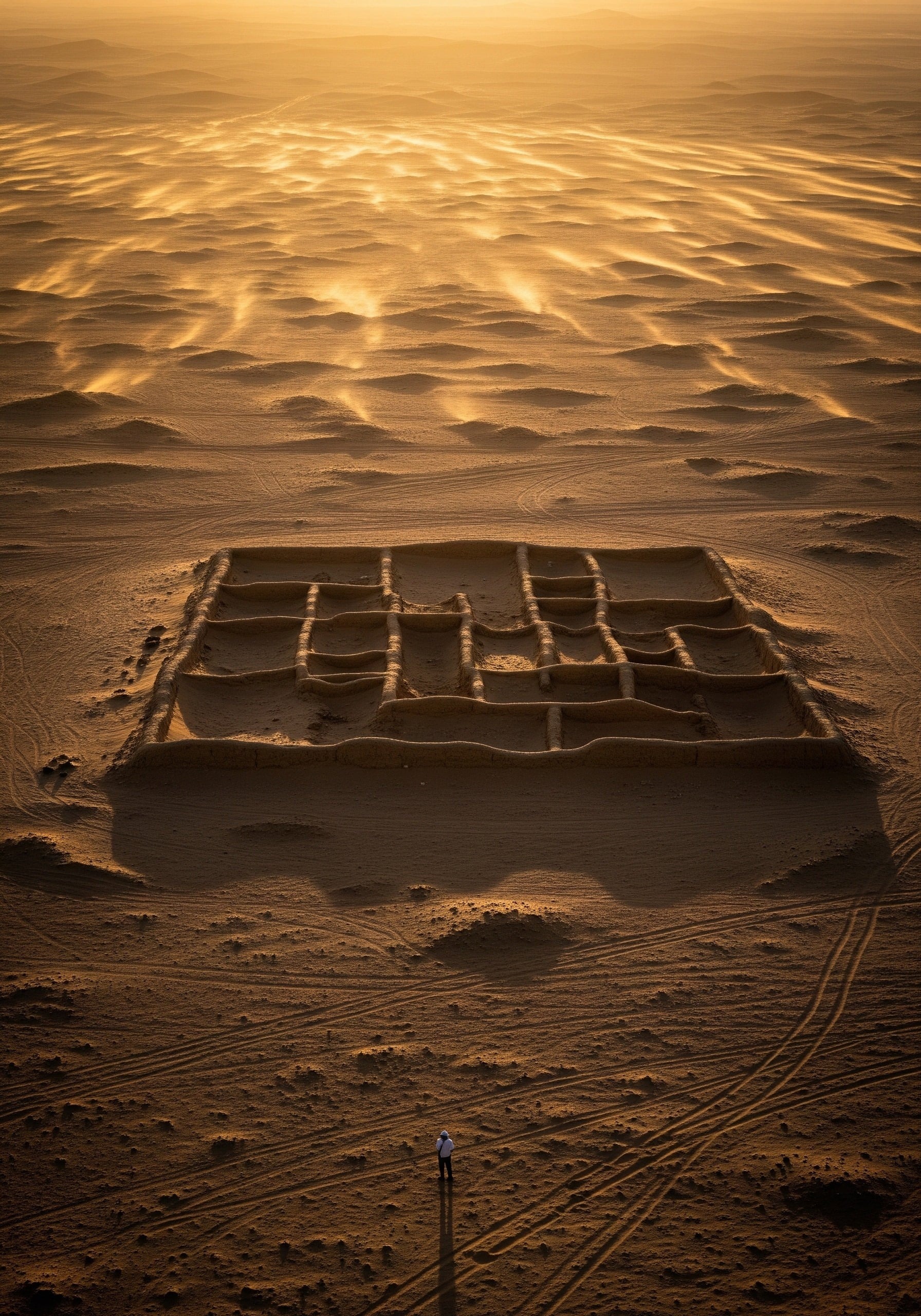
Among the lost cities never found, some still appear in cuneiform tablets, royal inscriptions and the journals of Victorian explorers — yet no spade has ever uncovered their walls. These are not fantasies. They are real capitals of real empires, places whose names ruled millions of people, then slipped beneath drifting sand, choking jungle or layered Nile silt and vanished from the map.
Key Facts
- Akkad, capital of the world’s first empire under Sargon the Great (c. 2334 BC), has never been located, despite ruling territory from the Persian Gulf to Anatolia.
- Itjtawy served as Egypt’s seat of power for roughly 350 years (c. 1985–1640 BC) and is thought to lie beneath the Nile floodplain near el-Lisht, buried by four millennia of silt.
- The Akkadian Empire collapsed around 2150 BC, a date now linked to a documented multi-century drought — the “4.2-kiloyear event” — that reshaped Mesopotamia.
- Irisagrig is known only from roughly 1,400 looted cuneiform tablets that surfaced on the antiquities market after 2003; its physical location remains unknown.
- British explorer Percy Fawcett vanished in 1925 in Brazil’s Mato Grosso searching for a city he called “Z”; LiDAR has since revealed real Amazonian earthworks but no Z.
In short: Several ancient capitals named in surviving texts have never been physically located, and a smaller set of legendary cities — Iram, Paititi, El Dorado — may be myth dressed as memory. Modern tools are closing the gap, but slowly.
Key Facts
- Akkad, capital of the world’s first empire under Sargon the Great (c. 2334 BC), has never been located, despite ruling territory from the Persian Gulf to Anatolia.
- Itjtawy served as Egypt’s seat of power for roughly 350 years (c. 1985–1640 BC) and is thought to lie beneath the Nile floodplain near el-Lisht.
- The Akkadian Empire collapsed around 2150 BC, a date now linked to the documented multi-century ‘4.2-kiloyear event’ drought.
- Irisagrig is known only from roughly 1,400 looted cuneiform tablets that surfaced on the antiquities market after 2003; its physical location remains unknown.
- British explorer Percy Fawcett vanished in 1925 in Brazil’s Mato Grosso searching for a city he called ‘Z’; LiDAR has since revealed real Amazonian earthworks but no Z.
In short: Several ancient capitals named in surviving texts have never been physically located, including Akkad and Itjtawy, while a smaller set of legendary cities like Iram and the Lost City of Z may be myth dressed as memory. Modern tools are slowly closing the gap between the lost and the found.
What we mean by “lost cities never found”
Archaeologists draw a careful line between “lost” and “legendary.” A truly lost city is one named in surviving documents — tax records, royal inscriptions, foreign correspondence — whose ruins simply have not been identified on the ground. A legendary city is one we know almost nothing about beyond a story, often a religious or mythic one. The distinction matters because the search strategies are completely different, as are the chances of success.
The cities that follow include both kinds. Some, like Akkad and Itjtawy, are mainstream archaeology — entire empires hinge on them. Others, like Iram of the Pillars or the Lost City of Z, sit in a grey zone where geography, folklore and obsession overlap. Together they show how much of the ancient world we still cannot see.
Akkad: the missing heart of the world’s first empire
Around 2334 BC, a court official from the city of Kish overthrew his king, took the throne name Sargon, and built a capital he called Agade — better known to history as Akkad. From it, his dynasty conquered the Sumerian south, pushed up the Euphrates into modern Syria, reached the cedar forests of Lebanon and crossed into the Iranian plateau. It was, by most measures, the first empire in human history.
And we cannot find its capital. Sumerian and later Babylonian texts mention Akkad constantly — its great temple Eulmash dedicated to the goddess Ishtar, its palace, its docks, its scribes — yet no mound in Iraq has been firmly identified as Sargon’s city. Excavators have proposed sites near the confluence of the Tigris and the Diyala, possibly buried under modern alluvial deposits or under the suburbs of greater Baghdad. After roughly 2150 BC the city fell silent; a Sumerian composition called “The Curse of Agade” blames the gods, but climate data now suggests a centuries-long drought contributed to the collapse.
Thinis and the buried capitals of ancient Egypt
If Akkad is the great lost city of Mesopotamia, Thinis is its Egyptian counterpart. According to the third-century BC priest Manetho, Thinis was the seat of Egypt’s First Dynasty, home to the kings who unified Upper and Lower Egypt around 3100 BC. The royal cemetery of those kings has been excavated for over a century at Abydos, with its astonishing boat burials and inscribed stelae. The city itself — where those kings lived, ate, made law and minted policy — has never been located.
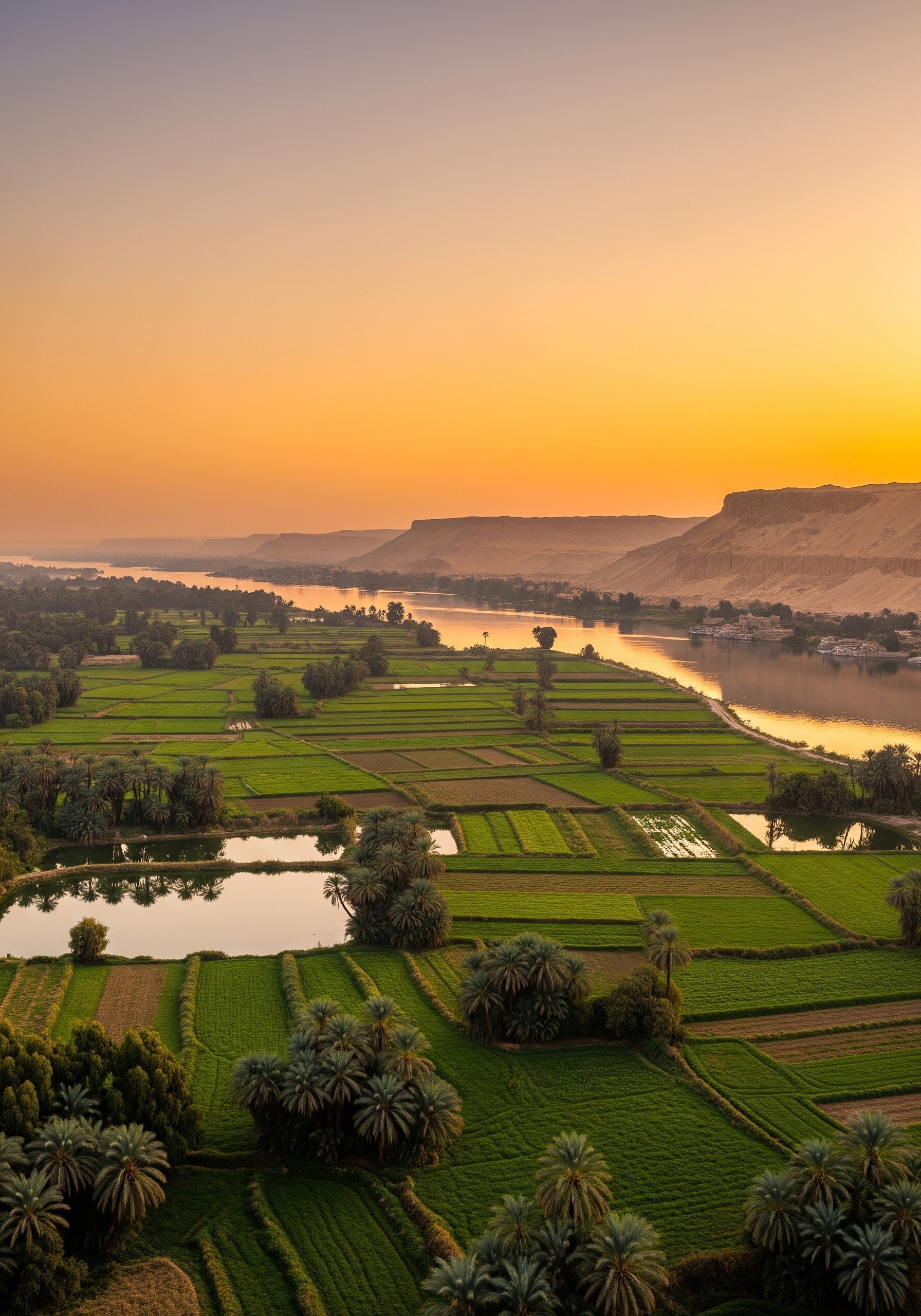
The most likely explanation is unromantic: thousands of years of Nile floods have buried it under metres of silt, and successive towns may have been built on top. The same problem haunts Itjtawy, the capital founded by Amenemhat I around 1985 BC, which ruled Egypt through most of the Middle Kingdom. Its name means roughly “Seizer of the Two Lands.” Royal pyramids at el-Lisht make its general neighbourhood almost certain, yet the urban core sits invisible somewhere under the floodplain. Recent geoarchaeological coring projects are now mapping the buried Nile branches that once defined where this royal city stood.
{IMAGE_2}
The Land of Punt: a country, not just a city
Some entries in the catalogue of lost cities never found are not single sites at all. The Land of Punt was, for ancient Egyptians, the source of the finest myrrh, frankincense, gold, ebony and live exotic animals. Queen Hatshepsut’s mortuary temple at Deir el-Bahari (c. 1470 BC) carries one of the most detailed trade narratives ever carved in stone, showing Puntite houses on stilts, baboons, fish recognisable as Red Sea species, and a portly queen named Ati. The fish in particular point to a coastline.
Yet Punt has never been placed on the map with certainty. Modern proposals run from northern Eritrea and Djibouti up to the Sudanese coast and inland into Ethiopia. In 2020, isotope analysis of mummified Puntite baboons narrowed the source region to that arc — their strontium signatures matched eastern Eritrea and Ethiopia — but the actual ports and towns remain unidentified. As with so many ancient mysteries, the surviving evidence is sharper at the edges than at the centre.
Irisagrig: a city we can read but not visit
One of the strangest lost cities never found is Irisagrig, a Mesopotamian centre that flourished during the Ur III period (around 2100–2000 BC). What makes it strange is that we have piles of its paperwork. Roughly 1,400 cuneiform tablets surfaced on the antiquities market in the early 2000s, eventually published by Assyriologists who realised they all came from a single, unknown city. They are mundane: receipts for sheep, beer rations, deliveries to officials of a king named Ibbi-Sin. They describe palace dogs, lion-keepers and temple offerings.
What they do not tell us is where Irisagrig sat. Because the tablets were looted, not excavated, the chain of provenance is broken. Some researchers suspect the source mound is in southern Iraq, near Adab; others place it further east. The case shows how the global trade in stolen antiquities can simultaneously give us a city’s voice and erase its address.
Lost cities never found in the Americas: Z, Paititi and El Dorado
In 1925, the British surveyor Percy Fawcett walked into the Mato Grosso jungle in Brazil with his son Jack and his son’s friend, looking for a city he called “Z.” He believed Amazonia had hosted a dense, sophisticated civilisation. Then he disappeared. Search parties found nothing, and his story became one of the great explorer myths of the twentieth century.
The deeper irony is that Fawcett was partly right. Beginning in the 2000s, archaeologists using LiDAR — laser pulses fired from aircraft to strip away the forest canopy in software — have revealed huge networks of geometric earthworks, roads and plazas in the Upper Xingu region (the Kuhikugu complex) and across the Bolivian Llanos de Moxos. They are not Fawcett’s gilded metropolis, but they are real, organised Amazonian centres he never lived to see. Other American legends — Paititi, the supposed final refuge of the Inca, and El Dorado, the gilded king misread as a city — have not fared as well. No archaeologist has ever produced ruins matching either story.
The legendary tier: Iram, Atlantis and Vineta
Beyond the verifiable list lies a second tier where evidence thins to vapour. The Qur’an describes Iram of the Pillars, “Ad of Iram,” a city destroyed by God in the Arabian Peninsula. In the early 1990s, a survey using satellite radar identified caravan tracks converging on an oasis called Shisr in Oman, sometimes promoted as “Ubar.” Subsequent excavation showed Shisr was a medieval frankincense fort, not an Arabian metropolis. The marketing stuck; the identification did not.
Plato’s Atlantis (c. 360 BC) is widely treated by classicists as an allegory, not the memory of a real Bronze Age civilisation, although the catastrophic Minoan eruption of Thera around 1600 BC almost certainly fed into the tradition Plato inherited. The Baltic legend of Vineta, a wealthy medieval trading city said to have been swallowed by the sea off the German-Polish coast, may yet be matched to a real Slavic emporium — but no one has done it. These cities sit in the borderland between history and story.
Why so many lost cities are never found
For an entire urban centre to vanish, one of a handful of conditions usually applies. The first is sediment burial: the great floodplains of the Nile, Tigris and Euphrates lay down so much silt and clay each century that metre-thick mounds form across millennia, hiding earlier mudbrick architecture from any surface survey. The second is continuous reoccupation: Baghdad, Cairo and Damascus all sit on top of older cities, and modern construction makes large-scale digging impossible.
The third condition is political instability. Many of the candidates here — Akkad, Thinis, Irisagrig, Waššukanni — sit in Iraq, Syria or other regions where decades of war, looting and restricted access have stalled archaeology. The fourth, and most poignant, is the destruction of context: a looted city can produce thousands of objects on the antiquities market without its physical address ever being recorded. Many famous artefacts in private collections almost certainly come from cities we cannot put on a map.
The Lost Capitals: A Quick Timeline
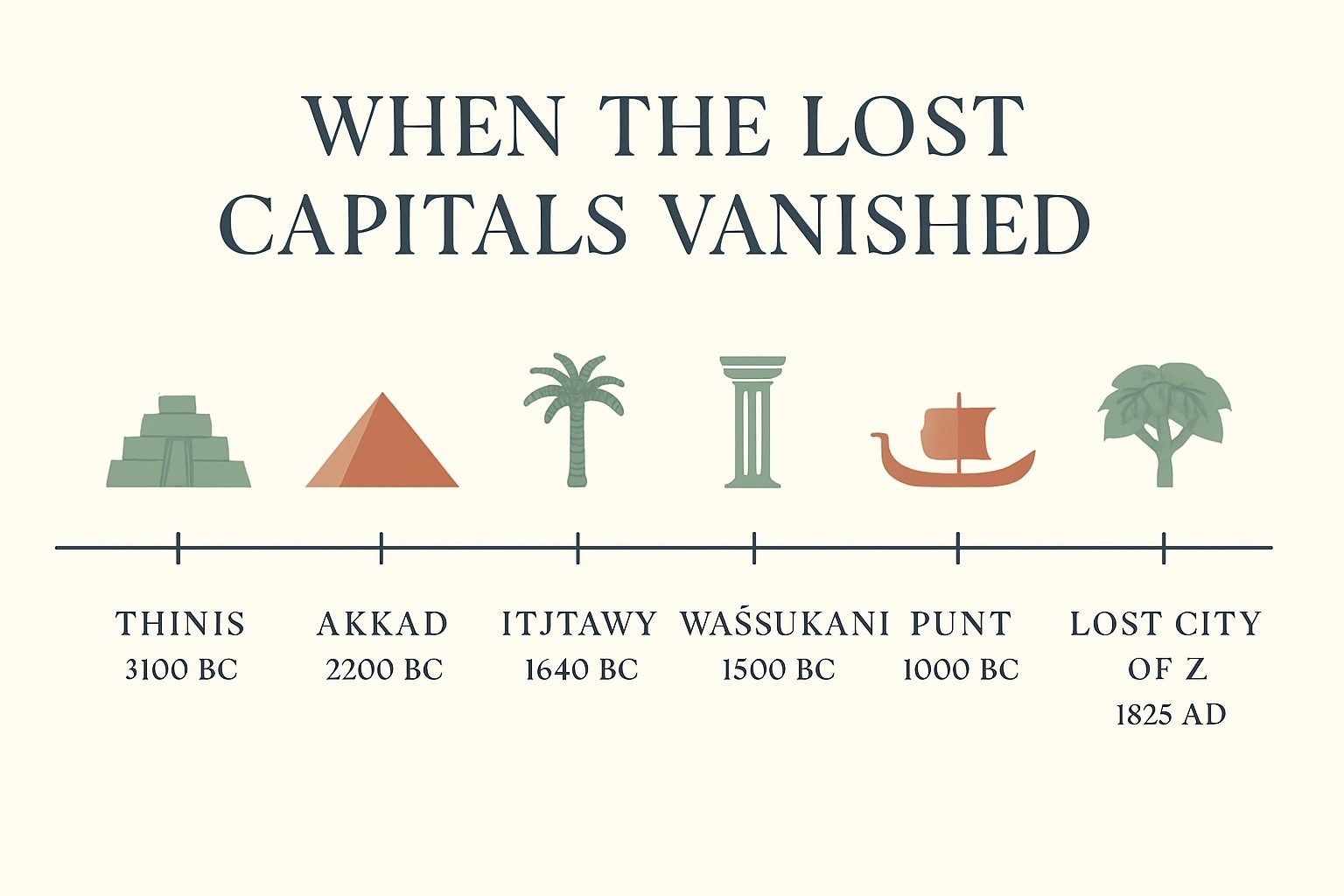
- Thinis · Egypt · capital c. 3100 BC · believed buried near Abydos under Nile silt.
- Akkad · Mesopotamia · capital 2334–2150 BC · likely in central Iraq, exact mound unidentified.
- Itjtawy · Egypt · capital c. 1985–1640 BC · buried under floodplain near el-Lisht.
- Irisagrig · Mesopotamia · active c. 2100–2000 BC · location erased by 21st-century looting.
- Land of Punt · Horn of Africa region · traded with Egypt c. 2500–1000 BC · coastline unknown.
- Waššukanni · Mitanni capital · 1550–1300 BC · suspected in northeastern Syria.
- Lost City of Z · Brazilian Amazon · legend popularised 1925 · partially superseded by real LiDAR-mapped earthworks.
How modern technology is changing the hunt
The tools archaeologists now bring to the search would look like science fiction to Howard Carter. Airborne LiDAR strips away forest and undergrowth pixel by pixel; satellite radar can detect buried walls through metres of sand by their effect on soil moisture; magnetometry maps the ghostly outlines of fired mudbrick. In recent years, researchers using Sentinel-2 and CORONA-era declassified imagery have identified scores of previously unknown Bronze Age sites across the Iraqi marshes and Syrian steppe. La Ciudad Blanca, the legendary “White City” of Honduras’s Mosquitia, was effectively confirmed by LiDAR in 2012–2015 — quietly moving from the legendary column into the discovered one.
None of this means the remaining lost cities will all yield. Many candidate mounds sit in active conflict zones, others under modern cities, others in alluvial plains where ground-penetrating radar struggles. What it does mean is that the inventory of cities we have read about but never seen is steadily shrinking — sometimes by years, sometimes by decades, but always in one direction. For broader context on how the deserts and rivers of the ancient Middle East still shape archaeology today, see our piece on the region’s ancient water systems, and for an example of a fully vanished culture being slowly reassembled from dust and DNA, our story on the lost people of the Green Sahara.
Frequently Asked Questions
Q: What are the most famous lost cities never found?
A: Akkad, capital of Sargon’s empire, and the Egyptian capitals Thinis and Itjtawy lead the list of real, document-attested cities still missing. Iram of the Pillars, the Lost City of Z and Paititi are widely searched legends with much weaker evidence.
Q: Has the Lost City of Z ever been found?
A: No exact match for Percy Fawcett’s “Z” has been located. However, LiDAR surveys of the Upper Xingu and the Bolivian Amazon since the 2000s have revealed extensive pre-Columbian earthworks — real Amazonian networks Fawcett did not live to see.
Q: Why have archaeologists never found Akkad?
A: Akkad probably lies in central Iraq, possibly near the confluence of the Tigris and the Diyala, buried under metres of river silt or beneath modern construction. Decades of conflict have also limited large-scale excavation in the region.
Q: Could lost cities like Atlantis be real?
A: Most classicists treat Plato’s Atlantis as allegory. Some of its details may echo the catastrophic Minoan eruption of Thera around 1600 BC, but no submerged civilisation matching Plato’s description has ever been found, and the geological setting he describes does not exist.
Every generation believes it has read the last chapter of the ancient world, and every generation is wrong. The lost cities never found are not absences — they are appointments. Somewhere under the Nile silt, under the Iraqi marshes, under the Amazon canopy, the bricks are still stacked exactly where their builders left them, waiting for the right instrument and the right patience to lift them back into the light.
Illustrations are AI-generated. Article fact-checked and human-edited.