The Oldest Civilization Still Alive Today: The Real Answer
Ask three historians to name the oldest civilization still alive and you will get four answers, a long pause, and an argument about what the word “civilization” even means. The honest reply hides inside that argument — and once you separate “civilization” from “culture,” the leaderboard becomes surprisingly clear.
Key Facts
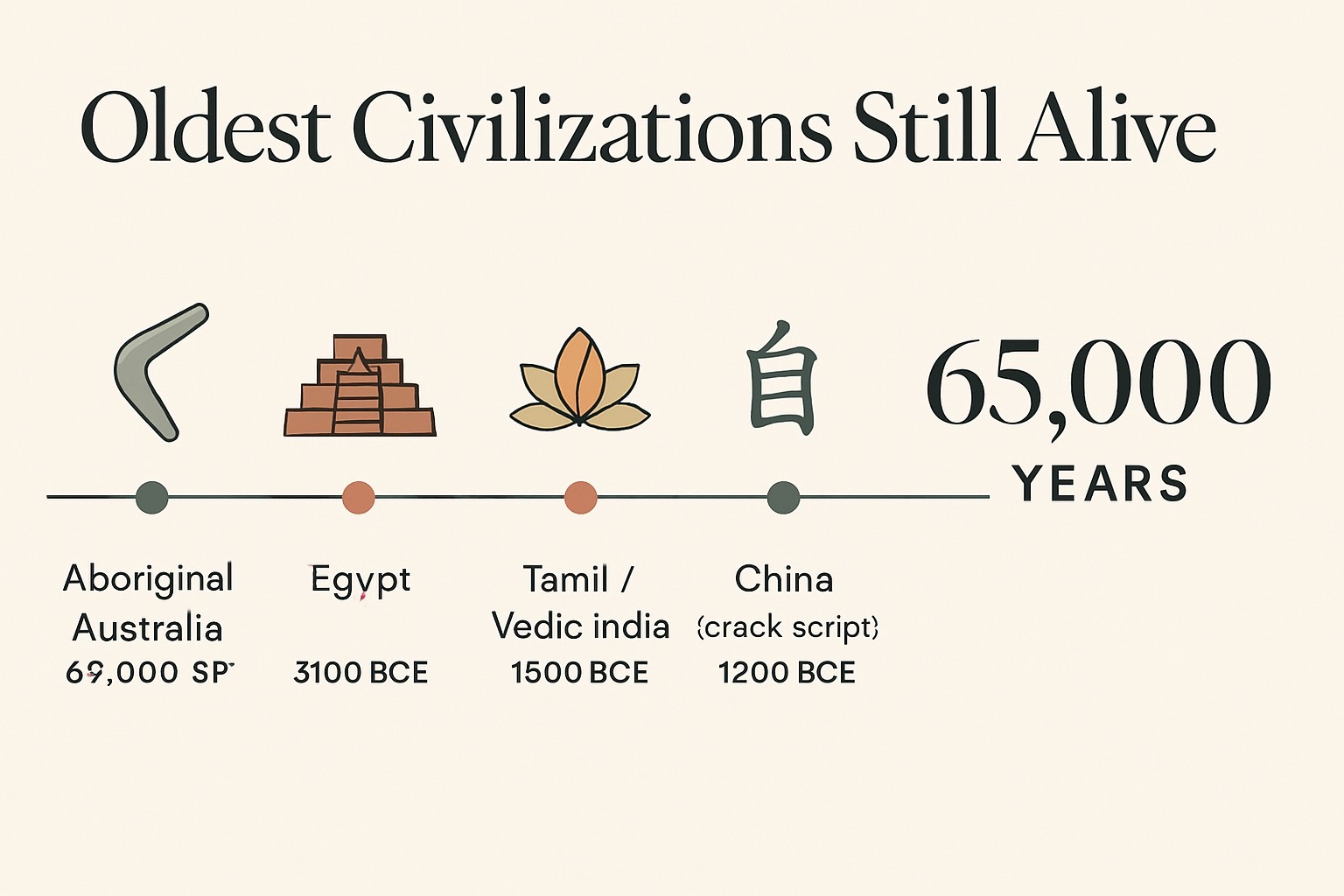
- Aboriginal Australians have continuously occupied the same continent for at least 65,000 years — by archaeological consensus, the oldest continuous living culture on Earth.
- The oldest continuously used writing system still in daily use is Chinese: oracle-bone script dates to roughly 1200 BCE, about 3,250 years of unbroken graphic lineage.
- Ancient Egypt as a civilization lasted roughly 3,100 BCE to 30 BCE — long, but it did end; the hieroglyphic religion was extinct by the 4th century CE.
- Sumerian Mesopotamia invented writing around 3,200 BCE; its gods were still being worshipped into the 3rd century CE before disappearing entirely.
- The Tamil language of South India is documented from roughly 500 BCE and is still spoken by about 80 million people — one of the world’s longest living classical languages.
In short: If you mean unbroken human culture, the answer is Aboriginal Australia at 65,000-plus years. If you mean an unbroken civilization — cities, writing, state, faith — the strongest case is China, on the back of a script that has been read and written continuously for roughly 3,250 years. Everyone else, including Egypt and Sumer, ended.
Key Facts
- Aboriginal Australians have continuously occupied the same continent for at least 65,000 years — by archaeological consensus, the oldest continuous living culture on Earth.
- The oldest continuously used writing system still in daily use is Chinese: oracle-bone script dates to roughly 1200 BCE, about 3,250 years of unbroken graphic lineage.
- Ancient Egypt as a civilization lasted roughly 3,100 BCE to 30 BCE; its hieroglyphic religion was extinct by the 4th century CE.
- Sumerian Mesopotamia invented writing around 3,200 BCE; its gods were still worshipped into the 3rd century CE before disappearing entirely.
- The Tamil language of South India is documented from roughly 500 BCE and is still spoken by about 80 million people.
In short: If ‘oldest’ means unbroken human culture, the answer is Aboriginal Australia at over 65,000 years. If it means an unbroken civilization with cities, writing, state and faith, the strongest case is China, on the back of a script read continuously for about 3,250 years. Egypt and Sumer both ended.
The question that sounds simple isn’t
Type “oldest civilization still alive” into a search bar and you will see the same three names recycled: China, Egypt, Mesopotamia. The pages rarely agree, because the word “civilization” has no settled definition. Does it require cities? Writing? A continuous state? A single language? A surviving religion? Each criterion crowns a different winner.
Modern scholars increasingly avoid the term entirely. As archaeologist Rowan Flad of Harvard University has noted, “civilization” is a concept with so much baggage that academics now prefer to talk about “cultures” or “traditions” — categories that can be measured without picking a moral hierarchy. That academic move matters here, because it changes the question from “which civilization is oldest?” to two cleaner questions: which culture is oldest, and which civilization has the longest unbroken thread.
Two different questions. Two different answers. Both have winners that are not in dispute among specialists — only in clickbait.
Aboriginal Australia: humanity’s oldest continuous living culture
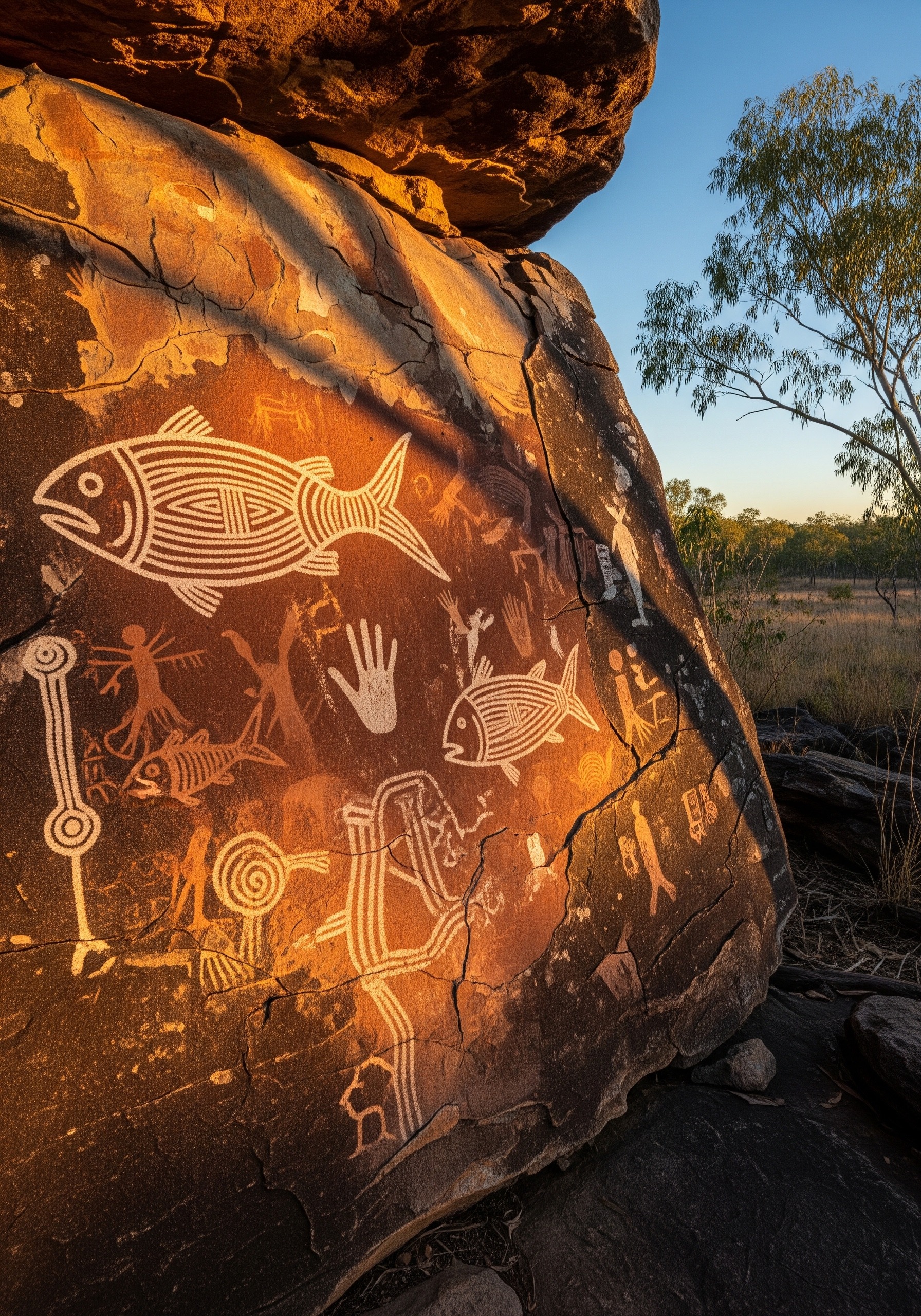
The cultural record holder is not close. Archaeological evidence from sites such as Madjedbebe in the Northern Territory dates human occupation of Australia to at least 65,000 years ago. Genetic work supports the same picture from a different angle: a 2011 study led by Morten Rasmussen, then at the University of Copenhagen, sequenced DNA from a century-old lock of hair and concluded that Aboriginal Australians descend from a single founding population that left Africa, reached Australia, and stayed.
{IMAGE_2}
“Stayed” is the operative word. Outside Africa itself, no other human population has occupied the same territory continuously for that long. Languages, ceremonies, and rock-art traditions in places like Kakadu have transmitted across more than 2,500 generations. There is genuine disagreement about the precise arrival date — some 2024 genetic models argue for a more recent figure closer to 50,000 years — but no serious archaeologist disputes that this is the planet’s oldest continuous living culture by a wide margin.
What it isn’t, in the technical sense, is a “civilization.” Aboriginal societies did not develop cities, writing, or centralized states — and they did not need to. That absence is the only reason the title is awarded to someone else when the question shifts.
The oldest civilization still alive: the case for China
If “civilization” means cities, writing, statecraft, and an unbroken cultural memory, the strongest case standing today is China. The argument rests on one stubborn artifact: the Chinese script.
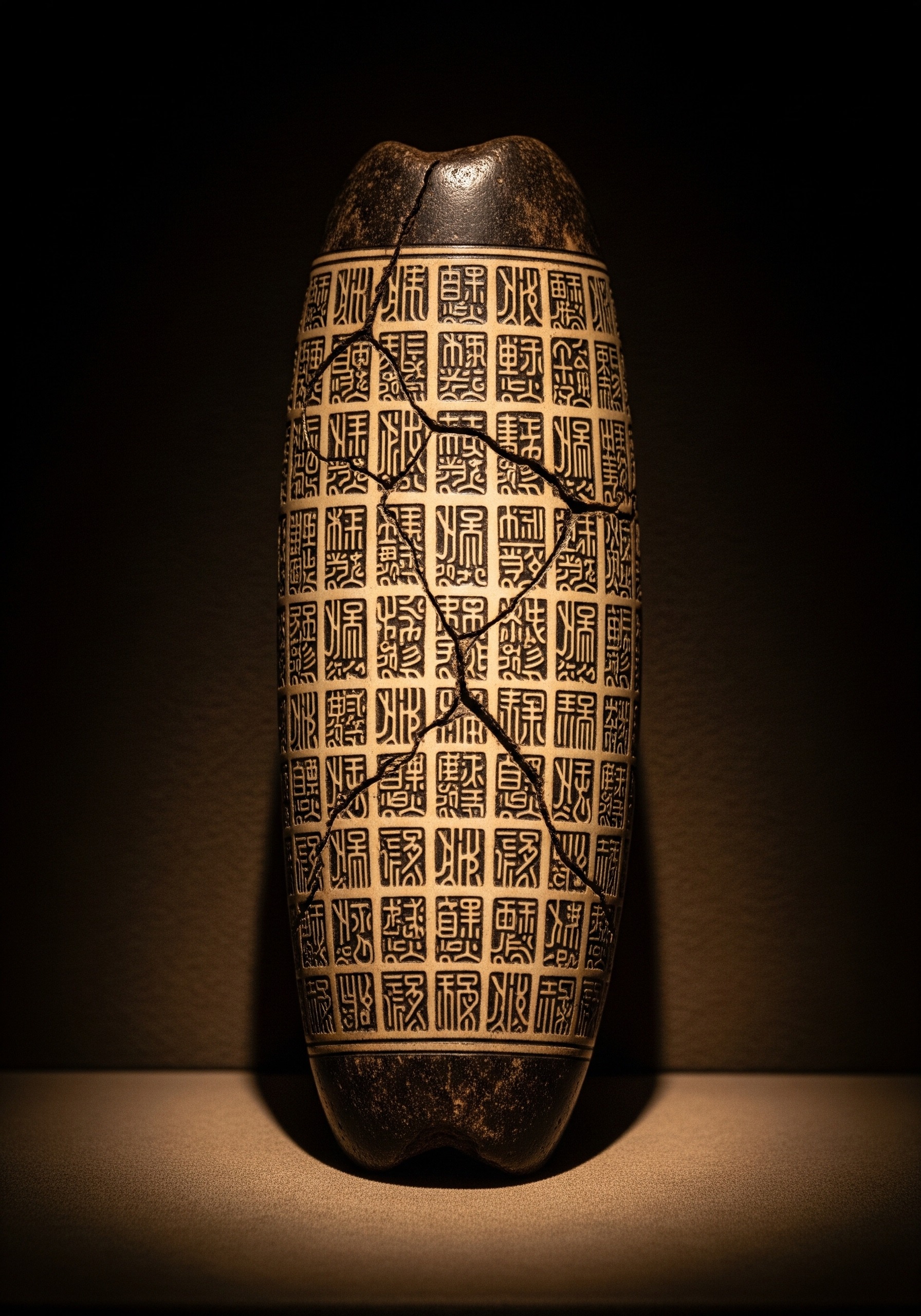
Oracle bones — the cracked turtle plastrons and ox shoulder blades used for divination in the late Shang dynasty around 1200 BCE — carry characters that a literate Chinese speaker today can partially read. The shapes have evolved, the language behind them has shifted, but the graphic system is the same one. That is roughly 3,250 years of continuous use. No other living writing system comes close. Egyptian hieroglyphs were forgotten for fifteen centuries; cuneiform was unreadable until the 19th century; the Latin alphabet is younger than Chinese characters by more than half a millennium.
Julia Schneider, a conceptual historian of China at University College Cork, has cautioned against the official Chinese claim of “5,000 years of continuous civilization” — a figure that is political branding rather than archaeological consensus. The honest number is closer to 3,250 years of demonstrably continuous high culture, which is still the longest documented run in the world.
Here’s the thing critics raise, and it’s a fair one: modern China is not Shang China. The state has been conquered, fractured, and rebuilt many times — by the Mongols, the Manchus, the 1911 revolution, the 1949 revolution. Whether that counts as one civilization or several depends on whether you weight political continuity or cultural continuity more heavily. Most specialists, when pressed, weight the culture. By that measure, China wins.
Egypt and Mesopotamia: the civilizations that finally ended
Ancient Egypt is the textbook answer to “longest-lasting civilization” — and the textbook is right, for a civilization that ended. From the unification of Upper and Lower Egypt around 3100 BCE under a king the Greeks would later call Menes, to the death of Cleopatra VII and the Roman annexation in 30 BCE, that is more than 3,000 unbroken years. By the 4th century CE the old religion had been outlawed, the hieroglyphs forgotten, and the language that became Coptic was already heading toward liturgical-only status.
Mesopotamia ran a similar marathon and finished earlier. Sumerian cuneiform appears around 3200 BCE in the city of Uruk; the gods named on those first tablets — Inanna, Enlil, Marduk — were still receiving offerings into the 3rd century CE, according to Philip Jones, associate curator of Babylonian collections at the Penn Museum. After that, nothing. The script went unread until Henry Rawlinson decoded it in the 1850s.
Both were extraordinary. Both are gone. They are the long-distance runners who collapsed before the finish line — which is exactly why neither qualifies as “the oldest civilization still alive.”
India and the Tamil thread
India is the candidate most often left out of these debates, and most underrated within them. The Indus Valley civilization at Harappa and Mohenjo-daro flourished from around 2600 BCE; its script remains undeciphered, and its direct line to modern India is contested. But South India offers a cleaner thread.
Classical Tamil literature dates from roughly 500 BCE, and Tamil is still spoken today by about 80 million people — making it one of two languages (alongside Sanskrit) that UNESCO recognizes as a classical language of continuous use. Hindu religious practice, in some form, runs back through the Vedic period (~1500 BCE) without a complete rupture. The case for India is weaker than China’s only because the political and writing-system continuities are messier — not because the cultural continuity isn’t real.
Scoring the contenders — a side-by-side
This is where most articles leave readers stranded with three names and no way to choose. Set aside the rhetoric and score the leading candidates on five measurable axes — written language continuity, religious continuity, political continuity, cultural-genetic continuity, and oldest direct evidence — and the picture clarifies.
The leaderboard, by what you mean
- Oldest continuous culture: Aboriginal Australians — ≥65,000 years
- Oldest civilization still alive (writing + cities + state): China — ~3,250 years
- Oldest classical language still spoken: Tamil — ~2,500 years
- Oldest continuously inhabited cities: Damascus and Jericho — ~6,000 and ~9,000 years respectively
- Longest civilization that ended: Ancient Egypt — ~3,000 years (3100 BCE – 30 BCE)
| Candidate | Earliest evidence | Writing today? | Faith today? | State today? | Verdict |
|---|---|---|---|---|---|
| Aboriginal Australia | ~65,000 BP | No (oral) | Yes | No | Oldest culture |
| China | ~1200 BCE (script) | Yes | Yes (mixed) | Yes | Oldest civilization |
| India (Tamil/Vedic) | ~1500 BCE | Yes | Yes | Yes | Strong runner-up |
| Egypt | ~3100 BCE | No (extinct) | No | Different state | Ended |
| Mesopotamia | ~3200 BCE | No (extinct) | No | No | Ended |
A scoring grid is unromantic, and that is the point. It pulls the answer out of the loudest claim and onto the evidence.
So which is it? Culture versus civilization, settled
The reason this question feels unanswerable is that it is actually two questions wearing one hat. Strip the hat off and the picture is clean. Aboriginal Australia is the oldest continuously living human culture by an enormous margin — sixty-five millennia. China is the oldest continuously living civilization in the technical sense — cities, script, state, faith, all running for roughly three and a quarter millennia. Egypt and Mesopotamia held the trophy for a long time and then lost it. India sits in honorable contention and probably belongs higher in the standings than most Western lists place it.
If a single answer is needed, the cleanest one is this: when people ask which civilization is still alive after the longest run, they almost always mean China — and the specialists agree, with the caveat that the official “5,000 years” number is propaganda and the honest number is closer to 3,250. When they mean which people have been here longest, doing the same things in the same place, the answer is Aboriginal Australia, and it isn’t close.
Both answers are older than every empire that ever wrote a history book. That is the part worth holding on to.
Frequently Asked Questions
Q: Is China really 5,000 years old?
A: That figure is official Chinese cultural messaging, not archaeological consensus. The earliest rigorously dated continuous evidence — the oracle-bone script — runs back about 3,250 years to roughly 1200 BCE. Earlier Neolithic cultures existed in the region but cannot be linked in an unbroken cultural line.
Q: Wasn’t Egypt the oldest civilization?
A: Egypt was the longest-lasting civilization that ended — roughly 3,100 years from unification under the first pharaoh to the Roman annexation in 30 BCE. But its religion and script were extinct by the early Christian era, so it is not “still alive.” Modern Egypt is an Arab-Muslim nation that overlies the ancient land.
Q: What about Greece? Or Persia?
A: Both are old and culturally vital, but each has gaps. Classical Greek civilization was reshaped by Christianization and the Ottoman period; ancient Persian Zoroastrian civilization was largely displaced by the Arab conquest in the 7th century CE. Strong heritage, broken continuity.
Q: Are Aboriginal Australians considered a civilization?
A: Not in the technical sense — they did not develop cities, writing, or centralized states. But they are universally recognized as the world’s oldest continuous living culture, with at least 65,000 years of occupation supported by archaeology and genetics.
Sources
- Live Science — What was the longest-lasting civilization? (interviews with Rowan Flad, Harvard; Julia Schneider, University College Cork; Philip Jones, Penn Museum)
- IFLScience — Who Holds The Title Of The Longest-Surviving Civilization?
- Australian Geographic — DNA confirms Aboriginal culture one of Earth’s oldest (Rasmussen et al. 2011 genetic study)
- Aboriginal Australians — Wikipedia (archaeological and genetic overview)
- American Historical Association — The Oldest Living Civilization
The question “what is the oldest civilization still alive” almost asks itself wrong. Asked properly — culture or civilization, which do you mean — it has two clean answers, both older than every story we usually tell about the past. And both are, remarkably, still here.
Illustrations are AI-generated. Article fact-checked and human-edited. Our editorial standards.