Animals That Can Regenerate Limbs: 2025 Science Guide
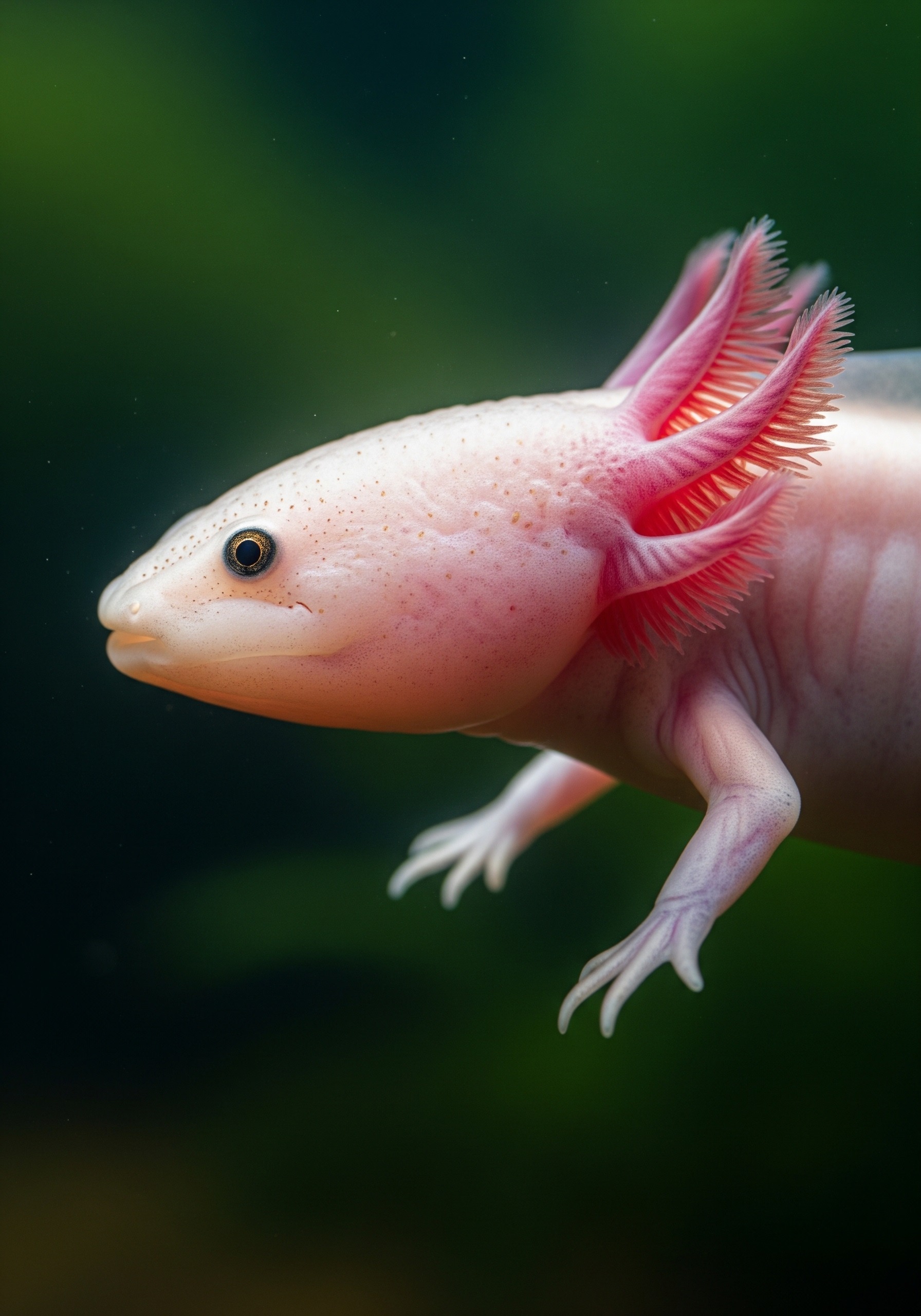
The most extreme animal that can regenerate limbs is the axolotl — a Mexican salamander that can grow back a foot, a leg, a jaw, sections of its spinal cord and parts of its heart, and do it again, and again, with the new limb functionally indistinguishable from the original. No other vertebrate comes close.
Key Facts
- Salamanders are the only vertebrates that fully regrow a complete, functional limb as adults — bone, muscle, nerve and skin.
- Axolotls (Ambystoma mexicanum) can regenerate their limbs, tail, jaws, retina, spinal cord, and parts of the heart and brain.
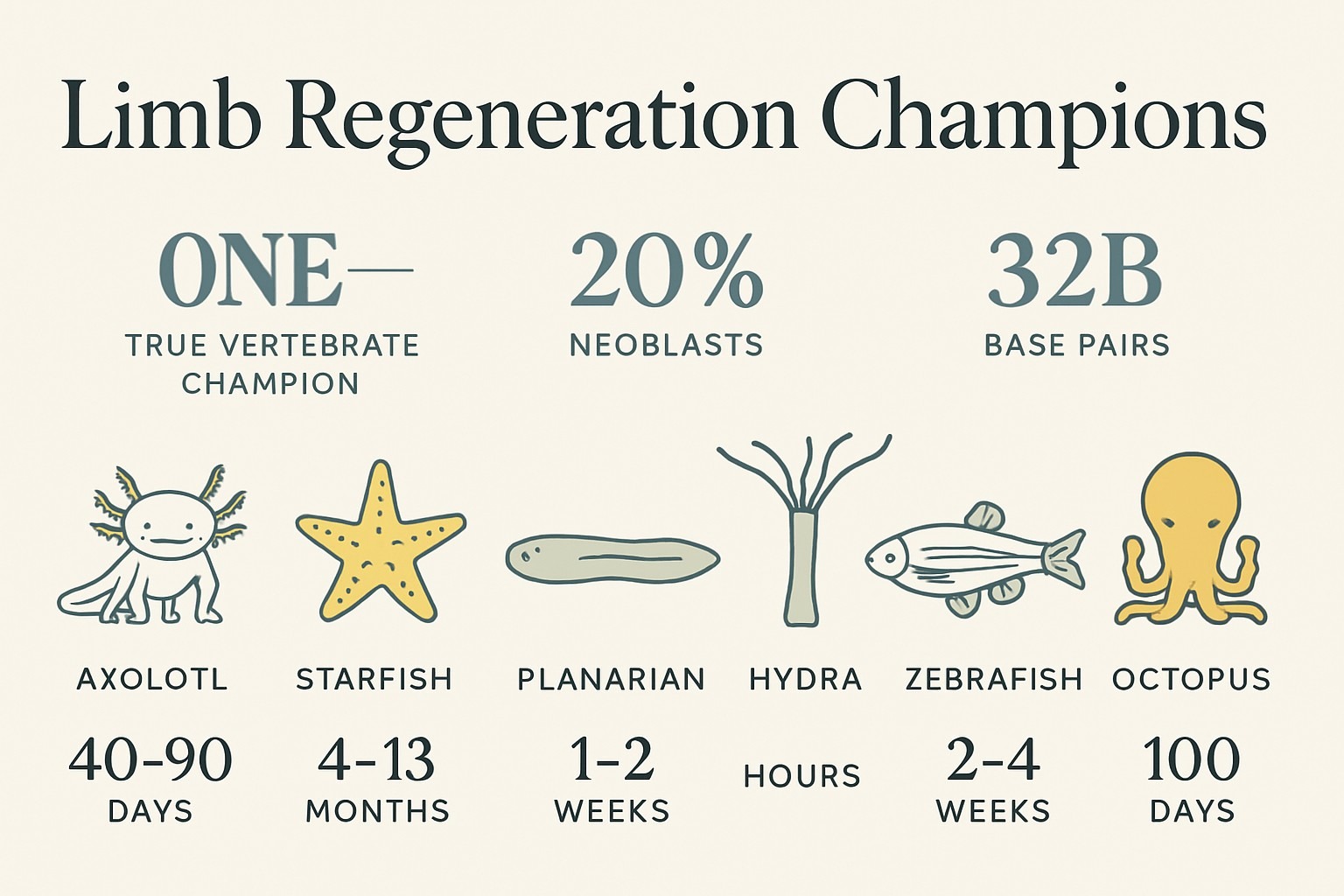
- Planarian flatworms regrow an entire body from a tiny fragment — neoblast stem cells make up roughly 20% of their tissue.
- In September 2025, a Harvard team led by Jessica Whited reported in Cell that an amputation in a salamander triggers a body-wide adrenergic alarm — uninjured limbs go into “ready mode” for weeks.
- Deer antlers grow at up to ~2.5 cm per day during peak season — the fastest known mammalian tissue growth.
In short: Full-limb regeneration in vertebrates is essentially a salamander superpower. Invertebrates — starfish, planaria, hydra — do it more extravagantly. Lizards, geckos, deer, and a few mammals only get partial credit. And the 2025 research finally has a clearer answer for why humans can’t.
Key Facts
- Salamanders are the only vertebrates that fully regrow a complete, functional limb as adults, rebuilding bone, muscle, nerve and skin.
- Axolotls (Ambystoma mexicanum) can regenerate limbs, tail, jaws, retina, spinal cord, and parts of the heart and brain.
- Planarian flatworms regrow an entire body from a fragment; neoblast stem cells make up roughly 20% of their tissue.
- In September 2025, a Harvard team led by Jessica Whited reported in Cell that amputation triggers a body-wide adrenergic alarm, with uninjured limbs in ready mode for weeks.
- An axolotl regrows fingers in roughly 40 to 50 days and a full limb in about 60 to 90 days; deer antlers grow up to about 2.5 cm per day.
In short: Full-limb regeneration in vertebrates is essentially a salamander superpower, and the axolotl is the gold standard, regrowing limbs, tail, jaw, spinal cord and parts of the heart scar-free. Invertebrates like planaria and hydra do it more extravagantly, while lizards, geckos and deer manage only partial regrowth.
What “regenerating a limb” actually means
The word does a lot of heavy lifting on the internet. Strictly, biologists separate three things. Wound healing — closing skin over a stump — every vertebrate does. Tissue regrowth — replacing some muscle, cartilage, or organ mass — many animals do. True epimorphic regeneration — rebuilding a fully functional, patterned limb with bone, nerve, blood vessel and skin in the right places — is rare. Among vertebrates, only urodele amphibians (salamanders, newts, and the axolotl) manage it as adults.
The mechanism is unmistakable. Within hours of amputation, cells at the stump dedifferentiate — adult cells essentially reverse out of their identity — and form a knob of progenitor cells called a blastema. The blastema then re-runs the developmental program that built the limb in the first place, only faster.
The axolotl: the vertebrate gold standard
The axolotl is the lab animal that broke regenerative biology open. A single individual can lose and regrow the same leg dozens of times. The replacement matches the original in length, joint count, digit pattern and nerve wiring. Fingers come back in roughly 40 to 50 days at standard lab temperatures; full limbs in around 60 to 90, depending on size and age.
{IMAGE_2}
That alone is remarkable. What 2025 made clearer is how the axolotl knows what to grow. James Monaghan and colleagues at Northeastern University, publishing in Nature Communications in June 2025, showed that a gradient of retinoic acid running shoulder-to-fingertip acts as positional memory. Cut a limb near the shoulder and the cells “read” a high retinoic acid signal, switch on a gene called shox, and rebuild from the shoulder down. Cut it at the wrist and they build only a hand. The enzyme CYP26B1 fine-tunes the gradient. Humans have retinoic acid, fibroblasts and the shox gene. We don’t have the responsive wiring.
The axolotl, by the numbers
- Genome: ~32 billion base pairs — about ten times the human genome.
- Body parts regenerated: limbs, tail, jaw, spinal cord, retina, ovary, sections of heart and brain.
- Limb regrowth time: ~40-90 days, age-dependent.
- Wild population: critically endangered; possibly only a few hundred remain in Xochimilco, Mexico.
Other salamanders, and the limits the internet skips
Axolotls aren’t alone. Adult red-spotted newts, fire salamanders, and Iberian ribbed newts all regrow legs and tails — though usually a little slower, and in cold climates dramatically slower. A roughly 300-million-year-old Carboniferous amphibian fossil (Micromelerpeton) preserves an irregularly-regenerated limb, telling us this is an ancient trick, not an evolutionary novelty.
Here is the caveat that almost no listicle mentions: regenerative power drops with age and complexity. Adult frogs are amphibians but they cannot regrow a full limb; tadpoles can, briefly, before metamorphosis shuts the door. Among salamanders themselves, the larger and older the animal, the slower and less perfect the rebuild. Regeneration is not a binary switch — it is a sliding capability that most vertebrates lost.
The invertebrate champions
Among invertebrates, salamander-level regeneration looks ordinary. Planarian flatworms are the genre’s strangest performer: roughly a fifth of their cells are pluripotent stem cells called neoblasts, and an animal can be cut into many pieces, each of which rebuilds a complete worm — head, gut, nervous system and all. Hydra, freshwater relatives of jellyfish, can be dissociated into a slurry of individual cells in a centrifuge tube; left undisturbed, the cells reaggregate and reorganize into a new hydra. It is hard to overstate how strange that is.
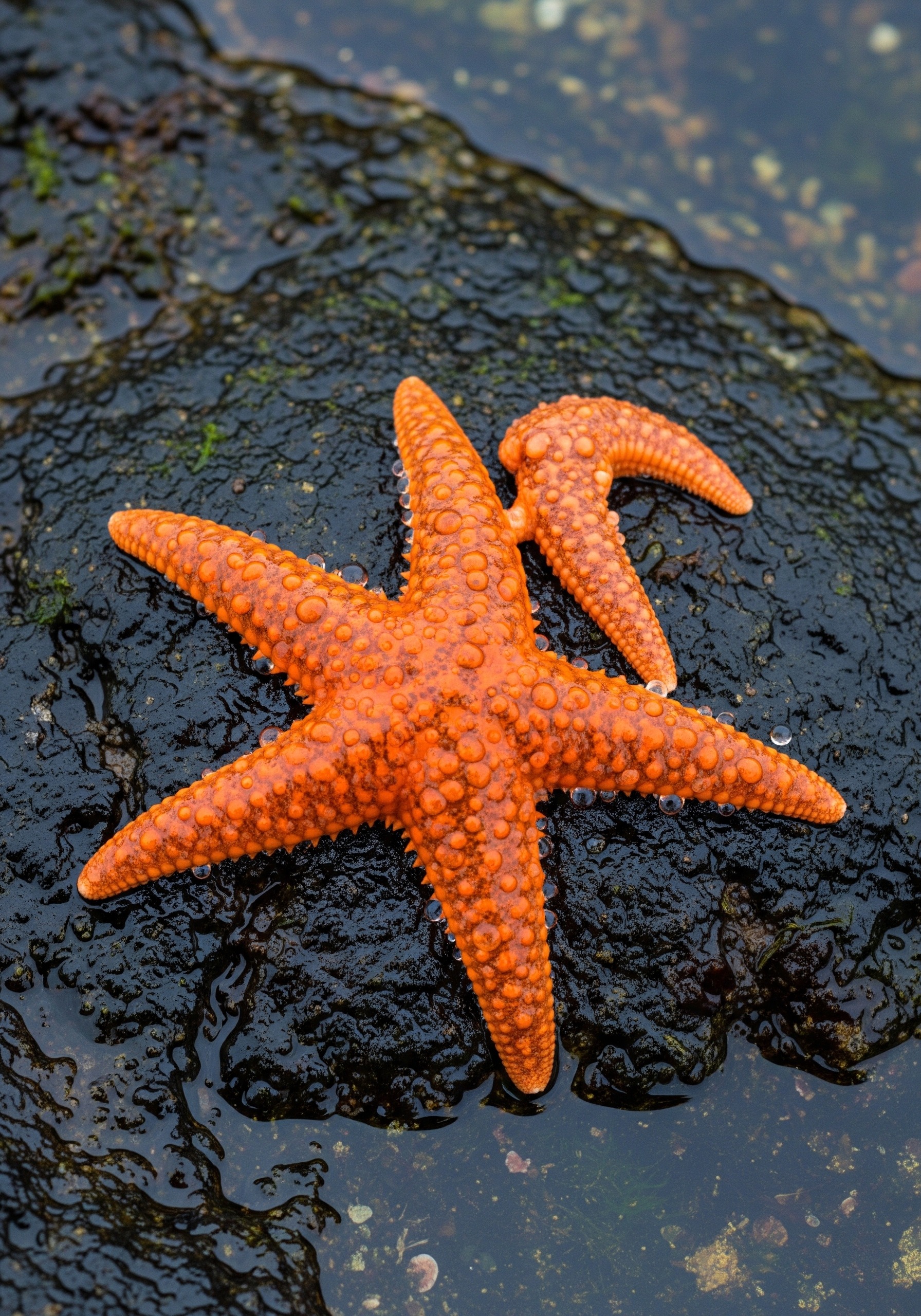
Starfish regrow arms over four months to a year, depending on species. Allostichaster capensis regenerates about 20% of an arm per month — five months to complete. The common cushion-skinned Asterias rubens manages closer to 7% a month, taking eight or nine. The viral claim that any cut starfish arm grows a new animal is mostly wrong: only a handful of tropical species, mainly in the genus Linckia, can pull that off, and only if a piece of central disc tissue is attached. Sea cucumbers go further still — they can eject their entire digestive system at a predator and grow a new one inside a few weeks. Earthworms regrow tail segments. Lobsters and crayfish replace claws and walking legs across successive molts.
The partial regenerators — and what they’re not
Below the salamanders sit the animals that fix something — but not really a limb. Lizards and geckos shed tails (autotomy) and regrow them, but the replacement is not a true tail: the new structure is a rod of unsegmented cartilage with simpler musculature and no regenerated vertebrae. Zebrafish regrow fins, scales, and — most interestingly to cardiology — around 20% of their hearts after injury. Deer regrow a full set of antlers every year; antlers are bone-and-skin organs that elongate at up to roughly 2.5 cm a day in season, the fastest known mammalian tissue growth. African spiny mice can heal large skin wounds without scarring and regrow some cartilage and hair follicles — the only mammals known to do anything genuinely regenerative beyond liver tissue. Octopuses regrow severed arms over about 100 days, complete with the dense neural network the arm contains (an octopus arm carries roughly two-thirds of the animal’s neurons).
Which animal regrows what — at a glance
| Animal | What it regrows | Time | True functional limb? |
|---|---|---|---|
| Axolotl | Limbs, tail, jaw, spinal cord, heart and brain tissue | 40-90 days | Yes |
| Newts & salamanders | Limbs, tail, eye lens | 2-12 months | Yes |
| Planarian flatworm | Entire body from a fragment | ~1-2 weeks | Yes (entire animal) |
| Hydra | Entire body from dissociated cells | Hours to days | Yes |
| Starfish | Arms (whole animal in Linckia) | 4-13 months | Yes (the arm) |
| Sea cucumber | Internal organs after evisceration | 3-6 weeks | Yes (organs) |
| Lizard / gecko | Tail | 2-6 months | No — cartilage rod, not a true tail |
| Zebrafish | Fins, scales, ~20% of heart | 2-4 weeks (fins) | Yes |
| Octopus | Arm + its neural network | ~100 days | Yes |
| Deer | Antlers (annually) | 3-4 months | Yes (an appendage, not a limb) |
| Spiny mouse | Skin, cartilage, hair follicles | Weeks | No — scarless repair only |
| Human | Liver tissue; fingertip in young children (sometimes) | Months | No |
Why can’t humans? The 2025 answer
We carry most of the same genes salamanders use. The mystery has always been why ours stay quiet. Two 2025 studies sharpened the picture considerably.
Jessica Whited and Duygu Payzin-Dogru at Harvard’s Department of Stem Cell and Regenerative Biology, publishing in Cell in September 2025 (with 38 co-authors and six years of work behind it), showed that an axolotl losing a limb sets off a body-wide adrenergic alarm — chemical signals from the sympathetic nervous system that “prime” stem cells across the uninjured limbs too. As Payzin-Dogru put it to the Harvard Gazette, there is something that senses the injury and goes into “getting ready” mode for the next one. The state lasts a few cell cycles, then fades. Humans have the same adrenergic plumbing; we don’t run the same response.
Monaghan’s group at Northeastern, in Nature Communications three months earlier, identified the positional-memory wiring (retinoic acid + CYP26B1 + shox) that lets cells know where on the limb they are. We have the parts; the circuit isn’t wired the same way. Here is the honest editorial line: the gap between salamander biology and clinical limb regeneration is no longer a complete mystery — it is a list of specific, testable differences. That is not the same thing as a therapy. Most regenerative-medicine researchers will tell you that translating any of this to a human is, optimistically, a multi-decade project. Some of it may never translate at all.
Myths the internet got wrong
Three corrections worth making, because they show up in roughly every viral video on this topic. First, a starfish cannot, in general, grow a new starfish from a single severed arm — that is a property of a few tropical species, mainly Linckia, and only when central disc tissue comes along. Second, a regenerated lizard tail is not the tail it lost; it is a simpler cartilage-based stand-in. Third, axolotls are not “immortal.” They are critically endangered, with a wild population thought to number in the few hundreds in the Xochimilco wetlands of Mexico City. The species that taught us the most about regrowing limbs may not regrow its own population.
Frequently Asked Questions
Q: What is the only vertebrate that can regrow a full limb?
A: The salamander group — newts, fire salamanders, and especially the axolotl. They are the only vertebrates that regenerate a complete, fully functional limb as adults, including bone, muscle, nerves and skin.
Q: Can a starfish really regrow from one arm?
A: Only some species, mainly the tropical Linckia sea stars, and only if a piece of the central disc is attached. Most starfish regrow lost arms over four to thirteen months, but a disc-less arm by itself dies.
Q: Do humans regenerate anything?
A: The liver regrows up to about two-thirds of its mass after surgery, blood and skin replace themselves continuously, and young children can sometimes regrow a fingertip including the nail. Whole limbs, no.
Q: Will science ever give humans limb regeneration?
A: Probably not in the next decade. The 2025 Harvard and Northeastern findings have identified specific signaling differences between salamanders and us — adrenergic priming and retinoic acid gradients — but moving from signaling biology to a functioning human limb is a much larger problem than identifying the genes involved.
Sources
- Payzin-Dogru, D., Whited, J. et al. (2025) — body-wide adrenergic priming in axolotl limb regeneration, Cell.
- Monaghan, J. et al. (2025) — retinoic acid, CYP26B1 and shox in axolotl positional memory, Nature Communications.
- Harvard Department of Stem Cell and Regenerative Biology — Whited lab program notes.
- National Geographic — axolotl biology and regenerative species coverage.
- Smithsonian National Zoological Park — starfish, sea cucumber and invertebrate regeneration overviews.
The animals on this list are not magic. They are running biological programs we have largely lost — and as of 2025, we are reading those programs in higher resolution than ever before. That alone is worth knowing. Whether it ever changes the human story is a longer question, and one nobody who works in the field will give a confident answer to.
Illustrations are AI-generated. Article fact-checked and human-edited. Our editorial standards.