Animal That Can Reproduce Without Mating: Parthenogenesis
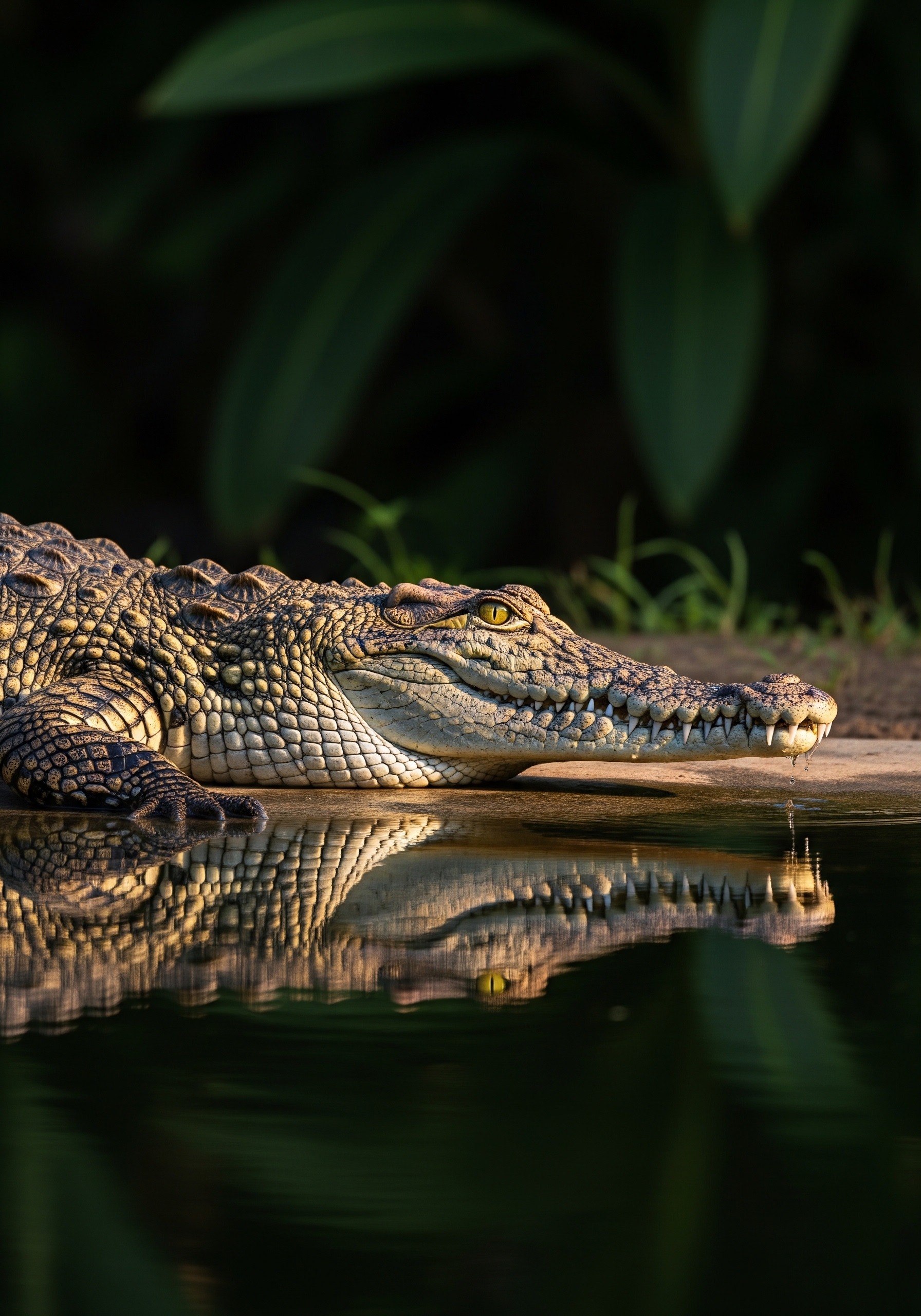
In a sleepy Costa Rican zoo in 2018, a female American crocodile that had not seen another of her kind in sixteen years did something biologists once thought impossible for her lineage: she laid a clutch of fourteen eggs, one of which contained a perfectly formed fetus genetically identical to her. Five years later, when the Royal Society’s Biology Letters finally published the case, the world learned that the list of any animal that can reproduce without mating just got considerably longer — and considerably stranger.
Key Facts
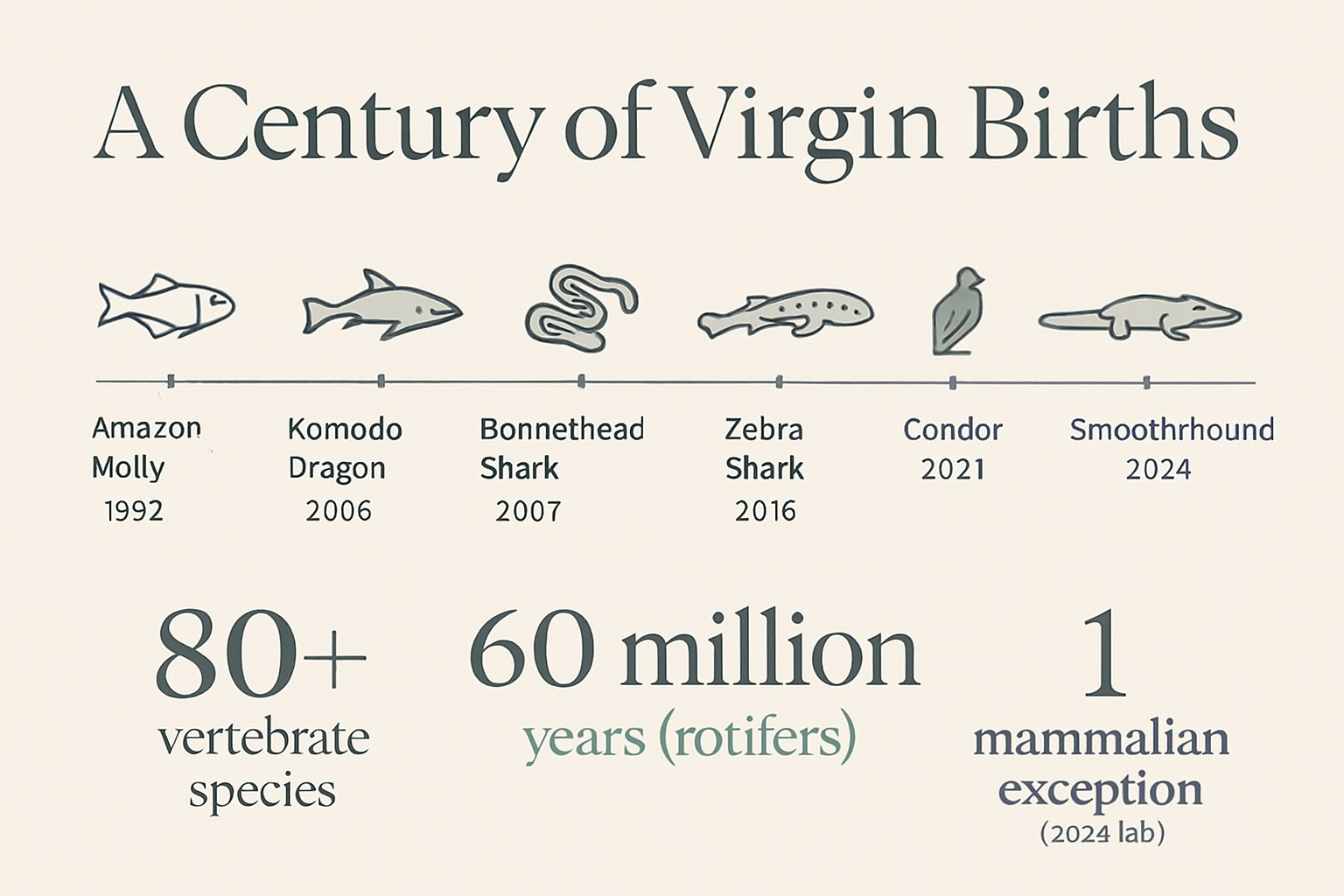
- Parthenogenesis — “virgin birth” — has now been documented in more than 80 vertebrate species, roughly half of them fish or lizards, plus countless invertebrates.
- The first confirmed virgin birth in a crocodilian was reported in 2023 by Warren Booth (Virginia Tech) and colleagues, from a female Crocodylus acutus held alone since 2002.
- The Amazon molly (Poecilia formosa), described as an all-female vertebrate by Carl and Laura Hubbs in 1932, was the first vertebrate ever shown to skip sex permanently.
- Mammals are the conspicuous holdout: a genetic safeguard called genomic imprinting blocks the trick — only an aggressive 2022 lab intervention by Wei and colleagues has ever overcome it in mice.
- Bdelloid rotifers, microscopic freshwater animals, have reproduced without males for an estimated 60 million years, with more than 460 described species.
In short: Across the animal kingdom, females from sharks to condors to crocodiles can — under the right conditions — produce viable offspring without a male. The science is no longer a curiosity; it is a serious window into reproduction, evolution, and what an endangered female alone in a tank might still be capable of.
Key Facts
- Parthenogenesis has now been documented in more than 80 vertebrate species, roughly half of them fish or lizards, plus countless invertebrates.
- The first confirmed virgin birth in a crocodilian was reported in 2023 by Warren Booth of Virginia Tech, from a female Crocodylus acutus held alone since 2002.
- The Amazon molly (Poecilia formosa) was described as an all-female vertebrate by Carl and Laura Hubbs in 1932 the first vertebrate ever shown to skip sex permanently.
- Mammals are blocked by genomic imprinting; only an aggressive 2022 lab intervention by Wei and colleagues overcame it in mice.
- Bdelloid rotifers have reproduced without males for an estimated 60 million years, across more than 460 described species.
In short: Parthenogenesis, reproduction without fertilization, has been documented in more than 80 vertebrate species plus countless invertebrates. Females from sharks to condors to crocodiles can produce viable offspring without a male. A landmark 2023 report described the first virgin birth in a crocodilian, a female American crocodile held alone since 2002 in Costa Rica.
A solo mother in Costa Rica
The female crocodile had been alone since she was two. Reptile-park staff had moved her into a single enclosure in 2002, and there she stayed — fed, observed, never mated. So when keepers found a clutch of fourteen eggs in early 2018, the simplest assumption was that something had gone unobserved. Wrong, it turned out.
Seven of the eggs looked viable. Staff incubated them. None hatched, but one contained a stillborn fetus complete enough to dissect, photograph, and — crucially — to sequence. The genetics, analyzed by Warren Booth’s lab at Virginia Tech, showed something unambiguous: the embryo carried only its mother’s DNA, and not in a simple cloned way either. It was the result of a fusion event inside her own egg cells.
Here’s the thing. Booth has spent two decades chasing this phenomenon in reptiles, and the crocodile case sat in his data set as a near-impossible outlier — until it didn’t. Crocodilians are part of an ancient group called archosaurs, the lineage that includes birds and once included dinosaurs. If a crocodile can do this, the trait probably runs deeper into evolutionary history than anyone had reason to suspect.
What “animal that can reproduce without mating” actually means
The technical term is parthenogenesis, from the Greek for “virgin creation.” Forget the fairy-tale framing: this is not cloning in the strict sense, and the offspring are almost never genetically identical copies of the mother. Most virgin-birth animals — and certainly the vertebrate ones — produce daughters (sometimes sons, in reptiles with ZW chromosomes) through a meiotic shortcut that recombines the mother’s chromosomes with herself.
Two flavors dominate, and the distinction matters because it predicts whether the offspring will be healthy or short-lived.
- Apomictic (true clones) — meiosis is skipped entirely; eggs form by mitosis. Offspring are genetic photocopies of the mother. Common in aphids, bdelloid rotifers, some whiptail lizards.
- Automictic (half-clones) — meiosis happens, then the egg “self-fertilizes” by fusing with a polar body. Most reptile and shark virgin births fall here. Offspring tend to be highly homozygous and often fragile.
{IMAGE_2}
Two ways to skip sex: the biology behind virgin births
Inside a normal egg, a cell called the oocyte divides twice during meiosis, jettisoning three “polar bodies” — discarded packets of DNA — to leave a single haploid egg waiting for a sperm. In automictic parthenogenesis, the egg simply reabsorbs one of those polar bodies. Diploidy restored. No sperm required.
Whether the offspring survive depends on which polar body fuses with what. Central fusion (between the egg and the second polar body) preserves much of the mother’s heterozygosity and yields the healthier outcomes — this is the route documented in zebra sharks and most pythons. Terminal fusion (between the products of the second meiotic division) collapses genetic diversity almost completely; offspring are nearly homozygous and rarely thrive in the wild. Both have been documented in captive snakes by Booth’s group.
Apomixis is rarer in vertebrates but common in invertebrates and a handful of all-female lizard lineages. The desert grassland whiptail (Aspidoscelis uniparens) reproduces this way — every individual is female, and every offspring is essentially a clone of her mother. The species has persisted for tens of thousands of generations without a single male.
| Animal | First documented | Where | Mode |
|---|---|---|---|
| Amazon molly (Poecilia formosa) | 1932 | Texas–Mexico border streams | Obligate, gynogenetic |
| Komodo dragon (Flora) | 2006 | Chester Zoo, England | Facultative, automictic |
| Bonnethead shark | 2007 | Henry Doorly Zoo, Nebraska | Facultative, automictic |
| Reticulated python (Thelma) | 2014 | Louisville Zoo, Kentucky | Facultative, automictic |
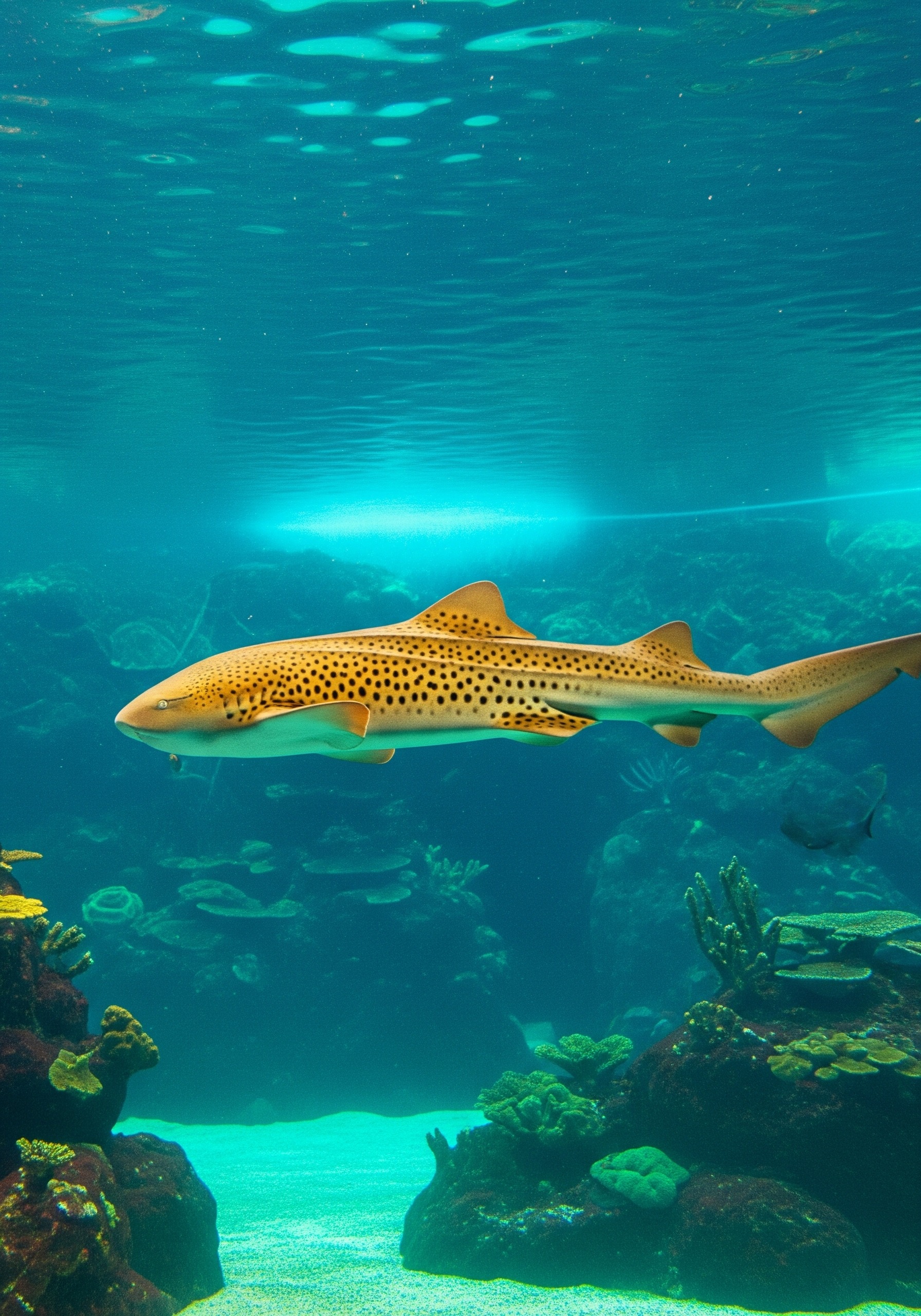
| Zebra shark (Leonie) | 2016 | Reef HQ Aquarium, Australia | Facultative, after sexual history |
| California condor | 2021 | San Diego Zoo Wildlife Alliance | Facultative, with males present |
| American crocodile | 2023 (event: 2018) | Parque Reptilandia, Costa Rica | Facultative, automictic |
| Common smooth-hound shark | 2024 | Italian aquariums | Recurrent (multiple years) |
The verified cases — from sharks to condors
Until the early 2000s, parthenogenesis in vertebrates was assumed to be the province of obscure fish and a few all-female lizard species. Then the captive cases started arriving, one after another, and most of them were embarrassing for the curators involved — because for years zoo staff had assumed sneaky mating, hidden sperm storage, or laboratory error.
Flora the Komodo dragon, at Chester Zoo in 2006, was the breakthrough. She had never been housed with a male; her eggs were sequenced by a team led by Phillip Watts of the University of Liverpool, and the offspring’s DNA was undeniably hers alone. A second female at London Zoo did the same thing in the same year. After that, the floodgates: bonnethead sharks in Nebraska, blacktip reef sharks in Virginia, zebra sharks in Townsville, pythons in Louisville, a pit viper in Missouri. Booth’s lab quietly built the catalogue.
The 2021 California condor case was the strangest. Two genetic surveys at San Diego Zoo Wildlife Alliance found that two male chicks, hatched in 2001 and 2009, carried no paternal DNA — even though their mothers were housed with fertile, sexually active males. Both birds died young, which fits the pattern of fragile homozygous parthenotes, but the implication unsettled the field: parthenogenesis may happen in the wild even when males are available, and we simply miss it because nobody sequences healthy-looking captive chicks.
Why mammals (including humans) can’t do this
Here is the part the headlines rarely get right. Mammals are not blocked from parthenogenesis because their eggs cannot self-activate — they can, and in fact human eggs occasionally do so in petri dishes, briefly. The block is a genetic safety system called genomic imprinting.
In mammals, certain genes are switched on only when inherited from the father, and others only from the mother. An embryo without paternal DNA inherits double doses of the maternal versions and zero of the paternal ones. The placenta, in particular, depends heavily on paternally imprinted genes — strip those out, and the pregnancy fails within weeks. Pig parthenotes typically die around day 30 with hypovascular placentas; mouse parthenotes never make it to birth without intervention.
The exception arrived in 2022, when Yanchang Wei and colleagues at Shanghai Jiao Tong University rewrote the methylation marks at seven imprinting control regions in mouse eggs and produced viable, fertile adult mice from unfertilized eggs. It is a laboratory feat that required gene-editing tools, not a process any wild mammal could perform on its own — but it does, at last, prove the imprinting barrier is the only barrier. A 1995 case of a partial human chimera, reported in Nature Genetics, hints that a few human cells can survive on a parthenogenetic genome, but nothing close to a viable human pregnancy has ever been documented or is biologically plausible without intervention.
Honest aside: this is the single most over-hyped part of the topic. No, your cat cannot. No, no woman has. And the New Testament reference, for what it’s worth, is a theological claim, not a biological one.
The 2024 surprise: recurrent parthenogenesis
Until very recently, every vertebrate virgin birth in the literature was framed as a one-off — a strange flicker, usually in a female with no other option. The assumption was that a healthy female with a mate would always pick sex. A 2024 study published in Scientific Reports, led by Antonio Di Natale and colleagues at the Acquario di Cala Gonone in Sardinia, blew that assumption apart.
Two captive female common smooth-hound sharks (Mustelus mustelus), held with no males, alternated parthenogenetic pregnancies year after year — at least four documented cycles. This is the first published case of recurrent facultative parthenogenesis in a vertebrate, and it changes the question. Virgin birth is not just an emergency reproductive fallback; in some species it can be a sustained reproductive strategy, repeated across seasons by the same individual.
For an endangered species like Mustelus mustelus — listed by the IUCN — that finding is more than a curiosity. It suggests that lone surviving females in the wild might keep populations limping along for longer than demographic models predict, though the resulting offspring’s genetic fragility is a serious caveat.
What this means for dinosaurs and conservation
Because crocodiles and birds are both archosaurs, and both groups now have documented virgin births, the trait is most parsimoniously interpreted as ancestral to the entire archosaur lineage. That includes the non-avian dinosaurs. There is no way to prove it, of course — soft-tissue reproductive biology does not fossilize — but the cladistic logic is clean: if the two surviving branches do it, the common ancestor almost certainly could too. Picture a lone female sauropod, last of her clutch in a drying floodplain, laying eggs that contain something. It is not implausible.
The conservation implications are immediate. For critically endangered species held in single-female captivity — pit vipers, certain lizards, perhaps even some condor populations — parthenogenesis is no longer a charming anomaly. It is a measurable, sometimes recurrent reproductive route that conservation programs need to account for: genetically, demographically, and ethically. (The genetically fragile offspring are still vulnerable; this is not a substitute for breeding programs, only an additional consideration.) The recent Charlotte the stingray story — where a North Carolina aquarium initially announced a virgin pregnancy that turned out, sadly, to be a tumor — is a useful reminder that not every unexplained pregnancy is a parthenogenetic miracle. The science is real; the rush to headline it is the part that needs care.
And the deeper truth, the one worth sitting with: the fact that life finds this many backdoors around the requirement to find a mate suggests that sex, however dominant a strategy, is not the only door. Evolution, given enough time and a stubborn female, builds spares.
Frequently Asked Questions
Q: What animals can reproduce without a male?
A: More than 80 vertebrate species have been documented, including Komodo dragons, several shark species (zebra, bonnethead, blacktip reef, smooth-hound), reticulated and Burmese pythons, the American crocodile, California condors, the Amazon molly, and dozens of whiptail-lizard lineages. Among invertebrates the list is much longer — aphids, many bees and wasps, water fleas, scorpions, stick insects, bdelloid rotifers, and some tardigrades.
Q: Can a chicken or turkey lay a fertilized egg without a rooster?
A: Turkeys, occasionally yes — parthenogenetic embryos have been documented in domestic turkeys since the 1950s, though they rarely hatch. Chickens, extremely rarely; the trait was bred out long ago. The standard supermarket egg is unfertilized and never will become a chick.
Q: Are the babies clones of the mother?
A: Usually no. In automictic parthenogenesis (most reptiles, sharks, birds) the offspring are “half-clones” — highly homozygous, but not identical. True genetic clones occur only in apomictic species like aphids and certain whiptail lizards.
Q: Could humans ever do this?
A: Not naturally. Human eggs sometimes self-activate briefly in lab settings, but a viable pregnancy is blocked by genomic imprinting. The 2022 mouse breakthrough by Wei and colleagues required precise gene-editing of seven imprinting regions — that is technology, not biology.
Sources
- Booth, W. et al., Biology Letters, Royal Society — first reported case of parthenogenesis in Crocodylus acutus, 2023
- Watts, P.C. et al., Nature — parthenogenesis in Komodo dragons, 2006
- Ryder, O.A. et al., Journal of Heredity, San Diego Zoo Wildlife Alliance — facultative parthenogenesis in California condors, 2021
- Di Natale, A. et al., Scientific Reports — recurrent parthenogenesis in Mustelus mustelus, 2024
- Wei, Y. et al., PNAS, Shanghai Jiao Tong University — viable mice from unfertilized eggs via imprinting rewrite, 2022
- Hubbs, C.L. and Hubbs, L.C. — original description of Poecilia formosa, 1932
Every few years a zookeeper finds an impossible clutch in a tank, and a quiet shake-up follows. The list of any animal that can reproduce without mating grows by one — sometimes by a whole branch of the tree of life — and our sense of what reproduction actually requires gets a little humbler. The crocodile in Costa Rica is alone, and yet not entirely so.
Illustrations are AI-generated. Article fact-checked and human-edited. Our editorial standards.