Polypedilum vanderplanki: The Midge That Survives Drying Out
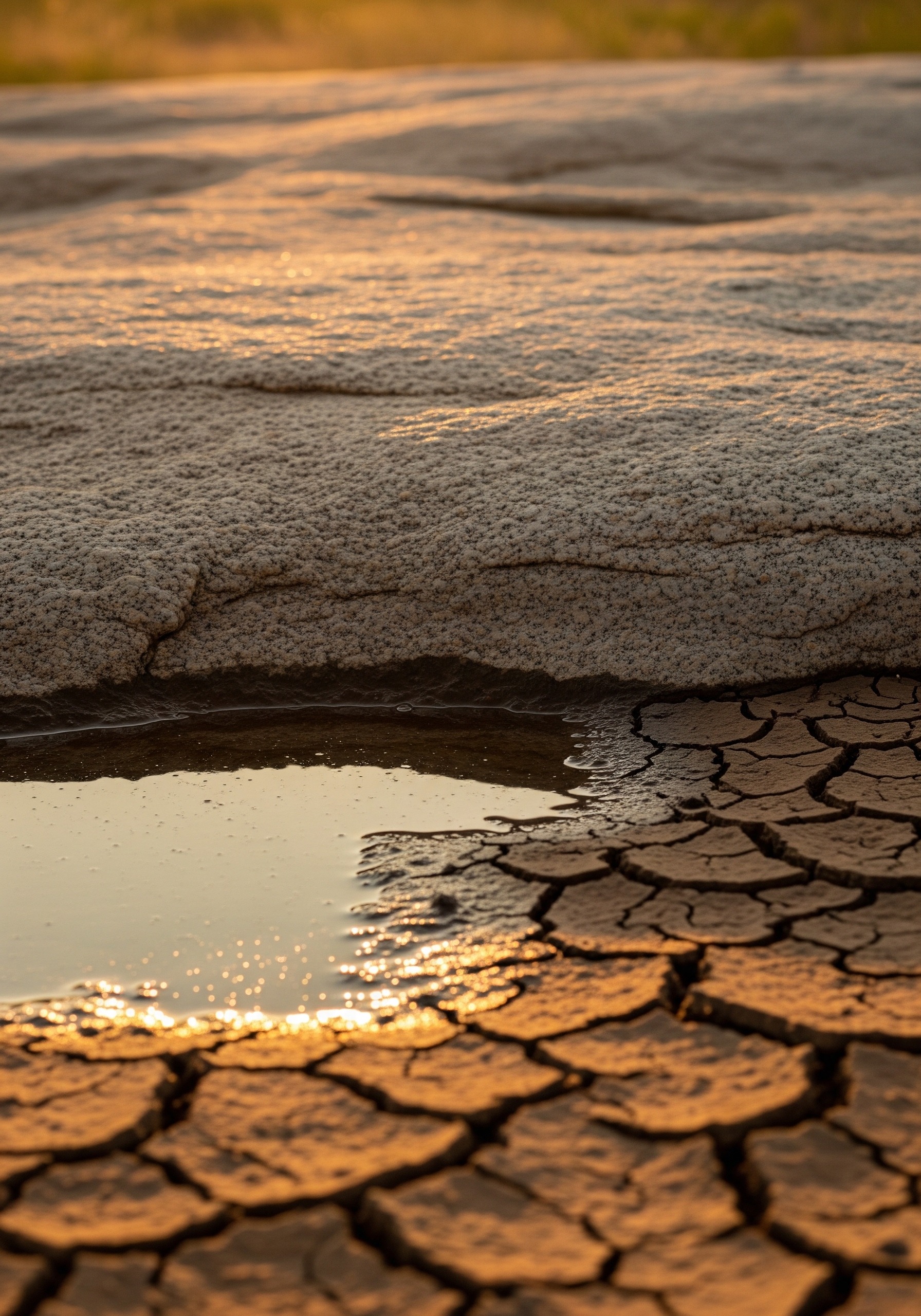
In the parched rock pools of northern Nigeria, the larva of Polypedilum vanderplanki does something no other insect on Earth can do — it dries out completely, sits in the dust for years, and then, with a single drop of rain, wakes back up.
Key Facts
- Native to temporary granite rock pools in semi-arid sub-Saharan Africa; described by British entomologist Howard E. Hinton in 1951 from specimens collected near Kano, Nigeria.
- Larvae lose up to 97% of their body water, dropping to roughly 3% moisture by weight, and still revive.
- In their dry state they have survived liquid-helium cold (around −270°C) and oven temperatures above +100°C.
- Dried larvae spent 18 months bolted to the outside of the International Space Station on the Russian–Japanese BIORISK experiment and revived after returning to Earth.
- The longest verified laboratory revival to date is at least 17 years in dry storage at room temperature.
In short: Polypedilum vanderplanki is a small African midge whose larva can be dried to a husk for years and brought back to life by water. The trick is not a tougher cell; it is a sugar called trehalose that turns the larva’s insides into a kind of biological glass.
Key Facts
- Polypedilum vanderplanki is a non-biting midge native to temporary granite rock pools in semi-arid sub-Saharan Africa, described by Howard E. Hinton in 1951 near Kano, Nigeria.
- Its larvae lose up to 97% of their body water, dropping to roughly 3% moisture by weight, and still revive.
- In their dry state the larvae have survived liquid-helium cold around -270 C and oven temperatures above +100 C.
- Dried larvae spent 18 months bolted to the outside of the International Space Station on the Russian-Japanese BIORISK experiment and revived after returning to Earth.
- The trick is the sugar trehalose, which vitrifies the larva’s interior into a biological glass; the longest verified lab revival is at least 17 years.
In short: Polypedilum vanderplanki is a small African midge whose larva can dry to a husk for years and revive with a drop of water. It loses up to 97% of its body water, surviving temperatures from about -270 C to above +100 C. The trick is the sugar trehalose, which turns the larva’s insides into a biological glass.
What Polypedilum vanderplanki actually is
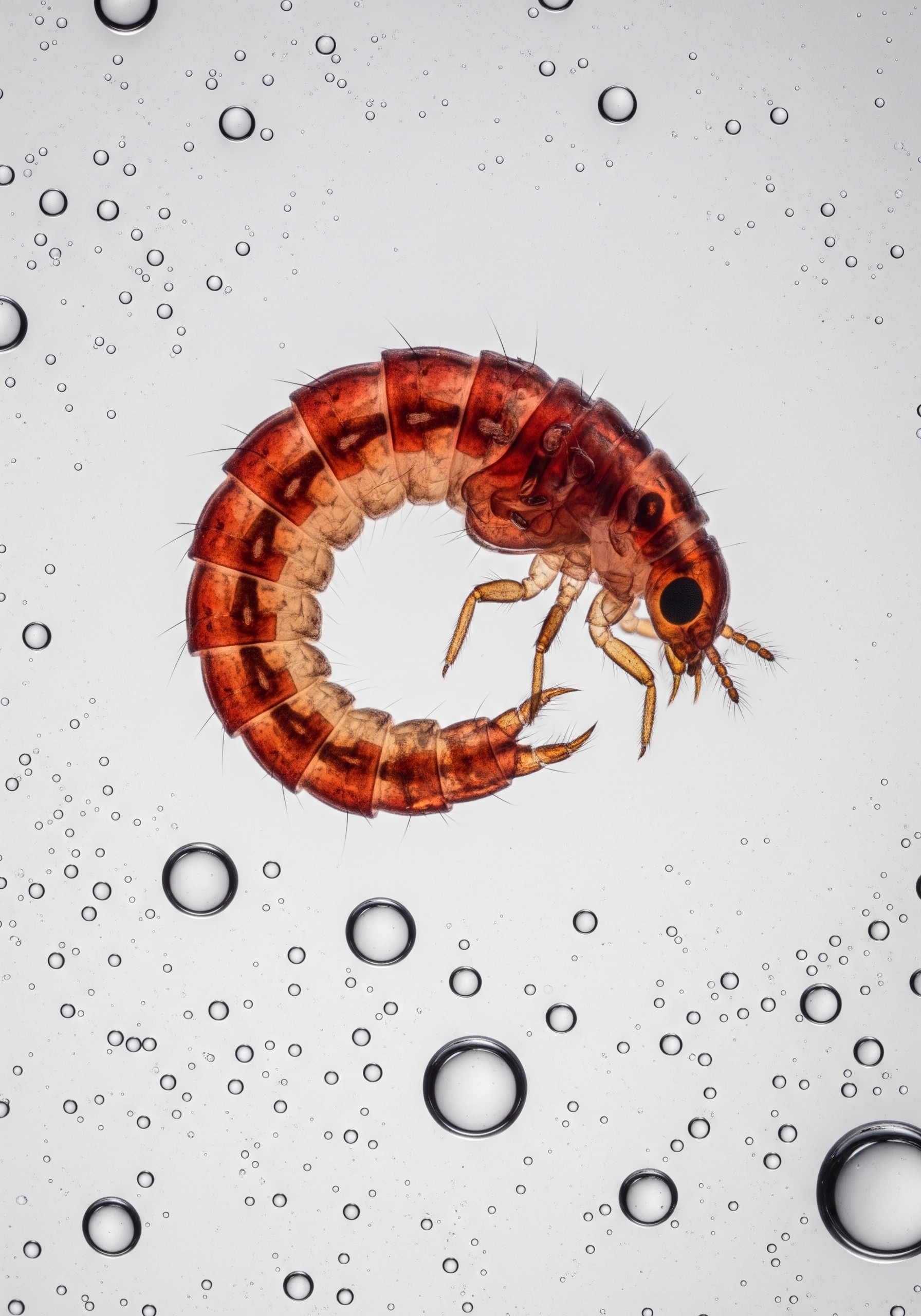
Strip away the headlines and Polypedilum vanderplanki is, on paper, unremarkable: a non-biting midge in the family Chironomidae, roughly the size of a mosquito, with a short adult life of a few days. It lives across the semi-arid belt of sub-Saharan Africa — populations are best documented in northern Nigeria, Uganda, and Malawi — and lays its eggs in shallow pools of rainwater that collect in granite outcrops.
What is remarkable is the design problem its larvae face. Those rock pools are not seasonal in any gentle sense. They are weather. A pool can hold water for a week and then evaporate to powder in a day. A mosquito larva caught in that pool dies.
The larva of P. vanderplanki goes to sleep.
The Nigerian rock pool that started it all
The story begins in 1951, in the Proceedings of the Zoological Society of London. Howard E. Hinton, then a curator at the British Museum (Natural History), published a paper with a quietly explosive title: “A new Chironomid from Africa, the larva of which can be dehydrated without injury.” Hinton had taken larvae collected from rock pools in northern Nigeria, dried them, and watched them walk back into life when he added water hours later.
For two decades the discovery was filed under “exotic invertebrates.” Hinton himself spent the rest of his career chasing the obvious question: what, exactly, was happening inside that dried-out body? The molecular answer would not arrive until the late 1990s and the 2000s, in laboratories an ocean away from his rock pools — most of them in Tsukuba, Japan.
{IMAGE_2}
Anhydrobiosis is not the same as cryptobiosis
Most popular pieces use the words interchangeably. They are not interchangeable, and the difference matters if you want to understand what this animal is actually doing.
Cryptobiosis — a term coined by the Cambridge biologist David Keilin in 1959 — is the umbrella label for any state in which an animal’s metabolism falls to undetectable levels and life resumes when conditions improve. It comes in four flavours: anhydrobiosis (no water), cryobiosis (deep cold), osmobiosis (high salt), and anoxybiosis (no oxygen). Tardigrades, brine shrimp eggs, and some soil nematodes all use one or more of these.
Anhydrobiosis is specifically the dry-state version, and Polypedilum vanderplanki is its undisputed insect specialist. It is, in fact, the only known insect that performs full anhydrobiosis as a juvenile and goes on to complete a normal winged adult life. That last detail separates it from the tardigrade: a tardigrade in cryptobiosis is itself, paused; a P. vanderplanki larva pauses, then grows up.
The molecular trick: trehalose and a glass made of sugar
Here’s the thing. When you dehydrate a cell quickly, the membranes collapse and the proteins denature, and the cell dies. To survive drying you cannot simply remove water — you have to replace it with something else that holds the molecular furniture in place.
Polypedilum vanderplanki replaces water with trehalose, a non-reducing disaccharide of two glucose units. As the rock pool evaporates, the larva — sensing the rising salt concentration in its own tissues — flips a metabolic switch and starts synthesising trehalose in industrial quantities. Speed matters. Work led by entomologist Takahiro Kikawada at Japan’s National Institute of Agrobiological Sciences (NIAS) found that larvae dried slowly over roughly 48 hours produced about 38 micrograms of trehalose each and recovered after rehydration. Larvae dried three times faster managed only about 7 micrograms — and none came back.
So what does the trehalose actually do? Two things. It hydrogen-bonds with cell membranes and proteins, holding them in their hydrated geometry even when the water that normally did that job is gone. And as the larva continues to dry, the trehalose itself stops behaving like a liquid and enters a glassy, immobile state — a process called vitrification. The larva’s cytoplasm becomes, quite literally, a glass. Inside that glass, every molecule is frozen in place; nothing can react, decay, or unfold. Trehalose is not the only player — heat-shock proteins, antioxidant systems, and an unusual family of late embryogenesis abundant (LEA) proteins all join in — but vitrification is the headline.
Surviving the impossible: space, helium, radiation
Once a P. vanderplanki larva is sealed inside its trehalose glass, ordinary biology stops applying. The numbers are not metaphors; they are laboratory results.
What a dried sleeping chironomid has survived
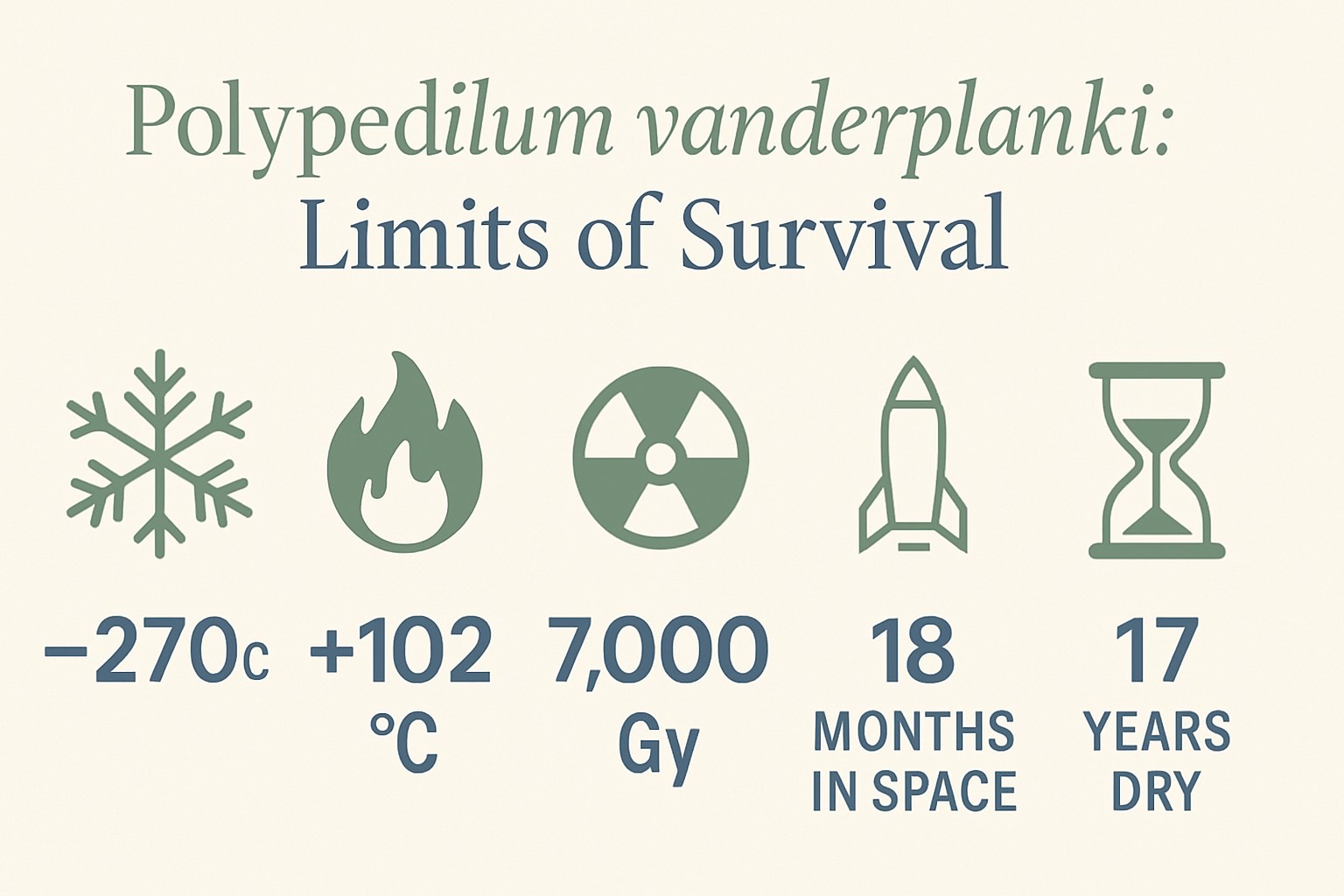
- Temperature: from about 3 K (−270°C, liquid helium) to roughly 375 K (+102°C).
- Radiation: 7,000 Gray of gamma rays — roughly 1,400 times the human lethal dose.
- Outer space: 18 months bolted to the exterior of the International Space Station; many larvae revived after return.
- Chemistry: immersion in 100% ethanol, then rehydration — survival.
- Time: documented revival after at least 17 years of dry storage at room temperature.
The space experiment, run as part of the Russian BIORISK programme by a team that included Russian biologist Natalia Novikova and Japanese collaborators, was the cleanest demonstration of all. Larvae glued to the station’s exterior received the full thermal cycling of low Earth orbit and a season’s worth of cosmic radiation. When they came home and got wet, they got up.
By any reasonable measure of toughness, this small African midge is the most extraordinary animal on this planet. A hibernating grizzly bear can go roughly five months without drinking; a dried P. vanderplanki larva can go almost two decades and counting.
Why only the larvae sleep — and what the adults do
A reasonable reader question: if this trick is so spectacular, why doesn’t every stage of the midge use it? The answer is part anatomy, part ecology.
The adult Polypedilum vanderplanki is a brief flying insect. It lives a few days, mates, lays eggs, dies. It has no dry season to bridge because it doesn’t try to bridge one. The pupa is similarly fleeting.
The larva is the only stage that gets stranded — and the only stage with the right body for vitrification. It is small (about 5 mm long), tucked inside a tubular nest of mud at the pool bottom, with a thick cuticle that slows water loss to a tolerable rate. The mud nest is the larva’s slow-drier. Strip it of that nest and the trehalose machine cannot finish its work in time, and even P. vanderplanki dies. Engineering, not magic.
Why this matters: medicine, vaccines, and the Pv11 cell line
If you could borrow whatever this insect does and apply it to a human red blood cell, or to a vial of vaccine, you would change medicine. The cold chain — the global refrigerated infrastructure that keeps vaccines, blood products, organs and biologics viable — exists precisely because most biology dies at room temperature. Dry-stable, shelf-stable biologics would not need it.
In 2010 Kikawada’s group at NIAS succeeded in establishing the first permanent insect cell line that retains the trehalose-based desiccation tolerance of the whole animal. It is known as Pv11, derived from P. vanderplanki embryos. Pv11 cells can be air-dried, stored at room temperature for months, and rehydrated with viability preserved — something no mammalian cell line can yet do. They are now used as a model system for engineering dry-storage tolerance into other cell types.
Then, in 2014, a team led by Oleg Gusev, Richard Cornette, Yoshitaka Suetsugu and Kikawada published the species’ full genome sequence in Nature Communications, alongside that of the closely related but desiccation-sensitive midge Polypedilum nubifer. The comparison was the point. P. vanderplanki carried hugely expanded clusters of anhydrobiosis-related genes — trehalose metabolism, LEA proteins, antioxidant systems, heat-shock factors — that simply were not there in its non-tolerant cousin. The paper gave biotechnology, for the first time, a usable parts list.
Whether any of this ever becomes a working dry vaccine in a real human clinic is, honestly, an open question. Insect trehalose machinery does not transfer cleanly into mammalian cells; LEA proteins do not fold the same way in our cytoplasm. But the species has handed us a working blueprint to copy, which is more than evolution usually offers.
Frequently Asked Questions
Q: How long can Polypedilum vanderplanki survive without water?
A: The longest verified laboratory revival is at least 17 years from a dry-storage cabinet at room temperature. Field estimates suggest considerably longer dormancy may be possible — the larva does not appear to “age” while vitrified — but only the documented number should be quoted with confidence.
Q: Is the sleeping chironomid the same kind of animal as a tardigrade?
A: No. Tardigrades are tiny eight-legged animals in their own phylum (Tardigrada). P. vanderplanki is a true insect — a midge in the order Diptera, family Chironomidae. Both groups use cryptobiosis to survive drying, but their lineages and biochemistry are independent inventions of a similar trick. P. vanderplanki is the only insect known to perform full larval anhydrobiosis.
Q: Where exactly does this midge live?
A: In ephemeral rock pools and clay-bottomed depressions across semi-arid sub-Saharan Africa. Populations are best documented in northern Nigeria (the type locality), Uganda, and Malawi. The pools are typically shallow, granite-bedded, and dry out within days of the rains stopping.
Q: Could humans ever use the same survival trick?
A: Not directly. Human cells do not synthesise trehalose, and human cell membranes are not built for vitrification. Research with the Pv11 cell line is actively exploring how to transfer fragments of the system — trehalose transporters, specific LEA proteins — into mammalian cells. Practical medical applications remain experimental.
Sources
- Hinton, H. E. (1951). “A new Chironomid from Africa, the larva of which can be dehydrated without injury.” Proceedings of the Zoological Society of London.
- Watanabe, M., Kikawada, T. and Okuda, T. — desiccation tolerance and trehalose synthesis studies, Journal of Experimental Biology and related work, 2002–2006, National Institute of Agrobiological Sciences, Tsukuba.
- Gusev, O., Suetsugu, Y., Cornette, R., Kikawada, T. and co-authors (2014). “Comparative genome sequencing reveals genomic signature of extreme desiccation tolerance in the anhydrobiotic midge.” Nature Communications.
- Cornette, R., Kikawada, T. and colleagues — research on LEA proteins, the Pv11 anhydrobiotic cell line, and transmembrane LIL proteins, NIAS / RIKEN.
- Novikova, N., Gusev, O. and colleagues — BIORISK / EXPOSE survival experiments on dried P. vanderplanki larvae aboard the International Space Station.
Polypedilum vanderplanki is small, drab, and almost never seen outside a few African valleys. It is also, by any honest measure, one of the strangest engineering achievements in the animal kingdom — a creature that can stop being alive without ever ceasing to exist, and start again whenever the rain returns. Sometimes evolution writes a sentence that simple.
Illustrations are AI-generated. Article fact-checked and human-edited. Our editorial standards.