The Deadliest Animals to Humans, Ranked by Annual Deaths
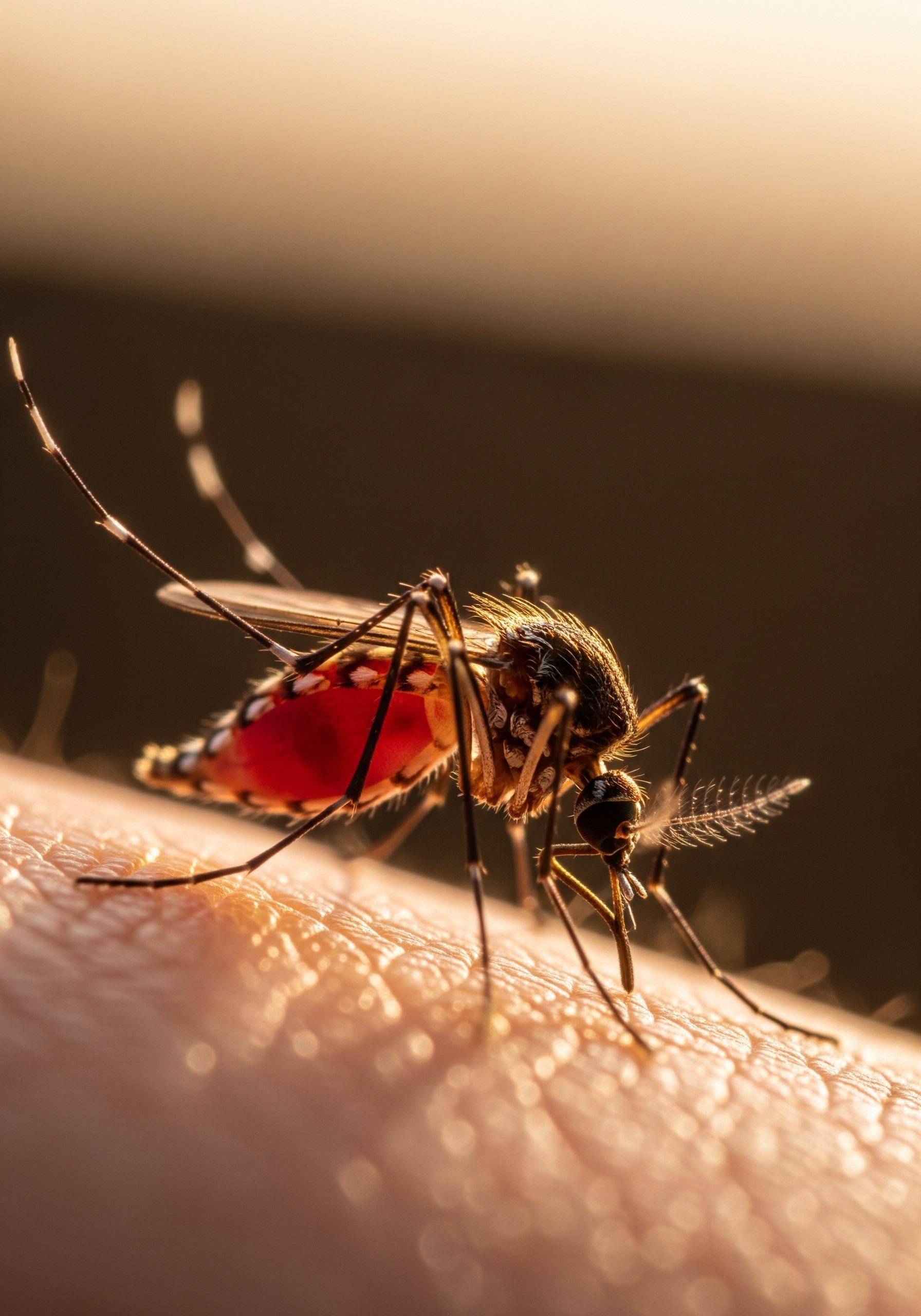
The deadliest animals to humans are almost never the ones we picture. We imagine a lion, a shark, a coiled cobra. The actual top killer is small enough to crush between two fingers — and it is, in any given year, on track to take more lives than the next nine animals on the list combined.
Key Facts
- Mosquitoes are responsible for roughly 725,000 to 1,000,000 human deaths every year, the great majority through malaria.
- The World Health Organization recorded about 597,000 malaria deaths across 83 countries in 2023 — nearly all of them children under five in sub-Saharan Africa.
- Venomous snakes kill an estimated ~100,000 people annually, with a single Toronto-led mortality study finding India alone lost an average of 58,000 lives a year to snakebite between 2000 and 2019.
- Domestic dogs are linked to around 30,000–40,000 human deaths a year, almost entirely through transmitted rabies — not bite wounds.
- Sharks, by contrast, kill an average of fewer than ten people worldwide annually, according to the Florida Museum’s International Shark Attack File.
In short: when researchers rank the most dangerous animals to humans by annual deaths, the list is dominated not by predators but by disease vectors. The actual killers fly, slither, or live in your house — and the gap between perception and reality is roughly one-thousand-fold.
Key Facts
- Mosquitoes are responsible for roughly 725,000 to 1,000,000 human deaths every year, the great majority through malaria.
- The World Health Organization recorded about 597,000 malaria deaths across 83 countries in 2023, nearly all of them children under five in sub-Saharan Africa.
- Venomous snakes kill an estimated 100,000 people annually; India alone lost an average of 58,000 lives a year to snakebite between 2000 and 2019.
- Domestic dogs are linked to around 25,000 to 40,000 human deaths a year, almost entirely through transmitted rabies.
- Sharks kill an average of fewer than ten people worldwide annually, according to the Florida Museum’s International Shark Attack File.
In short: Ranked by annual deaths, the deadliest animals to humans are disease vectors, not predators. Mosquitoes kill roughly 725,000 to 1,000,000 people a year, mainly through malaria; the WHO recorded about 597,000 malaria deaths in 2023. Snakes kill around 100,000, dogs 25,000 to 40,000 via rabies, while sharks kill fewer than ten people worldwide.
Why the Most Dangerous Animal Is the One You’d Least Suspect

Pull up any deadliest animals list and roughly the same lineup appears in roughly the same order. Mosquito at the top. Snake in the next slot. Hippo, crocodile, dog, scorpion scattered through the middle. The order is correct. The story most lists tell about it is not.
Here’s the thing. The shark you fear isn’t on the list because sharks aren’t dangerous — a bull shark, tiger shark or great white can kill a swimmer in under a minute. Sharks are absent because almost nobody meets one. The mosquito tops every list for the opposite reason: a single mosquito is barely a threat, but there are trillions of them, they bite billions of times every day, and a tiny fraction of those bites carry a parasite that has been killing humans for as long as humans have existed.
Deadliness, then, is really two numbers multiplied together: how lethal an encounter is, and how often the encounter happens. Predators win on the first axis. Vectors win, by an absurd margin, on the second.
The Top 10 Deadliest Animals to Humans, Reconciled
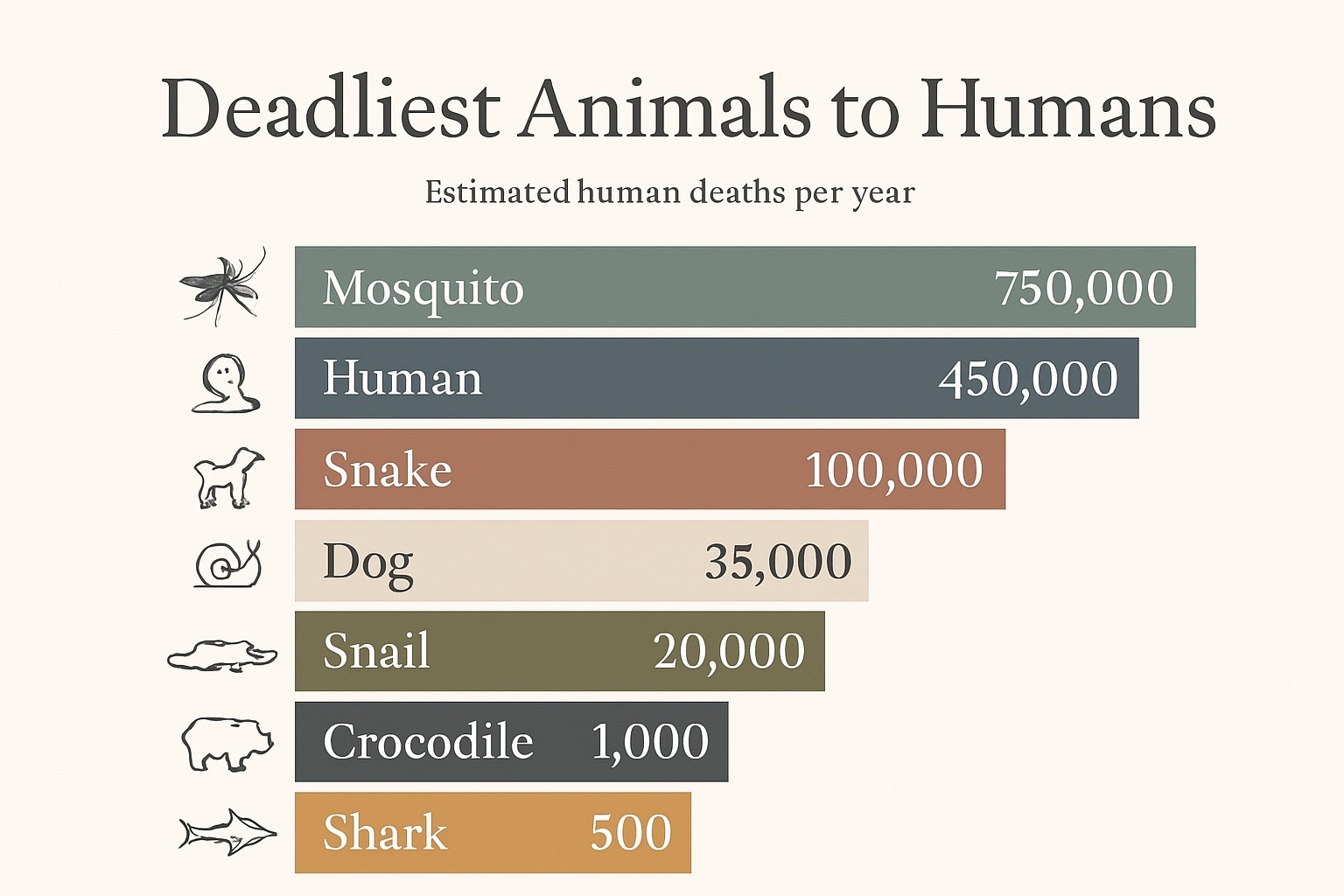
Here is the ranking the major sources broadly agree on — with the range each one gives, because (and this is the part most lists quietly omit) reputable institutions disagree by enough that the choice of source changes the picture. Cross-referencing Our World in Data, the World Health Organization, the U.S. CDC, Statista and the BBC yields this:
| Rank | Animal | Estimated human deaths / year | Cause of death |
|---|---|---|---|
| 1 | Mosquito | ~725,000 – 1,000,000 | Malaria, dengue, yellow fever, Zika, West Nile |
| 2 | Humans (homicide) | ~430,000 – 475,000 | Intentional violence |
| 3 | Snakes | ~50,000 – 138,000 | Envenoming, mostly in South Asia |
| 4 | Dogs | ~25,000 – 40,000 | Rabies transmission |
| 5 | Freshwater snails | ~10,000 – 200,000 | Schistosomiasis (parasite vector) |
| 6 | Assassin bugs (kissing bugs) | ~10,000 | Chagas disease |
| 7 | Scorpions | ~2,600 – 3,250 | Envenoming |
| 8 | Crocodiles | ~1,000 | Predation, mostly in Africa |
| 9 | Hippopotamus | ~500 | Direct attack |
| 10 | Elephants, lions, sharks combined | ~600 – 800 combined | Direct attack |
Two things in that table almost no other deadliest animals list shows you. First, the ranges are wide — the snake estimate doubles depending on the source. Second, the gap between rank 1 and rank 10 is not a doubling or even a ten-fold. It’s roughly a thousand-fold. That is the whole story of human mortality from animals in a single line.
{IMAGE_2}
Mosquitoes: Why the Number Just Shifted, Quietly
If you read a “mosquitoes kill a million people a year” headline before about 2020, it was citing the era when sub-Saharan malaria deaths were closer to 600,000 and the dengue and yellow fever totals on top pushed the figure near a million. The figure today is lower and the underlying picture has shifted.
The WHO’s most recent World Malaria Report counts about 263 million malaria cases and 597,000 malaria deaths in 2023, spread across 83 countries. Roughly 95% of those deaths occur in sub-Saharan Africa, and around three-quarters are children under five. Layer on dengue (rising), yellow fever (controlled but resurgent in pockets), Zika, chikungunya, West Nile and Japanese encephalitis, and the mosquito’s annual human toll lands somewhere between 725,000 and a million.
Two trends are pulling that number in opposite directions. New tools — the R21 and RTS,S malaria vaccines, next-generation bednets, single-dose ivermectin trials — are saving lives at scale. Climate-driven range expansion of the Aedes and Anopheles genera is pushing the disease into places that have no recent memory of it. The U.S. CDC noted that in 2023, for the first time in 20 years, locally acquired malaria appeared on American soil — ten cases across Florida, Texas, Maryland and Arkansas. That is a small number. It is also a line being crossed.
If you want to read about a place where mosquitoes have already rewritten an entire ecosystem, see our piece on the blood-red Hawaiian bird that one mosquito bite can kill.
Snakes: The 100,000 Estimate, and the Researcher Who Rewrote It
For years the standard figure for global snakebite mortality was around 100,000 deaths a year. It was good as ballpark, fragile as data. Snakebite happens overwhelmingly in poor, rural, agricultural communities where hospital death certificates often don’t exist — and where, when they do, “snake” is rarely written on them.
The cleanest answer came from a team led by epidemiologist Prabhat Jha, director of the Centre for Global Health Research at the University of Toronto. Using India’s Million Death Study — verbal autopsies of more than a million households — Jha and colleagues concluded in 2020 that India alone had lost roughly 1.2 million people to snakebite between 2000 and 2019, averaging about 58,000 deaths a year. That single-country figure is more than half of the global estimate.
The herpetologist Romulus Whitaker, founder of the Madras Crocodile Bank and the Centre for Herpetology in Tamil Nadu, has spent decades arguing the obvious follow-up: the four species responsible for the majority of those deaths — Russell’s viper, saw-scaled viper, common krait and Indian cobra — are well known, their venoms well studied, and effective antivenom exists. The killer here is not biology. It is the gap between rural farmer and stocked rural clinic.
This is the editorial point worth making bluntly: snakebite remains the world’s most neglected major cause of death, and the fact that a verified antidote exists for most fatal bites makes it the rare top-ten killer that could be cut in half within a generation by logistics alone.
Dogs, Rabies, and a Killer Hiding in a Friend
Roughly 30,000 to 40,000 people die each year from dog-related causes, and the surprise (for many readers) is the cause of death. Almost none of those deaths are from the bite itself. They are from rabies — a virus that, once it reaches the brain, kills more than 99% of the people it infects. Dogs are the vector for an estimated 99% of human rabies cases worldwide.
The good news, rarely told: rabies is one of the most preventable diseases on the deadliest-animals list. A bite cleaned within minutes, followed by post-exposure prophylaxis, is near-perfectly protective. Mass dog vaccination — covering roughly 70% of the dog population in a region — collapses transmission. The countries that have done it have effectively eliminated human rabies. The countries where 30,000+ people still die from it are the countries that haven’t.
The Animals We Fear More Than They Deserve
Sharks. Of about 70 unprovoked shark encounters logged annually by the Florida Museum’s International Shark Attack File, between four and ten end in a human death. In an average year, more Americans are killed by vending machines toppling over than by sharks worldwide.
Spiders. The reputation badly outruns the data. Even in Australia — home to the Sydney funnel-web and the redback — there has not been a recorded death from a Sydney funnel-web spider since antivenom was introduced in 1981. Worldwide spider-attributable deaths run in the very low double digits per year, lower than deer.
Bears, wolves, big cats. Lethal individually, almost statistical noise globally. Combined, large carnivores kill fewer people in a year than mosquitoes kill in roughly six hours.
This is not an argument that any of these animals is harmless. It is an argument that fear, as a guide to risk, is broken.
Exposure × Lethality: The Honest Framework
The clean way to read the deadliest animals list is to hold two columns in your head.
Lethality is how likely an encounter is to kill you. A great white shark scores high here. A mosquito scores almost zero — most bites do nothing, and only a fraction of mosquitoes in malaria zones carry the parasite.
Exposure is how many encounters happen. Sharks score almost zero — most humans live their whole life without meeting one. Mosquitoes score in the trillions of bites per day.
Multiply the two and you get expected deaths. That product is what every honest ranking is really measuring. It also explains why every intervention that works — bednets, vaccines, antivenom distribution, vector control, dog vaccination — targets the exposure column. We can’t make a cobra less lethal. We can keep it out of the bedroom.
What’s Changing in 2026
A few moving pieces are worth tracking. Malaria deaths in Africa have plateaued after decades of decline; resistance to artemisinin-based therapies has been confirmed in parts of East Africa, and the WHO has flagged it as a serious concern. Dengue had its worst global year on record in 2024, with the Americas reporting more cases than ever previously recorded. The mosquito species Anopheles stephensi, an urban malaria vector previously confined to South Asia, has established itself in several Horn of Africa cities — a quiet, consequential shift.
On the better side: a second malaria vaccine, R21/Matrix-M, is now rolling out across Africa alongside RTS,S. Snakebite was officially added to the WHO’s list of Neglected Tropical Diseases in 2017 with a stated goal of halving deaths by 2030, and antivenom production has begun (slowly) to scale.
The deadliest animals list, in other words, is not fixed. The mosquito will almost certainly hold the top spot for the rest of the decade. Everything below it is in motion.
Frequently Asked Questions
Q: What is the #1 deadliest animal to humans?
A: The mosquito, by an enormous margin. Mosquito-borne diseases — chiefly malaria, but also dengue, yellow fever, Zika and West Nile — kill an estimated 725,000 to 1,000,000 people every year. No other animal comes close.
Q: Are humans really the second deadliest animal?
A: Yes, in the sense most lists use the term. The United Nations Office on Drugs and Crime puts annual global homicides at roughly 430,000–475,000, which places humans second behind mosquitoes on every major ranking that counts human deaths caused directly by an animal.
Q: Why aren’t sharks, bears and lions higher on the list?
A: Because deadliness equals lethality multiplied by exposure. A single encounter with any of those animals can be fatal, but encounters are vanishingly rare. Sharks kill an average of fewer than ten people worldwide each year — far less than hippos (about 500) or even domestic cows.
Q: Which animal kills the most people in the United States?
A: Statistically, deer — through vehicle collisions, which cause around 200 U.S. deaths a year. Bees, wasps and hornets account for roughly 60–100 fatal sting reactions annually. Dogs cause about 30–50 fatal attacks. Sharks, in a typical year, kill one American or none.
Sources
- World Health Organization — World Malaria Report 2024 (2023 case and death data).
- U.S. Centers for Disease Control and Prevention — global health mosquito briefings, including the 2023 U.S. locally acquired malaria cases.
- Our World in Data — “What are the world’s deadliest animals?” (Hannah Ritchie, with data from the Institute for Health Metrics and Evaluation).
- Suraweera, Warrell, Whitaker, Jha et al. — “Trends in snakebite deaths in India from 2000 to 2019,” eLife, 2020.
- Florida Museum of Natural History — International Shark Attack File annual summary.
The list of the deadliest animals to humans is, in the end, a quiet lesson in scale. The animals that frighten us most barely register; the ones we swat without thinking carry a third of a city’s worth of lives every year. Knowing which is which is not just a piece of trivia. It’s how every intervention that has ever saved a life from an animal got started — by counting honestly, and going after exposure.
Illustrations are AI-generated. Article fact-checked and human-edited. Our editorial standards.