Great Horned Owl Facts for Kids: The Tiger of the Sky
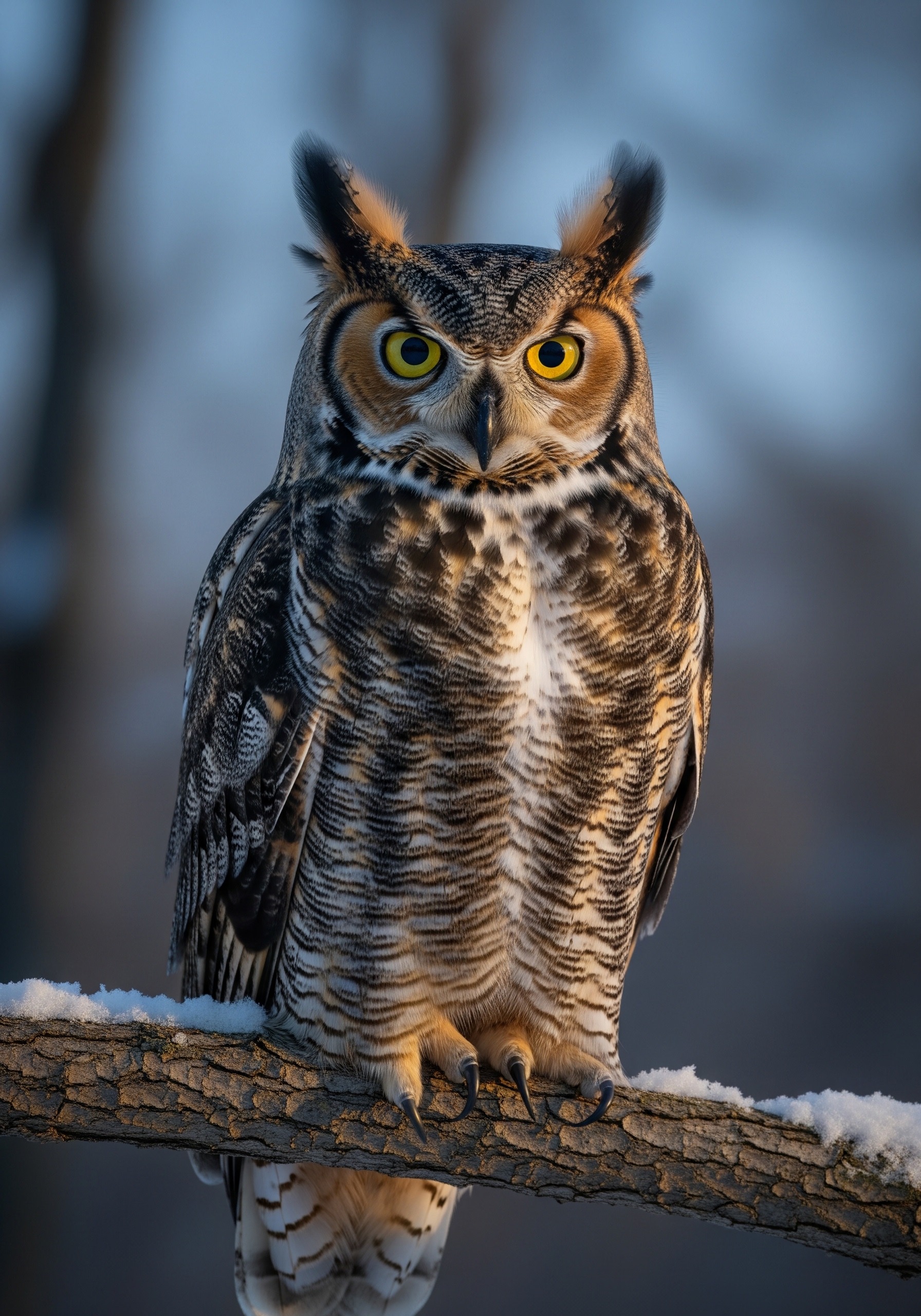
These great horned owl facts for kids start in the dark — with a sound. Three soft hoots drift through a January forest while every other bird is asleep. The animal that made them is twenty feet up in a bare oak, not moving, watching, with eyes nearly the size of a person’s. It is North America’s biggest “earless” owl, and biologists at the Cornell Lab of Ornithology call it one of the most powerful hunters on the continent. Native trackers gave it a better nickname. They called it the tiger of the sky.
Key Facts
- The great horned owl lives across most of North and South America — from the edge of Alaska’s tundra all the way down to the forests of Argentina.
- It stands up to 27 inches (68 cm) tall, with a wingspan that can stretch nearly 5 feet (152 cm).
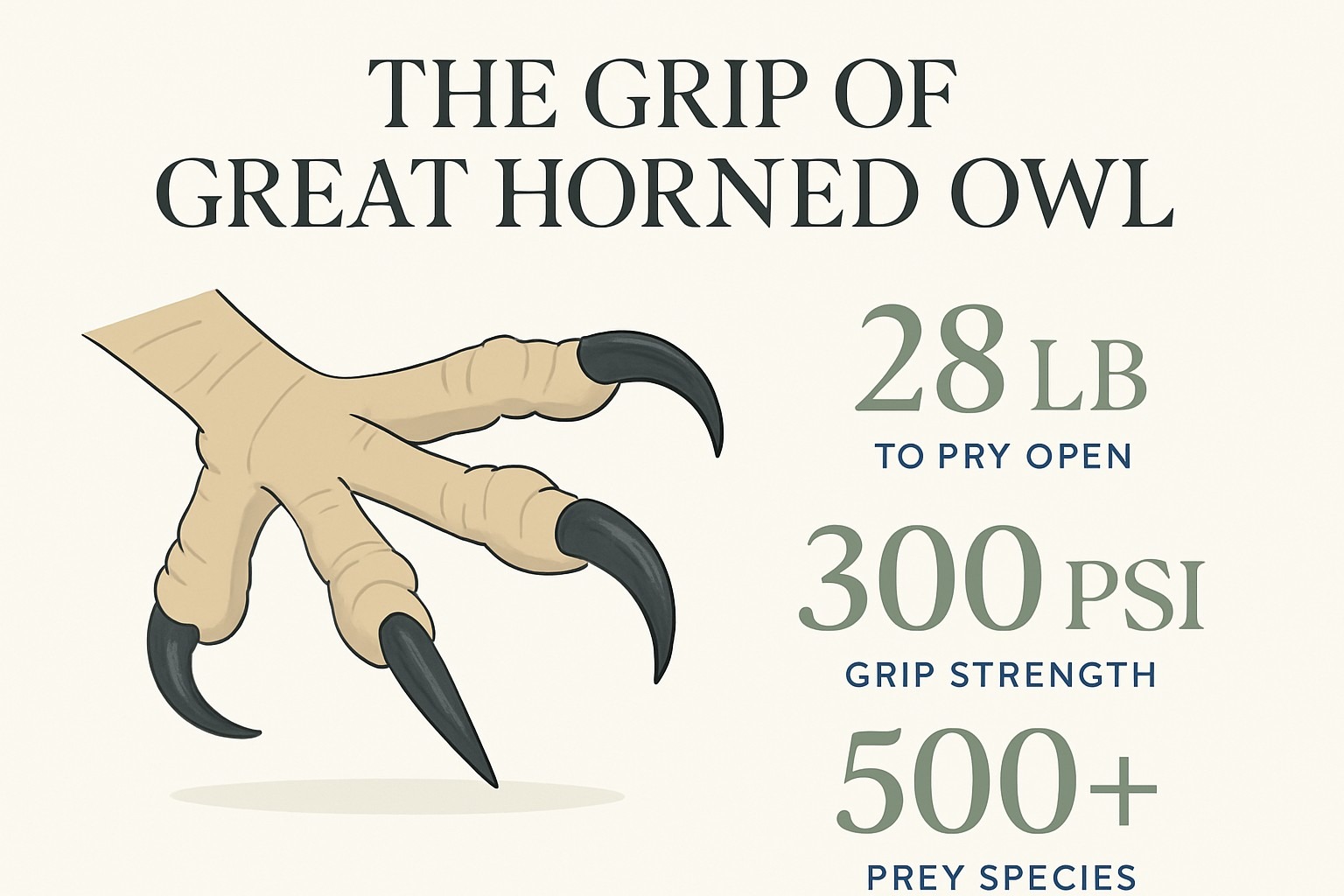
- Its clenched talons take about 28 pounds of force to pry open — strong enough to hold prey heavier than the owl itself.
- Scientists have recorded it hunting more than 500 different kinds of animals, including skunks, snakes, and porcupines.
- It can swivel its head about 270 degrees — almost a full circle — thanks to 14 neck bones (humans have only 7).
In short: The great horned owl is a giant, fearless night hunter found almost everywhere in the Americas. It has fake “horns,” a bendy neck, and grip-strength that lets it carry off animals bigger than itself — including the one creature most predators refuse to touch: the skunk.
Key Facts
- The great horned owl (Bubo virginianus) lives across most of North and South America, from the edge of Alaska’s tundra to the forests of Argentina.
- It stands up to 27 inches (68 cm) tall with a wingspan that can reach nearly 5 feet (152 cm), and weighs between 2 and 5.5 pounds.
- Its clenched talons take about 28 pounds of force to pry open — popularly estimated near 300 pounds per square inch — strong enough to hold prey heavier than the owl itself.
- Scientists at the Cornell Lab of Ornithology have logged more than 500 prey species, including snakes, porcupines and striped skunks, which the owl eats because it has a very weak sense of smell.
- The owl can swivel its head about 270 degrees thanks to 14 neck vertebrae (humans have 7); its ‘horns’ are feather tufts called plumicorns, and its ears sit at slightly different heights for stereo hearing.
In short: The great horned owl (Bubo virginianus) is a powerful night hunter found from Alaska to Argentina. It stands up to 27 inches tall, grips with talons needing about 28 pounds of force to open, hunts more than 500 prey species including skunks, and swivels its head 270 degrees using 14 neck vertebrae.
Great Horned Owl Facts for Kids: Meet the “Tiger of the Sky”
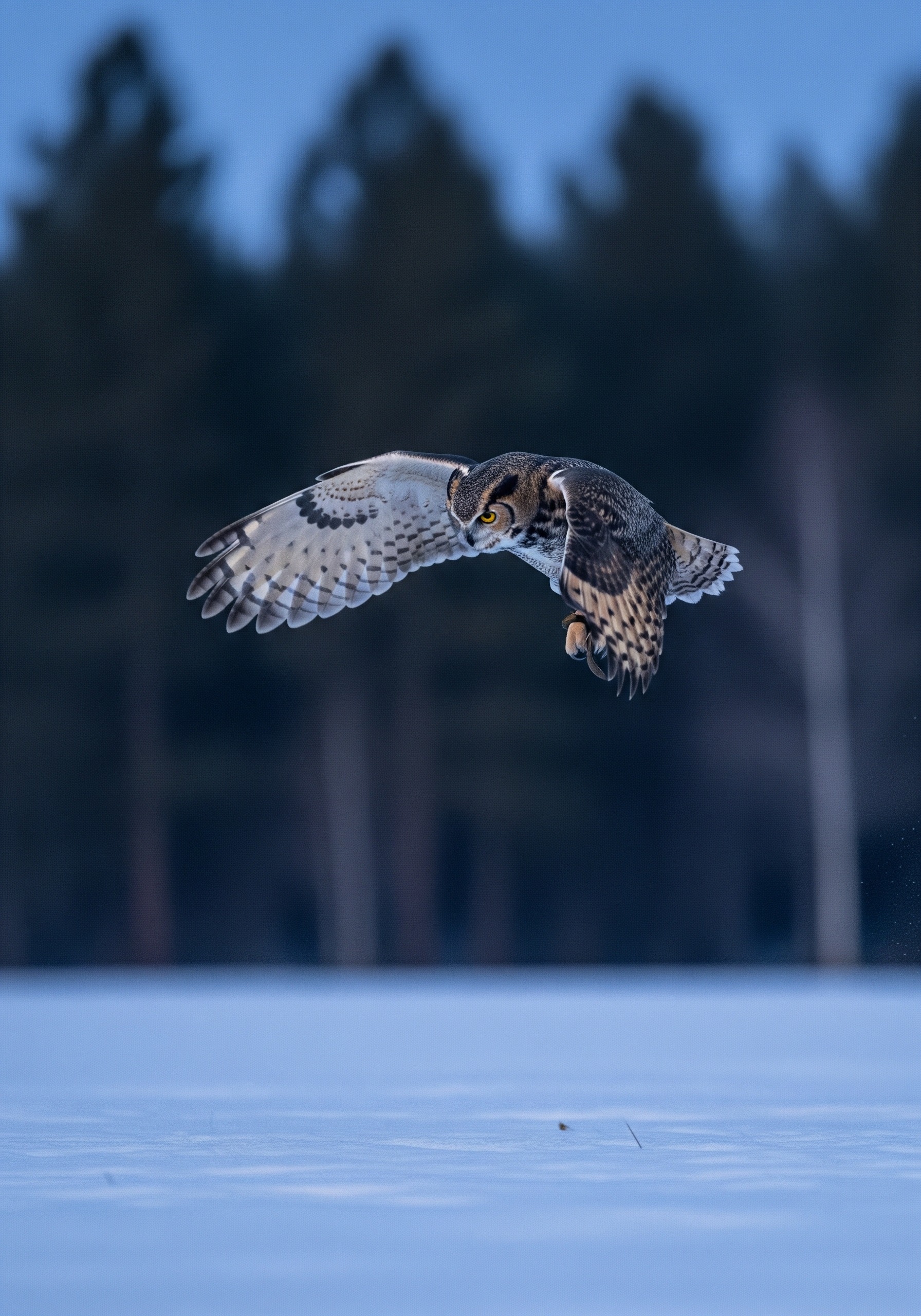
Bubo virginianus — that’s the scientific name — is a serious bird. Adults weigh between 2 and 5.5 pounds (about 1 to 2.5 kg). That doesn’t sound like much. A house cat weighs more. But pound-for-pound, this owl punches harder than almost any predator in its forest. A great horned owl will attack prey two or three times its own weight, including animals with quills, claws, and a spray you can smell a quarter-mile away.
That “tiger” nickname is not just for show. Audubon’s field guide calls the bird “aggressive and powerful,” noting that it will fight porcupines — sometimes to a draw, sometimes to a tragedy for both animals. There is a reason nothing the size of a rabbit wants to be out at midnight in great-horned-owl country.
A Bird Named for Things It Doesn’t Have
Look at any photo of this owl and you’ll spot two pointy bumps on its head. Those are not horns. They’re not ears, either. Scientists call them plumicorns — special feather tufts. Researchers at the Cornell Lab think the tufts probably help the owl look bigger and scarier to enemies, and may help it blend into broken tree branches when it wants to disappear. They are pure costume.
So where are the real ears? Hidden. They’re slits on the sides of the head, tucked under feathers. And here’s the surprising part: the two ear openings sit at slightly different heights. That mismatch is on purpose. It gives the owl a kind of natural stereo system, letting it pinpoint a mouse rustling under three inches of snow without ever seeing it.
Talons That Crush, and Eyes That See in the Dark
This is the part most kids’ articles skip, and it shouldn’t. The great horned owl’s talons are what make the bird famous among biologists. According to the Peregrine Fund and field studies summarized by the Cornell Lab, a clenched great horned owl’s foot takes roughly 28 pounds of force to pry open — about the same grip strength as an adult human hand, except packed into four needle-sharp, black-tipped claws. Popular estimates put the clamping pressure at around 300 pounds per square inch.
The Grip of a Great Horned Owl
- ~28 pounds of force — needed to pry one clenched foot open
- ~300 pounds per square inch — popular estimate of clamping pressure
- 2–3 × — the maximum prey weight, compared to the owl itself
- 4 toes per foot — three forward, one back, locking like a fishhook
When the owl strikes, it leads with its feet. The talons drive into the prey and the toes curl tight — a single squeeze can break a rabbit’s spine before the animal understands what has happened. Of all the predators a North American mouse has to worry about, the great horned owl is the one it will probably never hear coming.
{IMAGE_2}
The Great Horned Owl Diet: Even Skunks Aren’t Safe
Cornell scientists tracking great horned owl prey have logged more than 500 species on the menu. Rats, mice, voles, gophers, rabbits, hares, ground squirrels — that’s the everyday list. Frogs, snakes, fish, large insects — when food is short, all of it counts. But this is also the only North American predator that regularly hunts and eats striped skunks. Why? Turns out owls have a very weak sense of smell. The world’s worst stink simply doesn’t bother them. A great horned owl can stroll right up to a skunk and turn it into dinner without ever knowing what the rest of the forest is running from.
Beyond skunks, this powerhouse takes ducks, geese, herons, hawks, smaller owls, and (yes) the occasional house cat that wanders out after dark. Audubon naturalists have even watched great horned owls grip porcupines from above — the bird’s heavily feathered legs blunt most quills, though injuries do happen.
Silent Wings, Stereo Ears, Giant Eyes
How does a 4-pound bird sneak up on a wide-awake mouse? Three tricks, all built into its body.
Silent feathers. The leading edge of every flight feather is fringed like a tiny comb. That comb breaks up the rush of air that normally makes a flying bird whoosh. Other animals hear nothing at all.
Asymmetrical ears. Because one ear sits higher than the other, sound arrives at slightly different times. The owl’s brain compares the two signals and pins the prey’s exact location — even in total darkness, even through snow, even when the mouse is being almost perfectly still.
Giant eyes. A great horned owl’s eyes are nearly the size of a human adult’s, packed into a head about the size of a softball. They can’t move in their sockets, which is why the owl has to swivel its whole head. With 14 neck vertebrae (we have 7) and special blood vessels that don’t pinch when twisted, it rotates about 270 degrees in either direction.
And the prey never hears a thing.
Eggs in the Snow
While other birds are still flying south, great horned owls are getting ready to have babies. Pairs court each other in November and December with duets of low hoots — the male’s voice is lower, the female’s slightly higher, and they answer each other back and forth. By late January or early February — often when ice is still on the branches — the female lays 2 or 3 round white eggs.
The pair does not build its own nest. They steal one. An old hawk’s nest, a crow’s nest, a heron’s platform, sometimes even a squirrel drey will do, as long as it’s roomy and high up. The mother sits on the eggs for about 33 days, refusing to leave even in snowstorms. Chicks hatch white and fuzzy and stay close to their parents for nearly a full year, learning the family hunting ground. The species is the provincial bird of Alberta, Canada — fitting, because Albertan winters are exactly the kind of cold this owl shrugs off.
Great Horned Owl vs. Other Big Owls
Here is how the tiger of the sky stacks up against three other famous owls of the night:
| Owl | Weight | Wingspan | Famous For |
|---|---|---|---|
| Great Horned Owl | 2–5.5 lb | 3.3–4.8 ft | Strongest grip, eats skunks |
| Snowy Owl | 3.5–6.5 lb | 4.2–4.8 ft | Arctic camouflage, hunts in daylight |
| Barn Owl | 1–1.5 lb | 3.3–3.7 ft | Heart-shaped face, sharpest hearing of any bird tested |
| Great Gray Owl | 1.5–4 lb | 4.5–5 ft | Tallest North American owl — mostly fluff |
The great gray is taller. The snowy is heavier. But neither carries the talons or the appetite of a great horned owl, which is why old-time falconers and Cornell biologists alike still rank it the most dangerous of the four.
Frequently Asked Questions
Q: Are great horned owls dangerous to people?
A: They almost never bother humans, but they will defend a nest fiercely. If you ever find an owl chick on the ground, back away calmly — the mother is somewhere nearby watching you, and her talons are not a metaphor.
Q: What does a great horned owl sound like?
A: A deep, soft, four- or five-note hoot, usually written as “hoo-h’HOO-hoo-hoo.” Females have a slightly higher voice than males, and a mated pair will often hoot back and forth in a duet on winter nights.
Q: How long do great horned owls live?
A: In the wild, most live 5 to 15 years. The oldest wild great horned owl ever recorded by banded-bird researchers was more than 28 years old. In zoos, with no predators or food shortages, some have reached their 30s.
Q: Do great horned owls really eat skunks?
A: Yes — regularly. The owl’s sense of smell is so weak that famous skunk spray doesn’t faze it at all. Naturalists who handle wild great horned owls sometimes say the birds “smell faintly of skunk.” For the owl, that’s a small price for an easy dinner.
Sources
- Cornell Lab of Ornithology — All About Birds species account, Great Horned Owl
- National Audubon Society — Field Guide, Great Horned Owl
- The Peregrine Fund — World Center for Birds of Prey, raptor biology resources
- BioKIDS, University of Michigan Museum of Zoology — Bubo virginianus species page
- Smithsonian’s National Zoo and Conservation Biology Institute — raptor and bird fact sheets
If you ever stand outside on a still winter night and hear a soft, four-note hoot drift through the dark, stop walking. Look up. Somewhere on a high branch, a tiger is watching the snow.
Illustrations are AI-generated. Article fact-checked and human-edited. Our editorial standards.