Why Do Cicadas Come Out Every 17 Years? The Real Science
Why do cicadas come out every 17 years? Because, somewhere under a Midwestern oak, an insect the size of your thumb is keeping time — not by sunlight, not by temperature, but by counting the silent rhythm of the tree above it. After 17 of those rhythms, billions of red-eyed cicadas claw out of the soil within a few weeks of each other, sing for six loud weeks, mate, and die. The synchrony is not coincidence. It is the strategy.
Key Facts
- Periodical cicadas (genus Magicicada) spend roughly 99.5% of their lives underground — only about four to six weeks above ground, as adults.
- Seven species exist: three on a 17-year cycle, four on a 13-year cycle. Both 13 and 17 are prime numbers.
- Emergence is triggered when the soil about 8 inches (20 cm) deep climbs to roughly 64°F (17.9°C), usually in May or early June.
- Peak density can exceed 1.5 million cicadas per acre — enough biomass to choke a stream and feed every predator within reach.
- In 2024, the 17-year Brood XIII and the 13-year Brood XIX emerged in the same year for the first time since 1803. The next such double emergence is not due until 2245.
In short: 17-year cicadas use chemical cues in tree sap to count the seasons. When the count hits 17, they all surface together on a prime-numbered schedule that simply overwhelms anything trying to eat them. The synchronized noise is the species’ survival plan.
The 17-year clock in numbers
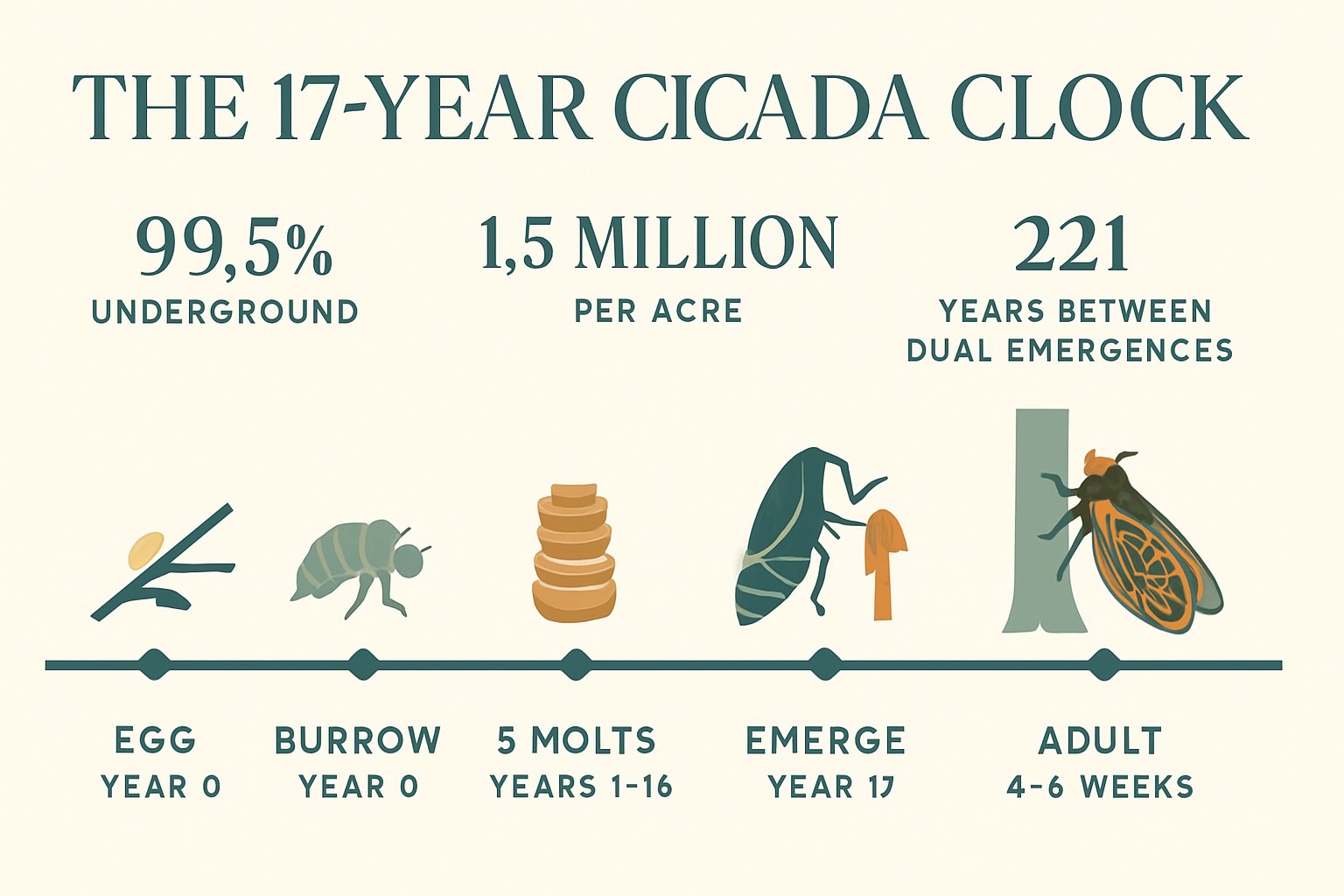
- 99.5% — share of a periodical cicada’s life spent underground.
- 5 — instar stages the nymph passes through, molting between each.
- ~64°F (17.9°C) at 8 inches deep — the soil temperature that triggers emergence.
- 1.5 million — peak cicadas per acre during a major brood emergence.
- 4–6 weeks — the entire above-ground adult lifespan.
- 221 years — the gap between Brood XIII + XIX co-emergences (1803 · 2024 · 2245).
Key Facts
- Periodical cicadas (genus Magicicada) spend roughly 99.5% of their lives underground, emerging as adults for only about four to six weeks.
- Seven species exist: three on a 17-year cycle and four on a 13-year cycle; both 13 and 17 are prime numbers that rarely sync with predator boom cycles.
- Emergence is triggered when soil about 8 inches (20 cm) deep reaches roughly 64 degrees Fahrenheit (17.9 degrees Celsius), usually in May or early June.
- Peak density can exceed 1.5 million cicadas per acre, and nymphs pass through five instar stages while feeding on xylem fluid from tree roots.
- In 2024 the 17-year Brood XIII and 13-year Brood XIX emerged together for the first time since 1803; the next such double emergence is not due until 2245.
In short: Periodical cicadas count years by sensing chemical changes in tree sap, not by an internal clock. After 17 cycles, billions emerge at once on a prime-numbered schedule that overwhelms predators. They spend about 99.5% of life underground, surface when soil hits 64 degrees Fahrenheit, and can exceed 1.5 million per acre.
Why do cicadas come out every 17 years — and not 5, or 50?
Two questions sit inside this one. Why so long, and why exactly that number.
Start with the long answer. Most insects rush. A monarch butterfly burns through a generation in weeks. Cicadas do the opposite. A nymph hatched in the summer of 2008 spent the entire Obama administration, the COVID pandemic, and two American presidential elections sucking xylem fluid from a single tree root in the dark. Nobody else on the continent is doing that. The leading hypothesis is that such an extreme delay evolved as protection from specialist predators during the ice ages, when short cold summers made yearly reproduction risky. Stretch the life cycle far enough, and no parasite can specialize in you, because no predator’s own life cycle lines up with yours.
But “exactly 17” is the harder question. Both 13 and 17 are prime numbers, meaning they share no common divisor with a predator’s own 2-, 3-, 4- or 5-year boom cycle. A predator on a four-year cycle, for instance, would only coincide with a 17-year cicada brood once every 68 years. That is the famous prime-number hypothesis. It is elegant. It is also — as we’ll see — incomplete.
How a cicada nymph counts the years
Here is the surprising part: a 17-year clock is not really a clock. There is no internal calendar. Cicadas count trees.
Each spring, the deciduous tree above a cicada nymph flushes new leaves, then sheds them in autumn — a process called abscission. The flow and chemical composition of xylem fluid, the watery sap the nymph drinks, changes with that yearly rhythm. The nymph appears to register each annual change as a tick on a counter.
That is not a guess. In a now-famous experiment, ecologist Richard Karban and colleagues moved 15-year-old cicada nymphs onto peach trees that had been forced into two leaf-bearing cycles per year. The cicadas emerged a year early — after 16 calendar years instead of 17. They had counted the cycles, not the time. Turns out the clock is in the tree.
The 2024 emergence was a once-in-221-years event
In the spring of 2024, two great cicada armies surfaced at the same time. Brood XIII, on a 17-year cycle, came up across northern Illinois, Iowa, and Wisconsin. Brood XIX, on a 13-year cycle, came up across a much larger swath of the Midwest and South, from Missouri down into northern Georgia. Their ranges brushed against each other in a narrow seam through central Illinois — Macon, Sangamon, Livingston and Logan counties were the rare places where someone could hear both broods at once.
This pairing matters because 13 and 17 have a lowest common multiple of 221. The last time these two specific broods emerged together was 1803 — the year of the Louisiana Purchase. The next time will be 2245. Anyone who walked into a humming Illinois woodlot in late May 2024 was hearing a sound nobody alive had ever heard and nobody alive will hear again. The pulse continues: in 2025, Brood XIV emerged across a broad band stretching from Kentucky and Tennessee up into New York and Massachusetts. Each year brings a different brood, somewhere.
{IMAGE_2}
What happens during the 99.5% of life nobody sees
Most accounts skip past the underground years as if nothing happened down there. Plenty happens.
A first-instar nymph, freshly hatched from an egg laid in a twig the previous summer, drops to the ground and burrows down. Over the next 13 or 17 years, depending on the species, it will pass through five distinct instar stages, molting between each. It tunnels, builds small earthen chambers near tree roots, and feeds — slowly, continuously — on xylem fluid, which is mostly water with trace amino acids. The diet is so poor that the cicada hosts symbiotic bacteria in specialized organs called bacteriomes to manufacture the amino acids the sap cannot supply.
Most nymphs live within two feet of the surface, which is why heavy spring rains, deep tilling, and construction in known brood territory can wreck local populations for a generation. The nymph is not asleep. By insect standards, it is working very slowly through a very long life.
How they know it is time: 64°F at eight inches
Around the 17th spring, the trigger comes. When the soil temperature 8 inches (20 cm) below the surface climbs above about 64°F (17.9°C), the nymphs begin building exit tunnels straight up — sometimes capped with small mud chimneys that mark their location days in advance.
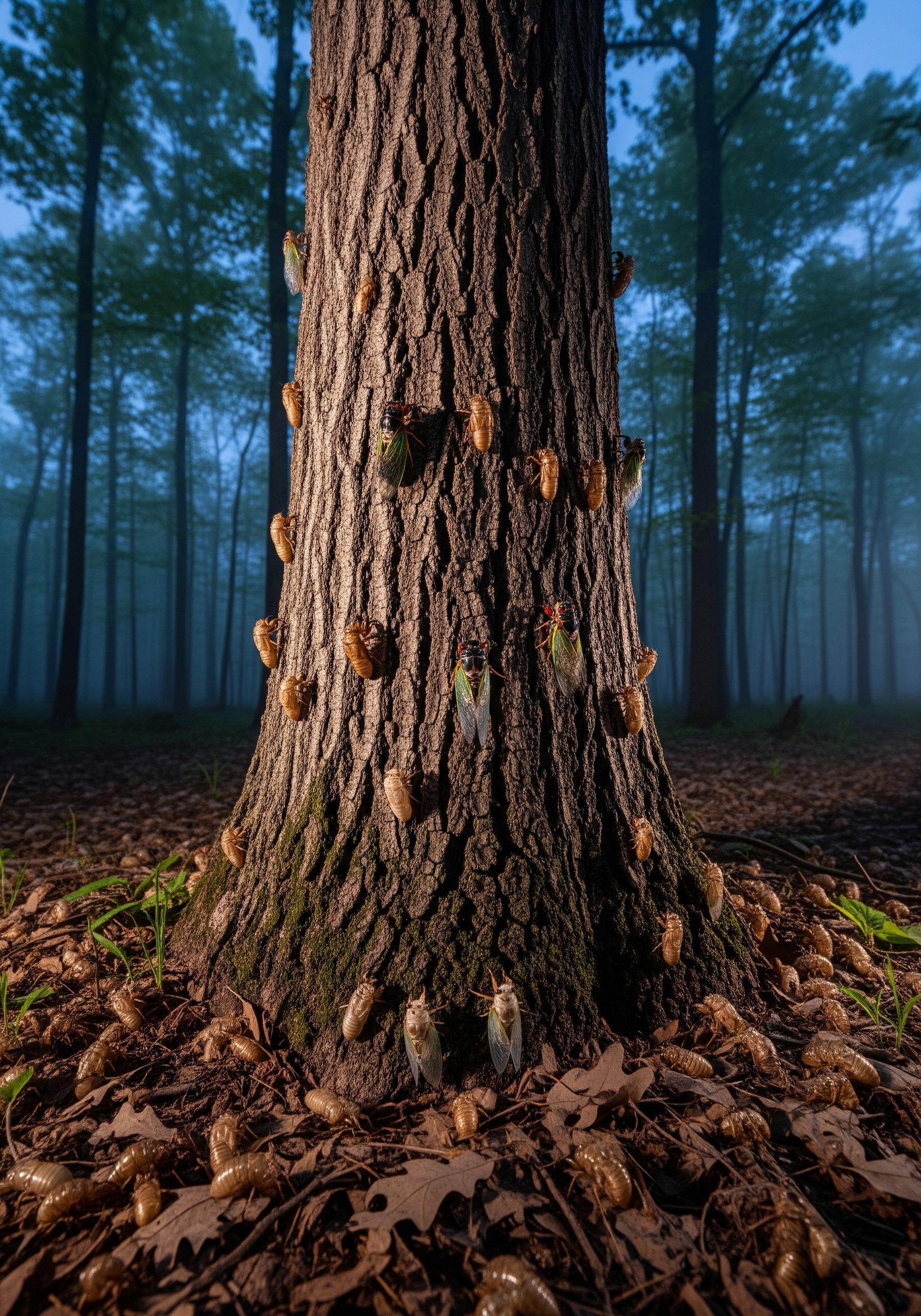
Emergence happens at dusk. That timing is not random either; the nymph is flightless and pale when it first surfaces, and full daylight would mean instant death by bird. Under cover of twilight, the nymph climbs the nearest vertical surface — a tree trunk, a fence post, a child’s swing-set leg — and splits open its final exoskeleton. The white, soft-bodied adult that crawls out will harden into the familiar black-and-red form within a few hours, and join the chorus by morning.
From that point, the adult cicada has roughly four to six weeks to live. It does not really eat. It mates, the female cuts slits into thin tree branches and lays eggs, and it dies. The whole point of the 17 underground years was this brief, frantic, very loud act.
The prime-number theory — and the hole in it
Here is where the textbook story gets shakier than most articles admit.
Prime-number arithmetic is elegant. Pick any prime cycle long enough and no predator can sync to it. But the U.S. has no 11-year cicadas, no 19-year cicadas, and no 23-year cicadas — only 13 and 17. If prime-ness alone were the engine of evolution, the other primes should be on the menu too. They are not.
John Cooley, an entomologist at the University of Connecticut who has spent decades mapping cicada broods, has noted this point directly: cicadas count tree cycles, but the question of why they settled on these two specific primes is genuinely open. Andrew Liebhold, a research entomologist with the U.S. Forest Service, has suggested the answer may lie in the unusual diversity of Eastern North American deciduous forest, which gave deep-rooted, slow-growing nymphs the broad menu of host trees they needed. Others point to interbreeding pressure: 13- and 17-year broods almost never overlap, so the long-cycle trait is protected from being diluted by hybridization with shorter-cycle relatives.
The honest summary, in 2026, is this: predator avoidance, prime arithmetic, glacial-era constraints and Eastern-forest diversity all probably matter, and no single explanation has won. What is certain is the outcome — a flawless 17-year clock, ticking under our feet, with no comparable analog anywhere else in the animal kingdom.
Why the forest needs them
Periodical cicadas are sometimes confused with locusts. They are not. They do not strip crops. The damage they do is small and surgical: females cut slits in thin branches to deposit eggs, which can prune young saplings — a problem only for newly planted orchards. For mature trees, the cost is trivial.
Benefits, on the other hand, are real. A brood emergence dumps an extraordinary nutrient pulse into the forest. Woodland birds time their broods to the bonanza; raccoons, opossums, fish, and even bears overeat. Dead adults rot into the leaf litter and return nitrogen to the soil. Studies in the years following Brood X emergences have measured small but real boosts in tree growth and bird reproductive success across affected forests. Ecologically, the event is an enormous, periodic gift.
And that 17-year cycle did not evolve to inconvenience suburban patios. It evolved as a synchronized survival strategy so successful that an entire forest ecosystem has built itself partly around the rhythm. The cicadas are not the problem. They are part of the schedule the trees themselves keep.
Frequently Asked Questions
Q: Do all cicadas come out every 17 years?
A: No. Annual cicadas, which sing every summer across most of the world, are different species — they emerge every year on overlapping 2-to-5-year staggered cycles. Only the seven periodical species in genus Magicicada, found exclusively in the eastern United States, are on the strict 13- or 17-year clock.
Q: Are 17-year cicadas dangerous to humans or pets?
A: They are harmless. They do not bite, sting, or carry disease. Dogs and cats sometimes overeat them and get an upset stomach, but the cicadas themselves are not toxic.
Q: When is the next major emergence?
A: A different brood emerges almost every year somewhere in the eastern U.S. Brood XIV emerged in 2025 across a broad eastern band. Brood I is due in 2029 in parts of Virginia, West Virginia, and Tennessee, and the famous Brood X — the largest 17-year brood — is next due in 2038.
Q: Can a 17-year cicada come out early?
A: Yes, occasionally. “Stragglers” — individuals that emerge a year or four off-schedule — are surprisingly common, especially the four-years-early pattern. Entomologist Gene Kritsky of Mount St. Joseph University has proposed that if enough stragglers emerge in the same year and successfully reproduce, they could eventually establish entirely new broods — one way the brood map may slowly redraw itself over centuries.
Sources
- Wikipedia: Periodical cicadas (Magicicada) — species count, brood maps, 2024 dual emergence specifics, soil-temperature trigger.
- National Geographic, “Why do U.S. cicadas lie dormant for over a decade?” — quoted findings from John Cooley (University of Connecticut) and Andrew Liebhold (U.S. Forest Service).
- University of Connecticut Periodical Cicada Information Pages — Chris Simon and John Cooley laboratory, phylogenetics and brood maps.
- Encyclopaedia Britannica, “Why Do Some Cicadas Appear Only Every 17 Years?” — xylem-counting mechanism, emergence trigger.
- Richard Karban et al., peach-tree manipulation study — direct evidence that cicadas count plant cycles, not calendar years.
- U.S. Library of Congress, Periodical Cicadas Research Guide — historical brood numbering established by Charles Marlatt (USDA, 1907).
The next time a spring evening in the Midwest fills with that thick, electric drone, remember what you are actually hearing: a 17-year wager, paid off all at once, by an insect that learned to count the seasons of a tree.
Illustrations are AI-generated. Article fact-checked and human-edited. Our editorial standards.