How Smart Are Crows? The Honest Answer From Science
How smart are crows? Smarter than most people guess, dumber than the viral headlines suggest, and stranger than either — a bird that can plan three moves ahead, remember a face for a decade, then fail a puzzle a kindergartener solves on the first try.
Key Facts
- In a 2014 University of Auckland experiment (Jelbert et al., PLOS ONE), six wild New Caledonian crows passed four of six water-displacement tasks at a level matching children aged 5–7.
- A common raven packs about 1.2 billion neurons into a walnut-sized brain — roughly twice the density of a primate brain of equal mass (Olkowicz et al., PNAS 2016).
- Andreas Nieder’s lab at the University of Tübingen recorded individual neurons in the crow pallium that fire in step with what the bird subjectively reports seeing — a neural signature long thought unique to mammals (Science, 2020).
- In a 2019 metatool study, New Caledonian crows planned three-step tool sequences — recovering a tool, to recover a longer tool, to reach food — before making a single move.
- Crows trapped in a rubber mask remembered and scolded that mask more than a decade later, and warned crows who had never witnessed the original event (Marzluff lab, University of Washington).
In short: Crows match a young human on certain reasoning tests, but the comparison flatters and misleads in equal measure. The real story is a brain built on a completely different blueprint that arrives at primate-class thinking by an entirely different road.
Key Facts
- In a 2014 University of Auckland experiment (Jelbert et al., PLOS ONE), six wild New Caledonian crows passed four of six water-displacement tasks at a level matching children aged 5 to 7.
- A common raven packs about 1.2 billion neurons into a roughly 14-gram brain, with some 900 million in the pallium — about twice the density of a primate brain of equal mass (Olkowicz et al., PNAS 2016).
- Andreas Nieder’s lab at the University of Tubingen recorded individual neurons in the crow pallium that fire in step with what the bird reports seeing — a signature long thought unique to mammals (Science, 2020).
- In a 2019 metatool study, New Caledonian crows planned three-step tool sequences before making a single move, using a short stick to get a longer stick to reach food.
- Crows trapped in a rubber mask remembered and scolded that mask more than a decade later, and warned crows who had never witnessed the event (Marzluff lab, University of Washington).
In short: Crows match young children on certain reasoning tests but fail others, so the ‘smart as a 7-year-old’ claim is narrow. Built without a cortex on a separate evolutionary line, the crow brain packs neurons at twice primate density and supports tool-planning, face memory and neural signatures of perception once thought unique to mammals.
How smart are crows? The honest answer the headlines skip
That “smart as a 7-year-old” line traces to one study, on one task, in one species of crow. The actual claim is narrower — and far more interesting — than the meme.
Corvids (the family that includes crows, ravens, magpies and jays) sit at the top of every credible ranking of avian cognition. They use tools. They cache thousands of food items and remember the locations months later. They recognise individual humans on sight. They cooperate, deceive, mob, and play. But intelligence is not a single number, and treating it as one is how careful scientific findings turn into Facebook posts that overshoot the data.
Here’s the thing. The same crows that pass a water-displacement test at a seven-year-old’s level fail a related task an eight-year-old solves cold. The story is not “crows equal small feathered children.” The story is that a brain built without a cortex, on a separate evolutionary line for roughly 300 million years, has independently evolved many of the same cognitive tricks.
The 7-year-old test: what crows actually did
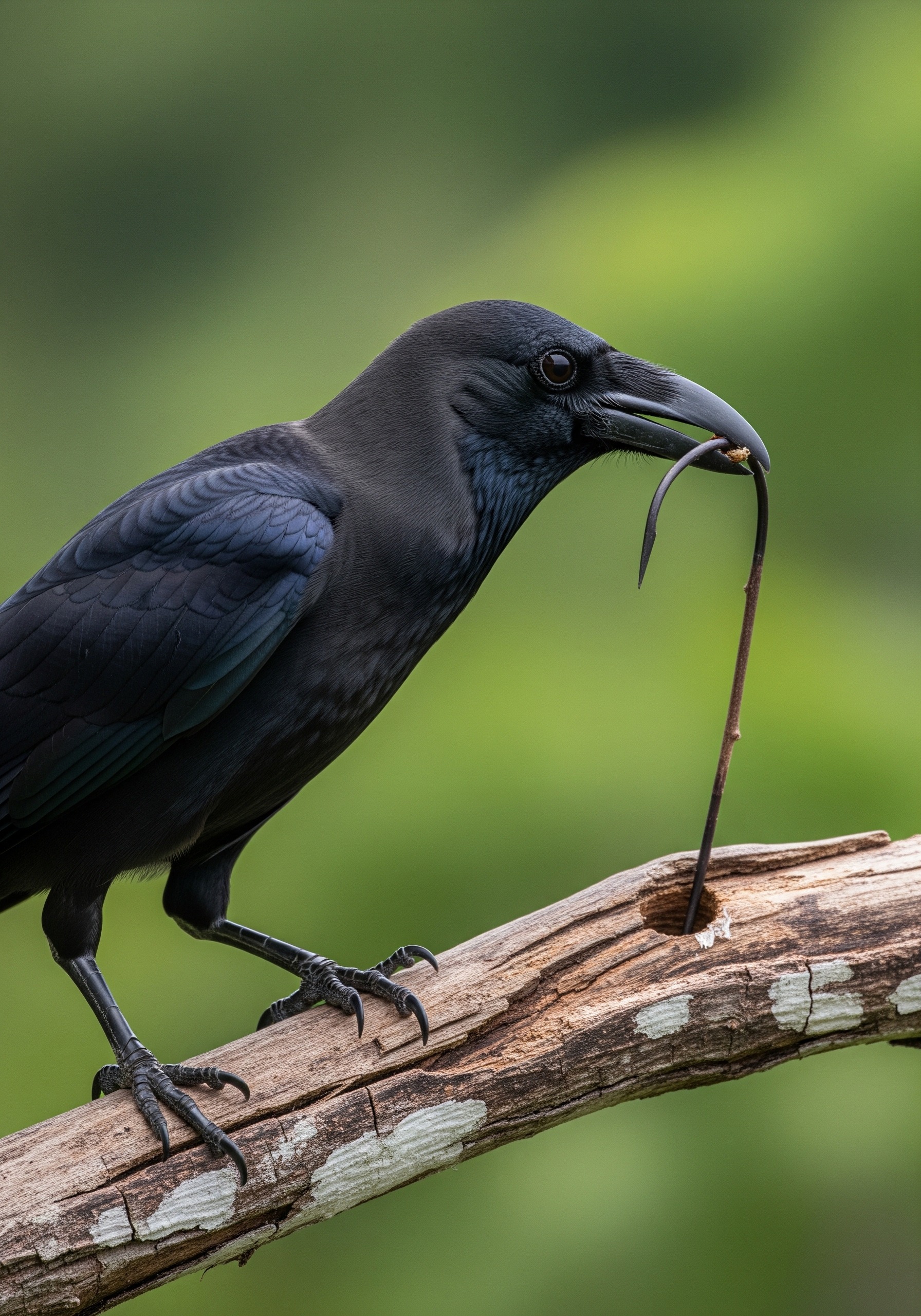
The headline comparison comes from a 2014 paper by Sarah Jelbert, Alex Taylor, Lucy Cheke, Nicola Clayton and Russell Gray, published in PLOS ONE. The team set six wild New Caledonian crows in front of a series of puzzles based on Aesop’s fable of the crow and the pitcher: a treat floats out of reach in a narrow tube, and only by dropping stones into the water can it be raised.
And they did it. The crows preferred sinking objects over floating ones, heavy stones over light ones, and a tube with a higher starting water level over a lower one. On four of the six tasks, their performance tracked five- to seven-year-old children given the same logic problems. That is the headline.
But the footnote is less flattering. On a counter-intuitive “U-tube” task — where dropping a stone into one visible tube secretly raises water in a separate connected one — the crows failed. So did most children under eight. The crows have a real causal grasp of water and weight; they do not have an abstract understanding of hidden connections. The seven-year-old comparison is true, narrow, and easy to misread.
{IMAGE_2}
Tools, traps, and planning three moves ahead
If one species has earned the corvid family its reputation, it is the New Caledonian crow — a glossy black bird from a single Pacific archipelago that, in the wild, manufactures hooked tools from twigs and serrated tools from the stiff leaves of the pandanus plant. Different crow populations on different parts of the island make subtly different tool designs, the closest thing to a non-human material culture ever documented.
In a 2019 study from Alex Taylor’s lab in Auckland, working with Nicola Clayton at Cambridge and Christian Rutz at St Andrews, captive New Caledonian crows were given a metatool problem: out of sight of the final food, they had to retrieve a short stick, use it to extract a longer stick from a box, and then use the long stick to fish out a treat. The crows planned the full sequence before starting — choosing the right opening tool first, even when distractor objects sat in plain view. The behaviour is structurally identical to a person scanning a workbench, deciding what to pick up first to reach what they actually want.
This is not problem-solving by trial and error. It is a mental model of a chain of causes, held in mind across steps. For decades, that was assumed to require a primate-style prefrontal cortex.
The crows do it without one.
A brain built on a different blueprint
Bird brains do not look like ours. There is no cerebral cortex — no thick, folded outer sheet of grey matter that, in mammals, is widely treated as the seat of higher thought. Instead, birds have a region called the pallium, and inside it a structure called the nidopallium caudolaterale, or NCL. Until recently, this looked too small and too differently organised to do what a cortex does.
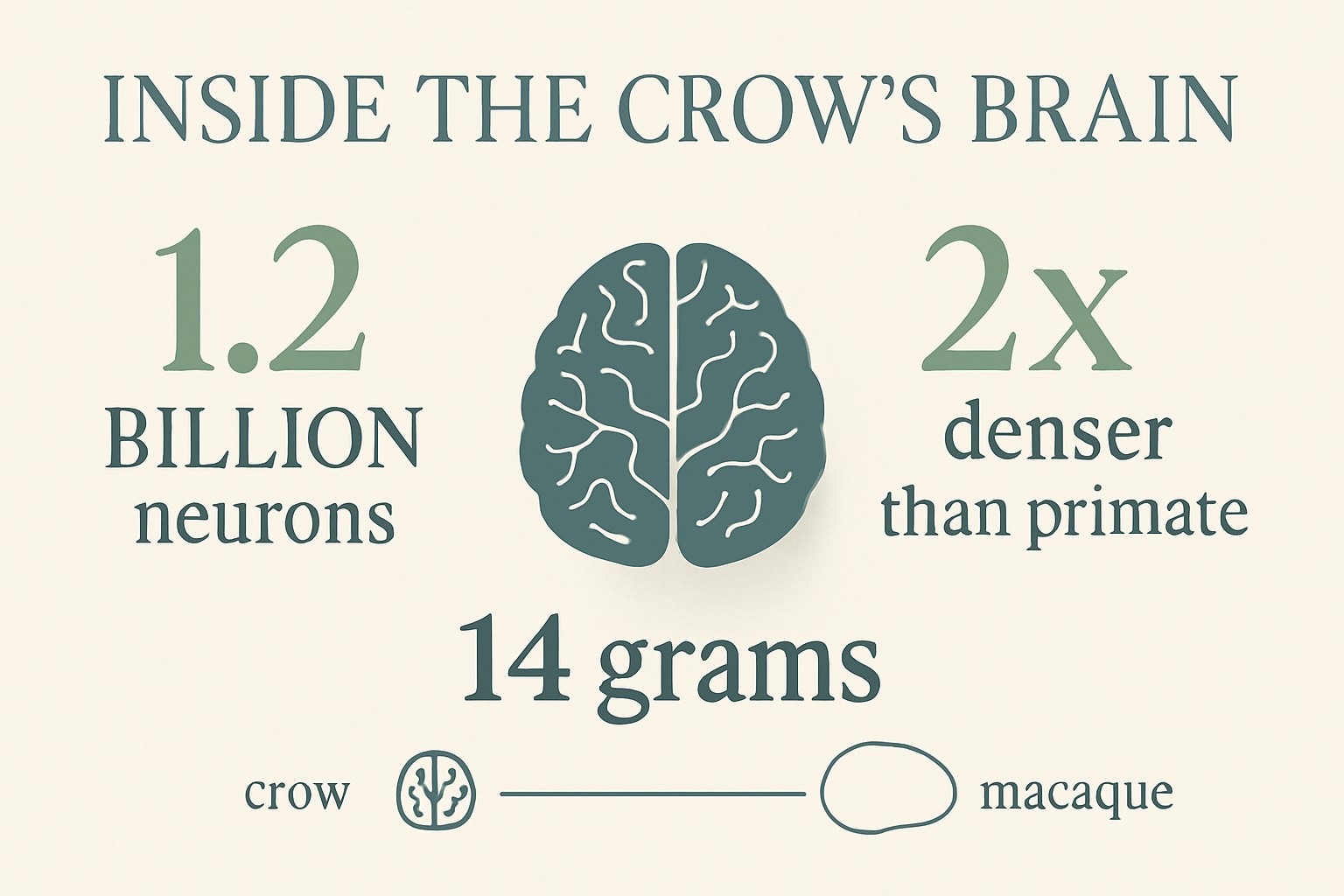
Two findings changed that picture. In 2016, Seweryn Olkowicz and Pavel Němec at Charles University in Prague published a comprehensive neuron count across bird species in PNAS. A common raven, they reported, carries roughly 1.2 billion neurons in a brain that weighs about 14 grams (about the weight of three pennies). Crammed into the pallium are some 900 million of them — packed at roughly twice the density of a primate brain. Ounce for ounce, songbirds and corvids are the most neuron-dense brains on the planet.
Crow Brain by the Numbers
- ~1.2 billion neurons in a common raven’s 14-gram brain (Olkowicz et al., PNAS 2016)
- ~900 million of those neurons sit in the pallium — the avian analogue of the cortex
- ~2× the neuron density of a primate brain of equal mass
- 4 of 6 Aesop’s-fable tasks solved at a 5–7-year-old level (Jelbert et al., 2014)
- 3-step tool sequences planned in advance, before the crow makes its first move
Four years later, Andreas Nieder’s lab at the University of Tübingen published in Science the first direct neural evidence of something like sensory consciousness in a non-mammal. The team trained carrion crows to report whether they had seen a faint visual stimulus, then recorded from individual NCL neurons. Those neurons did not just respond to the light on the screen. They tracked what the crow reported seeing. Same stimulus, different report from the bird, different neural activity. It is the same neural signature found in the primate prefrontal cortex.
What that implies is heavy. Either subjective awareness existed in our last common ancestor with birds, more than 300 million years ago, or it has evolved twice — once in mammals, once in birds — using entirely different hardware. Both possibilities rewrite the textbook.
They know your face — and they tell their friends
In 2006, the wildlife biologist John Marzluff at the University of Washington trapped seven American crows on his campus while wearing a rubber mask. He released them unharmed. Then he and his students walked the same paths wearing the mask — and were promptly scolded, dive-bombed, and mobbed by crows who had never been touched.
What followed makes the result extraordinary. The mobbing spread to crows who had never seen the original capture. Years later — Marzluff’s team documented it past a decade — the alarm response was still being triggered by the mask. Crows recognise individual human faces, hold the grudge, and broadcast the threat through their social network. We go deeper into the face-recognition research in a separate piece — but the headline is straightforward: if a crow has reason to dislike you, your face is now part of a generational cultural record.
It also works in the other direction. Crows that learn a particular human reliably feeds them will bring small objects — bottle caps, bits of glass, the occasional earring — and leave them where the feeder will find them. Whether that counts as gratitude or as opportunism dressed in feathers is a question better left to philosophers than to ornithologists.
What crows cannot do (and why honesty matters here)
Most popular coverage of crow intelligence reads like a highlight reel. The honest picture has shadows, and they matter.
Crows struggle with truly abstract problems — anything that requires reasoning about an entity they cannot directly perceive or have not previously encountered. They have no demonstrated language in the human sense; their alarm calls and family vocalisations are sophisticated, but no one has shown grammar. They show no clear evidence of teaching in the strict sense biologists use the word: actively modifying their own behaviour to instruct a naive learner at a cost to themselves. And the celebrated “smart as a seven-year-old” comparison applies to one species (New Caledonian) on one narrow class of physical-cognition test. Your neighbourhood American crow has not been put through the same battery; we are extrapolating.
Russell Gray, who has spent thirty years on this question, tends to put it bluntly: corvid cognition is genuinely impressive, structurally different from primate cognition, and chronically over-sold the moment it leaves the lab. None of that makes the bird in your back garden less remarkable. It just makes it more itself.
Why any of this matters
A crow’s brain is not a smaller, scrappier version of ours. It is a parallel solution to the same problem — how to be a flexible, social, long-lived animal in a world that punishes stupidity. That parallel arrival is the part scientists actually find astonishing. Intelligence, on the evidence the corvids supply, is not a uniquely mammalian property of a particular kind of folded cortex. It is something a brain can build with very different parts.
Knowing that changes how you watch the bird picking at a chip wrapper outside the supermarket. You are not looking at a feathered nuisance. You are looking at, conservatively, the cognitive equal of a small primate — wrapped in a body the size of a paperback, running on a brain you could hide under a thimble, and almost certainly looking back.
Frequently Asked Questions
Q: Are crows really as smart as a 7-year-old child?
A: On one specific kind of test — physical causal reasoning about water and weight — wild New Caledonian crows match children aged five to seven (Jelbert et al., 2014). They are not generally equivalent to a seven-year-old child; on social, linguistic, or abstract-reasoning measures, the comparison breaks down.
Q: What is the smartest bird in the world?
A: Most cognition researchers nominate either the New Caledonian crow (for tool manufacture and planning) or the kea, a New Zealand parrot (for inventive problem-solving). Common ravens and African grey parrots are close contenders. Ranking them is partly a matter of which test you weight most.
Q: Do crows actually remember human faces?
A: Yes. John Marzluff’s University of Washington team has documented mask-recognition that persists for more than a decade and spreads through crow social networks to birds that never witnessed the original event.
Q: Are crows smarter than ravens?
A: Ravens are larger, longer-lived, and arguably outperform crows on social-cognition tests (Thomas Bugnyar’s lab in Vienna). Crows generally outperform ravens on tool-related tasks. They are close cousins with different strengths — not a ranking so much as a division of labour.
Sources
- Jelbert, S. A., Taylor, A. H., Cheke, L. G., Clayton, N. S. & Gray, R. D. (2014). “Using the Aesop’s Fable Paradigm to Investigate Causal Understanding of Water Displacement by New Caledonian Crows.” PLOS ONE.
- Olkowicz, S., Kocourek, M., Lučan, R. K., Porteš, M., Fitch, W. T., Herculano-Houzel, S. & Němec, P. (2016). “Birds have primate-like numbers of neurons in the forebrain.” Proceedings of the National Academy of Sciences (PNAS).
- Nieder, A., Wagener, L. & Rinnert, P. (2020). “A neural correlate of sensory consciousness in a corvid bird.” Science.
- Marzluff, J. M. et al., University of Washington — mask-recognition and intergenerational alarm studies in American crows.
- Gruber, R. and colleagues (2019). Metatool and forward-planning experiments in New Caledonian crows. Current Biology.
Watch the crow on the fence post the next time you walk past one. It is, in all likelihood, watching you back — measuring, classifying, remembering. The headline will say it is as smart as a child. The truth is stranger, and more flattering to the bird: it is smart in a way no child will ever be.
Illustrations are AI-generated. Article fact-checked and human-edited. Our editorial standards.