Why Do Cats Purr? The Hidden Science Behind the Sound
Ask why do cats purr and you will get a different answer from a vet, a zoologist, and the cat on your lap — and as of 2023, even the vets and zoologists have had to update theirs. Press your hand to a sleeping cat’s ribs and you can feel the engine before you hear it: a low, even rumble at roughly twenty-five vibrations a second, produced by a four-kilogram animal that should not, on the physics of it, be able to make a sound that deep.
Key Facts
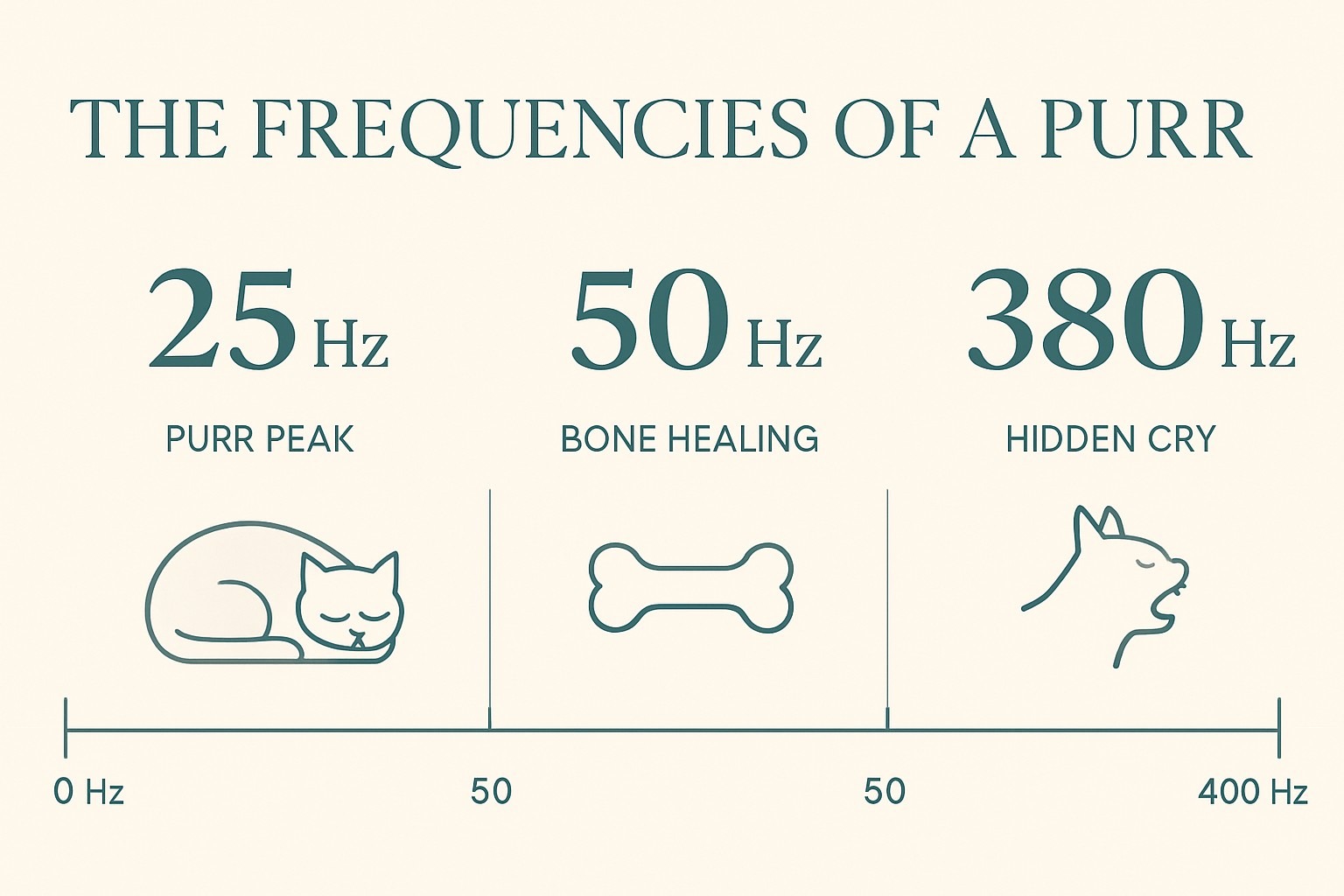
- Domestic cats purr at roughly 25-150 Hz, with their loudest peaks at 25 Hz and 50 Hz — frequencies you can hear in old basslines and feel in your sternum.
- Cats purr on both the in-breath and the out-breath, an almost unique trick among mammals; nearly all other animal vocalisations happen only on exhale.
- A 2023 University of Vienna study found dense connective-tissue “pads” inside cats’ vocal folds that let a four-kilogram animal produce a sound deeper than any human voice.
- Animal behaviourist Karen McComb of the University of Sussex showed that hungry cats embed a high-pitched cry, peaking near 380 Hz, inside an ordinary purr to manipulate humans into feeding them.
- A 2026 acoustic study reported that an individual cat’s purr is uniquely identifiable and stays stable for life, unlike its meow, which shifts constantly with context.
In short: Cats purr in contentment, in stress, in pain, in solicitation, and even close to death — using a vocal trick that science only properly described in 2023. The frequencies overlap intriguingly with bone-healing therapy, which is fascinating but not yet proof that being purred at heals you.
Key Facts
- Domestic cats purr at roughly 25–150 Hz, with loudest peaks at 25 Hz and 50 Hz.
- Cats purr on both the in-breath and out-breath, almost unique among mammals.
- A 2023 University of Vienna study found dense connective-tissue pads in cats’ vocal folds enabling the deep sound.
- Sussex behaviourist Karen McComb showed hungry cats embed a high-pitched cry peaking near 380 Hz inside a purr to solicit food.
- A 2026 acoustic study reported an individual cat’s purr is uniquely identifiable and stays stable for life.
In short: Cats purr at roughly 25–150 Hz—deeper than a four-kilogram animal should manage—on both in-breath and out-breath. A 2023 University of Vienna study traced it to connective-tissue pads in the vocal folds. Cats purr in contentment but also stress, pain and to solicit food, embedding a 380 Hz cry humans find hard to ignore.
The sound itself: what a purr actually is
Start with the strange physics. A typical adult cat weighs four to six kilograms — roughly the mass of a large chicken — and produces a sound around 25 hertz. The lowest note on a standard grand piano sits at 27.5 hertz. So a creature smaller than a loaf of bread is reliably making a sound deeper than the bottom of a concert grand, for minutes at a time, without seeming to draw breath.
That last part is the trick. A purr is not a single note but a chain of micro-bursts — about twenty-five tiny vibrations a second on the in-breath, and another twenty-five on the out-breath. The two sounds blend into a continuous rumble. Almost no other mammal does this. Even dogs, with their vocal range, have nothing equivalent — and the same small body that walks the world in near-perfect silence turns out to be capable of producing one of the loudest sounds-per-gram in the animal kingdom.
Most domestic cats hold the strongest peaks of their purr at exactly 25 Hz and 50 Hz, with quieter harmonics climbing up toward 150 Hz. That is the calm, contented purr. As we’ll see, it isn’t the only kind.
How cats purr — and why we got it wrong for fifty years
For most of the twentieth century, the explanation went like this: a “neural oscillator” inside the cat’s brain fires rhythmically, telling the laryngeal muscles to open and close the glottis about twenty-five times a second; air rushing through this rapidly twitching valve produces the bursts of sound. A tidy model. It also turned out to be incomplete.
In 2023, voice scientist Christian T. Herbst and colleagues at the University of Vienna published a finding in Current Biology that genuinely surprised the field. Working with excised cat larynges — vocal organs with no nerves, no brain, no living muscle to twitch — they pushed air through them and got purring. Self-sustained, at the right frequency, with no neural input at all.
What made it possible were structures the team called “pads”: small masses of dense connective tissue, up to four millimetres across, embedded in the vocal folds themselves. Turns out, the pads load the folds with extra mass and slow their vibration into the purring range. In other words, much of what we call purring is a passive aerodynamic effect — air, anatomy, and physics — not a metronome in the brain.
It complicates the older theory rather than killing it. Living cats almost certainly still use the brainstem signal and the laryngeal muscles to start a purr and modulate it. But the fundamental rumble lives in the hardware, not just the software. It is the first satisfying answer to a question physiologists had been arguing about since the 1970s.
Why do cats purr when you pet them?
Most owners know this version best: the cat folds into a loaf, half-closes its eyes, and lets the engine idle. The contented purr is real, and probably the original one. Kittens begin purring within days of birth, before they can see or hear properly, and seem to use it to keep contact with their mother during nursing — a tiny vibration she can feel through her body when she cannot easily see them in a dark nest.
In adult cats, the same circuit gets repurposed. A trusted human’s hand triggers something close to that early experience: warmth, pressure, safety. The purr is partly a self-soothing reflex and partly a signal — I am calm, you can stay close, please keep doing what you are doing. There is good evidence that cats purr more readily around familiar people than strangers, even when the stranger is the more skilled petter in the room.
It is worth being honest here: the warm-and-fuzzy purr is genuinely warm and fuzzy. It is just not the whole story.
{IMAGE_2}
The “solicitation purr”: when the rumble is really a demand
In 2009, animal behaviourist Karen McComb at the University of Sussex was repeatedly woken at dawn by her own cat with what sounded like an unusually insistent purr (Pepo, she has admitted, was the original suspect). She is a scientist; she recorded him. Then she recorded nine more cats and played the audio to fifty human listeners.
What she found was unsettling, in a clever way. Hungry cats produce a purr that sounds like a normal purr — same low rumble, same in-and-out breathing pattern — but layered inside it is a high-frequency peak around 380 Hz. That is squarely in the range of a human infant’s cry (300-600 Hz). Listeners with no cat experience still rated these “solicitation purrs” as more urgent and less pleasant than purrs recorded from the same cats while resting or being stroked.
Why would a small predator evolve that? Because, with humans in the room, it worked. Her interpretation has held up well in the years since: domestic cats appear to have stumbled onto an acoustic Trojan horse. The purr keeps the sound socially acceptable — it doesn’t make you want to throw a shoe — while the embedded cry hijacks the same parental nervous system that makes a human get out of bed for a baby. On the evidence we now have, the cosier interpretations of why cats purr have been doing too much of the heavy lifting in pop science. The purr carries affection; it also carries a request.
| Type of purr | When it happens | Acoustic signature |
|---|---|---|
| Contentment purr | Petting, nursing, resting near a trusted person | Low, even rumble; peaks at 25 and 50 Hz |
| Solicitation purr | Begging for food, attention, the door opened | Normal rumble + embedded ~380 Hz cry-like peak |
| Stress / injury purr | Vet visit, illness, after a fall, late life | Often steadier and longer; same frequency range |
| Kitten purr | First days of life, during nursing | Quieter, slightly higher; tactile contact with mother |
Purring under stress: pain, injury, and the deathbed purr
Anyone who has carried a cat into a veterinary clinic has heard this version: the purr that doesn’t stop, even though nothing in the situation is pleasant. Cats purr through broken legs, through labour, through the last hours of their lives.
Cats purr through everything.
Most researchers now read this as a self-soothing mechanism — a vibratory rhythm that lowers the cat’s own arousal, in the same family of behaviours as the way many cats jam themselves into cardboard boxes when stressed. The animal that learned to soothe itself when separated from its mother as a kitten still has the circuit as an adult, and it fires when the body needs settling for any reason: fear, pain, exhaustion, dying. The purr is not happiness. It is regulation.
It also helps make sense of an old observation: cats seem to recover from minor surgeries and fractures faster than dogs of similar size. That clinical impression is genuine; the explanation is not. Purring is one of the suspects — partly through stress reduction, possibly through something stranger and more mechanical, which is where the next section gets interesting.
The healing frequency question — what the research really shows
Here is where popular science writing tends to overreach, so it is worth being careful. The bone-density biologist Clinton Rubin, working at Stony Brook University, has shown in repeated studies that mechanical vibration in the 20-50 Hz band promotes bone density and accelerates healing in lab animals. His work uses dedicated vibrating platforms, not cats.
That range is exactly where a domestic cat’s strongest purring peaks sit. The coincidence is striking, and it is the basis of every “cats heal your bones” headline you have ever read. But — and this is the honest part most articles skip — no controlled study has shown that being in the presence of a purring cat measurably improves human bone density, fracture recovery, or any other clinical outcome. The frequencies match. The clinical proof does not yet exist.
What is well documented is gentler and probably more important: stroking a calm, purring cat lowers blood pressure in many people, reduces self-reported anxiety, and has been associated in some epidemiological studies with a modest reduction in cardiovascular events among cat owners. Whether the active ingredient is the purr, the warmth, the rhythm, or simply the calm of an animal that trusts you — nobody has cleanly separated those variables, and they may not be separable at all.
The frequencies inside a purr
- 20-30 Hz — the deep baseline rumble of a purring domestic cat
- 25 Hz & 50 Hz — the strongest peaks measured in most house cats
- ~380 Hz — the embedded “cry” hidden inside a hungry cat’s purr
- 20-50 Hz — the band that accelerates bone-cell growth in Clinton Rubin’s lab studies
- 27.5 Hz — for reference, the lowest note on a standard grand piano
Your cat’s purr is a signature
A finding published in early 2026 added a small, beautiful detail to the picture. When researchers analysed the acoustic structure of individual cats’ purrs over time, the purr turned out to be remarkably stable — uniquely identifiable, more or less for life. The same cat’s meow shifts constantly with mood, audience, and what it wants from the room. The purr does not. It is, in effect, an acoustic fingerprint.
That is consistent with what we now suspect about the mechanism. If much of the purr is produced by the physical properties of those connective-tissue pads in the larynx — anatomy that doesn’t change much through adult life — then it would be strange if the purr did drift. Your cat carries a signature in its chest. It will sound the same in fifteen years as it does tonight.
If you have ever woken in the dark and known which of your cats just walked onto the bed without opening your eyes, you were almost certainly using this fact.
Frequently Asked Questions
Q: Why do cats purr when you pet them?
A: The contented purr is a self-soothing reflex that begins in the first days of life, when kittens use it to stay in vibratory contact with their mother during nursing. A trusted human’s hand triggers a version of that same circuit — safety, warmth, pressure — so the engine starts up again. It is real comfort, not a performance.
Q: Why do cats purr when they are hurt or scared?
A: Because purring isn’t a happiness signal — it is a regulation signal. The same vibration that calms a nursing kitten can calm an adult cat in pain, in labour, at the vet, or near the end of life. The purr tells us less about the cat’s mood than about its need to settle itself.
Q: Can a cat’s purr actually heal you?
A: The frequencies overlap intriguingly with vibration ranges that improve bone healing in laboratory studies, but no controlled research has shown that being near a purring cat measurably heals a human bone or wound. What is well established: cat companionship is linked with lower blood pressure and reduced anxiety in many people.
Q: Do big cats like lions and tigers purr too?
A: Not in the same way. The cats that roar — lions, tigers, leopards, jaguars — generally cannot produce a true continuous purr; their larynges are built for the opposite trick. Smaller felids such as cheetahs, ocelots, servals, pumas and your house cat purr in a recognisably similar way, suggesting the behaviour evolved early in the cat family.
Sources
- Herbst, C. T. et al., “Domestic cat larynges can produce purring frequencies without neural input,” Current Biology, 2023 — University of Vienna.
- McComb, K. et al., research on solicitation purrs in domestic cats, University of Sussex.
- Rubin, C. T., research on low-frequency mechanical vibration and bone density, Stony Brook University.
- Lyons, L. A., commentary on the physiology of purring, UC Davis School of Veterinary Medicine.
- Library of Congress, “Why and how do cats purr?” — Everyday Mysteries reference series.
Most of our pets keep their secrets through silence. Cats keep theirs inside a sound — a small engine of bone, breath, and connective tissue that humans have been listening to for thousands of years and are only just beginning to understand. Next time the rumble starts up in your lap, you can know that you are hearing physics, behaviour, evolution, and a quiet negotiation, all at once.
Illustrations are AI-generated. Article fact-checked and human-edited. Our editorial standards.