Why Do Cats Knead? The Science of Making Biscuits
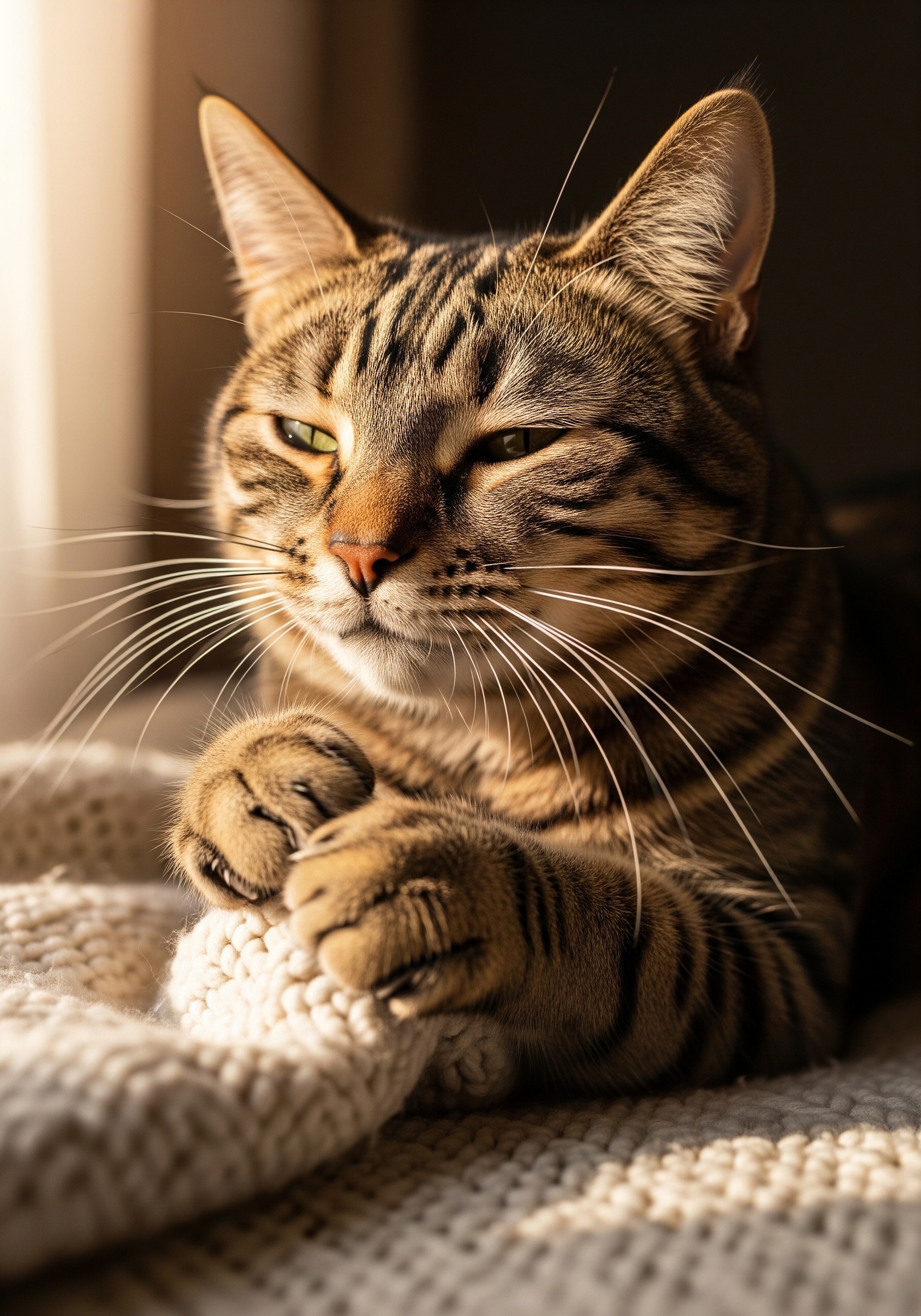
Why do cats knead? The rhythmic push-pull of a cat’s front paws on a blanket — what the internet now calls “making biscuits” — is one of the most universally watched feline behaviors and one of the least cleanly explained. Veterinary behaviorists agree it begins at the milk bar. After that, the science gets honest about what it does and does not know.
Key Facts
- Kneading begins in nursing kittens, who push at the mother’s mammary glands within hours of birth to stimulate milk flow.
- Cats have scent glands in their paw pads — every knead leaves an olfactory signature humans cannot detect.
- The behavior is “neotenic”: adult domestic cats retain a kitten action that adult wild cats largely do not, a hallmark of domestication.
- Kneading is almost always paired with purring, slow blinks, and sometimes drooling — a package vets read as deep contentment.
- Not every cat kneads. Individual personality and early life predict it more than breed does.
In short: Cats knead because the motion is wired in at the milk bar, and domestication never made them grow out of it. Adult cats use the same action for comfort, scent-marking, and bonding — one origin, several modern jobs.
Key Facts
- Kneading begins in nursing kittens, who push at the mother’s mammary glands within hours of birth to stimulate milk flow.
- Cats have scent glands in their paw pads, so every knead leaves an olfactory signature humans cannot detect.
- The behavior is neotenic—adult domestic cats retain a kitten action that adult wild cats largely do not.
- The wild ancestor, Felis lybica, has been on a domestication trajectory for roughly 10,000 years.
- A widely cited 2019 Current Biology study by Kristyn Vitale found most cats form a secure attachment to their owners.
In short: Cats knead because the paw-pushing motion is wired in at nursing, when kittens stimulate milk flow, and domestication left them retaining the kitten behavior into adulthood—a trait called neoteny. Adult cats reuse it for comfort, scent-marking via paw-pad glands, and bonding, often all at once, usually while purring.
A behavior that starts at the milk bar
Kneading is one of the first complex motor patterns a kitten performs. Within hours of birth, a blind, mostly deaf newborn finds a nipple by smell and warmth, latches on, and begins the alternating paw-push that triggers milk letdown. “The way the behavior starts is: they knead the mother’s mammary glands to actually suck the milk,” Leticia Fanucchi, an animal behavior scientist at Oklahoma State University, told Scientific American.
That paw pressure is doing real work. It helps move milk mechanically through the mammary tissue, and it likely cues oxytocin release in the queen — the same hormone behind milk letdown and social bonding in most mammals. The kitten gets calories. The mother gets a chemical sense of this is mine. Both purr through it.
That’s the origin. Everything else about adult kneading is an echo of that first transaction.
Why adult cats keep kneading
Most mammals stop nursing motions when they stop nursing. Cats don’t. The reason has a name: neoteny.
Neoteny is the retention of juvenile traits into adulthood, and it is one of the defining features of domestication. Domestic dogs keep wolf-puppy behaviors that adult wolves grow out of. Domestic cats keep kitten behaviors — meowing at humans (adult feral cats rarely meow at each other), play-pouncing past sexual maturity, and yes, kneading. The wild ancestor of our housecat, Felis lybica, has been on a domestication trajectory for roughly 10,000 years. That is enough time to lock juvenile motor patterns into the adult repertoire.
This matters because it reframes the question. Kneading is not “left over.” It is selected for, in the practical sense that the cats people chose to keep — calm, affectionate, kittenish — were the ones still kneading at age ten. We bred for it without trying.
Why do cats knead blankets, pillows, and anything soft
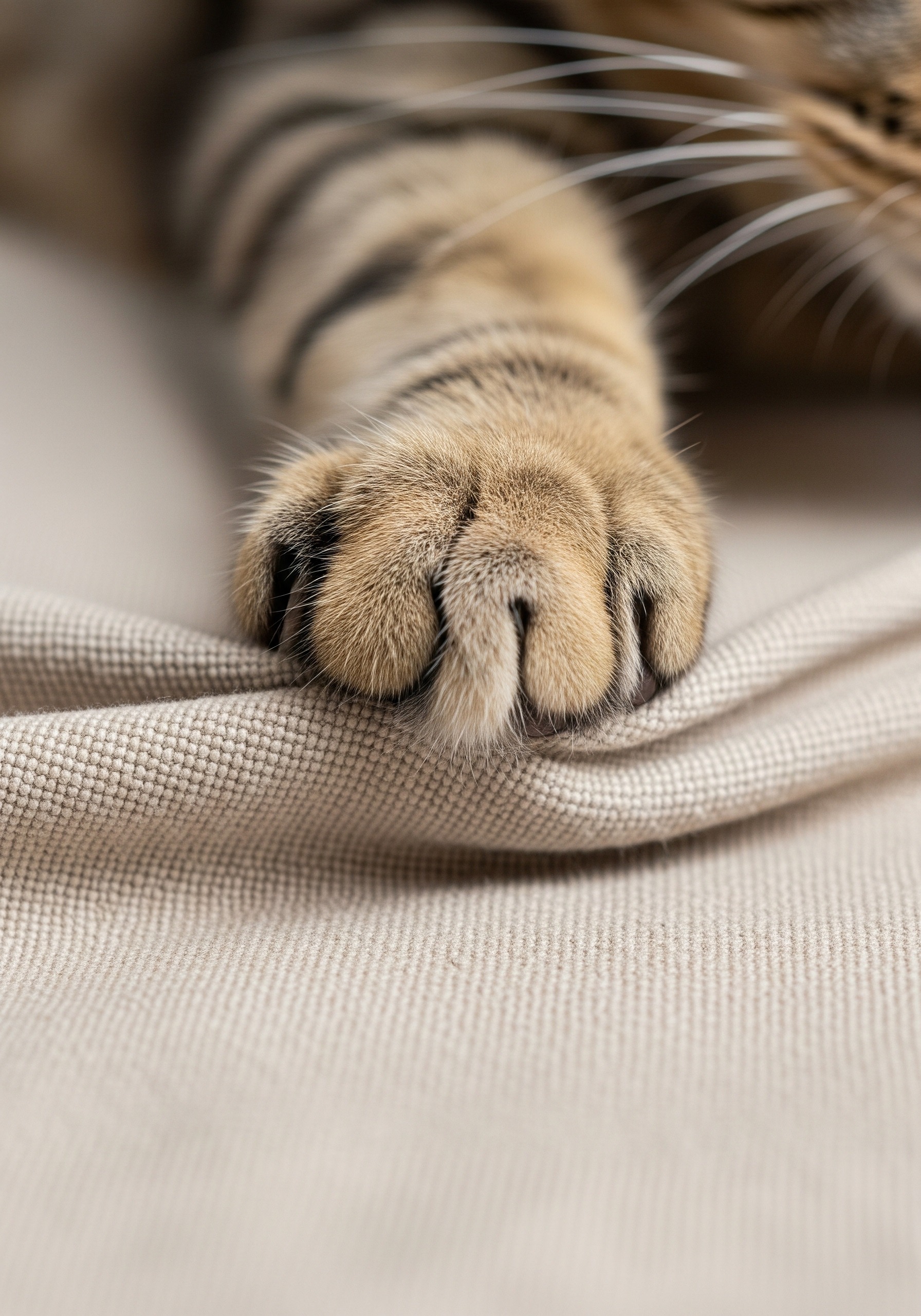
The texture is doing work. Cats overwhelmingly knead soft, pliant surfaces and may only “march” reflexively on hard ones. That points to a sensory loop: soft material under the paw pads gives the same yielding feedback as a mother’s belly. The motion completes itself.
Cats also have scent glands tucked between their paw pads. Every push deposits pheromones — chemical signatures invisible to us but loud to other cats. A favorite blanket isn’t just comfortable. After enough kneading, it smells, to its owner, unambiguously like home. This is part of the same multi-purpose paw biology that lets cats walk in near-perfect silence — those padded paws are doing several jobs at once.
The rhythmic motion itself appears to be self-soothing. Repetitive, gentle, predictable movement engages the parasympathetic nervous system in mammals broadly, which is the body’s “rest and digest” branch. Whatever else kneading is, it is also a cat tranquilizing itself.
{IMAGE_2}
The four leading theories — and why none of them is the whole answer
The honest scientific position is that kneading is overdetermined: several non-mutually-exclusive reasons reinforce each other. Behaviorists tend to weight four. Here’s the thing — they don’t compete. They stack.
- Nursing echo: A retained motor pattern from the first weeks of life, when paws stimulated milk flow.
- Scent-marking: Pheromones from paw-pad glands deposit on the surface. The cat is claiming the spot.
- Comfort and self-soothing: Repetitive motion plus purring lowers arousal — feline self-regulation.
- Bonding signal: Directed at a person, kneading is an affiliative behavior — the cat treating you as safe company.
A cat kneading your lap before a nap is almost certainly doing all four at once. The behavior persists because the payoff stacks. Trying to pick “the real reason” misreads the animal.
Why do cats knead you specifically?
This is the version of the question most owners actually want answered. Why me? Why my chest at 4 a.m.?
The short answer is that kneading directed at a person is the same behavior — but the target is significant. Kristyn Vitale, an applied animal behaviorist now at Unity Environmental University, has spent years studying cat–human attachment. Her widely-cited 2019 study, published in Current Biology, found that the majority of cats tested formed a secure attachment style with their owners — the same kind of bond previously documented in human infants and domestic dogs. Most cats, in other words, do not merely tolerate their people. They orient to them as a safe base.
Kneading is one of the behaviors in that bonded repertoire. When a cat picks your chest and starts working its paws into your sweater, it is, in animal-behavior terms, an affiliative signal — and not a small one. Some adult cats reserve the behavior almost entirely for one or two trusted humans.
The honest truth about the “wild ancestor nest” theory
One explanation gets repeated in nearly every popular article: that cats knead because their wild ancestors trampled tall grass to make a sleeping nest, and sometimes to check for snakes. It is a satisfying story. It is also weaker than it is usually presented.
Here’s the issue. There is little well-documented field observation of wild felids — lions, leopards, the African wildcat — performing the rhythmic alternating-paw kneading that domestic cats do on a blanket. Big cats flatten grass before lying down, but flattening is not the same motor pattern as kneading. The behavior we see on our couches traces most cleanly to nursing, not to nest construction. The snake-check version is a folk extension built on a folk extension.
This is, in my view, the part of the story most popular write-ups get subtly wrong. A behavior can be real, common, and ancient, and we can still not know all of its reasons. Cats do not owe us a tidy explanation.
The drooling, the purring, the half-closed eyes
Kneading rarely arrives alone. It usually comes packaged with a slow-blink, a steady purr, a softening of the whole body, and in some cats a small amount of drooling. Veterinarians read the combination as deep contentment — a cat that is, in clinical shorthand, parasympathetic-dominant. The drool, when it happens, is most likely a holdover from nursing: a relaxed jaw, an active swallow reflex, a body that briefly thinks it is two weeks old again.
The point is that kneading is not a single signal. It is the visible tip of a whole physiological state. The cat is regulating itself, and inviting you into the regulation.
When kneading is different
Most kneading is healthy. A few patterns are worth noticing, without alarm. Cats that knead with extended claws and accidentally puncture skin or clothing are not being aggressive; they simply never learned, as kittens, to retract their claws for a soft target. Sliding a folded blanket between cat and skin solves it.
Frantic, prolonged kneading paired with vocalization in an unspayed female is usually estrus-linked and resolves with the cycle. Sudden onset of compulsive kneading in an older cat that previously did not do it — particularly alongside other behavior changes — is worth a routine veterinary check, not because kneading is dangerous, but because abrupt behavioral shifts in senior cats sometimes flag cognitive or medical change. None of this should worry the owner of a typical, contented, biscuit-making cat.
Frequently Asked Questions
Q: Why do cats knead blankets so often?
A: Blankets give the same yielding feedback under a paw that a mother’s belly does — soft, warm, slightly elastic. That texture seems to complete the sensory loop. The blanket also accumulates the cat’s own pheromones over time, which makes kneading it more rewarding with each session. Many cats settle on one or two specific blankets and ignore the rest.
Q: Why do cats knead you and not their bed?
A: Kneading directed at a person is an affiliative behavior — the cat is treating you as safe company, not as furniture. It typically reflects a bonded relationship rather than a search for soft material. A cat that climbs onto your chest specifically to knead is paying you a serious feline compliment.
Q: Does kneading mean a cat was weaned too early?
A: This is a popular folk explanation with little evidence behind it. Cats weaned at normal ages knead at roughly the same rates as those weaned early. Kneading is best understood as a retained kitten behavior in nearly all domestic cats, not as a sign of disrupted development.
Q: Should I stop my cat from kneading me?
A: No, with one practical adjustment: keep nails trimmed, and slip a soft layer between cat and skin if the claws are sharp. The behavior itself is a strong positive signal, and interrupting it tends to confuse the cat rather than redirect it.
Sources
- Scientific American — “Why Do Cats Knead like They’re Making Biscuits?” (interviews with Leticia Fanucchi of Oklahoma State University, Susan Nelson of Kansas State University, and Kristyn Vitale of Unity Environmental University).
- Vitale, K. R., Behnke, A. C., and Udell, M. A. R. — “Attachment bonds between domestic cats and humans,” Current Biology, 2019.
- PetMD — veterinary behavior review of feline kneading.
- Wikipedia — “Kneading (cats),” behavioral summary.
- Popular Science and Inverse — reporting featuring veterinary behaviorist Katherine Pankratz and cat scientist Mikel Delgado of Feline Minds.
Cats keep many of their reasons to themselves. Kneading is one of the more generous exceptions — a behavior that, once you know what you’re seeing, lets you watch a small animal soothing itself, marking the world as familiar, and quietly telling you that you are part of the familiar world. That is more than most species offer. It is enough to know.
Illustrations are AI-generated. Article fact-checked and human-edited. Our editorial standards.