Do Dragonflies Bite or Sting? The Honest Answer
Do dragonflies bite? Yes — but almost never the way folklore says. A four-inch hawker landing on your sleeve looks like a tiny dinosaur with goggles, and for two thousand years humans have decided that meant trouble. The truth is stranger and quieter than the myth.
Key Facts
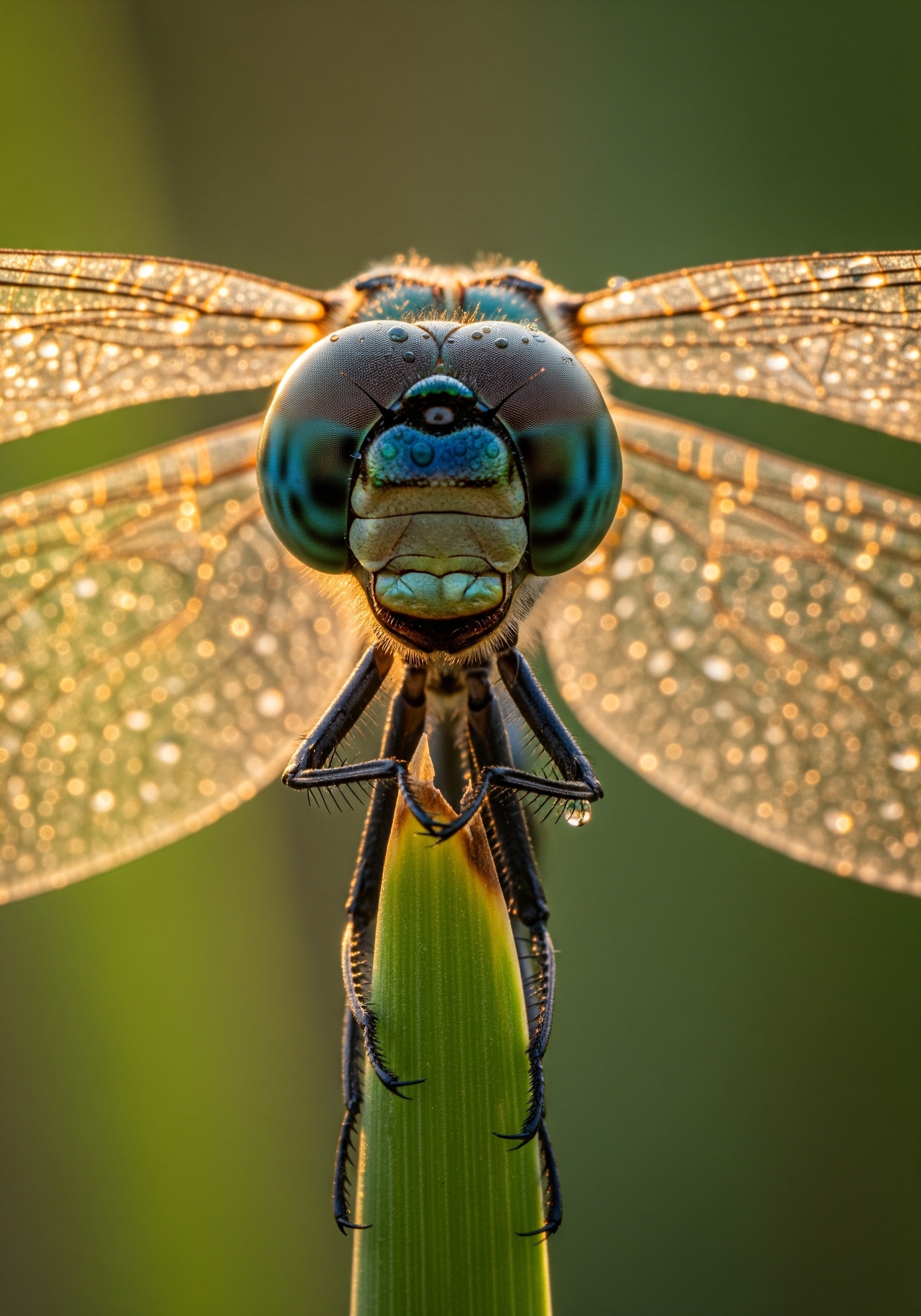
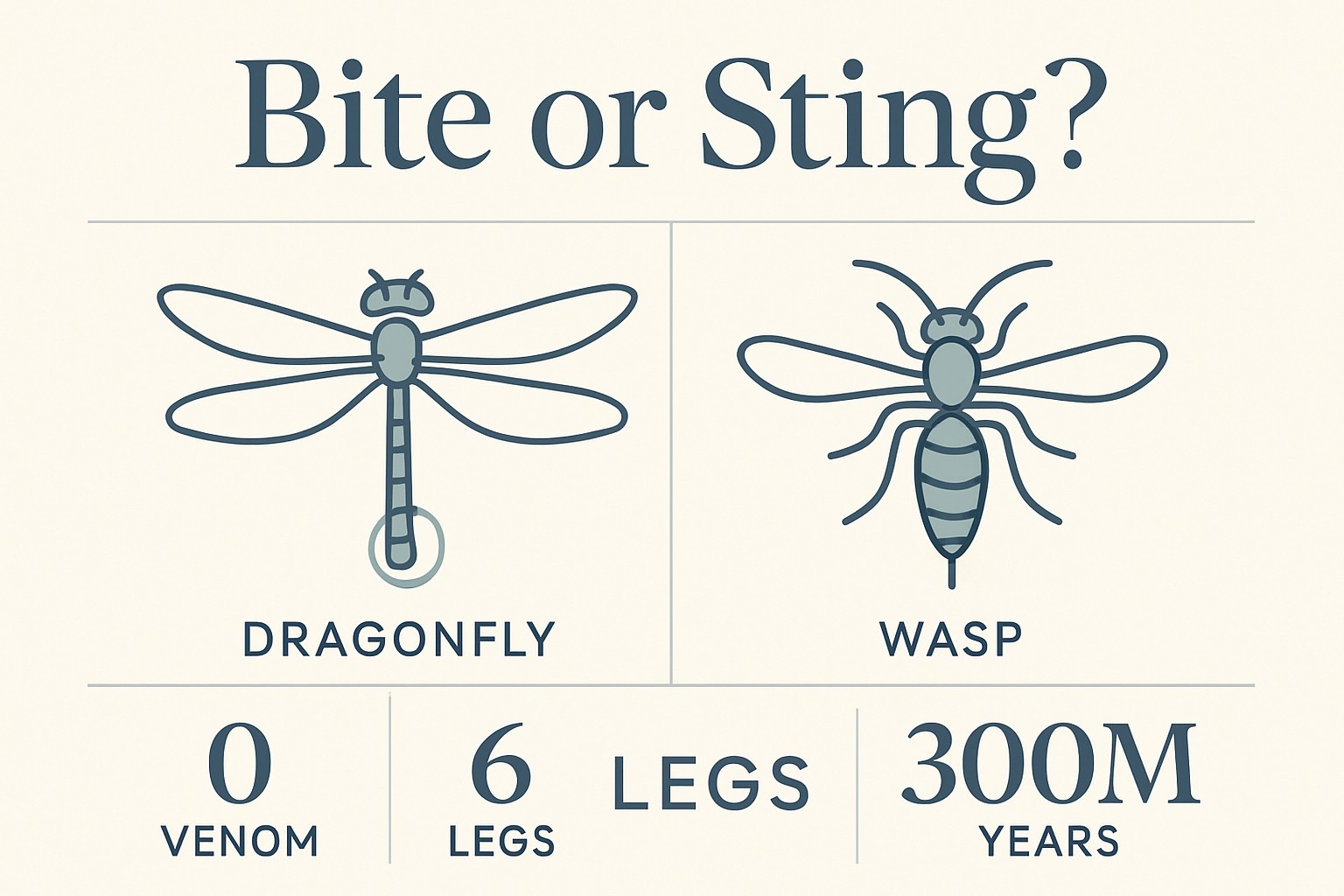
- Dragonflies have no stinger and no venom — the structures at the rear of the abdomen are claspers or egg-laying organs, not weapons.
- Only the largest species can break human skin with their mandibles, and only when held in the hand; free-flying dragonflies do not bite.
- Their serrated mandibles are biomechanically extreme — peer-reviewed nanoindentation testing reports a hardness near 0.85 GPa, comparable to mild industrial steel.
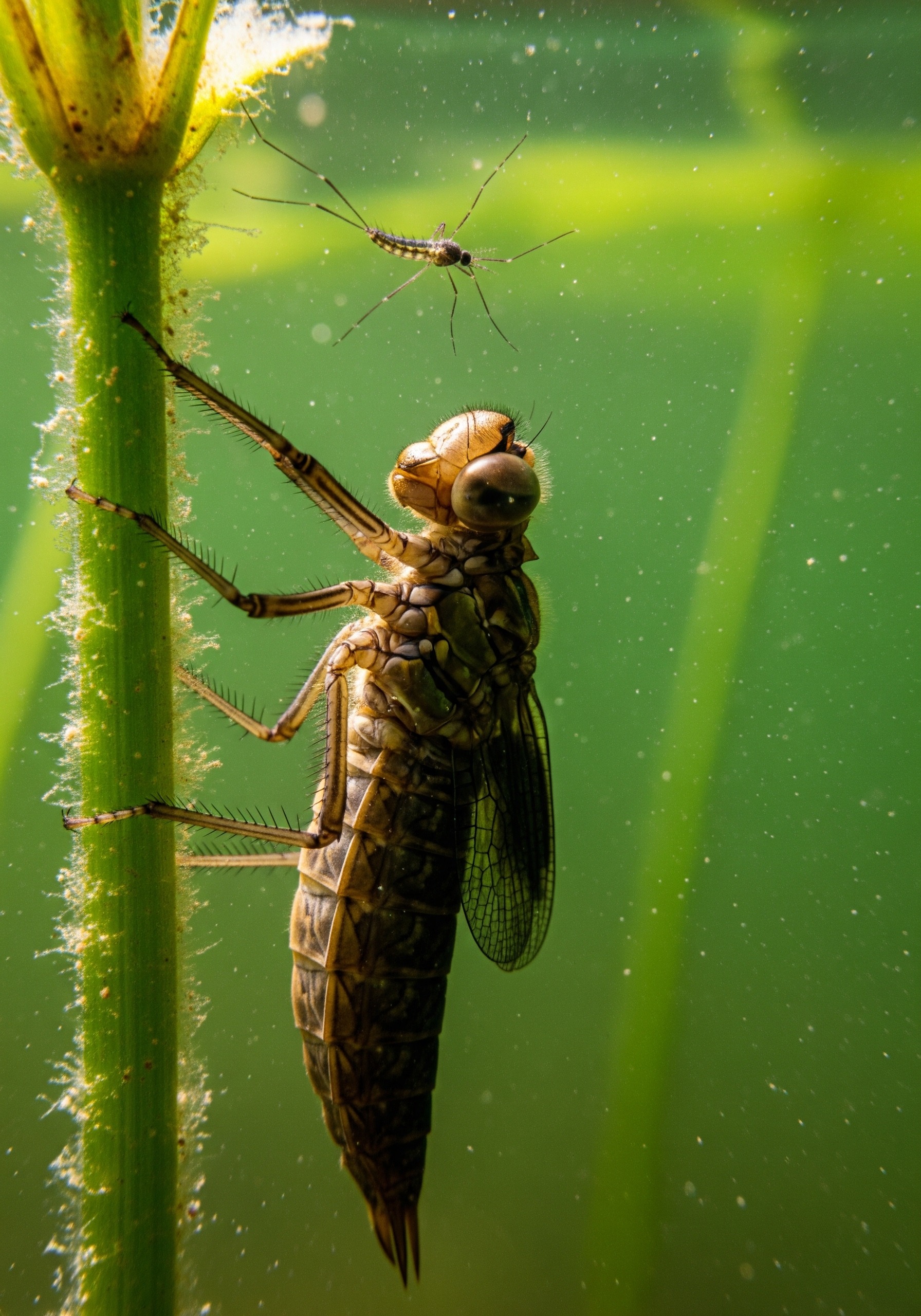
- Underwater dragonfly larvae fire a hinged lower lip called the labium in well under a tenth of a second — one of the fastest predatory strikes in the insect world.
- Folk names like “horse-stinger” and “devil’s darning needle” trace to medieval Europe; none reflect actual dragonfly behavior.
In short: A dragonfly can bite if you grab one, the bite is usually a pinch, and they cannot sting at all. The far more interesting story is how they evolved jaws hard enough to crack a mosquito’s armor — and why people kept inventing reasons to fear them.
Key Facts
- Dragonflies have no stinger and no venom—the rear-abdomen structures are claspers or egg-laying organs.
- Only the largest species can break human skin with their mandibles, and only when held in the hand.
- Nanoindentation testing reports dragonfly mandible hardness near 0.85 GPa, comparable to mild industrial steel, with a Young’s modulus around 9.1 GPa.
- Underwater dragonfly larvae fire a hinged lower lip (the labium) in under a tenth of a second.
- Folk names like horse-stinger and devil’s darning needle trace to medieval Europe and don’t reflect real behavior.
In short: Dragonflies can bite if grabbed, but only the largest species can break skin, and they cannot sting at all—the rear-abdomen structures are claspers or egg-layers, not weapons. Their serrated mandibles reach a hardness near 0.85 GPa, comparable to mild steel. Free-flying dragonflies ignore humans entirely.
Do dragonflies bite humans? Yes — but the trigger matters
Here’s the thing: a dragonfly will not chase you. It will not corner you. British entomologist Richard Jones, a Fellow of the Royal Entomological Society, has recounted being bitten exactly once across decades of fieldwork — by a golden-ringed dragonfly (Cordulegaster boltonii) he had picked up. The insect curled, twisted, and clamped down on his finger. He felt a sharp pinch. No blood. No swelling. No follow-up.
That’s the pattern. Free-flying dragonflies hunt mosquitoes, midges, and small moths in midair. Humans are not on the menu — not the body chemistry, not the wing-beat frequency, not the silhouette. The only reliable way to provoke a bite is to trap the insect between your fingers, against your skin, or in cupped hands. Even then, smaller species (under three inches across the wings) usually cannot apply enough force to pierce skin.
So why the persistent fear? Mostly visual. Dragonflies look armored because they are armored, and large enough to register on the human startle reflex. That ancient pattern-recognition reads “predator” before the conscious mind catches up.
Can dragonflies sting? The myth has a backstory
No species of dragonfly anywhere on Earth possesses a stinger.
None. The pointed shape at the rear of the abdomen is not a weapon; in males it’s a clasper used during mating, and in females it’s an ovipositor for placing eggs into water or plant tissue. Neither structure can break skin, and neither carries venom.
But the myth that they sting is old. In medieval English, dragonflies were “horse-stingers” — a name that may have stuck because farmers watched the insects hover near grazing horses and assumed the worst. The dragonflies were actually hunting horseflies and stable flies feeding on the animals. The hovering predator got blamed for its prey’s bites.
Across the Atlantic, the name shifted darker: “devil’s darning needle.” Folklore in parts of New England warned children that dragonflies would sew shut the eyes, ears, or mouths of liars in their sleep. A version of the same story appears in Swedish, Romanian, and Iberian folk traditions — an unusually wide spread that suggests an old, shared European root. None of it is true. The needle-thin abdomen is just an aerodynamic body plan.
{IMAGE_2}
Inside the jaw: what makes a dragonfly bite work
Interesting biology starts here. The order Odonata gets its name from the Greek for “tooth,” and the mandibles are exactly that — paired, serrated, scissor-like blades that shear sideways rather than top-to-bottom. A 2021 study published in the materials-science journal Materials, using nanoindentation testing on dragonfly nymph mandibles, reported a Young’s modulus around 9.1 GPa and a hardness near 0.85 GPa. For comparison, that puts the cutting edge in the same mechanical neighborhood as mild industrial steel — extraordinary for a biological tool made of chitin and structural protein.
Hardness isn’t uniform, and that detail is what biologists found striking. The cutting edge is harder than the base, a “nanomechanically graded” design that resists chipping under repeated impact. Modern engineering still struggles to replicate this gradient in synthetic blades. A dragonfly, in other words, evolved a self-sharpening serrated knife around 250 million years before steel was forged.
What does this mean for a human finger? In the largest species — the emperor (Anax imperator), the golden-ringed, North America’s giant darner (Anax walsinghami), and the immense tropical helicopter damselflies — the mandibles can pierce skin if the insect bites down hard and twists. In smaller species, the jaws meet skin and slide off. That is why credible bite reports almost always involve a specific subset of larger Anisoptera.
The hidden biter: dragonfly larvae and the world’s fastest lip
Most people picture dragonflies as flying adults, and forget that the insect spends the vast majority of its life — sometimes five years, in cold-water species — submerged as a wingless aquatic predator. Nymphs are where the real engineering lives.
Dragonfly larvae carry a hinged appendage called the labium folded under the head like a switchblade. When prey drifts within range, hydraulic pressure from contracting abdominal muscles fires the labium forward in well under a tenth of a second — fast enough that human eyes register only a blur. Two opposable hooks at the tip clamp the prey and retract it back to the waiting mandibles. The same 2021 nanoindentation work confirmed the larval mandibles share the gradient-hardness architecture of the adult’s.
Can a nymph bite a human? In theory, yes, if you reach into a pond and grab one. In practice, almost no one ever has — the larvae are cryptic, and they will not pursue a hand. They will, however, ambush minnow fry, mosquito larvae, tadpoles, and small newts. A single nymph can eat several thousand mosquito larvae before it ever sees the sky.
Which dragonflies are big enough to break skin
Of the roughly 6,300 described dragonfly and damselfly species, only a small fraction reach the body size where a bite is anything more than a pinch. Worth knowing if you handle insects:
- Emperor dragonfly (Anax imperator) — Europe’s largest, wingspan up to about 4.3 inches. Reports of skin-breaking bites in handlers exist but are rare.
- Common green darner (Anax junius) — North America’s most familiar large species, wingspan around 3 inches. Capable of a sharp pinch.
- Golden-ringed dragonfly (Cordulegaster boltonii) — Britain’s longest dragonfly. Documented to deliver a noticeable bite when restrained.
- Giant darner (Anax walsinghami) — the largest in North America, found in the desert Southwest, wingspan up to about 4.4 inches.
- Helicopter damselflies (genus Megaloprepus) — Central American rainforest giants with wingspans approaching 7 inches. Rarely encountered by anyone outside the tropics.
For everything smaller — bluets, dancers, meadowhawks, skimmers — the bite, if you can even provoke one, registers as faint pressure and nothing more.
Myth vs evidence — a quick reference
- “Dragonflies sting” — False. No species has a stinger or venom. Zero exceptions.
- “They chase humans” — False. They hunt small flying insects and ignore mammals.
- “A bite needs medical attention” — Almost never. A pinch with no venom carries the same general infection risk as any minor scrape.
- “They transmit disease” — No documented case. Unlike mosquitoes, dragonflies are not known disease vectors.
- “Big dragonflies are aggressive” — Toward other insects, yes. Toward you, no.
If a dragonfly bite happens
None of this is medical advice and you should not need any. For general background, a dragonfly bite leaves what looks like two parallel pinpoints or a small reddened patch, sometimes a trace of blood, rarely more. Standard minor-wound hygiene — wash with soap and water — is the same care any small skin break deserves. If discomfort is significant or anything looks off, talk to a clinician. That guidance applies to any minor wound, not specifically to this one.
What dragonflies will not do: cause an allergic reaction comparable to a bee or wasp sting (no venom proteins are involved), inject pathogens, or return to bite again once released. The encounter ends when the insect flies away — which is generally the moment your grip loosens.
Frequently Asked Questions
Q: Do dragonflies bite without provocation?
A: Functionally, no. The reliable triggers are being held, trapped against skin, or netted. Free-flying dragonflies do not target humans. The handful of online accounts of “unprovoked” bites almost always involve an insect landing on bare skin and being instinctively grabbed by the person.
Q: Are dragonflies dangerous to children or pets?
A: No. They have no venom and no inclination to attack. A small child squeezing one might get a startling pinch from a large species, but there is no toxicological risk, and pets eating dragonflies — common with cats — face no danger from the insect itself.
Q: What is the difference between a dragonfly and a damselfly bite?
A: Damselflies (suborder Zygoptera) are smaller and slimmer, with proportionally weaker jaws. Most damselflies cannot apply enough force to be felt at all. Dragonflies (suborder Anisoptera) include the larger species capable of a noticeable pinch.
Q: Why do dragonflies hover near me at the lake?
A: You are walking through a swarm of mosquitoes, midges, or gnats — and the dragonflies are hunting them. A standing human stirs up insects from grass and attracts biting flies, which dragonflies eat. They are working, not threatening you. Entomologists call the behavior a “feeding swarm,” and it is genuinely useful to be inside one.
Sources
- Royal Entomological Society — taxonomic and behavioral reference for the order Odonata.
- British Dragonfly Society — species records, identification, and bite-incident commentary.
- Materials (MDPI), 2021 — peer-reviewed nanoindentation study on the cutting apparatus of dragonfly nymphs.
- Smithsonian Institution, National Museum of Natural History — Odonata collections and cultural folklore notes.
- Discover Wildlife magazine — published field commentary from entomologist Richard Jones.
Three hundred million years ago, ancestors of the modern dragonfly hunted across Carboniferous swamps with wingspans the size of seagulls. The descendants now hovering at your local pond are smaller, but the body plan is largely unchanged — a self-sharpening jaw, a hydraulic lip in the larva, a brain wired to predict the flight path of a mosquito in midair. You can pick one up if you must, and it might pinch. Better, probably, to let it work.
Illustrations are AI-generated. Article fact-checked and human-edited. Our editorial standards.